Stik: The Lines That Connect Us All
Artist Spotlight · The Collection Editorial
“I want my work to be understood by everyone, not just people who go to art galleries.”
Stik, various interviews
In the spring of 2023, a quiet but significant thing happened in the London art world. A Stik mural, painted directly onto the exterior wall of a residential block in Hackney, drew crowds of local residents, tourists, and serious collectors alike, all standing on the pavement together, looking up at the same spare, tender image of two figures holding hands. That scene, unlikely and unplanned, captures something essential about why Stik matters: his work dissolves the boundaries between street and gallery, between the dispossessed and the privileged, between the child who can read a stick figure and the seasoned collector who pays significant sums to own one. Few artists working today achieve that kind of democratic resonance, and fewer still do it with such apparent simplicity.
Stik
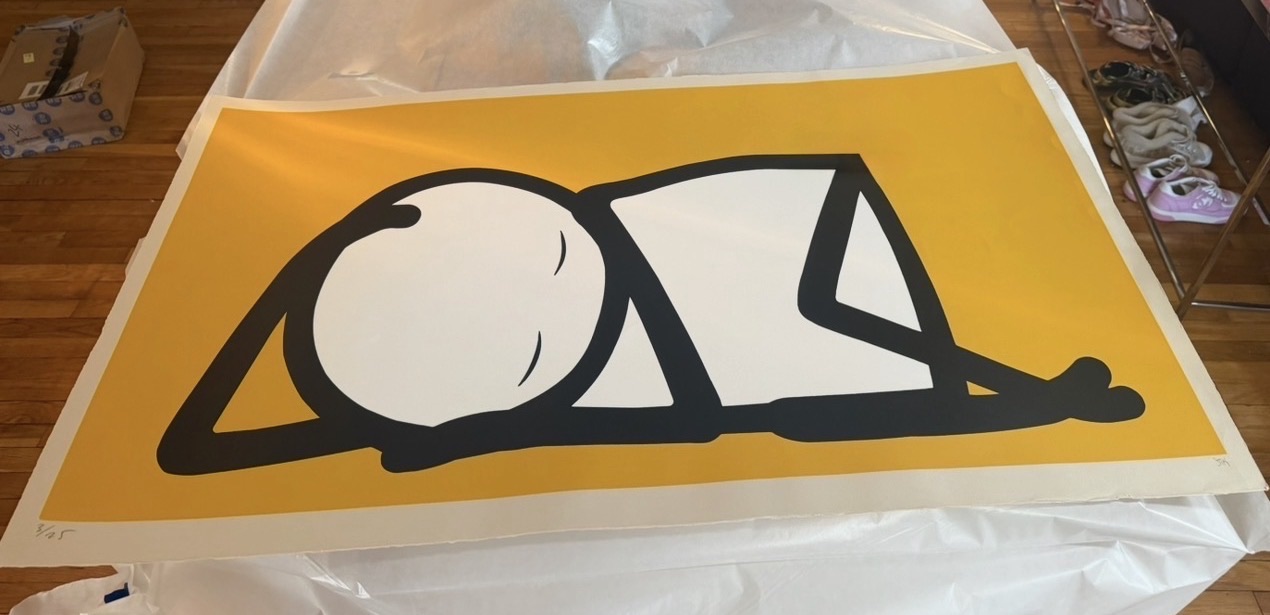
Sleeping Baby (Yellow Variant), 2015
Stik grew up and found his footing as an artist in Hackney, east London, one of the city's most layered and contested boroughs. Hackney has long been a meeting point of cultures, generations, and economic extremes, and it was here that Stik spent time experiencing homelessness firsthand. That period of profound vulnerability did not break him; it gave him a subject and a moral compass that has never wavered. The streets became his studio and his community, and the people living rough alongside him became his first audience.
This is not background colour to his practice. It is the practice itself, the animating force behind every mark he makes. His emergence as a recognisable street artist came in the mid to late 2000s, when his stick figures began appearing across the walls of Hackney and beyond. The timing coincided with a broader moment of energy in the London street art scene, a period when artists were claiming public space with ambition and urgency.
Stik
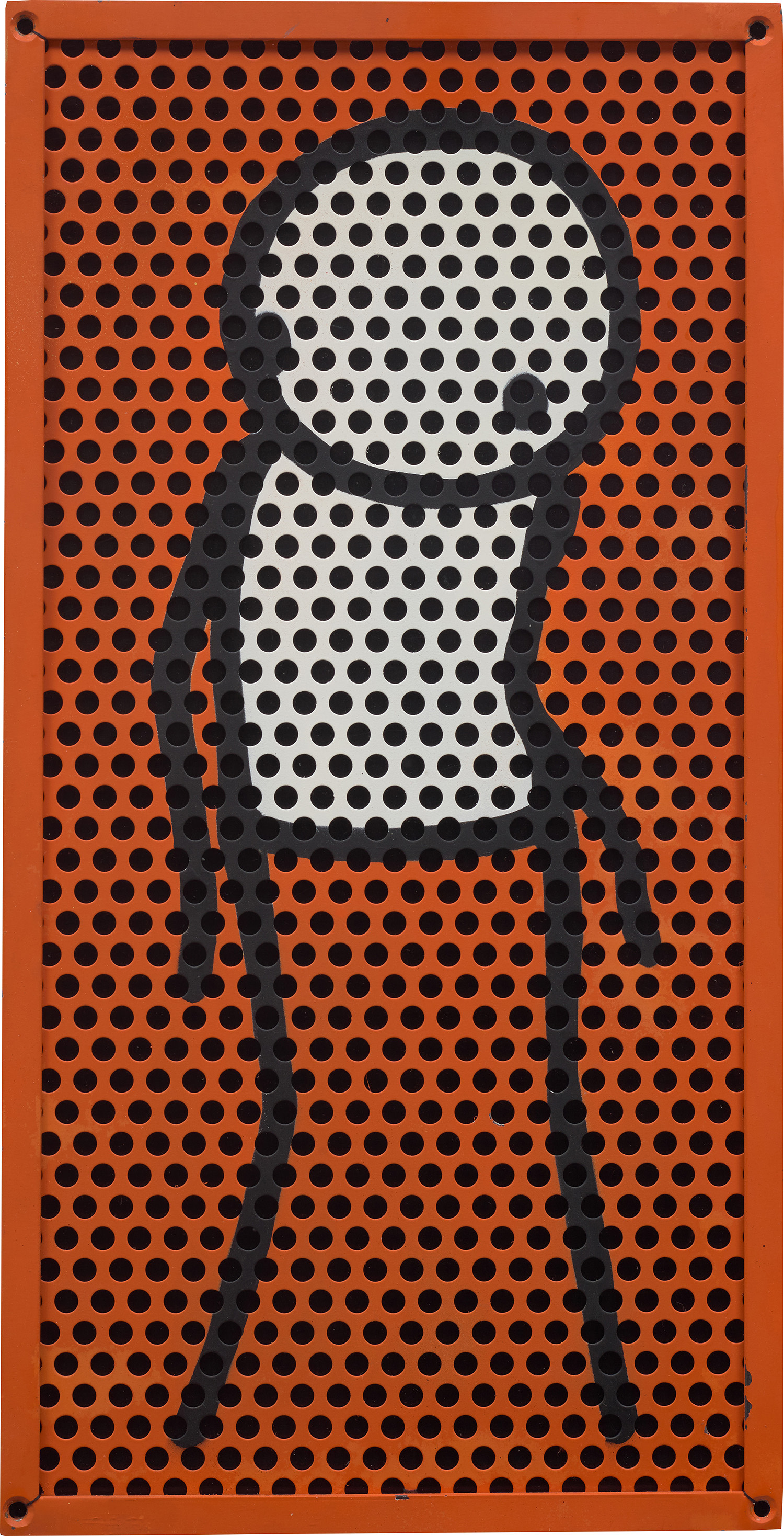
Orange Junkie, 2011
Yet Stik's visual language stood apart from the layered complexity of his peers. Where others favoured intricate stencils, photorealistic portraiture, or typographic density, Stik was moving in the opposite direction, stripping the human form down to its most essential components. A circle for a head. A few lines for a body.
Eyes rendered as simple marks. The reduction was not a limitation; it was a philosophy. What makes Stik's figures so affecting is precisely their openness. Because the faces carry no ethnicity, no age, no gender in any fixed sense, every viewer can locate themselves within them.
Stik
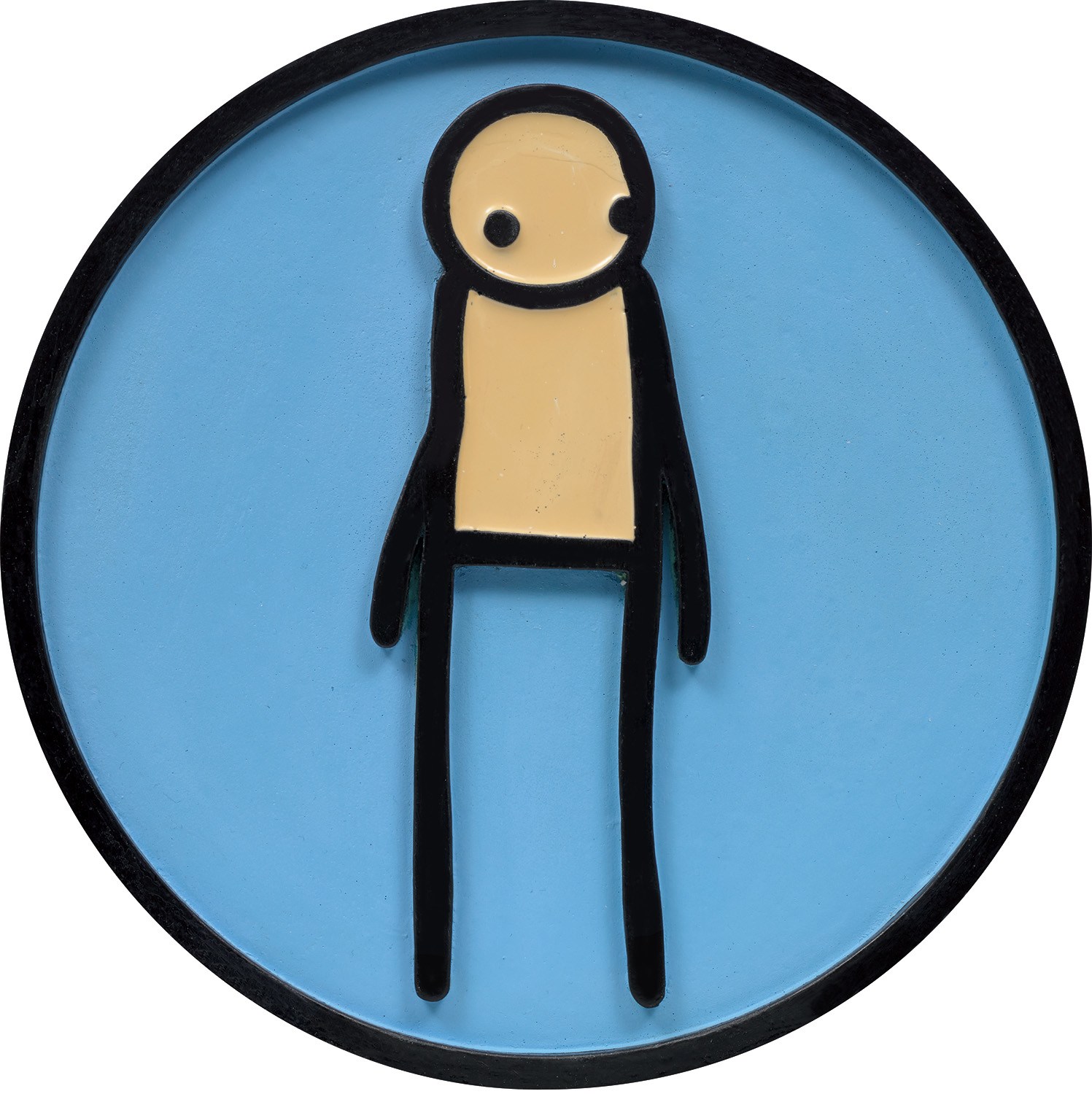
Plaque (Heritage Blue)
A sleeping baby is every sleeping baby. A rough sleeper curled against a wall is every person who has ever felt unseen. This universality is not accidental. Stik has spoken about his figures as vessels for collective feeling, and the works bear that intention out.
His piece Rough Sleeper, one of the most quietly devastating images in his body of work, distills an entire social crisis into a single curled form on the ground. It is both a portrait of a specific reality and an ethical challenge to the viewer. As his reputation grew through the late 2000s and into the 2010s, Stik expanded his practice to include works on paper and fine art prints, bringing his imagery into conversation with the traditions of printmaking and limited edition publishing. Works such as Sleeping Baby (Yellow Variant), a 2015 screenprint on Arches 88 fine art paper, and Lovers, produced as a screenprint on Somerset Newsprint wove paper, demonstrate his careful attention to surface and material even within a democratic, edition based format.
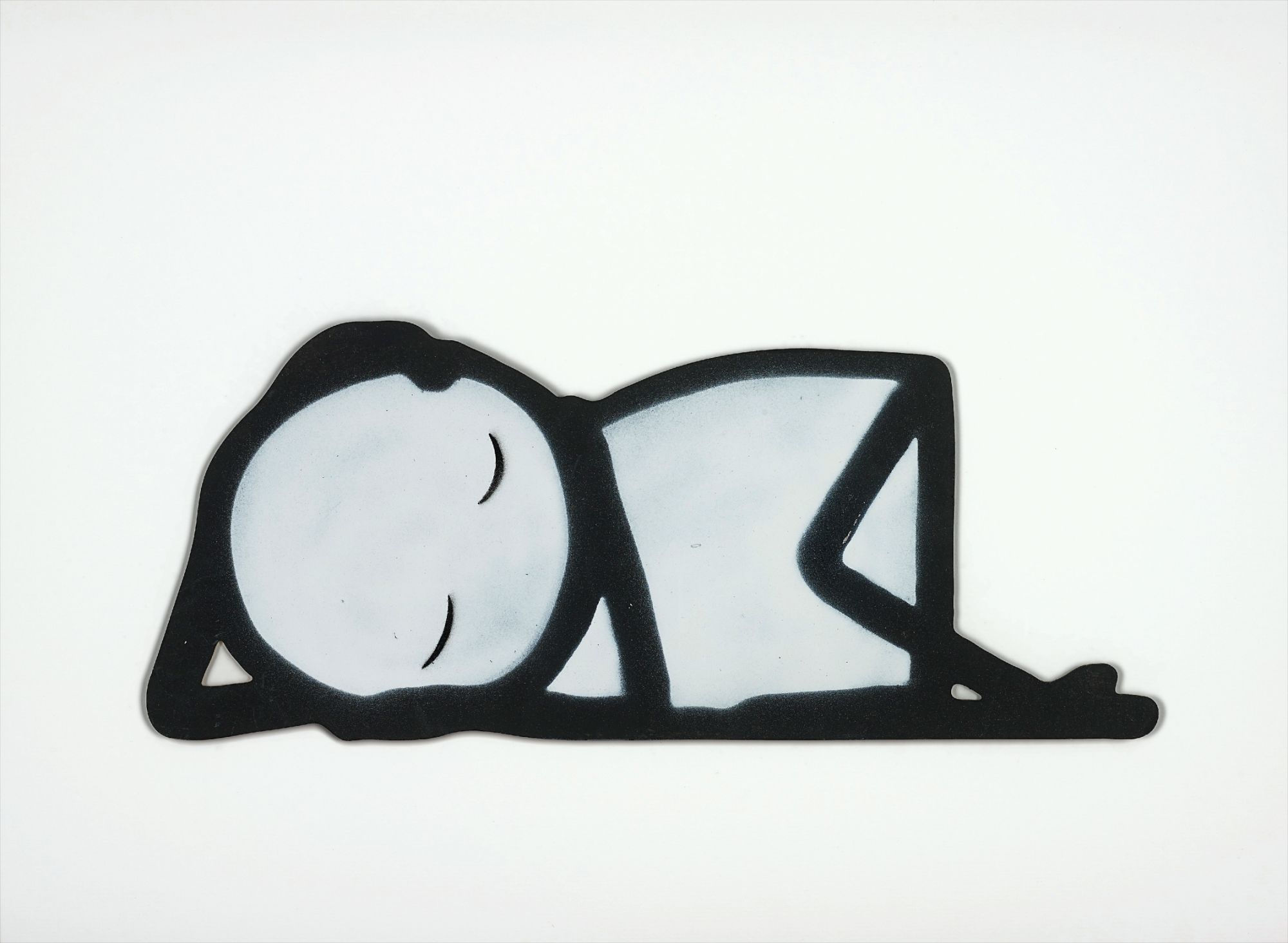
Stik
Rough Sleeper
His 2020 work Holding Hands, an offset lithograph issued in five parts across a sequence of colours including red, orange, yellow, teal, and blue, extends his recurring motif of connection into something almost celebratory, a chain of linked figures that feels urgently optimistic. These printed works are among the most sought after entry points into his practice, offering collectors the opportunity to own something that carries the full weight of his vision. Stik has also worked in sculpture and three dimensional objects, with pieces such as Plaque (Heritage Blue) and Blank Plaque, both hand cast in colour tinted polyurethane resin, occupying a playful and pointed position in his output. The plaque format deliberately evokes the blue plaques that adorn buildings across Britain to commemorate figures of historical significance.
By casting his own figures in this institutional form, Stik raises a gentle but pointed question about who gets remembered and who gets erased. It is the kind of conceptual clarity that elevates his work beyond the purely visual and into the realm of genuine ideas. On the secondary market, Stik's work has demonstrated consistent and growing collector interest, with screenprints and works on paper appearing at auction at Christie's, Bonhams, and specialist print sale rooms. His editions, particularly early works such as Orange Junkie from 2011 and unique objects like Magpie from 2009, a spray paint on wood piece in the artist's own frame, attract strong bidding from collectors who understand that the combination of emotional directness, art historical intelligence, and social commitment represented in his practice is genuinely rare.
Collectors who have been with him since his early years in Hackney have watched those works appreciate significantly, but the more important observation is that demand continues to grow among a new generation of collectors who are drawn as much to what the work stands for as to its formal qualities. In terms of art historical context, Stik occupies an interesting position between the legacy of street art as a movement, with figures like Jean Michel Basquiat and Keith Haring as precedents for the journey from margin to market, and the broader tradition of socially committed British art. His minimalism has drawn comparisons to Cy Twombly in its reduction of the mark to something primal and expressive, while his subject matter connects to a lineage of artists who have used their practice as an act of solidarity. The artist L.
S. Lowry, who spent decades painting the working figures of industrial northern England, is perhaps an unexpected but fitting reference: both artists found dignity and visibility in lives that mainstream culture overlooked. What Stik has built over the past two decades is not simply a body of work but a practice rooted in genuine ethical commitment, one that has never traded its origins for the comforts of the art world establishment. His figures remain on the walls of Hackney.
His prints remain within reach of collectors who are not billionaires. His sculptures ask uncomfortable questions in the most polite possible format. The art world is full of artists who talk about community and solidarity. Stik is one of the very few who has lived it, made it visible, and turned it into something that will endure.