School of Indochina
Bronze Voices From a Forgotten Indochine
Artist Spotlight · The Collection Editorial
There are moments in art history when a movement crystallizes so completely that its works seem to carry the atmosphere of an entire era within them. The School of Indochina, known in Vietnamese as Trường Mỹ thuật Đông Dương and in the works catalogued here under the Chinese notation 中南半島學派, represents one of the most remarkable and underappreciated chapters in twentieth century Asian modernism. As museum curators from Hanoi to Paris revisit the colonial encounter through fresh eyes, and as major auction houses in Hong Kong and Paris have in recent years elevated the bronzes and paintings of this period to serious collecting territory, the moment to understand this school deeply and personally has never felt more urgent. The École des Beaux Arts de l'Indochine was founded in Hanoi in 1925 by the French painter Victor Tardieu and the Vietnamese artist Nguyễn Nam Sơn.
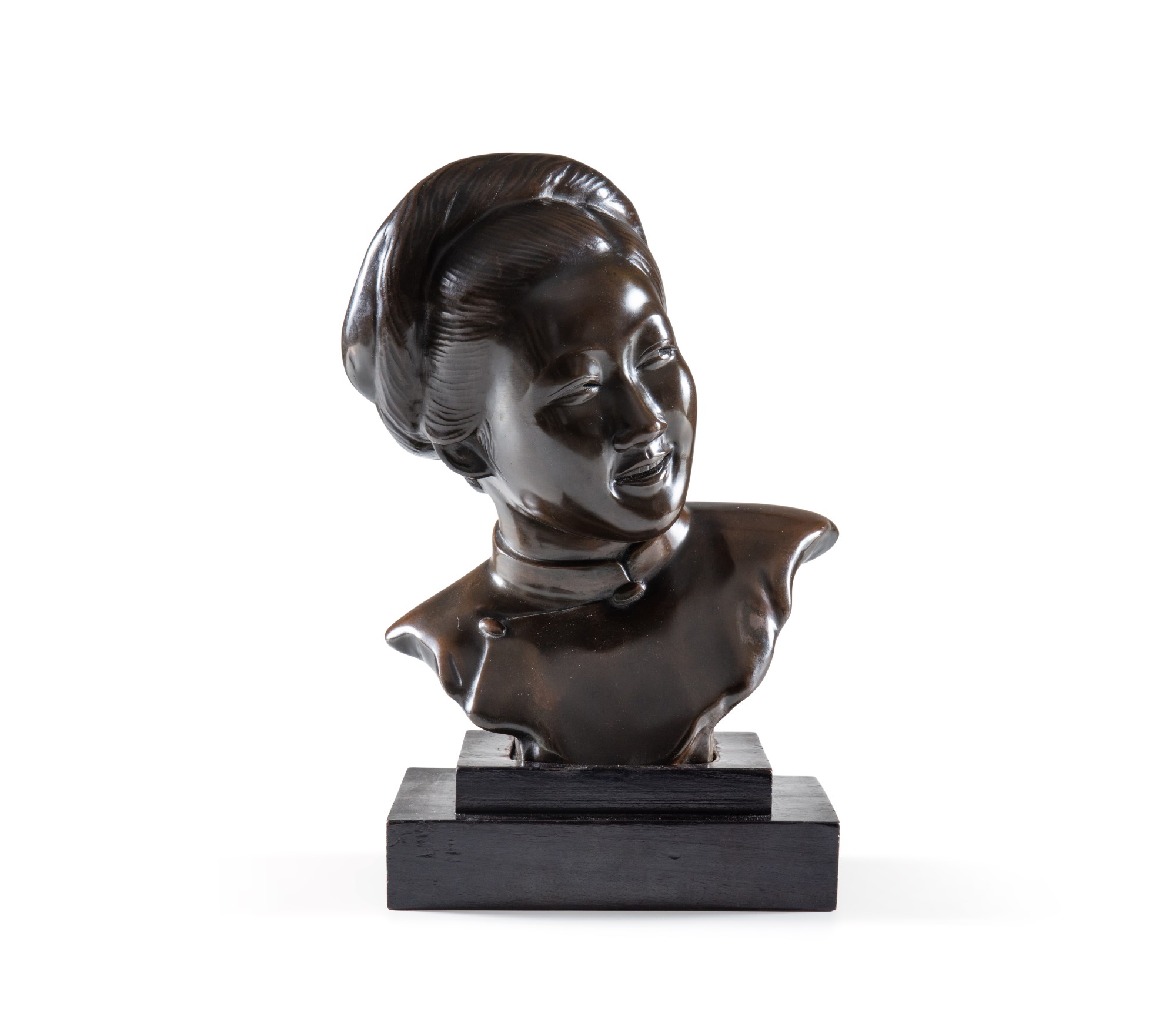
School of Indochina
中南半島學派, 女人頭像, 1940
Its founding was an act of creative negotiation, a meeting point between French academic tradition and the deep visual cultures of Vietnam, Cambodia, and Laos. Tardieu had come to Indochina to complete a mural commission and encountered in Nguyễn Nam Sơn a collaborator whose understanding of local aesthetics transformed what might have been a colonial imposition into something genuinely hybrid. Together they petitioned the French colonial administration for the resources to establish a school that would train artists in both Western technique and the visual inheritance of the region. From its earliest classes, the school attracted students who would go on to define Vietnamese modernism.
Figures such as Nguyễn Gia Trí, Tô Ngọc Vân, and the sculptor Đinh Gia Tự emerged from its studios. The curriculum balanced life drawing, sculpture, and painting with studies of lacquer technique and silk painting, mediums deeply rooted in Vietnamese craft tradition. This synthesis produced an aesthetic language that was neither purely French nor purely Vietnamese, but something genuinely new: sensuous, formally assured, and emotionally present in ways that purely academic European work of the same period often was not. The bronze female portrait heads documented in the collection here, dated to 1940 and 1945, sit at the heart of what made the school's sculptural output so compelling.
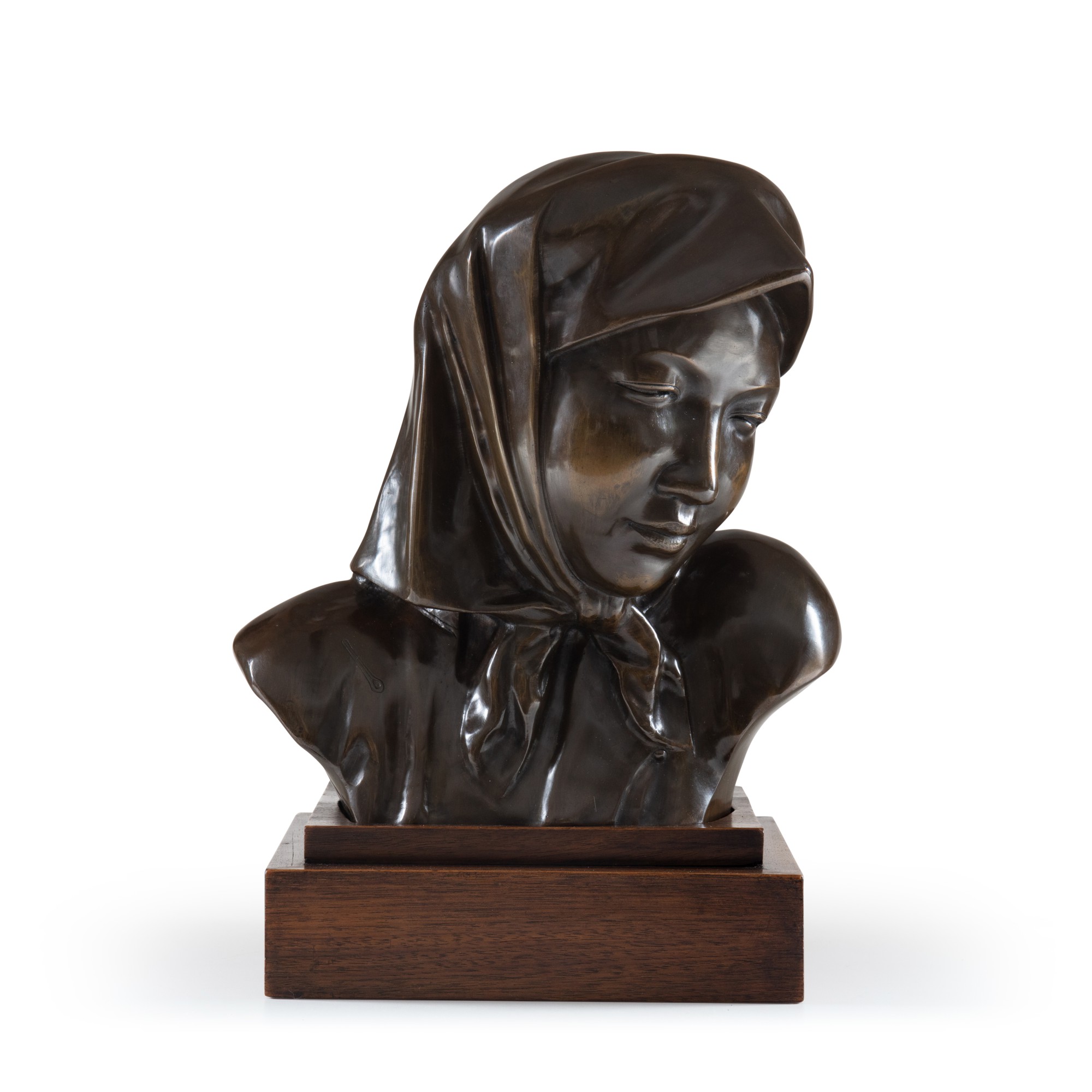
School of Indochina
中南半島學派 , 女人頭像, 1945
These years bracket one of the most turbulent periods in Indochinese history, spanning the Japanese occupation and the final years of French colonial administration before the August Revolution of 1945. That such formally refined, contemplative works were being produced during this period speaks to the school's extraordinary commitment to its artistic mission under pressure. The female subject in these bronzes carries within her composed gaze the complexity of that historical moment: she is neither a European academic ideal nor a purely ethnographic subject, but a figure with individual presence and psychological depth. The choice of bronze as a medium is itself significant.
Casting in bronze required resources, institutional support, and technical infrastructure that the school worked hard to maintain. It also announced sculptural ambition in a register that European collectors and institutions would recognize and respect, while the particular treatment of surface and form in these works draws on traditions of craftsmanship rooted in Southeast Asian metalwork. The female portrait head as a subject allowed the school's sculptors to explore questions of identity, beauty, and representation that were genuinely contentious in colonial Indochina, where Western aesthetic hierarchies were constantly being negotiated against local self understanding. For collectors, the works associated with the School of Indochina occupy a rare position in the market.
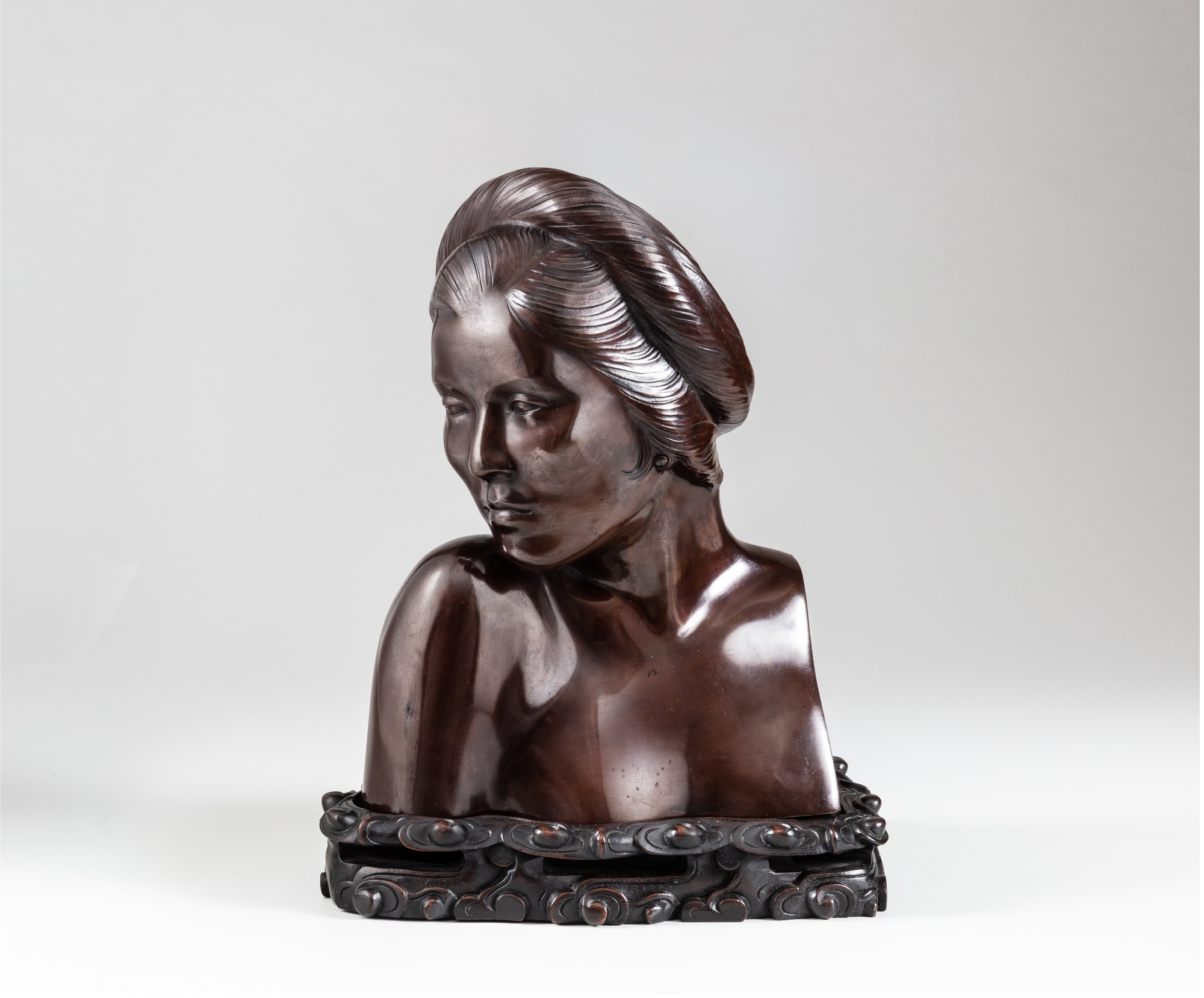
School of Indochina
中南半島學派, 女人頭像, 1940
They are simultaneously art historical documents of enormous importance and objects of genuine aesthetic power. The bronzes in particular have attracted serious attention from collectors across East and Southeast Asia as well as from European and American institutions building collections that reflect a more complete account of global modernism. Works from this school appear at auction relatively infrequently, which means that when examples of quality come to market, they command attention from knowledgeable buyers who understand their scarcity. The dating of works to specific years within the school's active period, as with the 1940 and 1945 bronzes represented here, adds both historical specificity and collecting significance.
The broader context of the school places it in fascinating conversation with other colonial and postcolonial art movements of the early twentieth century. In some ways it parallels the Bombay Progressive Artists Group in India, which also emerged from the encounter between European modernism and a rich indigenous visual culture. It shares qualities with the work of artists associated with the Société Annamite d'Encouragement à l'Art et à l'Industrie, and its legacy runs forward into the generation of Vietnamese artists who worked through the wars of the mid and late twentieth century. Artists such as Mai Trung Thứ, who eventually settled in France, and Lê Phổ carried the school's sensibility into international collecting circles where their work is now highly sought.
The legacy of the École des Beaux Arts de l'Indochine is finally receiving the sustained scholarly and curatorial attention it deserves. Exhibitions in Hanoi, Paris, and Singapore over the past decade have drawn new audiences to this material, and younger scholars are producing critical frameworks that honor both the school's achievements and the complex conditions under which it operated. For collectors and admirers of twentieth century art, engaging with the School of Indochina is an act of expanding the conversation about where modernism happened and what it meant. These bronze heads, quiet and resolved, ask us to look carefully and to recognize in their stillness a whole world of creative intelligence and historical experience.
Explore books about School of Indochina
Vietnamese Painting
Atherton Dulcie
Art of Southeast Asia
Philip Rawson
Modern Vietnamese Art: A Concise History
Nora A. Taylor
Asian Art
Michael Sullivan
Southeast Asian Modernism
Nora A. Taylor
The History of Modern Vietnamese Literature
Linh Dinh