Sanford Robinson Gifford
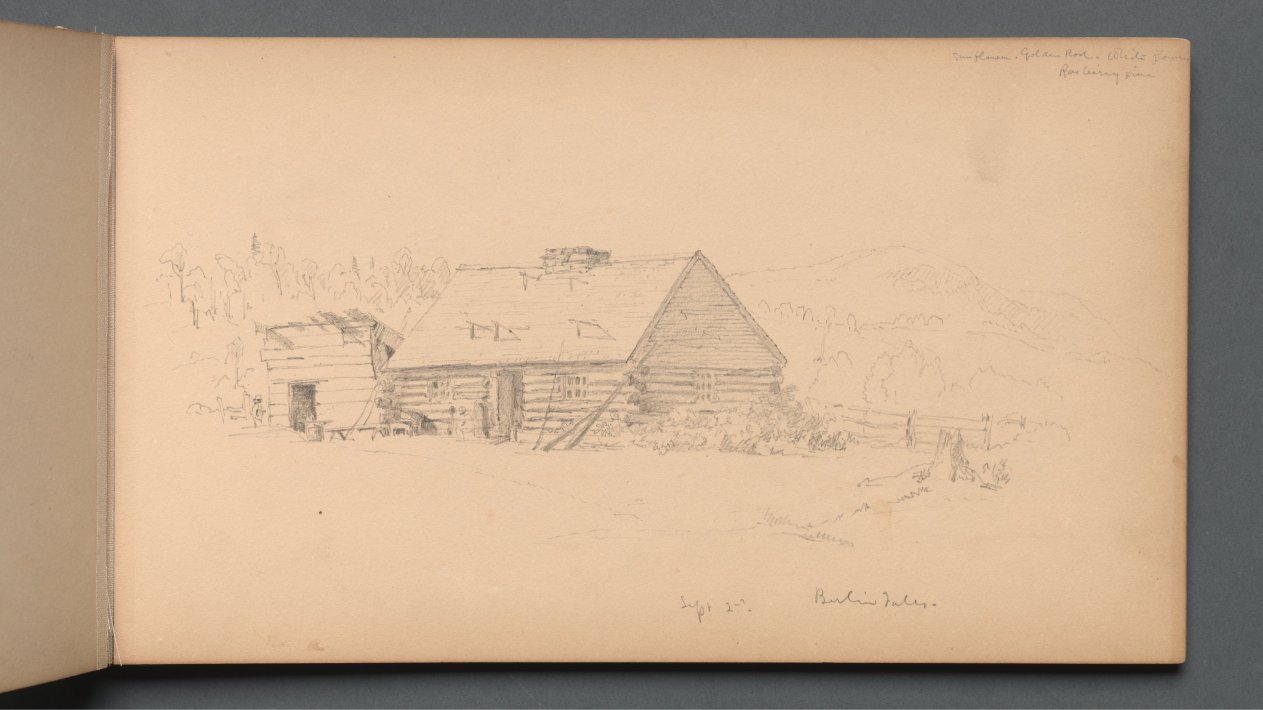
Sanford Gifford, Painting Pure Golden Light
Artist Spotlight · The Collection Editorial
There is a moment, arriving just before dusk in the Catskill Mountains, when the light thickens into something almost tangible, when the air itself seems to glow amber and the horizon dissolves into warm haze. Sanford Robinson Gifford spent his career chasing exactly that moment. Today, as collectors and institutions return with fresh eyes to the great tradition of American landscape painting, Gifford stands out not merely as a dutiful member of the Hudson River School but as one of the most poetic and singular visual minds of the nineteenth century, an artist whose work rewards close, unhurried attention in ways that feel startlingly contemporary. Gifford was born in 1823 in Greenfield, New York, into a prosperous and cultured family that eventually settled in Hudson, a small city on the banks of the river that would give the school he joined its name.
Sanford Robinson Gifford
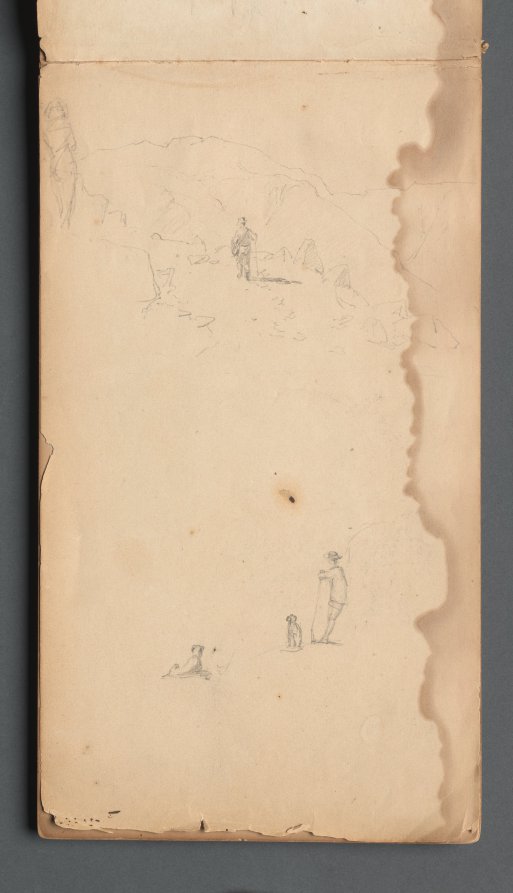
Sketchbook, page 02: Figure in a Landscape with Dog, 1859
He enrolled at Brown University in 1842 but left after two years, drawn more powerfully toward art than academia. He moved to New York City and began studying figure drawing under the painter John Rubens Smith, but it was a series of sketching trips through the Catskills and the Berkshires in the late 1840s that truly set his course. Encountering the work of Thomas Cole and finding kinship with the circle forming around the Hudson River, Gifford understood almost immediately that landscape, and specifically American landscape suffused with light and air, was his calling. His early development accelerated rapidly.
By 1851 he was exhibiting at the National Academy of Design in New York, where he would show consistently for decades and eventually become a full Academician. Two extended trips to Europe, the first from 1855 to 1857 and a second in the early 1860s, were enormously formative. In London he absorbed the atmospheric luminosity of J.M.
Sanford Robinson Gifford
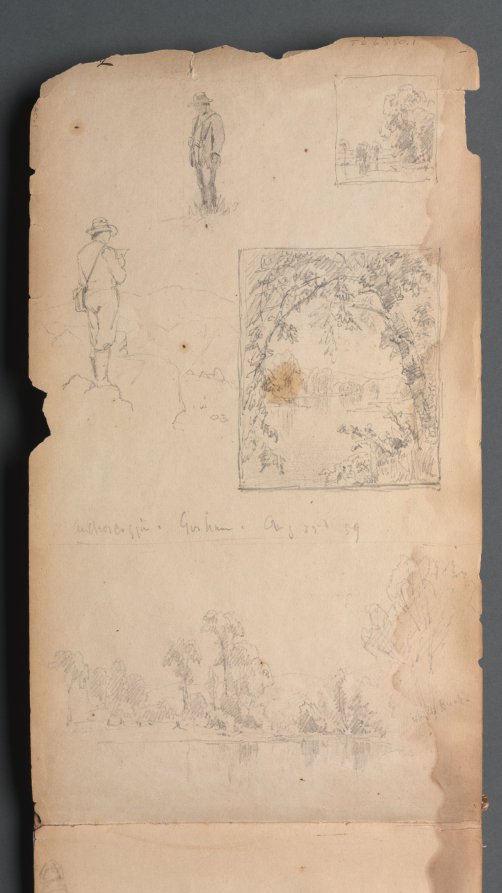
Sketchbook, page 01: Self Portraits with Vignittes, 1859
W. Turner. In Italy, especially in the Roman Campagna and along the Adriatic coast, he encountered a quality of light that confirmed and deepened instincts he had already begun cultivating at home. He also traveled through the Alps, the Rhine Valley, and the Near East, gathering material that would feed his imagination for years.
Where many American painters returned from Europe impressed by European subject matter, Gifford returned more committed than ever to the expressive power of light itself, regardless of geography. What distinguishes Gifford's mature practice is his extraordinary treatment of what he called the "evanescent" qualities of atmosphere. Other Hudson River painters rendered topography with documentary precision, celebrating the grandeur and particularity of American terrain. Gifford was less interested in the specifics of a mountain's profile than in the envelope of glowing air that surrounded it.
Sanford Robinson Gifford
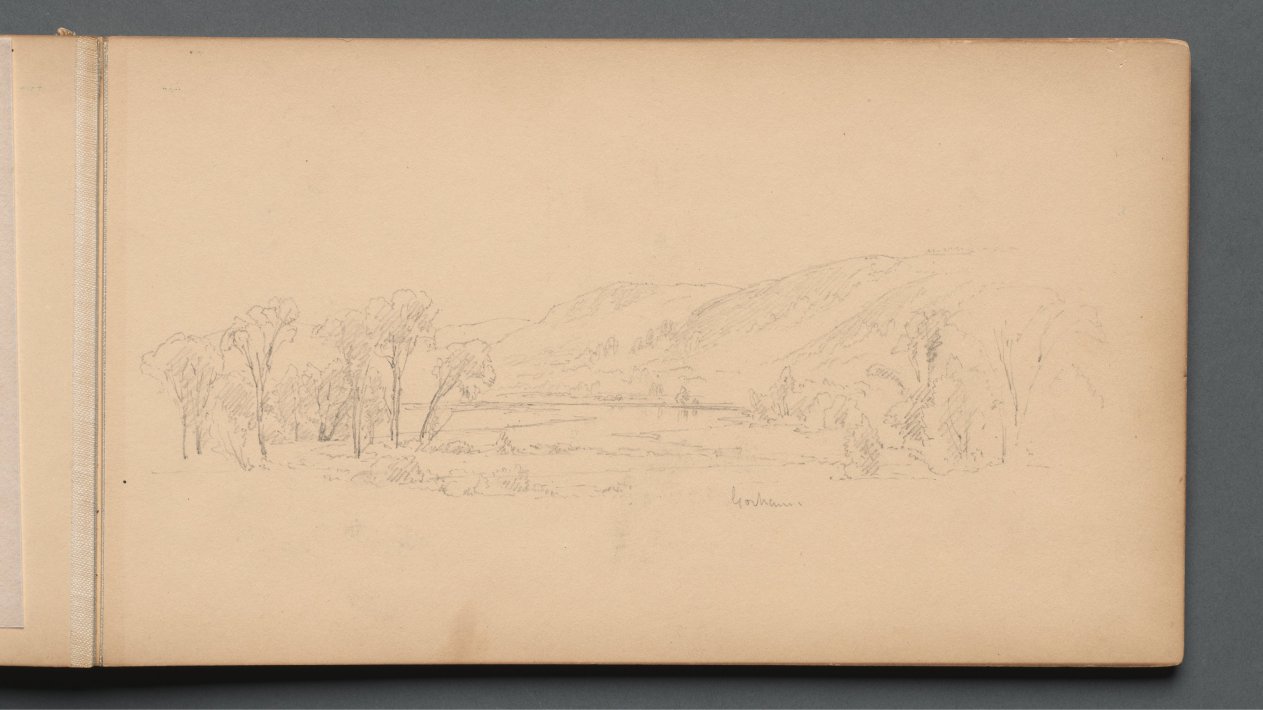
Sketchbook, page 06: "Gorham" (Maine), 1859
His canvases are constructed in thin, layered glazes of warm color, typically golden yellows, amber, rose, and soft ochre, applied over carefully prepared underpaintings so that light appears to emanate from within the picture rather than fall across its surface from outside. This technique places him firmly among the Luminists, the loosely grouped second generation of Hudson River painters that also included Fitz Henry Lane and Martin Johnson Heade, all of whom shared a fascination with stillness, radiance, and the near dissolution of solid form into suffused light. Among his most celebrated works, "A Home in the Wilderness" from 1866 demonstrates his full powers magnificently. A small settler's cabin nestles in an immense landscape where forest, water, and luminous sky occupy the canvas in almost equal, carefully balanced measures.
The human presence is minimal, almost incidental, and yet the painting radiates a profound warmth, a sense that this vast wilderness is not threatening but deeply, quietly hospitable. "Autumn, a Wood Path" from 1876 achieves something even more intimate, guiding the eye down a forest trail where the canopy filters and transforms autumn sunlight into something almost spiritual. His sketchbooks, including the remarkable 1859 Maine sketchbook pages now available on The Collection, reveal the working intelligence behind the finished paintings: rapid graphite notations of coastlines, waterfalls, and cloud formations, sometimes annotated with color observations, that show a mind perpetually hungry for atmospheric data from the natural world. For collectors, Gifford occupies a particularly compelling position in the market.
Sanford Robinson Gifford
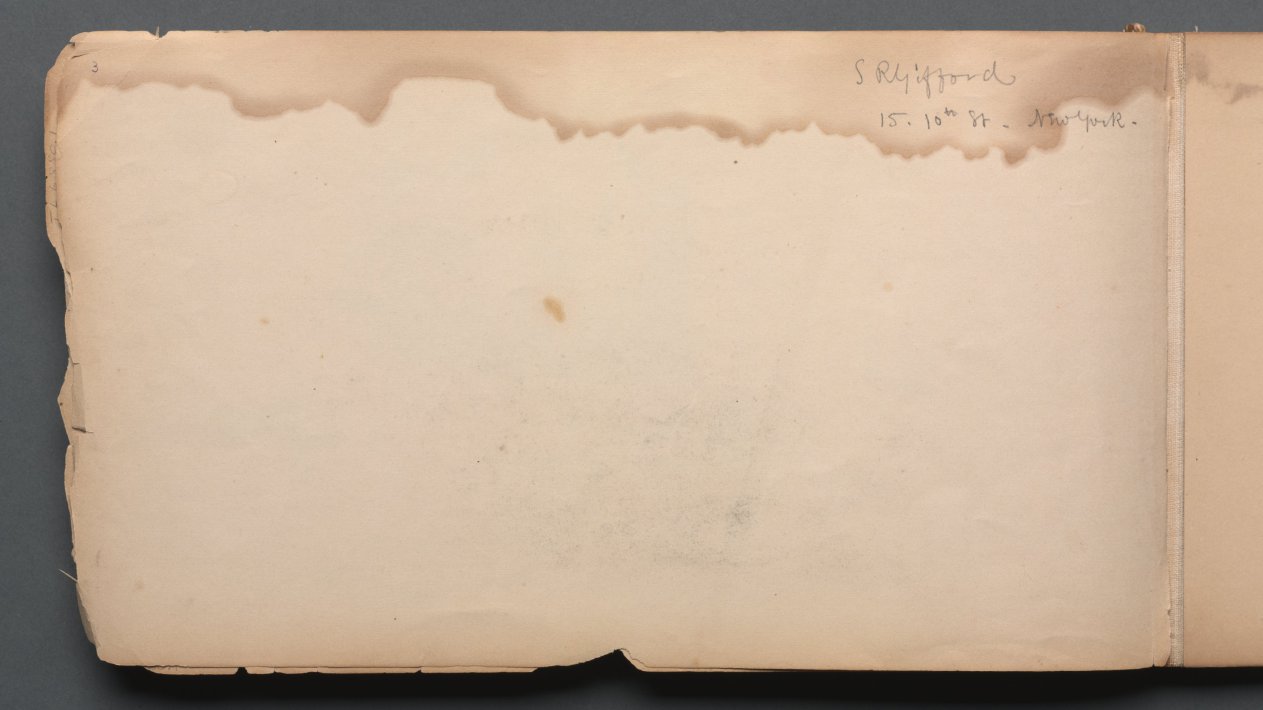
Sketchbook, page 03: " S.R. Gifford 15 10th Street New York" , 1859
His work appears regularly at the major American auction houses, and strong examples, especially his luminous oil paintings from the 1860s and 1870s, command serious prices that reflect both art historical recognition and genuine aesthetic desirability. His finished oils have achieved results in the hundreds of thousands of dollars at auction, and museum quality examples rarely come to market twice in a generation. Drawings and sketchbook pages offer a more accessible point of entry and carry their own distinct value as documents of his process, showing the intimate, exploratory side of an artist who was always essentially thinking through light. Collectors drawn to Gifford tend to share a sensibility: they respond to quietude, to subtlety, and to the kind of beauty that asks something of the viewer rather than announcing itself immediately.
To understand Gifford fully it helps to see him in relationship to his contemporaries and his successors. Among Hudson River painters, Frederic Edwin Church and Albert Bierstadt were his peers and occasional companions on sketching expeditions; where they reached for drama and scale, Gifford reached for stillness and warmth. The Luminist comparison with Fitz Henry Lane is particularly illuminating, since both painters achieved their effects through an almost scientific patience with light, though Gifford's palette tends toward the warmer end of the spectrum and his compositions toward the terrestrial rather than the marine. Looking forward, his sensibility anticipates something of the mood found in the Tonalist painters of the late nineteenth century, figures like George Inness in his later career, who also sought to dissolve the boundary between observed landscape and felt emotion.
Gifford died in 1880 at the age of fifty six, relatively young for a painter at the height of his reputation. A memorial exhibition held at the Metropolitan Museum of Art in New York in 1880 and 1881 drew wide attention and underscored the regard in which he was held by his contemporaries. That regard has only deepened with time. In an era when viewers are hungry for art that rewards slowness, that offers genuine visual nourishment rather than immediate shock, Gifford's paintings feel less like historical artifacts and more like a standing invitation.
To spend time with one of his glowing canvases is to be reminded of what landscape painting at its finest can do: dissolve the boundary between the world outside and the light we carry within.
Featured Works
Sketchbook, page 02: Figure in a Landscape with Dog
1859
Sketchbook, page 01: Self Portraits with Vignittes
1859
Sketchbook, page 06: "Gorham" (Maine)
1859
Sketchbook, page 03: " S.R. Gifford 15 10th Street New York"
1859
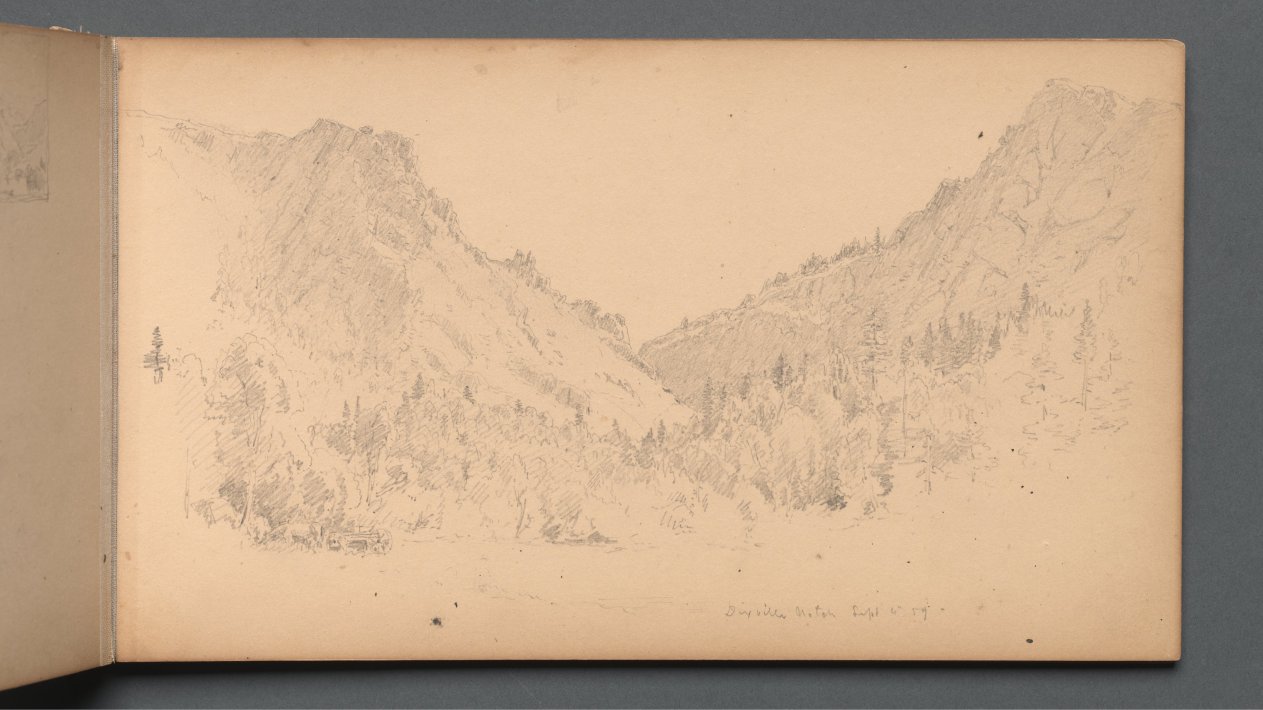
Sketchbook, page 18: "Dixville Notch, Sept. 4, 89"
1859
Sketchbook, page 14: "Berlin Falls September 2nd"
1859
Explore books about Sanford Robinson Gifford
Sanford Robinson Gifford (1823-1880)
Ila Weiss
Sanford Robinson Gifford: A Retrospective Exhibition
American Federation of Arts
The Gifford Pinchot and Sanford Robinson Gifford Papers
Library of Congress
Sanford Robinson Gifford: Luminous Landscapes
Kevin Avery
American Light: The Luminist Movement
John Wilmerding