Ronald Ventura

Ronald Ventura, Where Every Layer Reveals More
Artist Spotlight · The Collection Editorial
When Sotheby's Hong Kong brought Ronald Ventura's painting Grayground to auction in 2011, the room did something rooms rarely do: it held its breath and then erupted. The work sold for HKD 14.3 million, shattering the previous auction record for a Filipino artist and sending a clear signal to the international art world that something extraordinary was happening in Southeast Asian contemporary art. That moment crystallized what collectors and curators in Manila, Singapore, and beyond had quietly known for years.
Ronald Ventura

Untitled 無題
Ventura was not simply a promising regional talent. He was one of the most compelling figurative painters working anywhere in the world. Ronald Ventura was born in Manila in 1973, and the city shaped him in ways that are visible in every square centimeter of his canvases. Manila is a place of beautiful, productive contradictions: Spanish colonial architecture standing beside American era concrete blocks, Catholic iconography layered over older animist traditions, Tagalog and English tangled together in daily speech.
Growing up surrounded by this density of competing visual and cultural languages gave Ventura an instinct for accumulation and collision that became the defining quality of his mature work. He studied at the University of Santo Tomas College of Fine Arts and Design, an institution with deep roots in classical European training, and that formal grounding in drawing and composition gave him the technical fluency to later break rules with genuine authority. His early career in the 1990s showed a painter working through influences with tremendous energy and intellectual appetite. He absorbed the expressive figuration of Neo Expressionism, the graphic flatness of comic art and tattoo culture, and the layered symbolism of the Philippine tradition of religious imagery.
Ronald Ventura
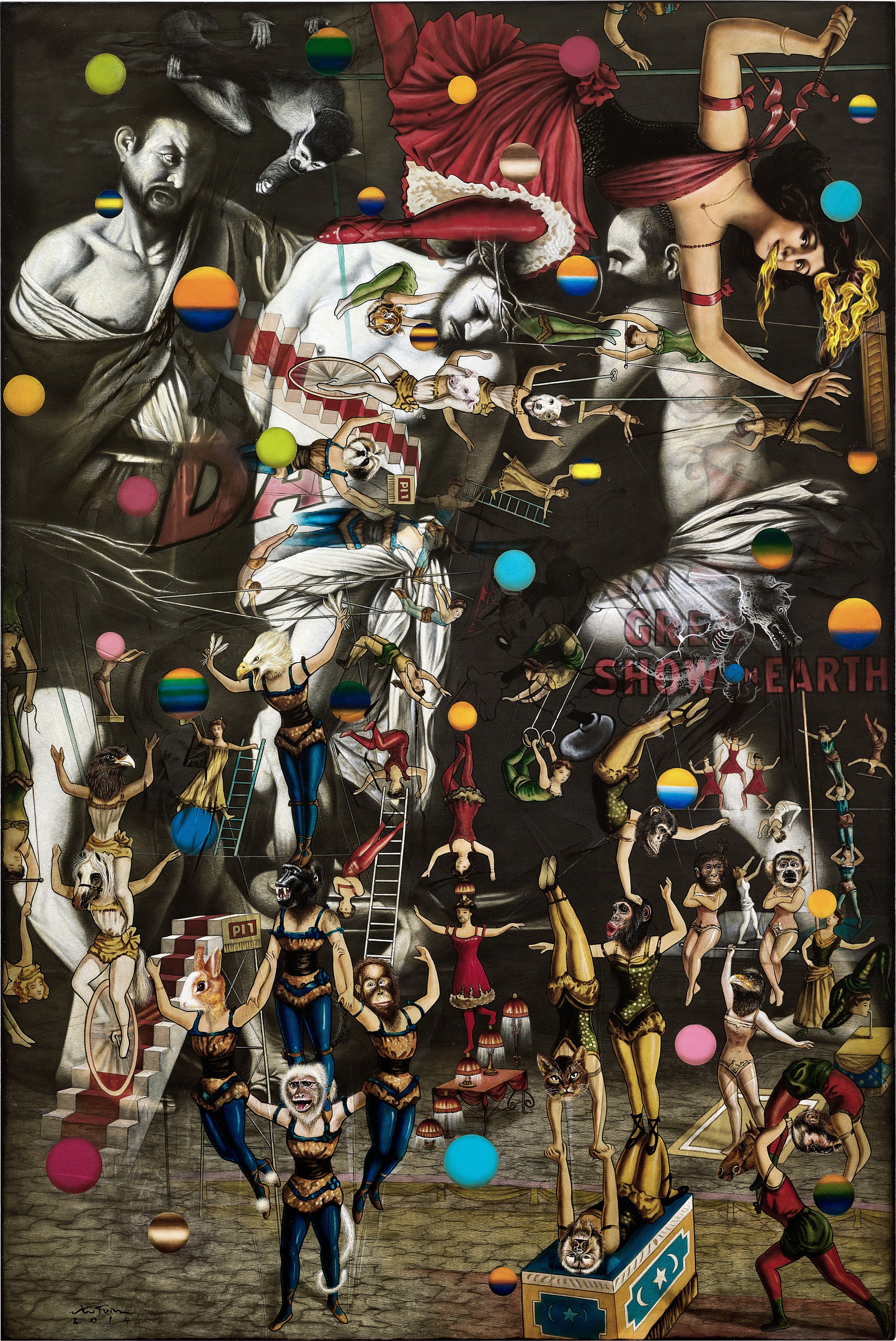
Carne Carnivale 嘉年華
Rather than choosing among these sources, Ventura developed a practice built on their simultaneous presence. By the early 2000s his signature approach had crystallized: paintings of remarkable density in which anatomical figures are wrapped in text, overlaid with geometric patterns, interrupted by graphic motifs drawn from tattoo flash sheets and folk imagery, and pushed to a level of detail that rewards long looking. The canvases feel less like pictures and more like ecosystems, each element in dynamic tension with every other. The works that first drew serious international attention include pieces that exemplify this layered complexity.
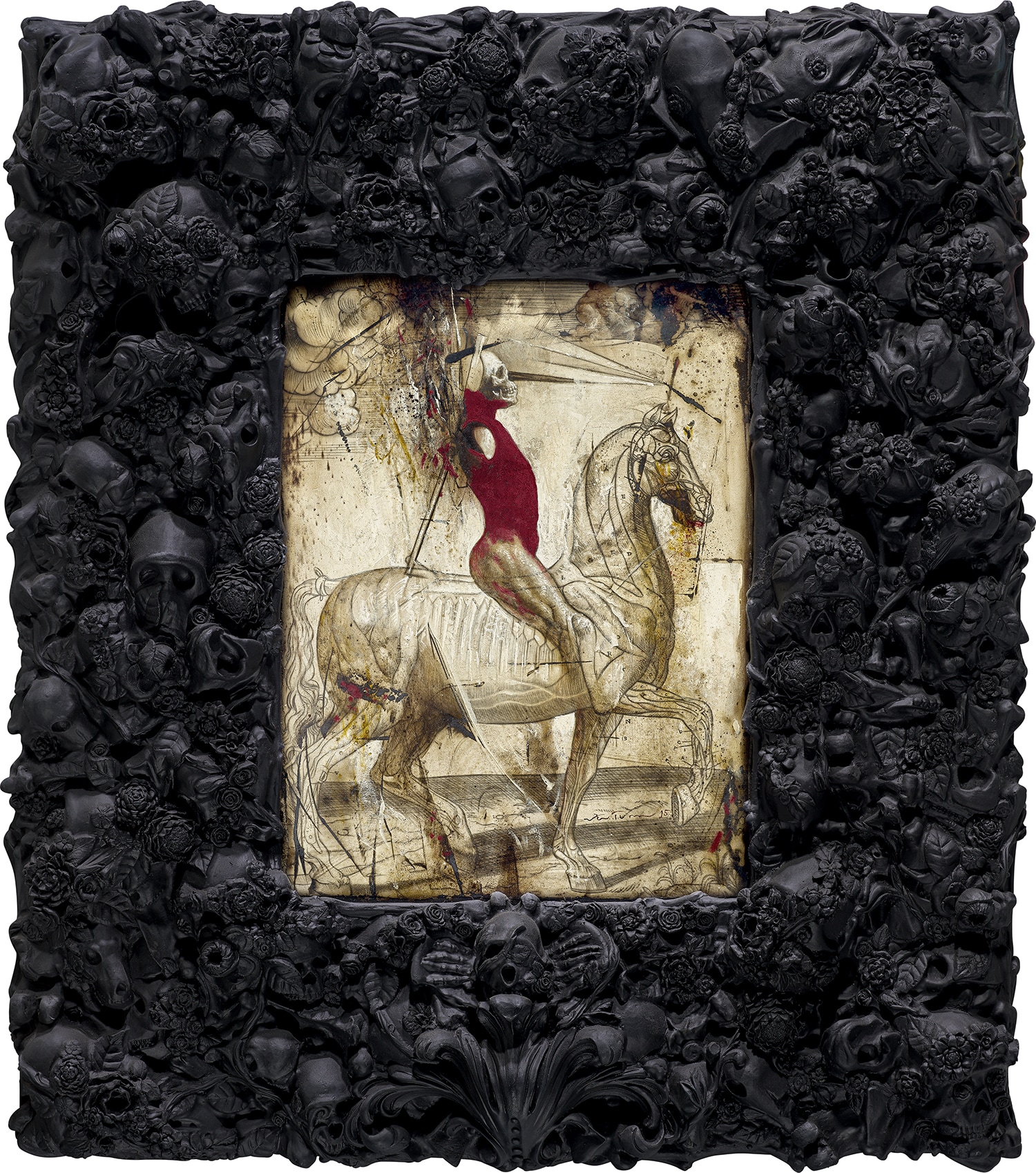
Carne Carnivale, rendered in oil on canvas, demonstrates Ventura at his most theatrically ambitious, staging a kind of carnivalesque pageant in which the human body becomes both subject and surface, simultaneously celebrated and dissected. His ongoing Hunting Ground series, multiple works of which were completed in 2015 and have circulated among discerning private collections, represents a sustained meditation on predation, vulnerability, and the violence latent in natural and social hierarchies. These are paintings in which a figure might be simultaneously hunter and hunted, observed and observer, the moral ambiguity rendered not through vague brushwork but through an almost obsessive accumulation of precise detail. His work on paper and mixed media pieces carry the same quality of intensity compressed into smaller formats.
Ronald Ventura
Hunting Ground Series 11, 2015
The artist frequently presents his paintings in artist made frames, which should be understood not as decorative afterthoughts but as integral extensions of the work itself, drawing the boundary between art object and world into question from the very start. The sculptural dimension of Ventura's practice deserves equal attention. He moves between painting, drawing, and three dimensional work with a fluency that speaks to his understanding of form as a continuous investigation rather than a series of separate disciplines. His sculptures bring the same vocabulary of layering, cultural quotation, and anatomical curiosity into physical space, allowing viewers to move around the accumulation of meanings rather than simply stand before it.
This versatility has made him particularly compelling to collectors who are building collections with conceptual coherence rather than simply acquiring isolated decorative objects. For collectors approaching Ventura's market today, several qualities make his work particularly significant. His paintings on canvas in oil represent the core of his practice and command the strongest collector interest. Works from the Hunting Ground series carry special weight given their thematic coherence and the critical attention they received upon completion.
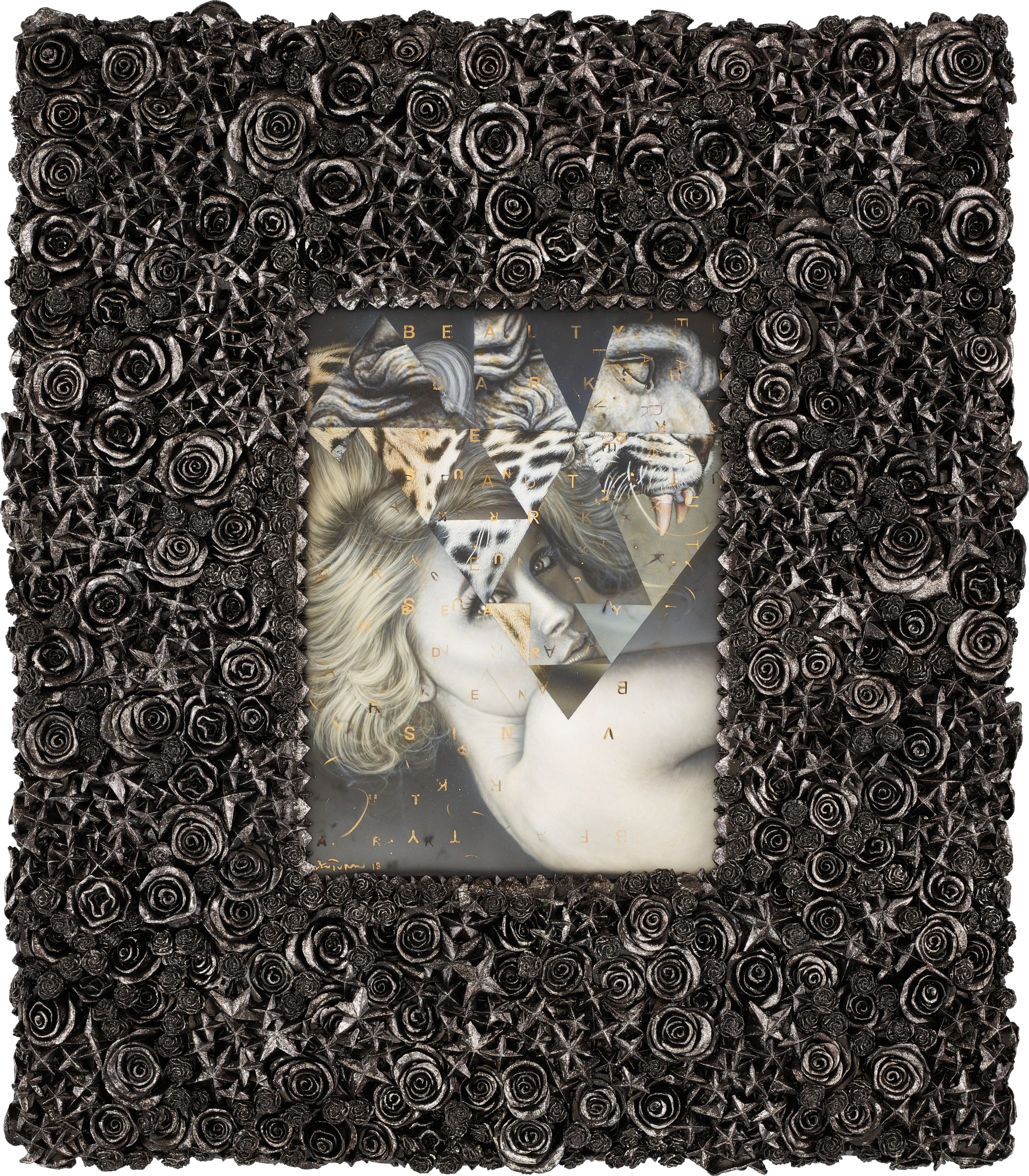
Ronald Ventura
無題
The presence of his artist framing is worth noting as a condition detail: frames conceived by Ventura as part of the work carry authentic documentary importance. His auction trajectory following the 2011 record has remained strong, with continued interest from collectors across Hong Kong, Singapore, and increasingly in European and American markets as Southeast Asian contemporary art has moved from specialist category to mainstream collecting priority. Institutions across Asia and in the West have added his work to permanent collections, which is one of the most reliable indicators of lasting market confidence. Collectors considering his work should look closely at the integrity of his layering technique and the consistency of his conceptual framework across individual pieces.
In the broader context of contemporary art history, Ventura belongs to a generation of figurative painters who reclaimed the painted body as a site of philosophical and political meaning at a moment when abstraction and conceptualism had long dominated critical conversation. He shares intellectual territory with artists like Gerhard Richter in his interest in the image as both surface and depth, and with Neo Expressionists like Georg Baselitz and A.R. Penck in his willingness to load the figure with symbolic cargo.
But his specific synthesis of Filipino cultural sources, tattoo and graphic traditions, and Western art historical references produces something that cannot be adequately described as derivative of any of these precedents. He is in conversation with them while remaining irreducibly himself. Among Filipino artists, he is naturally discussed alongside figures such as Manuel Ocampo, whose work engages Philippine history and Catholic imagery with comparable irreverence and erudition. What makes Ronald Ventura genuinely important, beyond the auction records and the museum acquisitions, is the quality of his sustained ambition.
He has not simplified his vision to make it more immediately accessible, nor has he replicated early successes in a way that might satisfy market demand but diminish artistic integrity. His work continues to evolve, to absorb new questions, and to insist that painting can carry as much complexity as any human situation it attempts to represent. In a moment when global collecting has rightly turned its serious attention to Southeast Asian art, Ventura stands as the figure who most fully demonstrates why that attention is not merely fashion but genuine discovery. His paintings ask the viewer to slow down, to look longer, to accept that meaning is not found on the surface but accumulated through sustained attention.
That is a rare and valuable invitation, and one that collectors, scholars, and curious visitors to collctn.art are fortunate to have extended to them.
Explore books about Ronald Ventura
Ronald Ventura: Iconoclasm
Christina Chung
Ronald Ventura: Monograph
Various curators
Ronald Ventura: The Anthropocene Series
Tessa Maria Guazon
Ronald Ventura: Collected Works 2000-2020
Silverlens Gallery