Robyn Denny
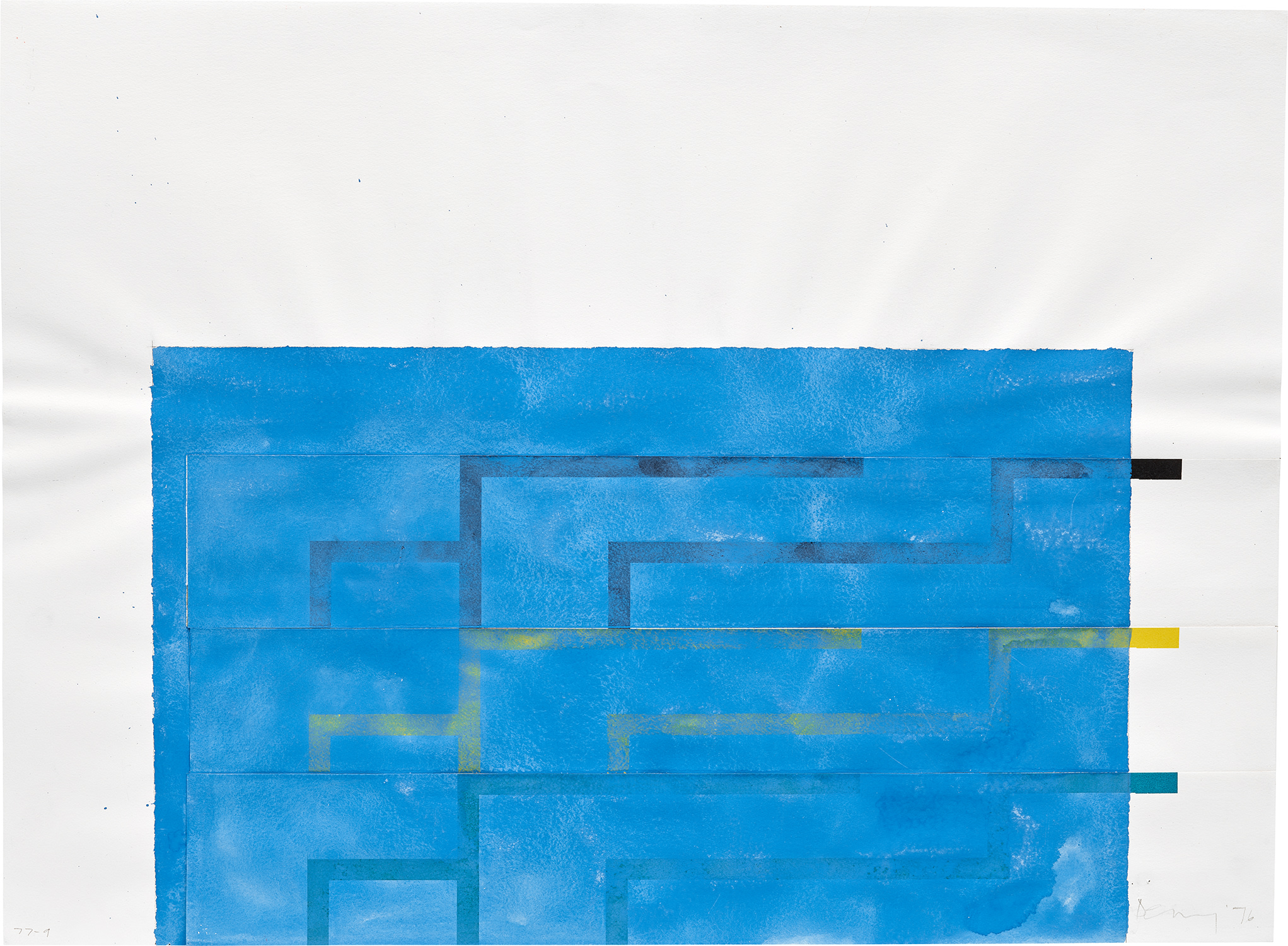
Robyn Denny: Architecture of Light and Color
Artist Spotlight · The Collection Editorial
Stand before one of Robyn Denny's large canvases and something unusual happens. The painting does not simply hang on the wall and wait to be observed. It opens, slowly, like a door into a space that exists somewhere between architecture and pure sensation. This quality, the sense that a painting could function as an environment rather than an object, was Denny's central preoccupation across six decades of extraordinary work, and it is precisely why his paintings feel as alive and demanding today as they did when they first transfixed audiences in London and New York during the 1960s.
Robyn Denny
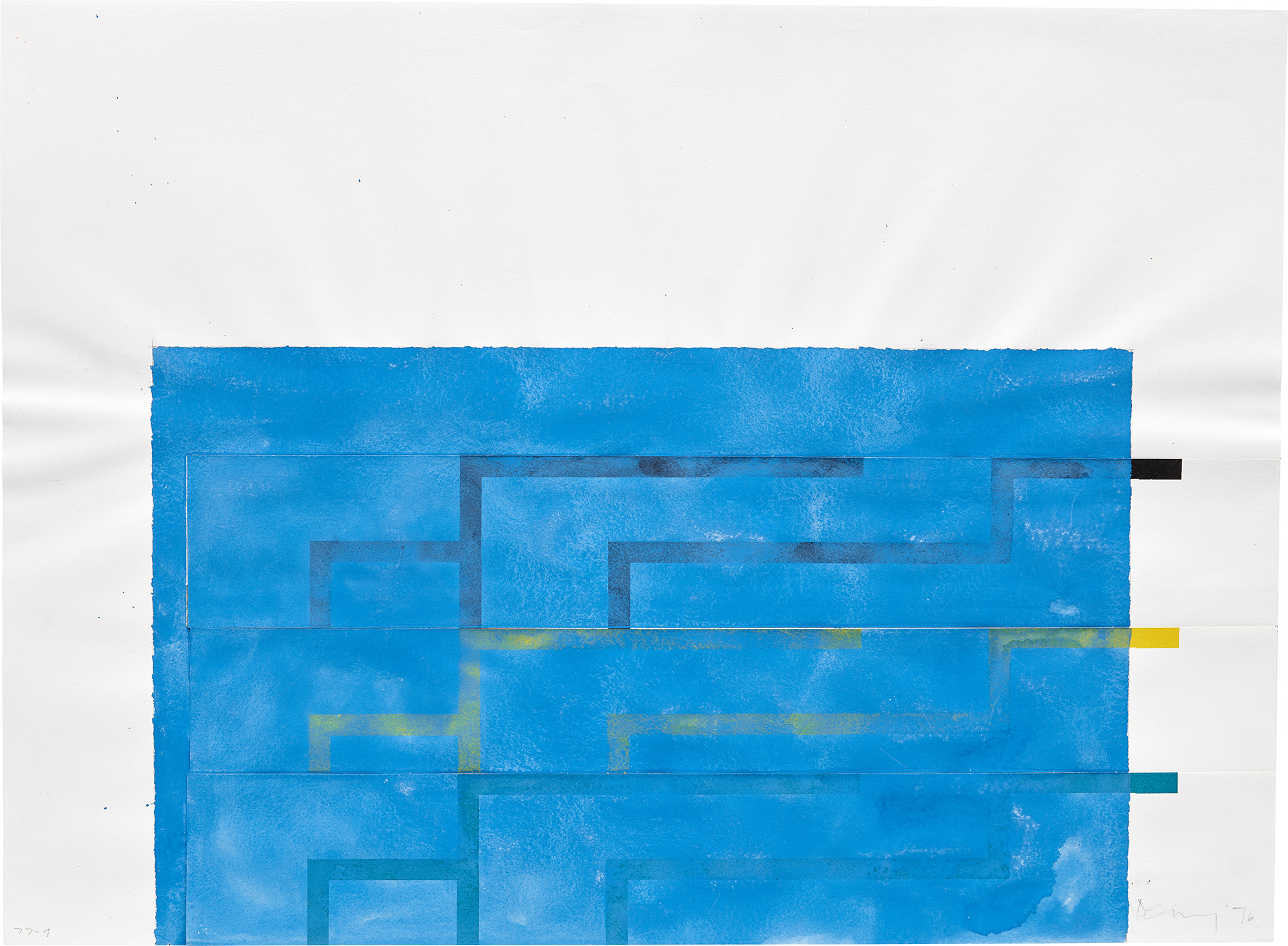
77-9
Robyn Denny was born in 1930 and came of age artistically at a moment of tremendous possibility for British painting. He studied at Guildford School of Art and then at the Royal College of Art in London, where he encountered a generation of peers equally hungry to break from the provincialism that had constrained British modernism. The Royal College in the mid 1950s was a charged environment, producing artists who would define the visual culture of the following decades. Denny absorbed the rigorous formal debates happening there while also looking intensely outward, toward the gestural ambition of American Abstract Expressionism and the cooler, more calculated investigations emerging from across Europe.
It was during his time in Paris, where he studied at the École des Beaux Arts, that Denny began to crystallize the ideas that would animate his mature practice. He returned to London with a sophisticated awareness of the international conversation in abstraction, and he arrived back just as that conversation was beginning to shift away from the gestural and the expressive toward something more structured and optical. Denny became a pivotal figure in this transition. He was one of the organizers of the landmark 1960 exhibition Situation, held at the RBA Galleries in London, which brought together British abstract painters committed to large scale, non illusionistic work.
Robyn Denny
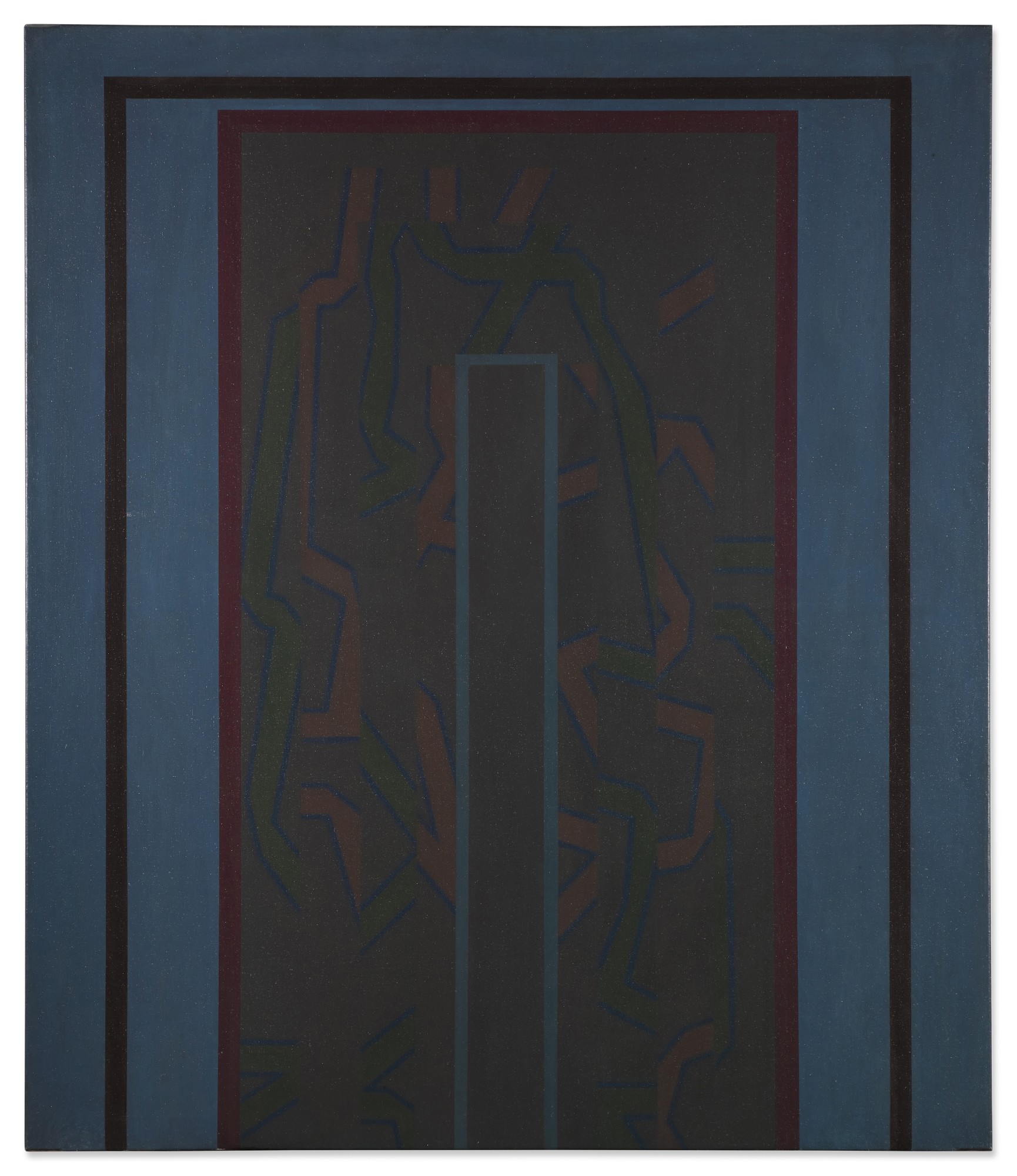
The Golden Gospel, 1963
Situation was a defining cultural moment, asserting that British abstraction deserved to be considered on the same terms as its American counterpart. Denny's artistic development in the late 1950s and 1960s traces a confident arc toward what would become his signature mode. His compositions became increasingly symmetrical, built around stacked and nested geometric forms, often rectangles and arched or portal like shapes, rendered in carefully modulated color fields. The palette was never arbitrary.
Denny worked with color the way an architect works with light, understanding that adjacent tones could activate one another and that the proportion of a field mattered as much as its hue. His canvases were conceived at human scale quite deliberately. He wanted the viewer to stand before them the way one stands before a doorway or a window, with the body registered as part of the experience. The paintings were not illustrations of space.
Robyn Denny
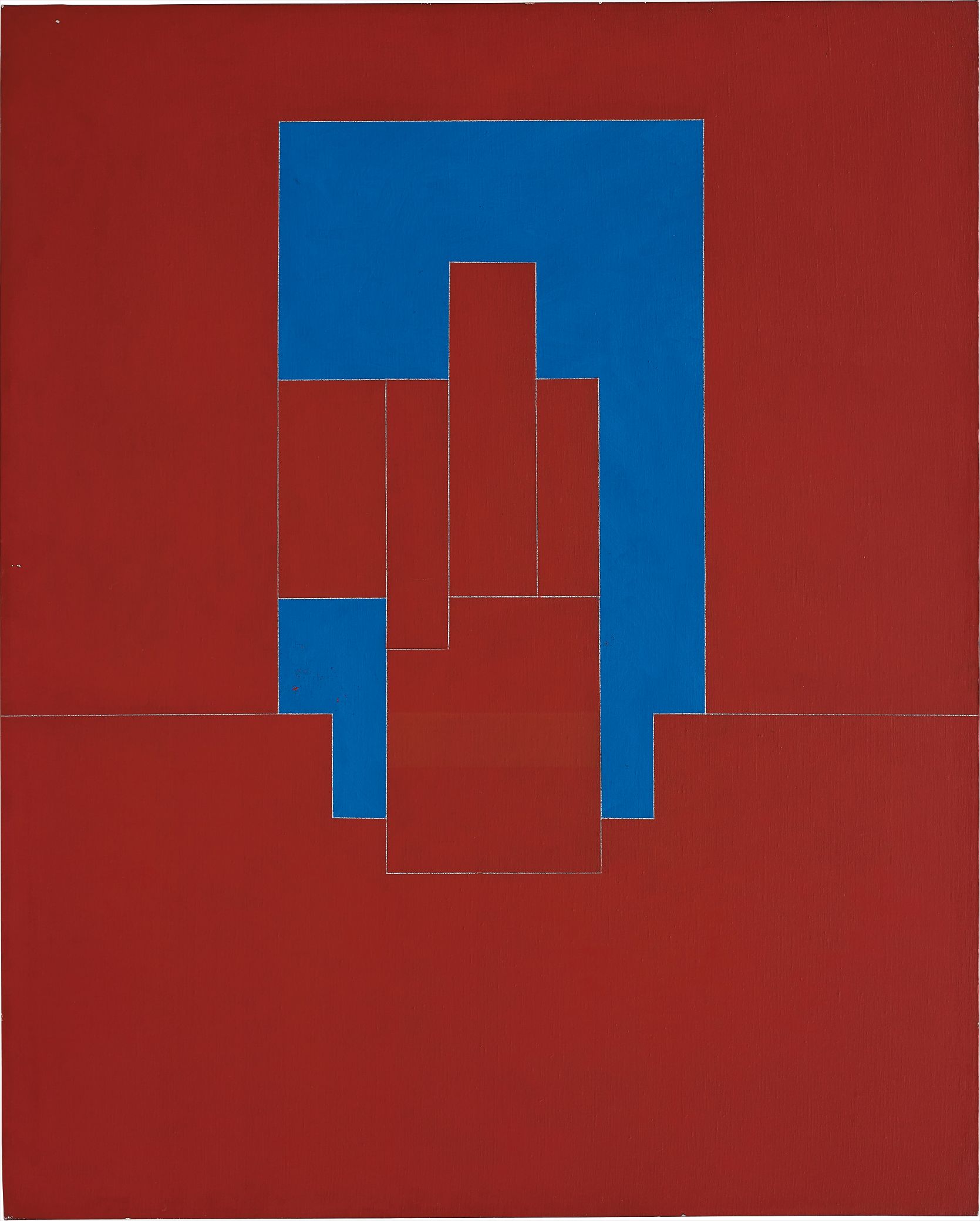
Graffiti 4, 1975
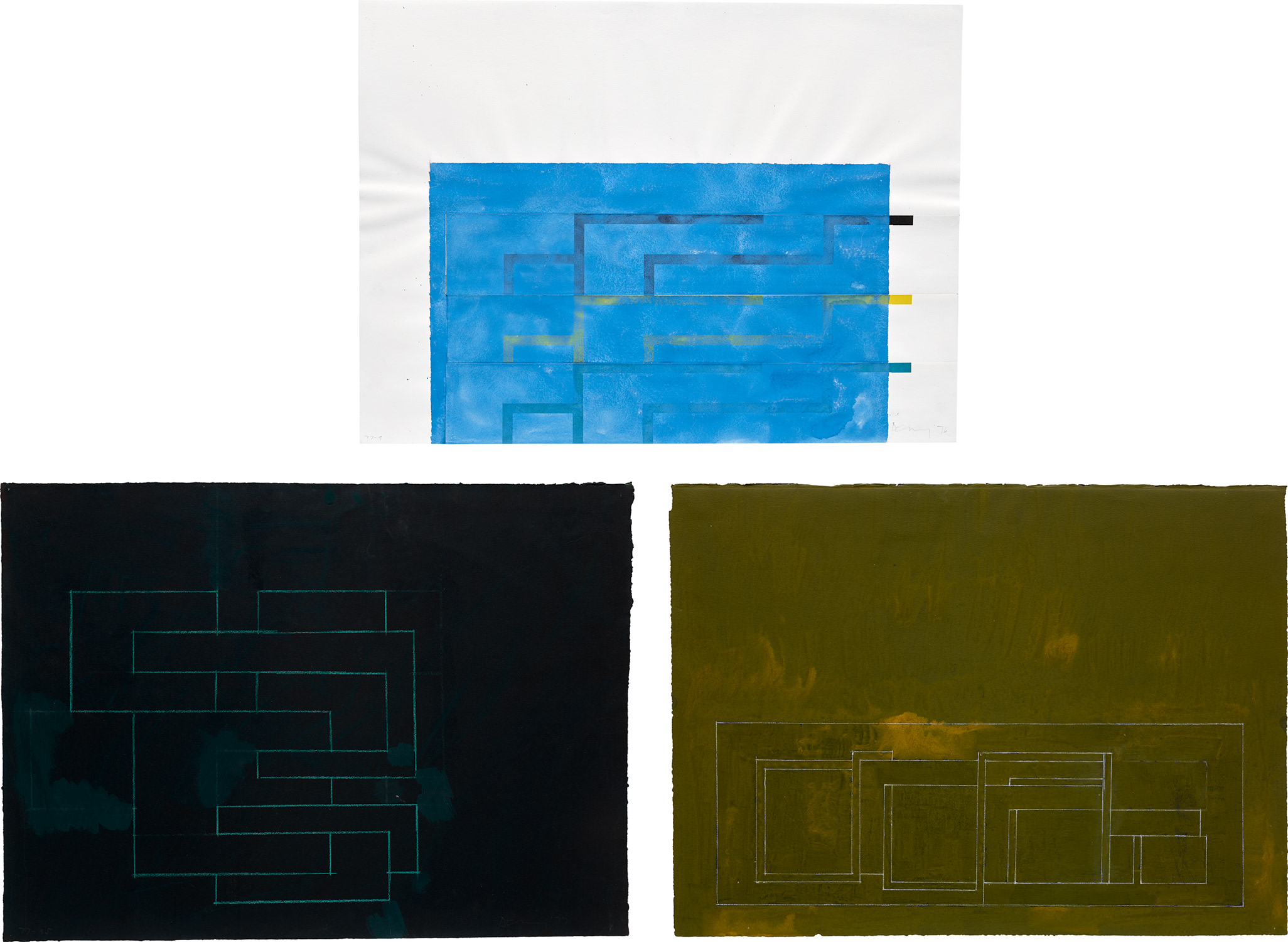
They were, in his thinking, spatial events. Among the works that best illuminate Denny's achievement is The Golden Gospel, painted in 1963, a canvas that demonstrates his command of symmetry as a tool for generating meditative tension rather than static resolution. The painting draws the eye inward through a series of tonal shifts that reward sustained attention. His series of works from 1977, including the gouaches and works on paper designated within his systematic titling as 77 9, 77 17, and 77 35, reveal a different register of his intelligence.
Executed on fine papers including T.H. Saunders and Crisbrook handmade paper, and incorporating both gouache and crayon with collage, these works show Denny thinking through his formal concerns with the intimacy and directness that works on paper uniquely permit. They are not studies or footnotes to the paintings.
Robyn Denny
77-9; 77-17; and 77-35
They are complete works with their own authority. The print series Light of the World from 1970, published by Bernard Jacobson Ltd. in London, extended Denny's ideas into multiples and brought his visual thinking to a broader audience, demonstrating his belief that great abstract art need not be confined to singular precious objects. For collectors, Denny represents a compelling and still underappreciated chapter in the story of postwar British and international modernism.
His work sits at the intersection of several important currents: the British response to American Hard Edge painting, the European tradition of Concrete Art, and a distinctly architectural sensibility that connects him to thinkers and makers across disciplines. Works on paper offer an accessible entry point into his practice, revealing the hand and the thought process in ways that complement the monumental canvases. Collectors drawn to artists such as Kenneth Noland, Ellsworth Kelly, and Bridget Riley, who all explored the optical and emotional possibilities of geometric abstraction during the same era, will find in Denny a figure who belongs firmly in that distinguished company. British peers including Peter Stroud and John Hoyland shared aspects of his formal ambitions, though Denny's particular focus on symmetry and what he described as the viewer's bodily encounter with the picture plane gives his work a singular character within that group.
Denny exhibited widely throughout his career, with significant shows in London, New York, and beyond, and his work entered important public and private collections on both sides of the Atlantic. The Tate collection holds key examples, and his presence in museum holdings across Britain reflects the esteem in which he was held by curators and historians of modernism. Yet there remains a sense, shared among those who know the work well, that Denny has not yet received the full critical reconsideration that his achievement warrants. This is beginning to change, as renewed scholarly and market interest in postwar British abstraction has brought fresh attention to the Situation generation and the remarkable ambition they brought to bear on the fundamental questions of what painting could do and be.
Robyn Denny died in 2014, leaving behind a body of work that continues to ask something genuine of everyone who stands before it. His paintings do not flatter or entertain in any easy sense. They require stillness, attention, and a willingness to let color and form do their slow, patient work. For those who give them that attention, the reward is considerable: a sense of having encountered something that was made with total conviction, by an artist who understood that abstraction at its best is not an absence of meaning but a different and more open kind of presence.
His legacy is that of a painter who trusted the viewer completely, and whose work remains more than worthy of that trust.