Robert Combas
Robert Combas, France's Glorious Untameable Visionary
Artist Spotlight · The Collection Editorial
In the grand sweep of postwar European painting, few figures have maintained such relentless creative energy across five decades as Robert Combas. The Musée d'Art Moderne de la Ville de Paris has long counted his works among its holdings, and his canvases continue to appear in significant international survey shows examining the legacy of figuration and Neo Expressionism. As institutions and collectors worldwide reassess the movements that disrupted the dominance of abstraction in the late twentieth century, Combas stands at the center of that conversation, his reputation only deepening with time. Combas was born in Lyon in 1957 and grew up in Sète, the Mediterranean port town that also shaped the poet Paul Valéry and the painter and poet Joë Bousquet.
Robert Combas
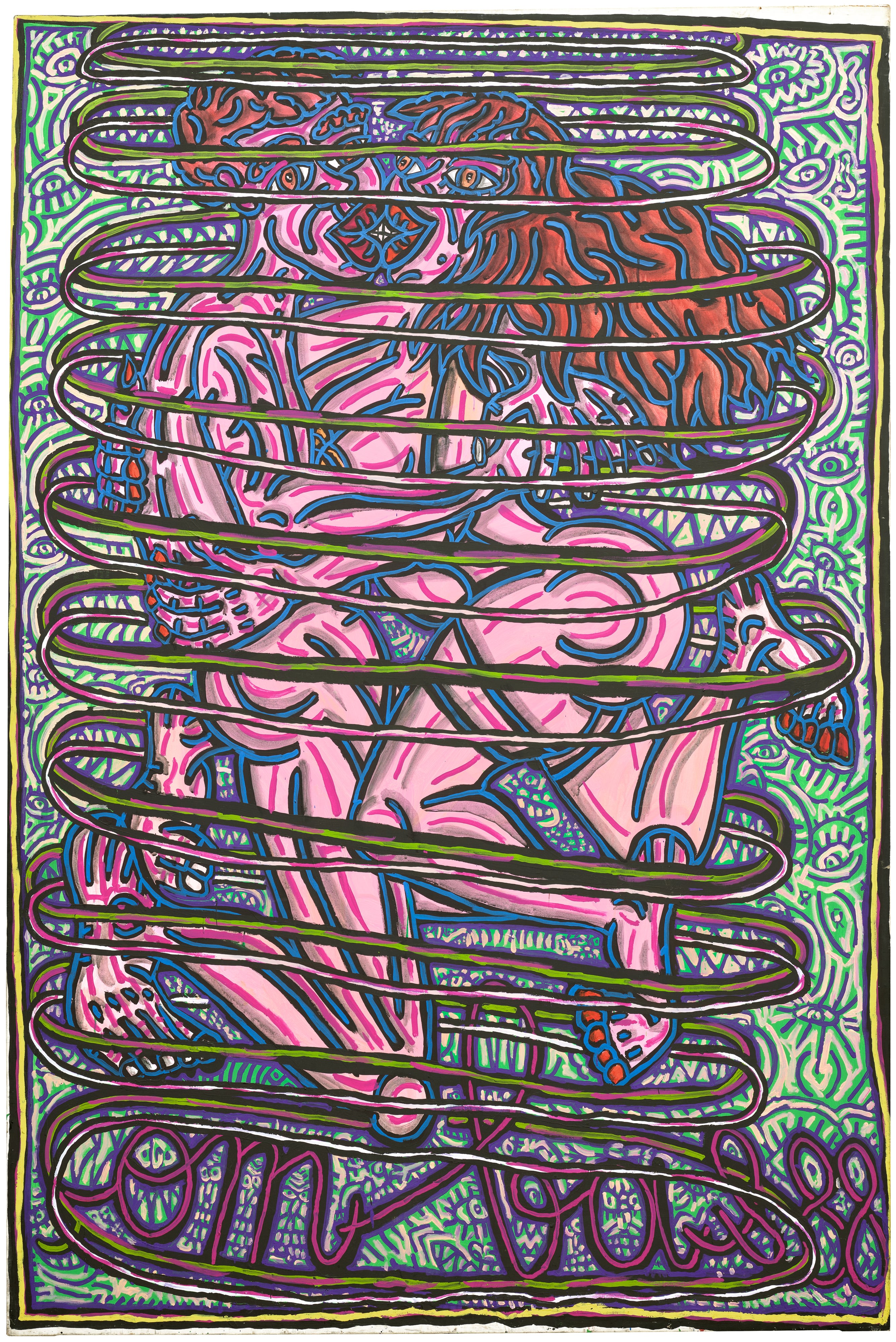
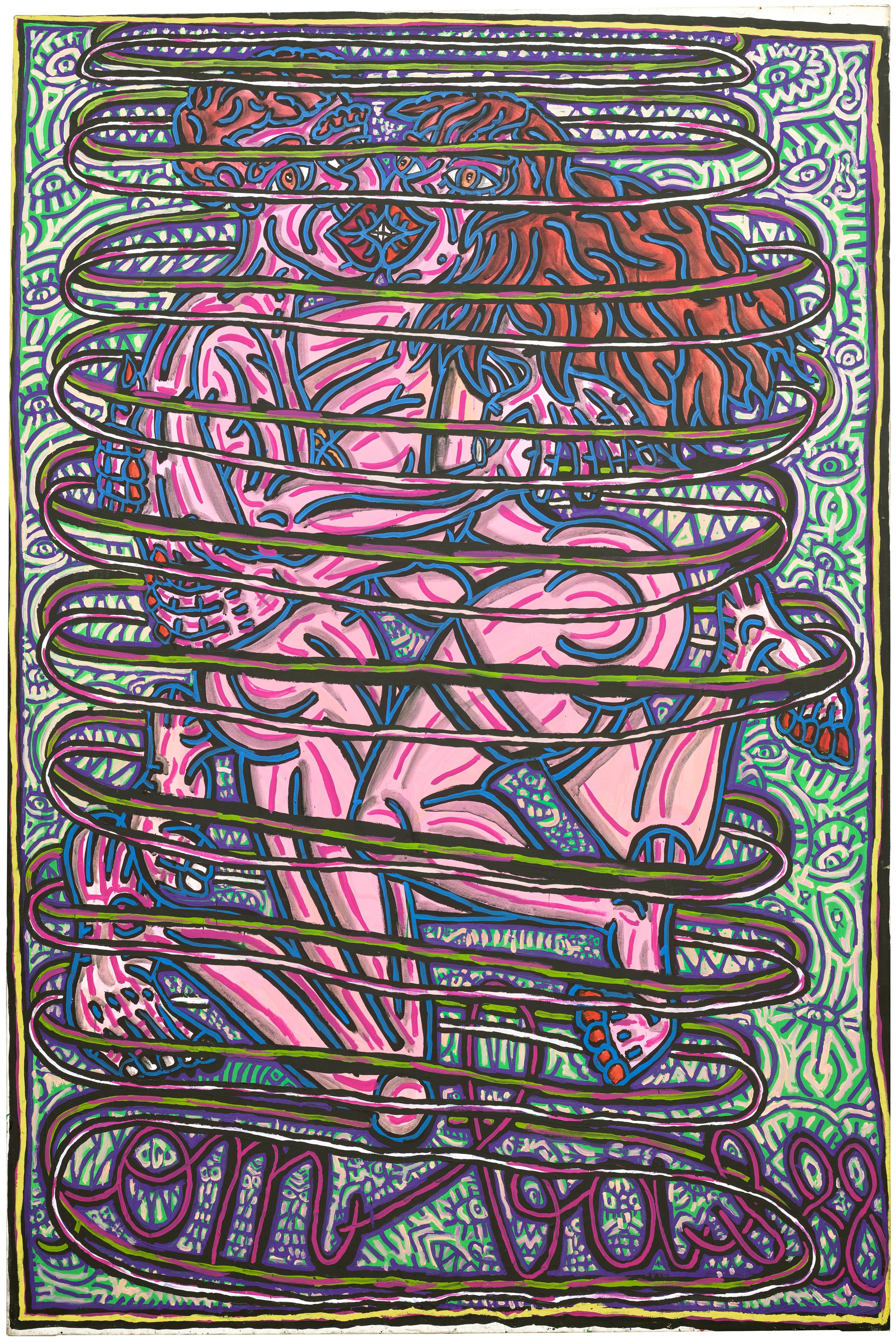
Robert et Geneviève font la danse de Sain Guy, ils tournent en faisant des petits bonds. Ils s'enivrent de la tête tournée du fait de valser en valsant. Car ils dansent la valse à "genoux les jambes" : des fois se relever et sauter, puis s'embrasser sur les joues puis se remettre sur pied, et crier "J'ai froid aux tétés ou j'ai la gangrène au vié", puis se retirer aussi sec de là où on est. Tout ça, toujours en tournoyant comme des interprètes d'opéra à la pile Wonder., 1988
That southern light and the particular vitality of the Languedoc coast left a permanent mark on his sensibility. He studied at the École des Beaux Arts in Montpellier in the late 1970s, where he encountered the ideas and energies that would crystallize into one of the most important French art movements of the modern era. The Mediterranean world gave him a love of heat, color, and abundance, qualities that would become the very grammar of his painting. In 1979, alongside fellow painters Hervé Di Rosa and later in dialogue with artists such as François Boisrond and Rémi Blanchard, Combas helped forge Figuration Libre, France's spirited and irreverent response to the Neo Expressionism emerging simultaneously from Germany and the United States.
The movement took its name from a kind of liberated figuration, a refusal of the cool detachment of conceptual art and the austerity of minimalism in favor of raw, image saturated canvases that borrowed freely from graffiti, comic books, rock music, and street culture. If Georg Baselitz and A.R. Penck were reclaiming the painted figure in Germany, and Jean Michel Basquiat was electrifying New York, Combas was doing something equally urgent and distinctly French: fusing the carnivalesque tradition of folk art with the restless visual noise of contemporary popular culture.
Robert Combas
Soumission, 2006
His breakthrough came rapidly and with great force. By the early 1980s, his canvases were generating serious attention in Paris and beyond. A work such as "The Chat Vert La Nuit Se Retrouve À Découvrir Un Monde De Nuit Pas Piqué Des Hannetons" from 1984 demonstrates exactly what made Combas so arresting: the surface is densely colonized by figures, animals, and text, rendered in acrylic with a confidence that feels simultaneously naïve and deeply knowing. The titles themselves are events, sprawling, breathless, almost novelistic in their scope.
His 1987 canvas "L'amour entre un chauve et une chevelue" shows his gift for finding tenderness and humor within chaos, two figures caught in a moment of intimacy amid a swirling universe of color and incident. These are paintings that demand to be read as well as seen, and that quality of layered meaning rewards sustained looking. The work from 1988 that bears one of the most extravagantly titled works in the canon of contemporary French painting, the piece depicting Robert and Geneviève dancing what Combas describes as the waltz "à genoux les jambes," is a masterpiece of his mature voice from that decade. The title runs for several lines and reads like a stream of consciousness prose poem, entirely in keeping with Combas's belief that language and image are not separate territories but co conspirators in the creation of meaning.
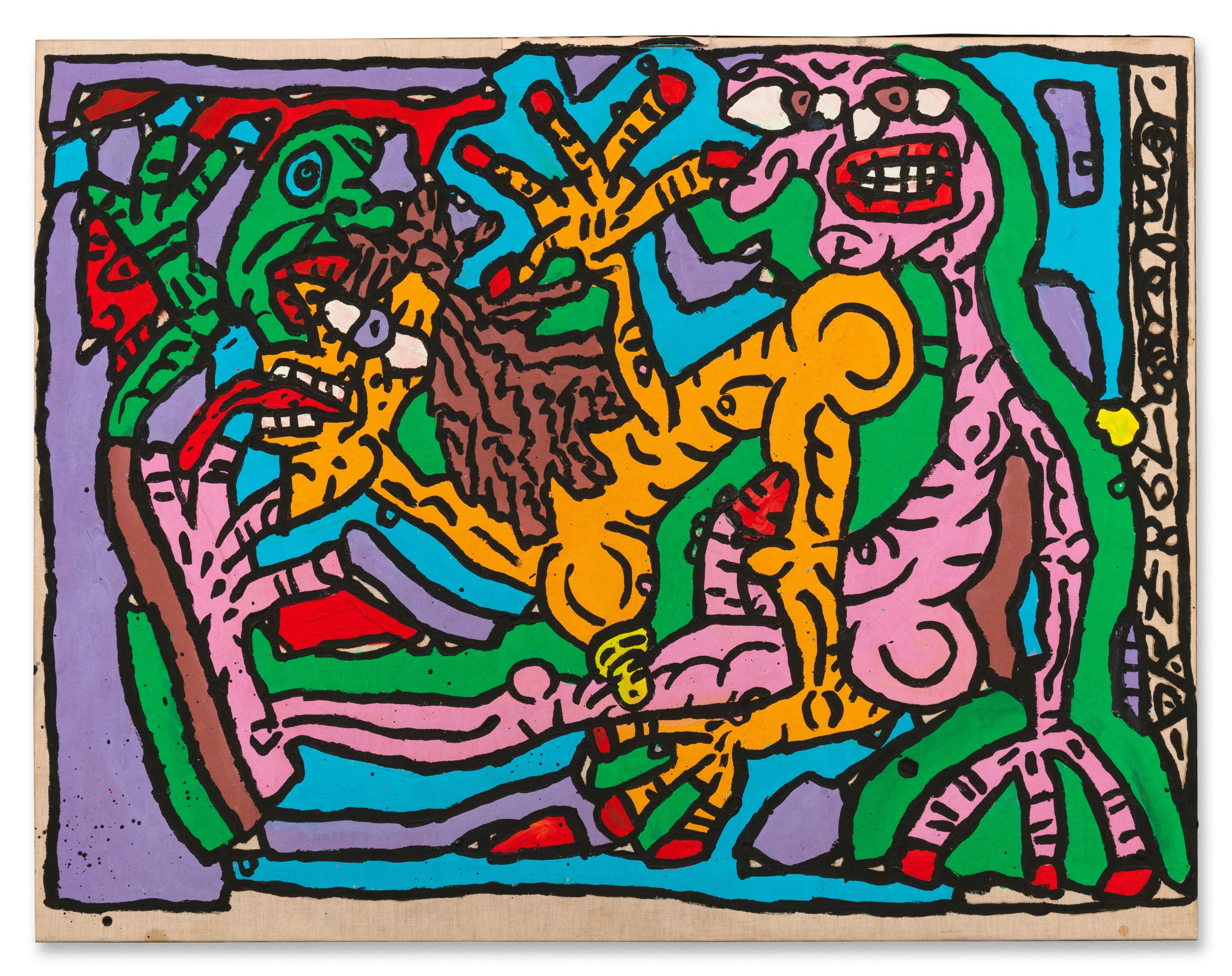
Robert Combas
L’amour entre un chauve et une chevelue, 1987
His 1989 work "Exécution de Louis XVI et d'autres" brings that same frenzied energy to a historical subject, collapsing the distance between past and present with the ease of an artist who genuinely believes all of history is available material. By 1994 and works such as "Composition," executed in acrylic on batik print on cotton, his appetite for unconventional surfaces and mixed techniques was fully established, showing a painter who refuses to be confined by the conventions of the stretched canvas. For collectors, Combas represents a compelling and still accessible point of entry into the Figuration Libre movement, which has attracted sustained curatorial attention from major European and American institutions. His works appear regularly at auction, with strong results for canvases from the pivotal years of 1984 to 1995, a period when his language was fully formed and his output was extraordinarily prolific.
Collectors drawn to the energy of Basquiat or Keith Haring often find in Combas an equally charged but distinctly European sensibility, one rooted in the café culture, rock and roll mythology, and Mediterranean exuberance of southern France rather than the streets of New York. The range of media in his practice, from pure acrylic on canvas to mixed media works incorporating collage and unusual fabric grounds, means that collections can represent his voice across multiple registers of scale and material. Within art history, Combas belongs to a generation that includes not only his Figuration Libre peers but also the German Neo Expressionists and the American Bad Painting practitioners who collectively reinvented the possibilities of painting in an era dominated by theory. His closest spiritual relatives are artists like Kenny Scharf and Basquiat in their shared devotion to popular iconography, but his roots in French folk tradition and his particular relationship with text give his work a flavor that is entirely his own.
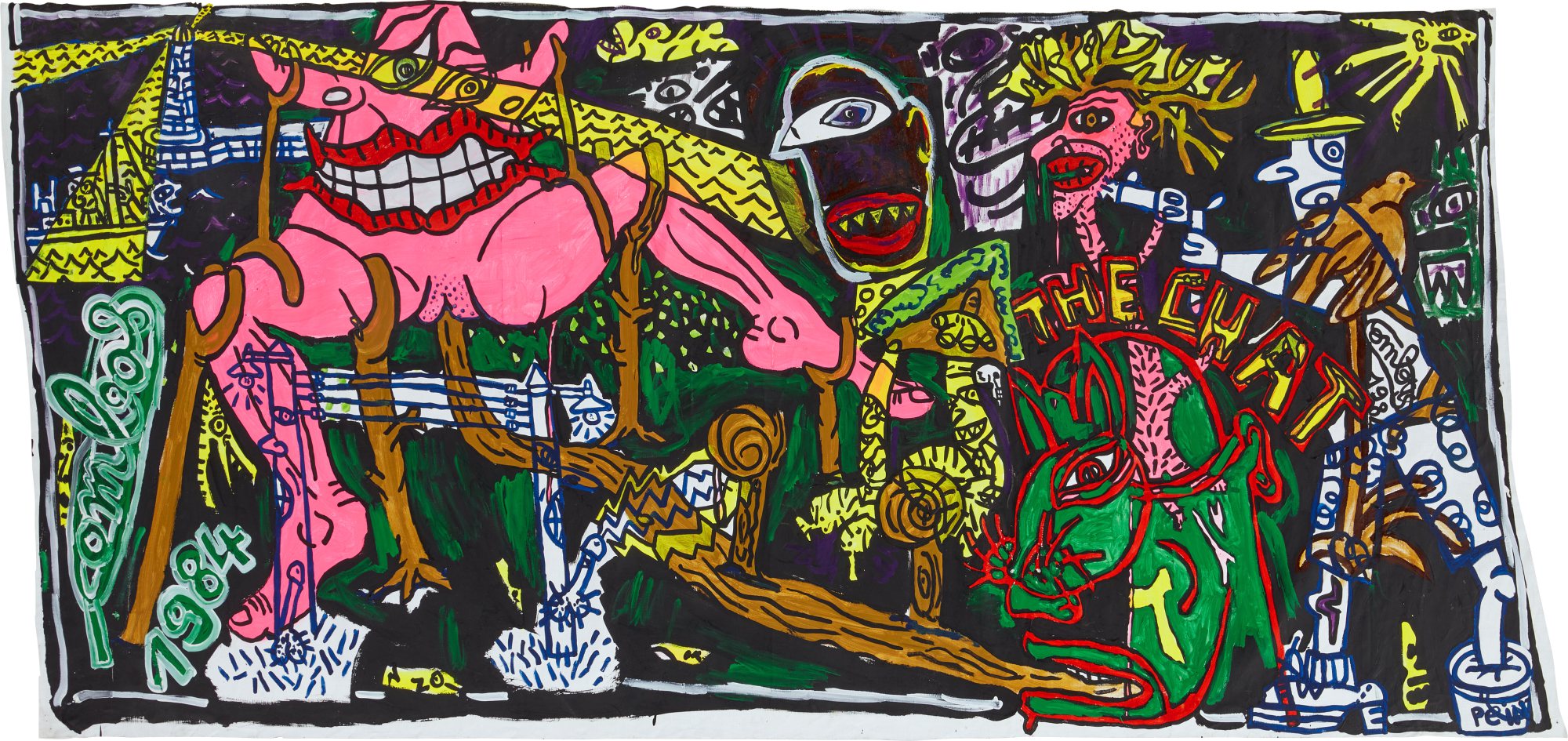
Robert Combas
The Chat Vert La Nuit Se Retrouve À Découvrir Un Monde De Nuit Pas Piqué Des Hannetons !, 1984
He has cited rock music as a formative influence, and there is something genuinely punk in the refusal of refinement that animates even his most technically ambitious canvases. Robert Combas is now in his late sixties and the breadth of what he has produced over five decades constitutes one of the great bodies of work in contemporary French art. His paintings are held in public and private collections across Europe and the United States, and the critical case for his importance has only grown stronger as the art world has come to understand Figuration Libre not as a provincial footnote to international Neo Expressionism but as one of its defining chapters. To own a Combas is to possess something genuinely alive, a painting that refuses to stand still, that continues to pulse and shout and sing long after it has found its home on the wall.
Explore books about Robert Combas