Richard Hamilton
Richard Hamilton, The Original Pop Visionary
Artist Spotlight · The Collection Editorial
“I want to hold a mirror up to the consumer society we live in and reflect its obsessions.”
Richard Hamilton, interview with the ICA, London
Few moments in postwar British art feel as electric in retrospect as the opening of 'This Is Tomorrow' at the Whitechapel Gallery in London in August 1956. Among the contributions from twelve groups of artists and architects, one small photographic collage stopped visitors in their tracks. Richard Hamilton's 'Just what is it that makes today's homes so different, so appealing?' crammed a domestic interior with bodybuilders, pin ups, a television set, a tin of ham, and a lollipop bearing the word POP in bold capitals.
Richard Hamilton
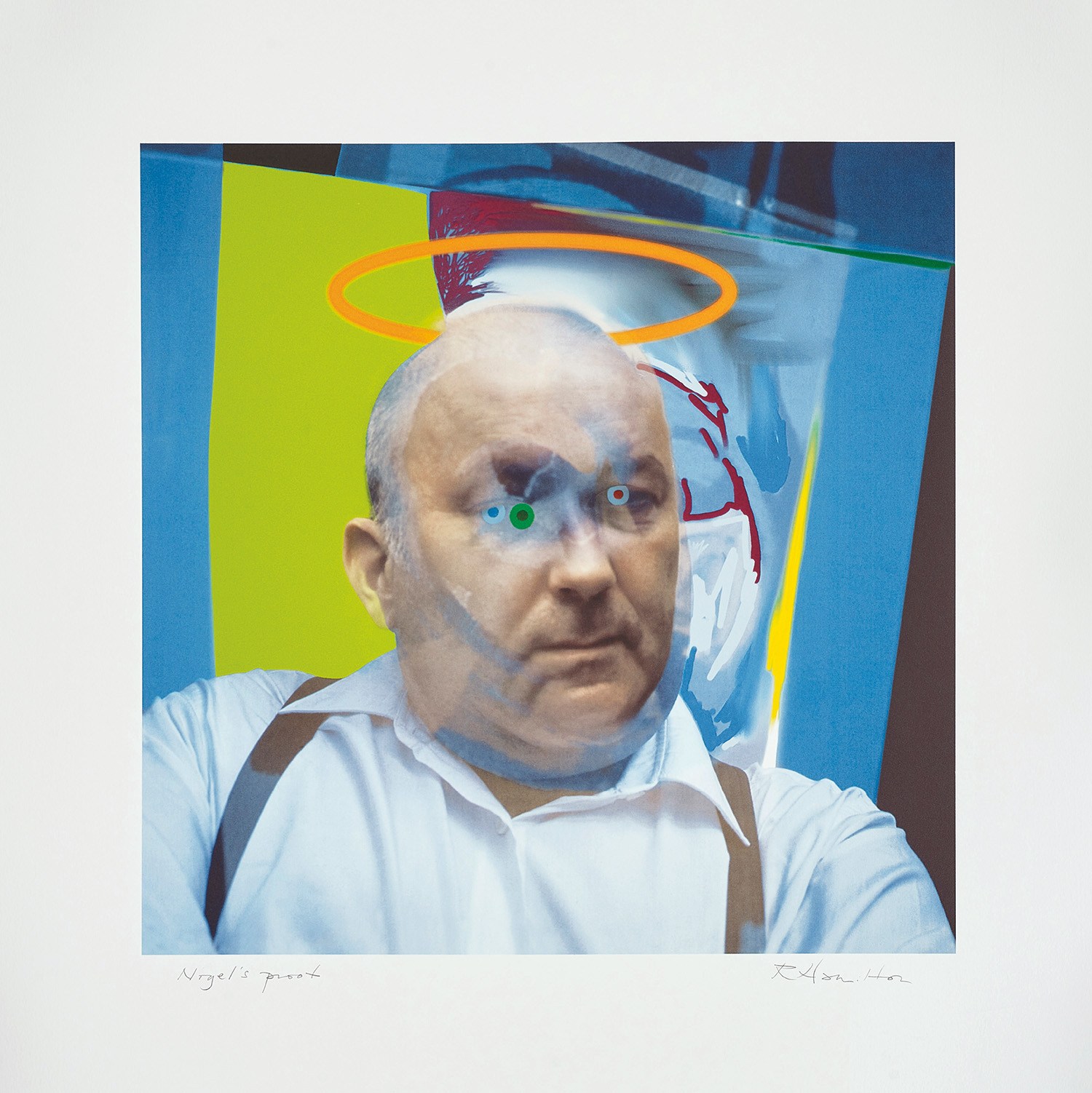
Portrait of Dieter Roth
It was irreverent, seductive, and startlingly new. It was, in the most literal sense, the opening image of a movement. That collage is now housed in the Kunsthalle Tübingen, and it continues to draw students, scholars, and collectors from across the world, its relevance undiminished more than six decades after it was made. Richard Hamilton was born in London in 1922 and grew up in modest circumstances in Pimlico.
He left school at fourteen and took work as an apprentice in an electrical firm before his artistic talent earned him a place at the Royal Academy Schools in 1938. His studies were interrupted by the Second World War, during which he worked as a jig and tool draughtsman, an experience that sharpened his instinct for precision and his sensitivity to the designed object. After the war he returned to formal training at the Slade School of Fine Art, graduating in 1951, and shortly afterwards joined the teaching staff at the Central School of Arts and Crafts and later at King's College, Newcastle, where he would prove a formative influence on a generation of British artists. His intellectual formation owed as much to ideas as to technique.
Richard Hamilton
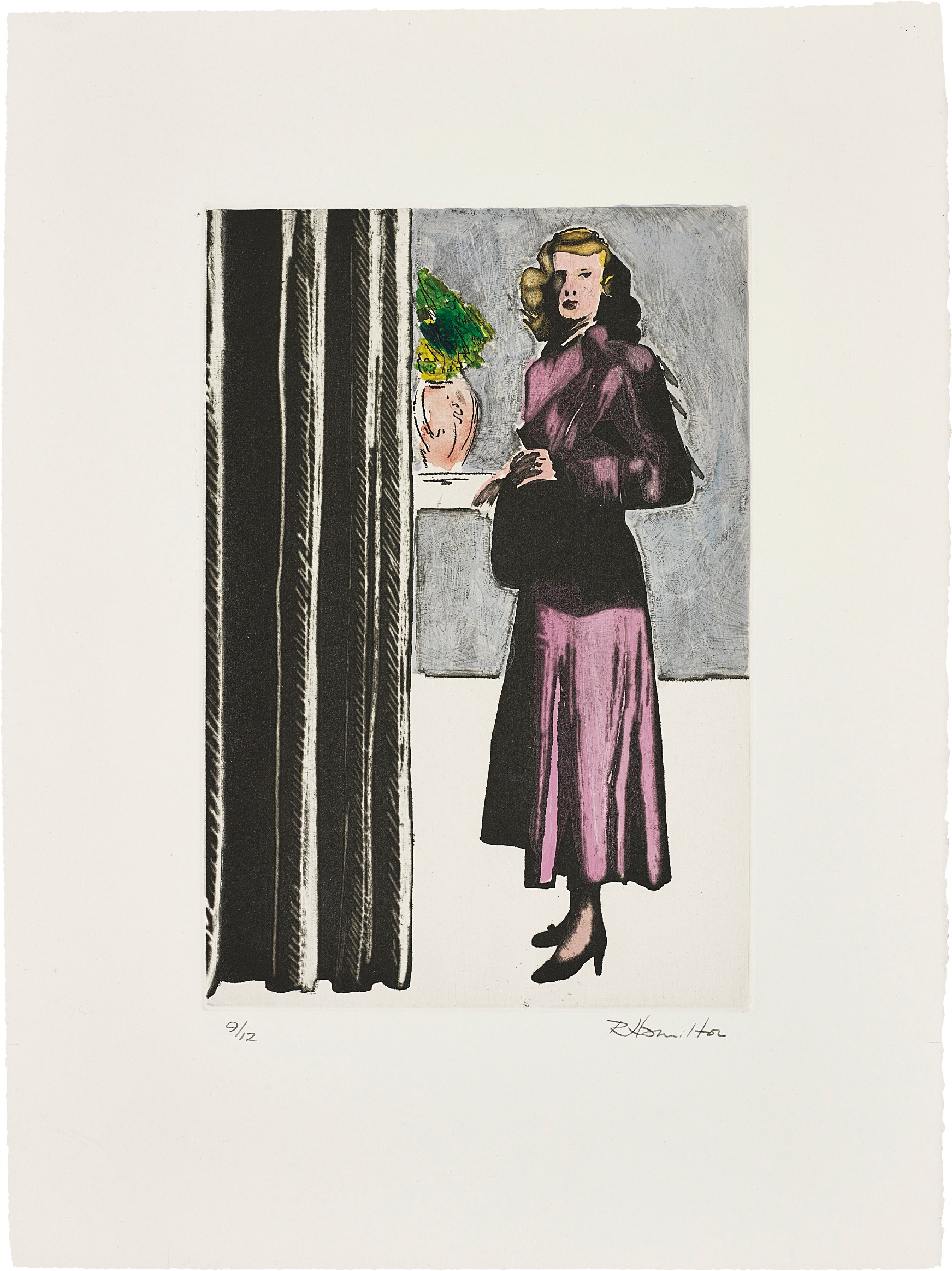
Patricia Knight I (coloured)
Hamilton was a devoted student of Marcel Duchamp, and his 1960 reconstruction of Duchamp's 'Large Glass' for an exhibition in Newcastle remains one of the most rigorous acts of homage in twentieth century art history. Through the Independent Group, the loose collective of artists, architects, and critics that gathered at the Institute of Contemporary Arts in London during the early 1950s, Hamilton engaged deeply with questions about mass media, advertising, technology, and the aesthetics of consumer culture. Where others saw these forces as threats to high culture, Hamilton saw them as the defining visual language of modern life, worthy of the same analytical attention that had always been applied to painting and sculpture. Hamilton's development as an artist was characterised by restless formal experimentation rather than a fixed signature style.
“Pop art is: popular, transient, expendable, low-cost, mass-produced, young, witty, sexy, gimmicky, glamorous, and Big Business.”
Richard Hamilton, letter to Peter and Alison Smithson, 1957
He moved fluidly between painting, printmaking, photography, collage, and later digital processes, always allowing the subject matter to determine the appropriate medium. His paintings from the late 1950s and 1960s, including works such as 'She' from 1958 to 1961 and 'Hommage à Chrysler Corp' from 1957, dissected advertising imagery with a cool, near clinical intelligence, celebrating and interrogating consumer desire simultaneously. He was never simply satirising popular culture; he was genuinely fascinated by it, by its rhythms and its seductions, and that fascination gave his work a warmth and complexity that pure critique alone could not have produced. Among the works available through The Collection, the range of Hamilton's printmaking practice reveals itself with particular clarity.
Richard Hamilton
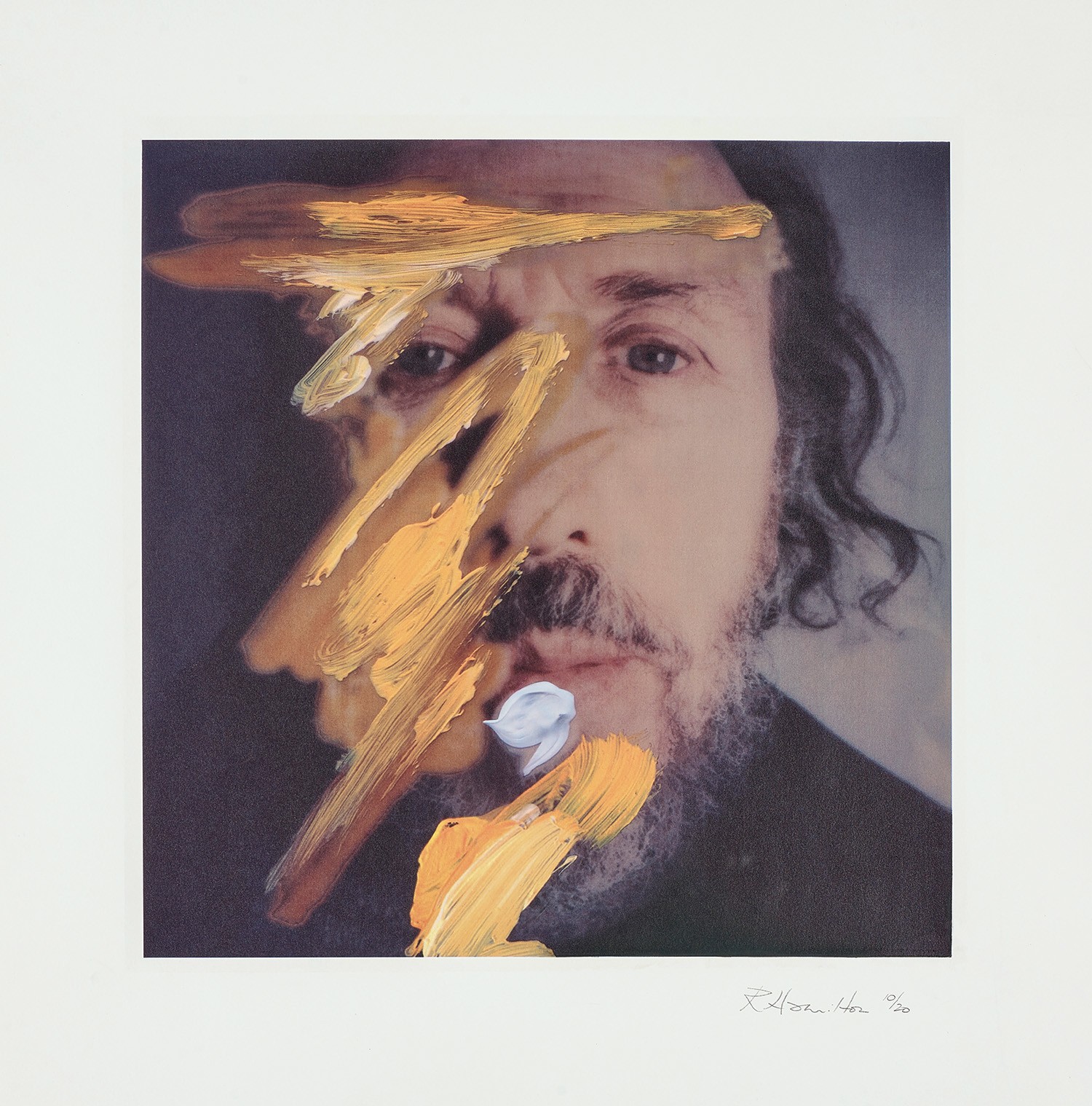
Self-Portrait with Yellow
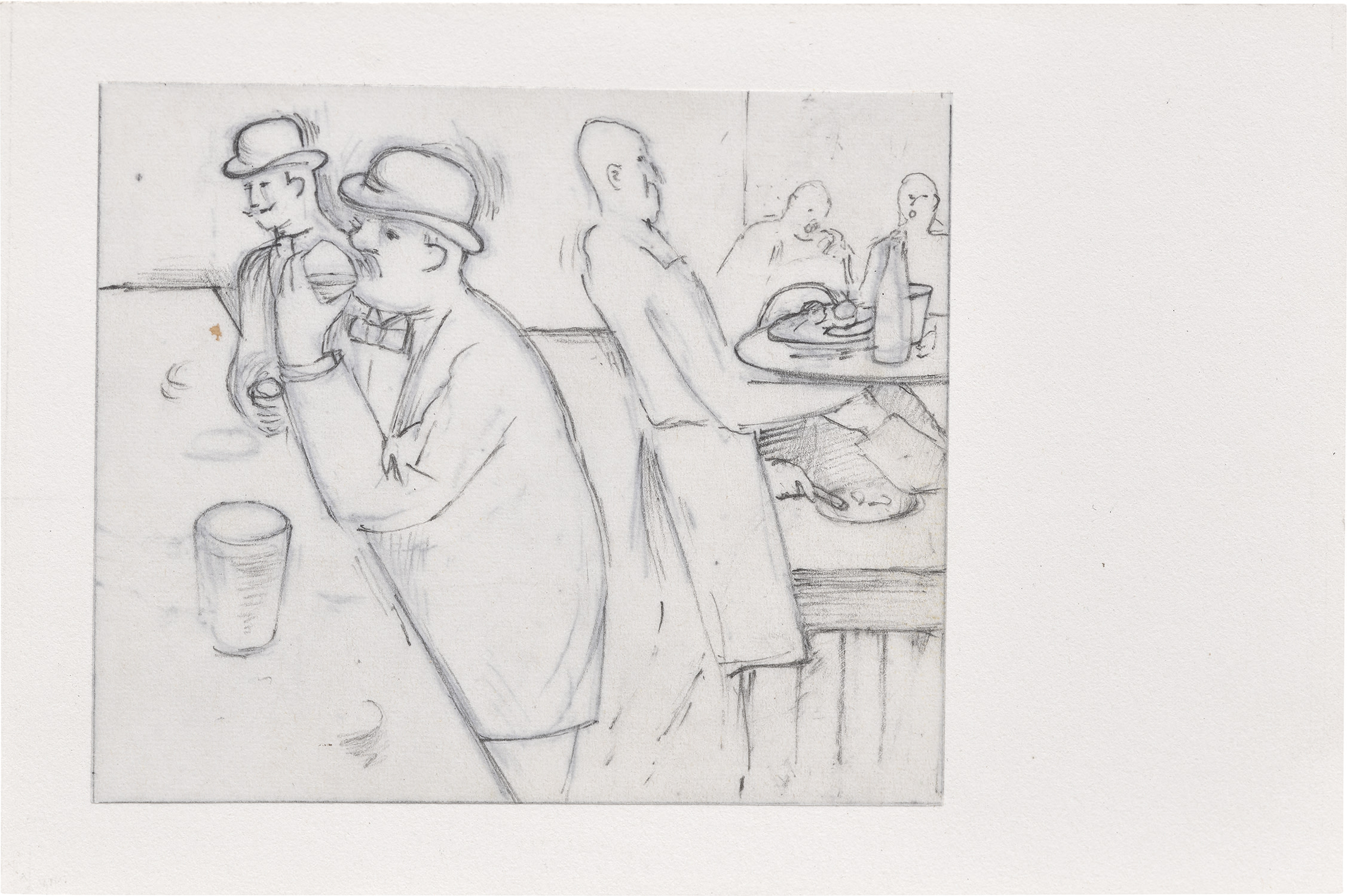
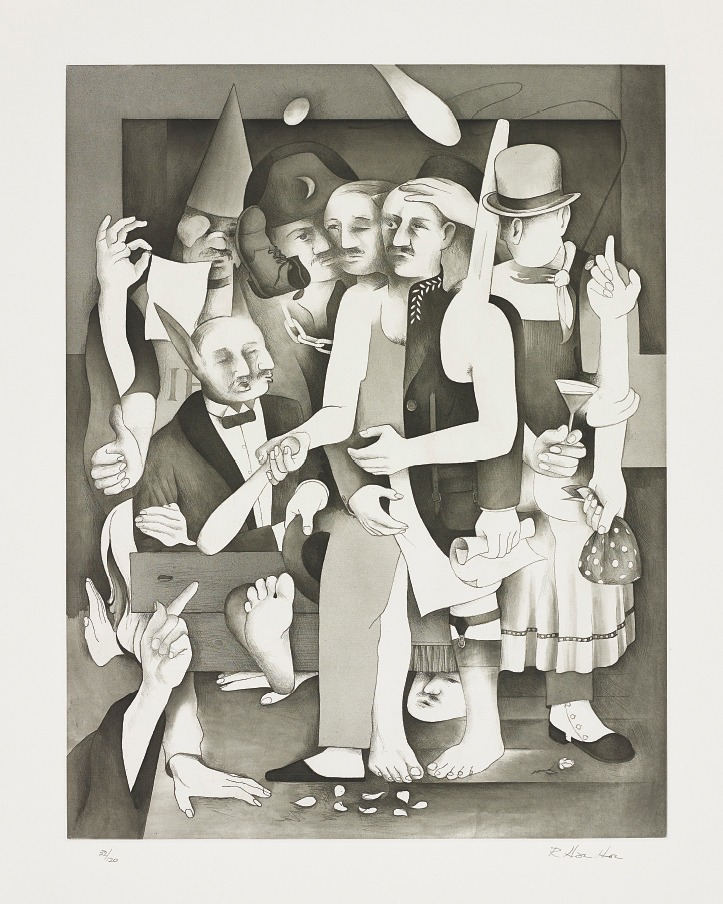
Works such as 'Patricia Knight I (Coloured)', executed in lift ground aquatint with unique hand colouring in acrylic, demonstrate his mastery of the intimate interplay between mechanical reproduction and individual mark making. 'The Critic Laughs', a laminated offset lithograph and screenprint with enamel paint and collage, carries his wry commentary on the art world itself into a dazzlingly layered physical object. 'The Transmogrifications of Bloom', drawn from his lifelong engagement with James Joyce's Ulysses, reveals another dimension of Hamilton entirely: the scholar, the literary artist, the man who corresponded with Samuel Beckett and spent years developing a visual response to one of the twentieth century's greatest novels. 'Motel I' and 'Esquisse (Sketch)' show the quieter, more introspective register that balanced his more confrontational works.
And 'The Heaventree of Stars', a late etching published in a small edition of forty, carries an almost celestial gravity, a late work by a master entirely at ease with his own vision. For collectors, Hamilton represents one of the most intellectually rewarding areas of the postwar British market. His prints and multiples, produced in close collaboration with master printers and published through institutions including the Kunstmuseum Winterthur and the Alan Cristea Gallery in London, are distinguished by their technical ambition and their conceptual rigour. Because Hamilton regarded printmaking not as a secondary activity but as a primary creative act, even the editioned works carry the full weight of his thinking.
Richard Hamilton
The Transmogrifications of Bloom
Signed proofs, particularly dedicated or annotated impressions such as the 'Portrait of Dieter Roth' noted as 'Nigel's proof', carry additional significance for collectors seeking works with personal provenance and documentary interest. His market has been consistently supported by major institutions including Tate Modern, the Museum of Modern Art in New York, and the Guggenheim Bilbao, and significant works at auction through Christie's and Sotheby's have reinforced his standing as a blue chip name within the postwar and contemporary canon. In terms of art historical context, Hamilton belongs in conversation with the American Pop artists who followed in his wake, Andy Warhol, Roy Lichtenstein, and James Rosenquist among them, though his practice was always more European in its philosophical underpinning, more connected to Duchamp, to Joyce, and to the critical traditions of the Independent Group. British contemporaries including Eduardo Paolozzi, with whom he collaborated closely, and later artists such as Peter Blake and Patrick Caulfield, share something of his terrain, though each staked out their own distinct ground.
Hamilton's political engagement, evident in works responding to the Troubles in Northern Ireland and in his searing commentary on the Iraq war, gives his body of work a moral seriousness that distinguishes him from artists content to inhabit Pop's more decorative registers. Richard Hamilton died in London in September 2011 at the age of eighty nine, having remained artistically active almost to the end of his life. A major retrospective at Tate Modern in 2014 introduced his work to a new generation of visitors and confirmed his canonical status definitively. What endures is the quality of his attention: his refusal to accept that anything in the visual world was beneath serious looking, and his insistence that the gap between fine art and everyday life was a fiction worth dismantling.
For collectors who prize work that rewards both the eye and the mind, few artists of the twentieth century offer more.
Explore books about Richard Hamilton
Richard Hamilton
Richard Hamilton, Dieter Schwarz
Richard Hamilton: Collected Words 1953-1982
Richard Hamilton
Richard Hamilton
Dieter Schwarz
Richard Hamilton: Thinking Painting
Richard Hamilton
Richard Hamilton: Documents
Richard Hamilton, Corinna Lotz