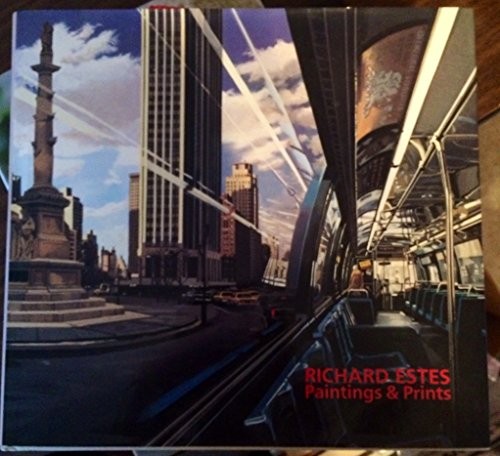
Richard Estes
Richard Estes: The City Rendered Luminous
Artist Spotlight · The Collection Editorial
“I find the city endlessly fascinating. There is always something new to see, some combination of light and reflection I have not noticed before.”
Richard Estes
Stand before a Richard Estes painting long enough and something remarkable happens. The eye begins searching for the brushstroke, the telltale smear of pigment that would betray the human hand behind the image, and finds almost nothing. What it finds instead is light: light bouncing off plate glass storefronts, light pooling in chrome fixtures, light fracturing through the windows of a New York diner into a thousand discrete, perfectly observed reflections. Estes, now in his nineties, has spent more than six decades making that light permanent, and the art world has never quite recovered from the experience.
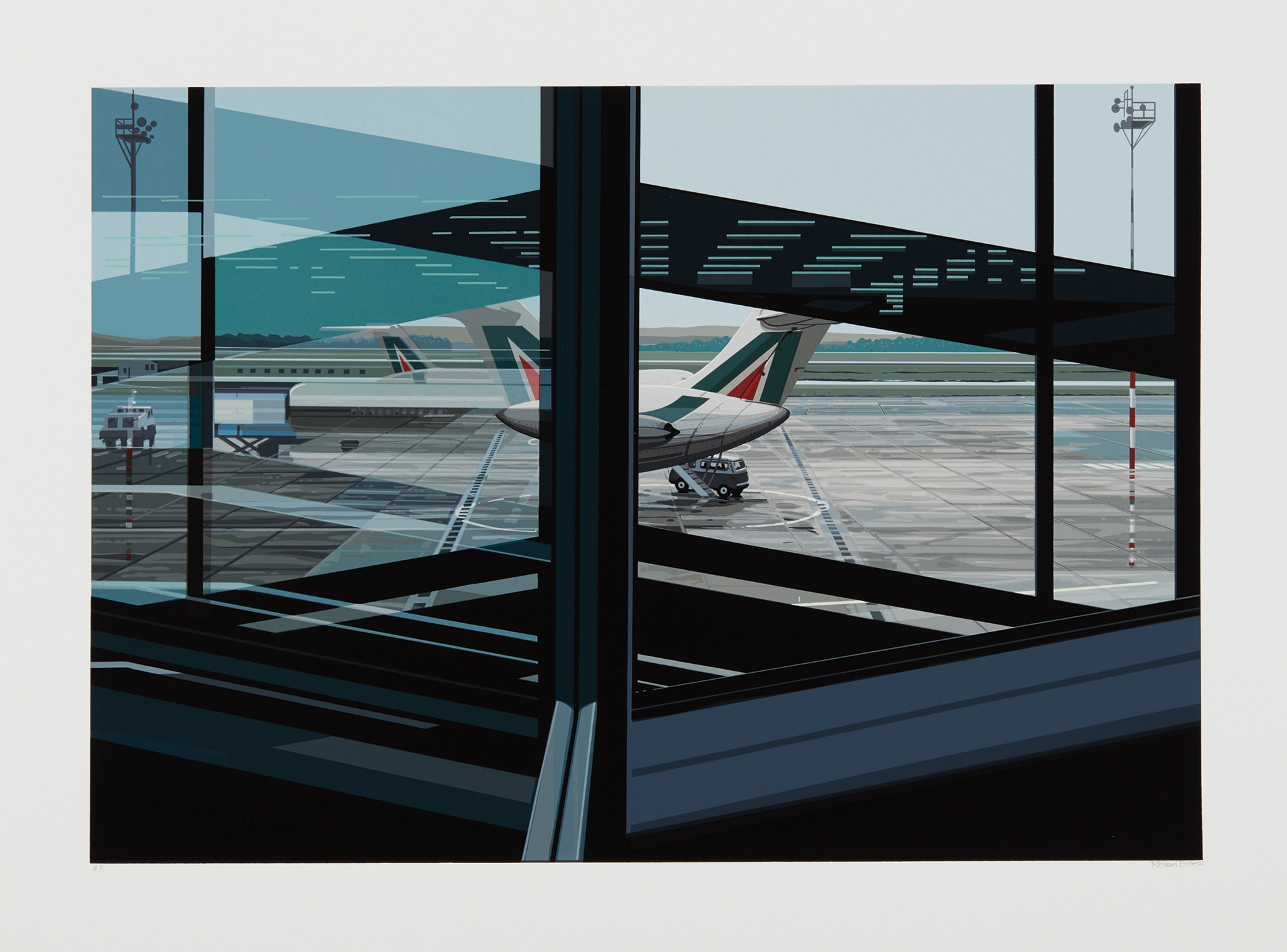
Richard Estes
Post Office, 33rd and 8th
His 2014 retrospective at the Smithsonian American Art Museum in Washington, D.C., titled Richard Estes' Realism, drew wide critical attention and reaffirmed his standing as one of the most technically singular painters the United States has ever produced. Richard Estes was born in 1932 in Kalamazoo, Michigan, a fact that carries a certain poetry when you consider that his life's work would become an extended love letter to urban density and metropolitan complexity.
He studied at the School of the Art Institute of Chicago from 1952 to 1956, absorbing the rigors of classical draftsmanship and developing an eye for composition that would later prove essential. After graduating he moved to New York City, working for several years as a commercial artist and graphic designer, a period that sharpened his instincts for clarity, precision, and the communicative power of a well resolved image. The city itself became his subject almost immediately, its streets and shopfronts offering an inexhaustible supply of visual information. The New York that Estes encountered in the late 1950s and early 1960s was a city still largely untouched by the wave of redevelopment that would transform its streetscape in subsequent decades.
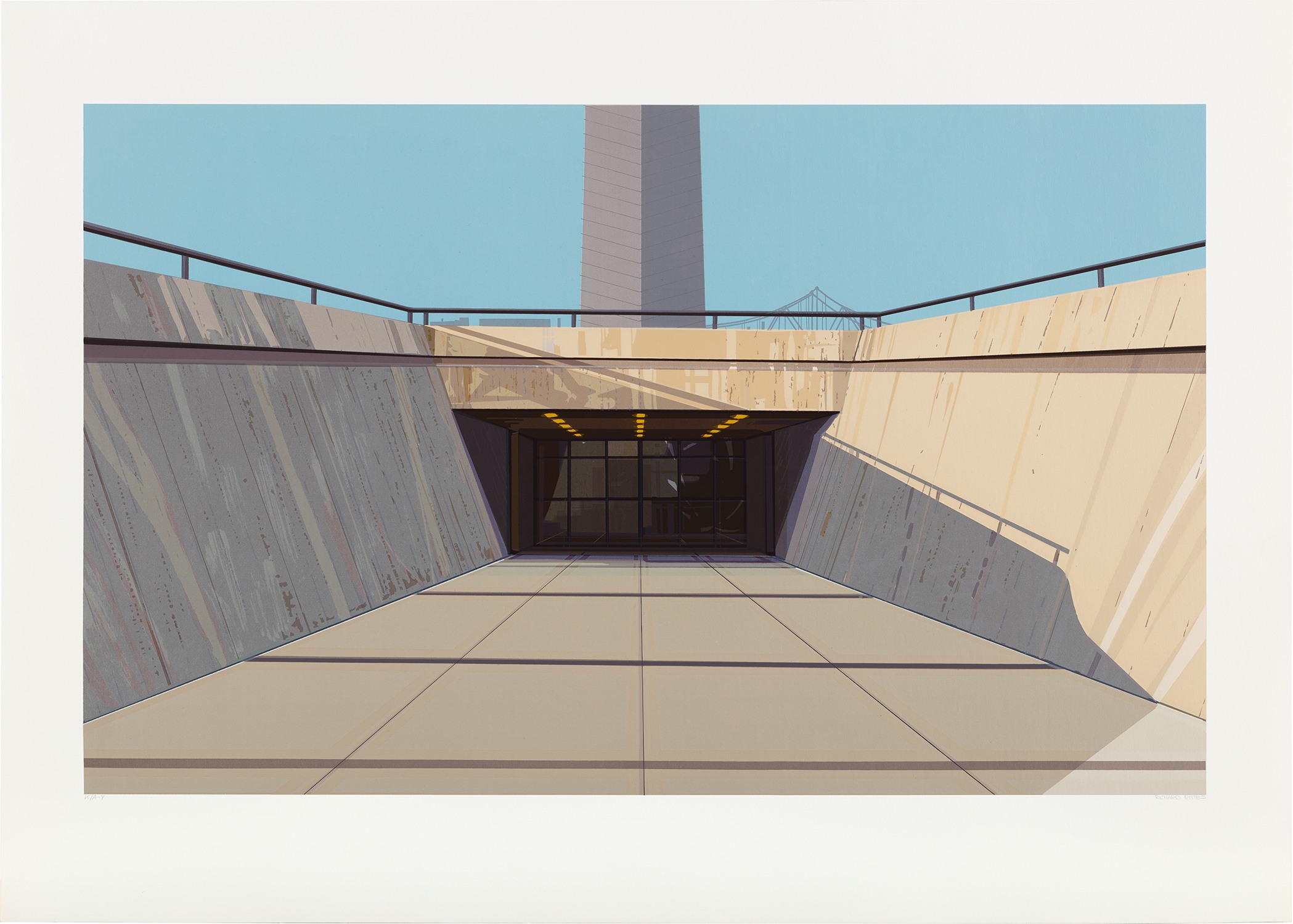
Richard Estes
Arch, St. Louis, from Urban Landscapes I (A. p. 113)
He began photographing storefronts, luncheonettes, pharmacies, and subway entrances, using these photographs not as finished documents but as raw material for paintings of extraordinary compositional sophistication. Unlike many of his peers in the photorealist movement, Estes rarely worked from a single photograph. He would combine multiple images, adjusting angles, compressing or expanding space, editing out figures and pedestrians to arrive at a scene of almost preternatural stillness. The result is a New York that feels simultaneously documentary and dreamlike, a city caught in an eternal present tense.
The late 1960s and the 1970s represent the period in which Estes fully arrived as a major force in contemporary painting. His first solo exhibition at the Allan Stone Gallery in New York in 1968 introduced his large scale urban oils to a public that was simultaneously startled and captivated. Critics who had grown accustomed to the gestural abstractions of the New York School found themselves disarmed by work that seemed to insist, without apology, on the beauty of the ordinary. Estes was a central figure in what became known as photorealism or superrealism, a movement that included Chuck Close, Ralph Goings, and Audrey Flack, each pursuing their own relationship with photographic imagery but none quite matching the architectural grandeur of Estes at his best.
Richard Estes
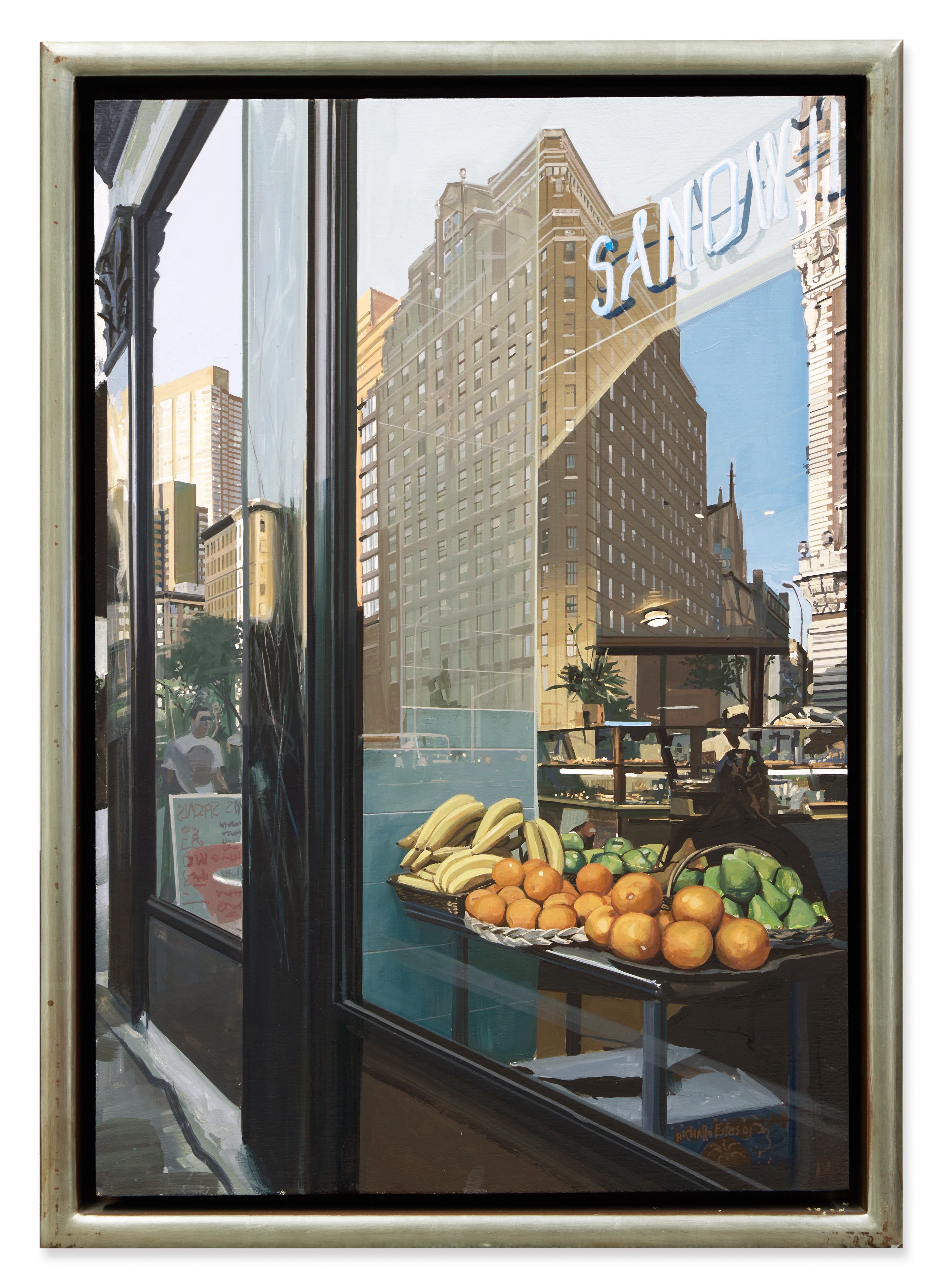
Broadway Still Life, 2003
His paintings from this period, including the celebrated "Food City" and the diner paintings that became emblematic of the movement, are now held in major institutional collections across the country. It is worth pausing on the question of what, precisely, makes an Estes painting so compelling beyond its obvious technical virtuosity. The answer lies in his treatment of reflection. Estes understood early that the glass facades of the modern city do not simply reveal what is behind them; they also mirror what is in front of them, layering the scene with competing images that the eye must actively work to disentangle.
A storefront window in an Estes painting might simultaneously show the interior of a shop, the reflection of the building across the street, and a fragment of sky, all rendered with equal clarity and equal conviction. This layering transforms what might otherwise be documentary painting into something closer to visual philosophy, an inquiry into the nature of seeing itself. His prints, particularly the celebrated Urban Landscapes series produced in collaboration with Parasol Press in New York, translated these concerns into the screenprint medium with astonishing fidelity. Works such as "Arch, St.
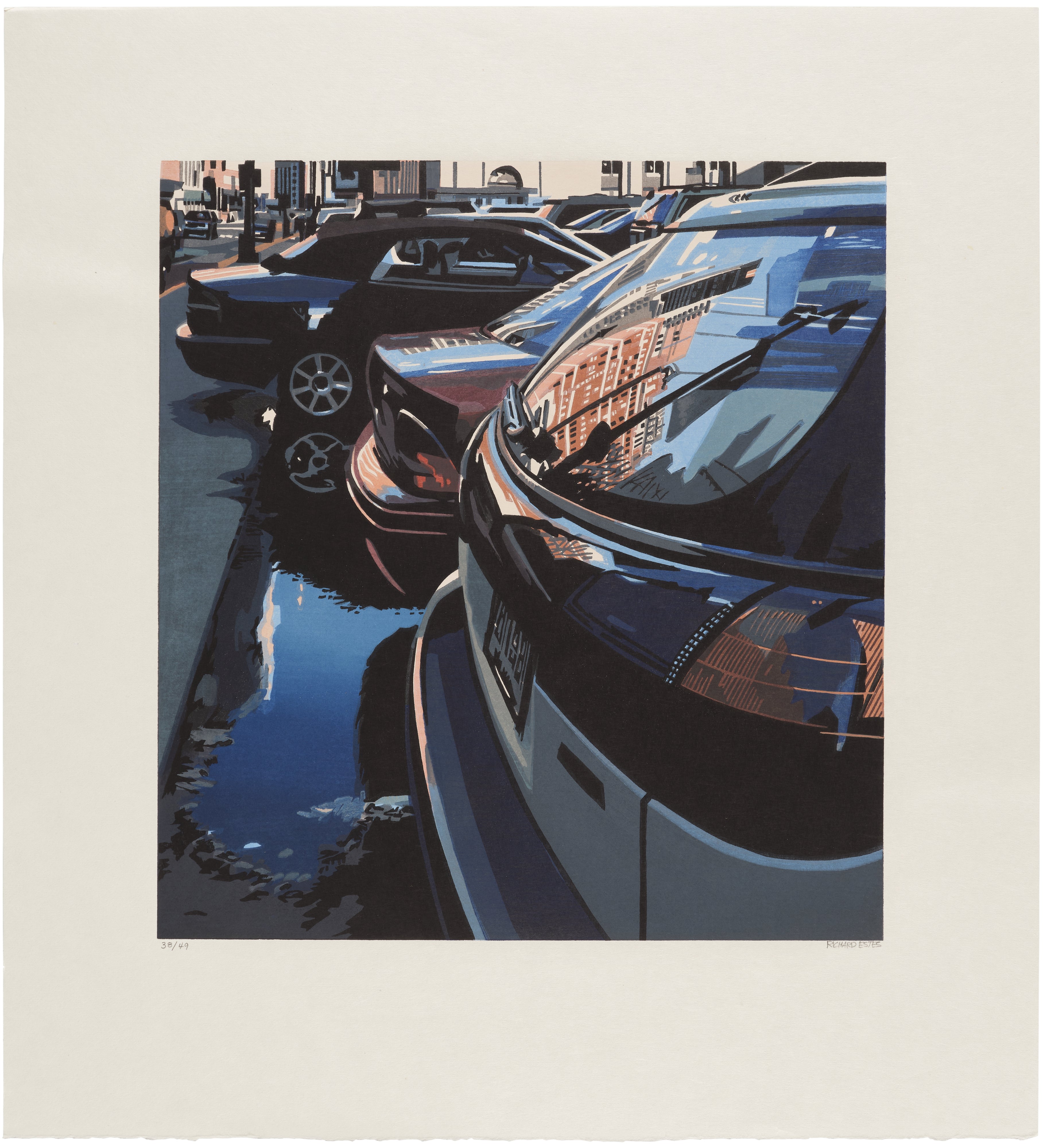
Richard Estes
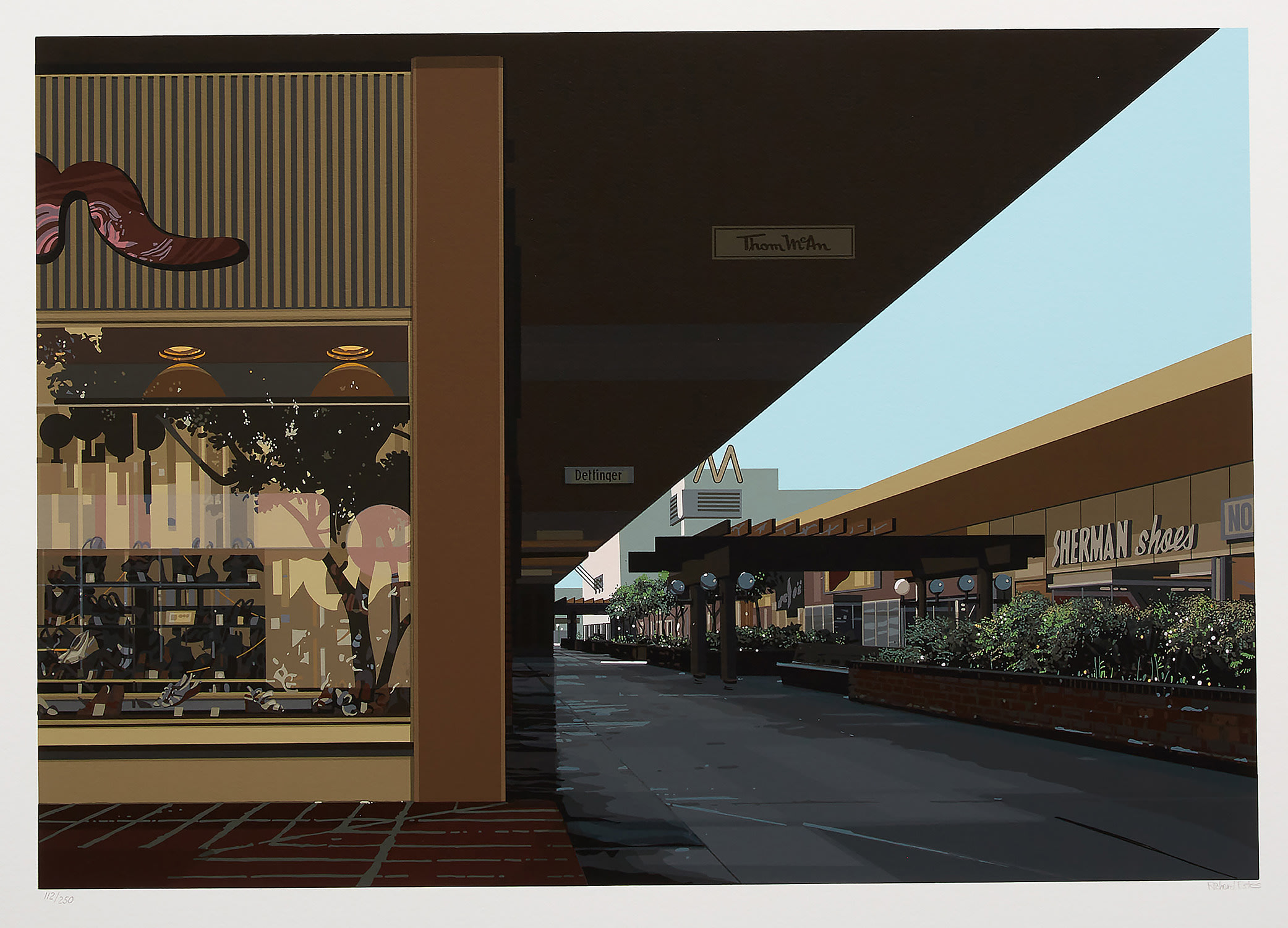
Lakewood Mall, from Urban Landscapes No. 3 (A. p. 123)
Louis," "Subway," "Ten Doors," and "Flughafen (Airport)" from the Urban Landscapes portfolios demonstrate that his compositional intelligence loses nothing in translation from oil to ink on Fabriano Cottone or Schoeller's Parole paper. For collectors, the Estes market offers a range of entry points that reward careful attention. His screenprints from the Urban Landscapes series, published by Parasol Press and carefully editioned and signed, represent some of the most sought after works on paper by any American artist of his generation. These prints appear regularly at auction at Christie's, Sotheby's, and Phillips, where they consistently perform at or above estimate, reflecting the sustained appetite for his work among serious collectors.
His oils, particularly the large format urban canvases from the 1970s and early 1980s, are rarer and command significantly higher prices when they do appear. The 2003 oil on wood panel "Broadway Still Life" exemplifies the maturity of his later practice, demonstrating that his engagement with the city continued to deepen rather than calcify. Collectors drawn to photorealism often find that Estes serves as a gateway to related figures such as Chuck Close and Ralph Goings, but his work tends to hold its own aesthetic identity firmly and rewards returning attention in ways that not all of his contemporaries can claim. Estes occupies a position in American art history that is both singular and generative.
He came of age at a moment when abstraction held nearly unchallenged authority in the critical establishment, and he chose, without polemic or confrontation, simply to paint what he saw. That quiet stubbornness turned out to be a form of radicalism. His influence can be traced through subsequent generations of painters who found in his work permission to take seriously the visual texture of contemporary life, to treat a chrome napkin dispenser or a rain slicked sidewalk as worthy of the same sustained attention once reserved for history painting and portraiture. Museums including the Metropolitan Museum of Art, the Art Institute of Chicago, and the Smithsonian American Art Museum hold his work in their permanent collections, and his reputation continues to grow as the cultural moment he documented so precisely recedes further into history and becomes, paradoxically, more vivid.
What Estes ultimately gives us is a form of seeing that feels like a gift. His paintings ask us to slow down, to look again, to notice that the world we move through every day is saturated with a beauty so specific and so fleeting that only extreme patience and extraordinary skill can hold it still long enough for us to recognize it. That is not a small achievement. That is, in fact, the whole point of art.
Explore books about Richard Estes