Richard Diebenkorn
Richard Diebenkorn: California Light, Infinite Grace
Artist Spotlight · The Collection Editorial
“I can't work from other art. I need that relationship with the real thing.”
Richard Diebenkorn
When the San Francisco Museum of Modern Art unveiled its expanded building in 2016, the works of Richard Diebenkorn held a place of honor that felt entirely earned. SFMOMA has long been among the most dedicated institutional stewards of Diebenkorn's legacy, and its galleries devoted to his paintings serve as a kind of secular pilgrimage site for anyone serious about postwar American art. That devotion is shared by the Metropolitan Museum of Art and MoMA in New York, where his canvases continue to draw sustained, reverent attention from curators and visitors alike. Few American painters of the twentieth century have achieved this kind of cross institutional consecration, and fewer still have done so with such quiet, luminous authority.
Richard Diebenkorn
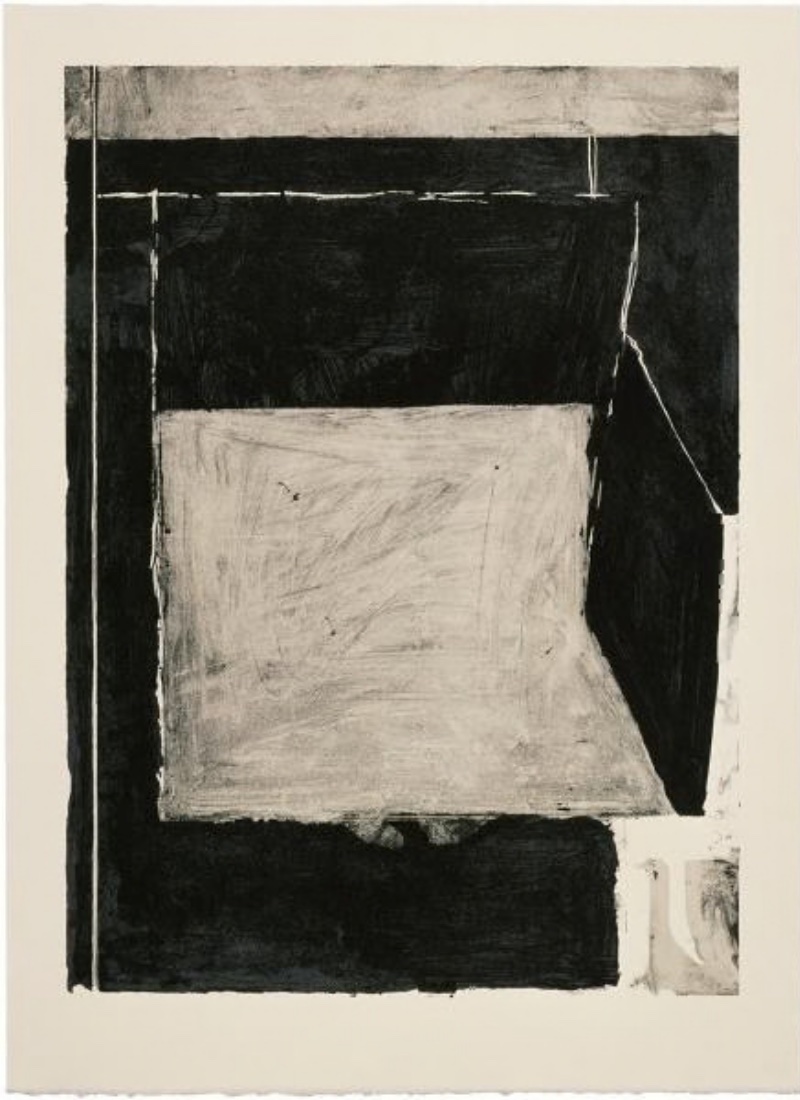
Black & Grey, 1985
Richard Diebenkorn was born in Portland, Oregon in 1922 and raised largely in San Francisco, a city whose particular quality of light would prove formative in ways he could not yet have understood. He studied at Stanford University before serving in the United States Marine Corps during World War II, a period that interrupted but did not diminish his developing artistic ambitions. After the war he studied at the California School of Arts and Crafts and later at the University of New Mexico in Albuquerque, where the vast desert landscape made a deep impression on his sense of space and color. The critic and curator Jane Livingston later wrote that Diebenkorn was one of those rare artists shaped as much by geography as by pedagogy, and the evidence bears this out across every phase of his long career.
His early work placed him firmly within the orbit of Abstract Expressionism, the dominant mode of serious American painting in the late 1940s and early 1950s. His Berkeley series, painted during the years he lived and taught in the Bay Area, shows the influence of Willem de Kooning and Franz Kline, but already something distinctly Diebenkorn is present: a certain restraint, a preference for open breathing space over gestural drama, a sensitivity to how light diffuses rather than concentrates. Works from this period, including the oil on canvas Berkeley Number 12 from 1954, reveal an artist in confident dialogue with Abstract Expressionism while already beginning to ask what might lie beyond it. The works on paper from this same period, dense with ink, gouache, charcoal, and graphite, show a restless intelligence constantly testing the boundaries of what abstraction could hold.
Richard Diebenkorn
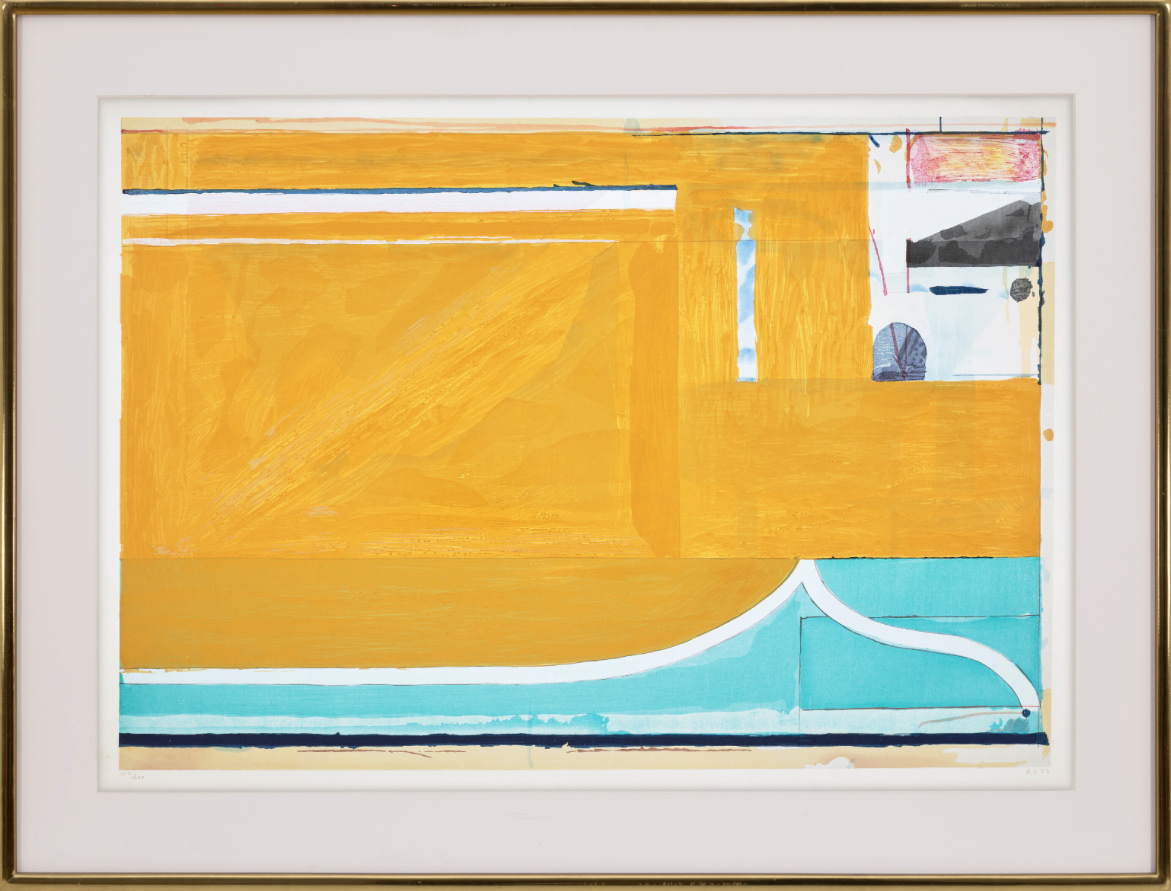
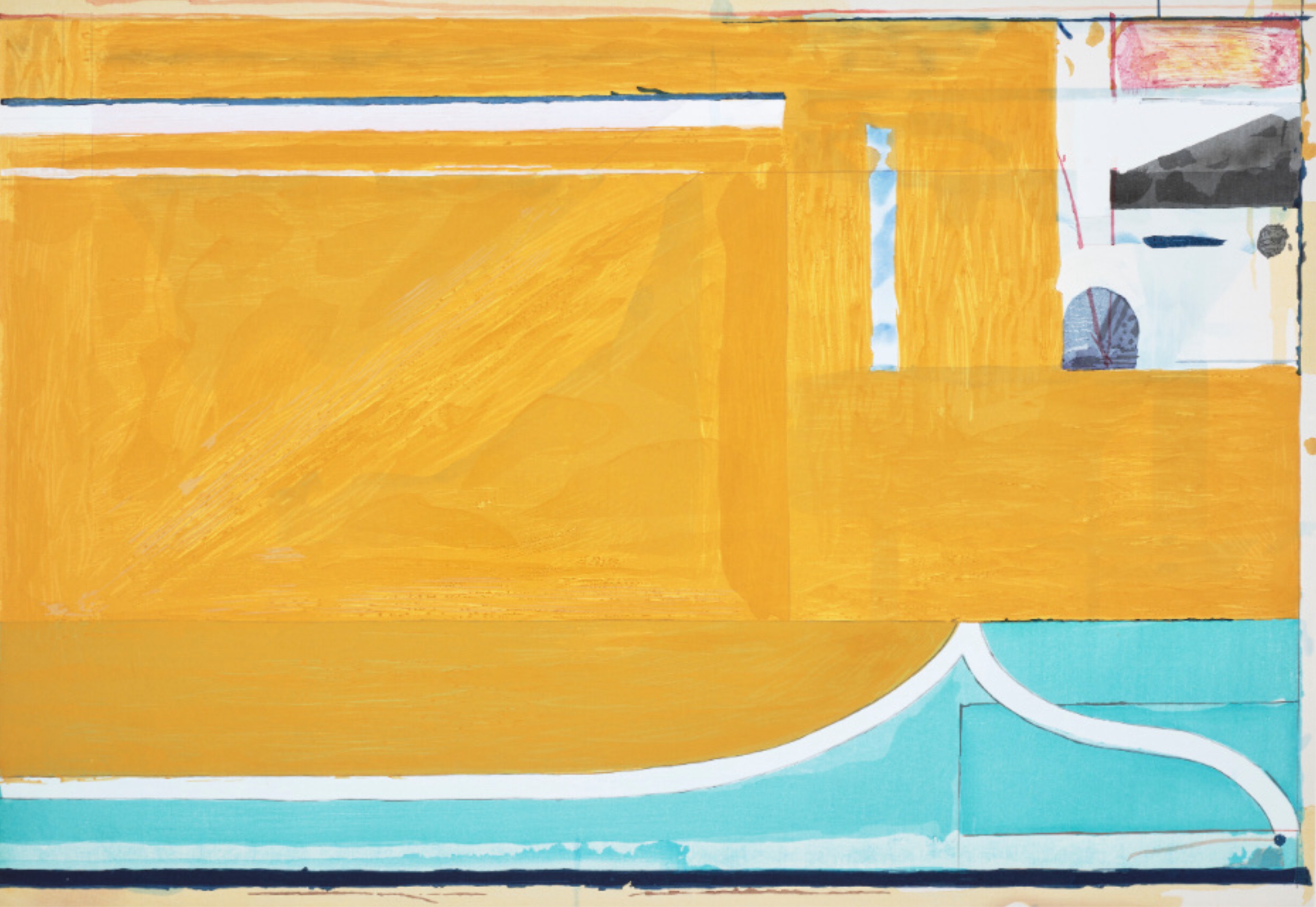
Ochre, 1983
In a move that surprised the New York art world and puzzled some critics, Diebenkorn turned toward figuration in the mid 1950s, joining David Park and Elmer Bischoff in what became known as the Bay Area Figurative Movement. This was not a retreat but a deepening. His paintings of seated figures, landscapes, and interiors from this period carry the structural rigor of his abstract work while grounding it in observed reality, creating a dialogue between the seen and the felt that feels entirely his own. Then, in 1967, after relocating to Santa Monica to teach at UCLA, he began the body of work that would define his reputation for all time: the Ocean Park series.
“My idea was simply to get all the elements right.”
Richard Diebenkorn, 1982
Named for the neighborhood in Santa Monica where his studio was located, the series ultimately comprised more than 140 large scale paintings made over two decades, and it stands as one of the most sustained and coherent artistic achievements in American modernism. The Ocean Park paintings are immediately recognizable and perpetually surprising. They are architectural in their underlying geometry, with ruled lines and carefully considered planes of color organizing the canvas into zones that suggest walls, windows, horizons, and light sources without ever depicting any of these things literally. The colors are Californian in the truest sense: the blue of the Pacific at midday, the pale gold of afternoon inland air, the grey green of coastal sage.
Richard Diebenkorn
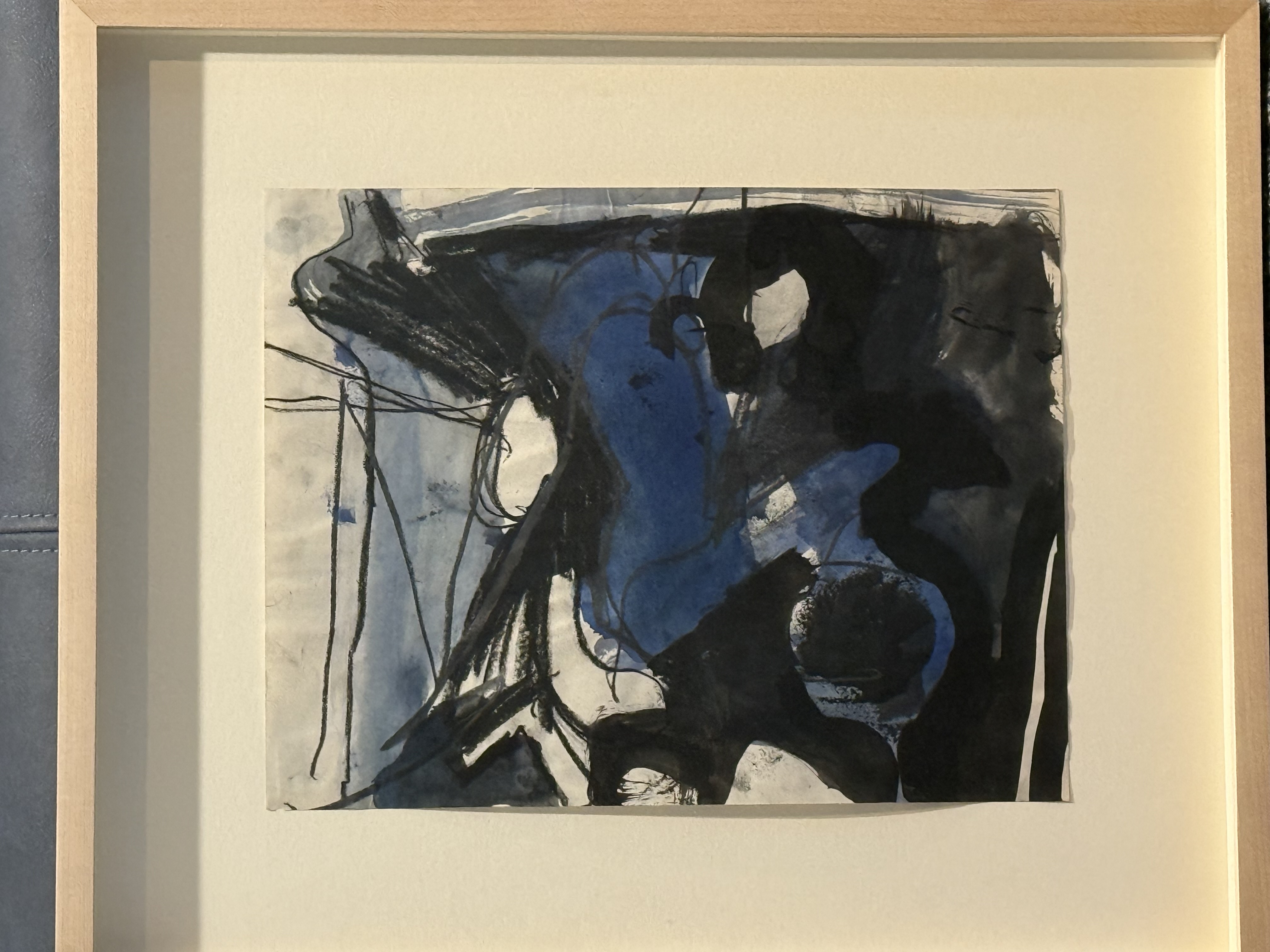
Untitled (CR 1306), 1954
What distinguishes them from other geometric abstraction is their luminosity, the sense that light is not represented but actually present within the surface of the paint. Diebenkorn worked and reworked these canvases obsessively, scraping back layers to reveal underlayers, allowing revisions to remain visible as pentimento, treating the finished painting as a record of a process rather than the erasure of one. The result is painting that rewards prolonged looking in a way that very little art of any era manages. For collectors, Diebenkorn represents one of the most compelling opportunities in the blue chip postwar American market.
His works appear across a range of media, which matters significantly for those building collections at different price points. His prints, including the woodcuts produced in the early 1980s such as Ochre from 1983 and Blue from 1984, are technically extraordinary and represent some of the finest American printmaking of the twentieth century. The Ochre woodcut, printed in colors on Mitsumata paper, demonstrates how completely Diebenkorn translated the sensibility of his paintings into a completely different medium. His lithographs, including the luminous Colored Landscape and the sensitive Seated Woman, are similarly prized.
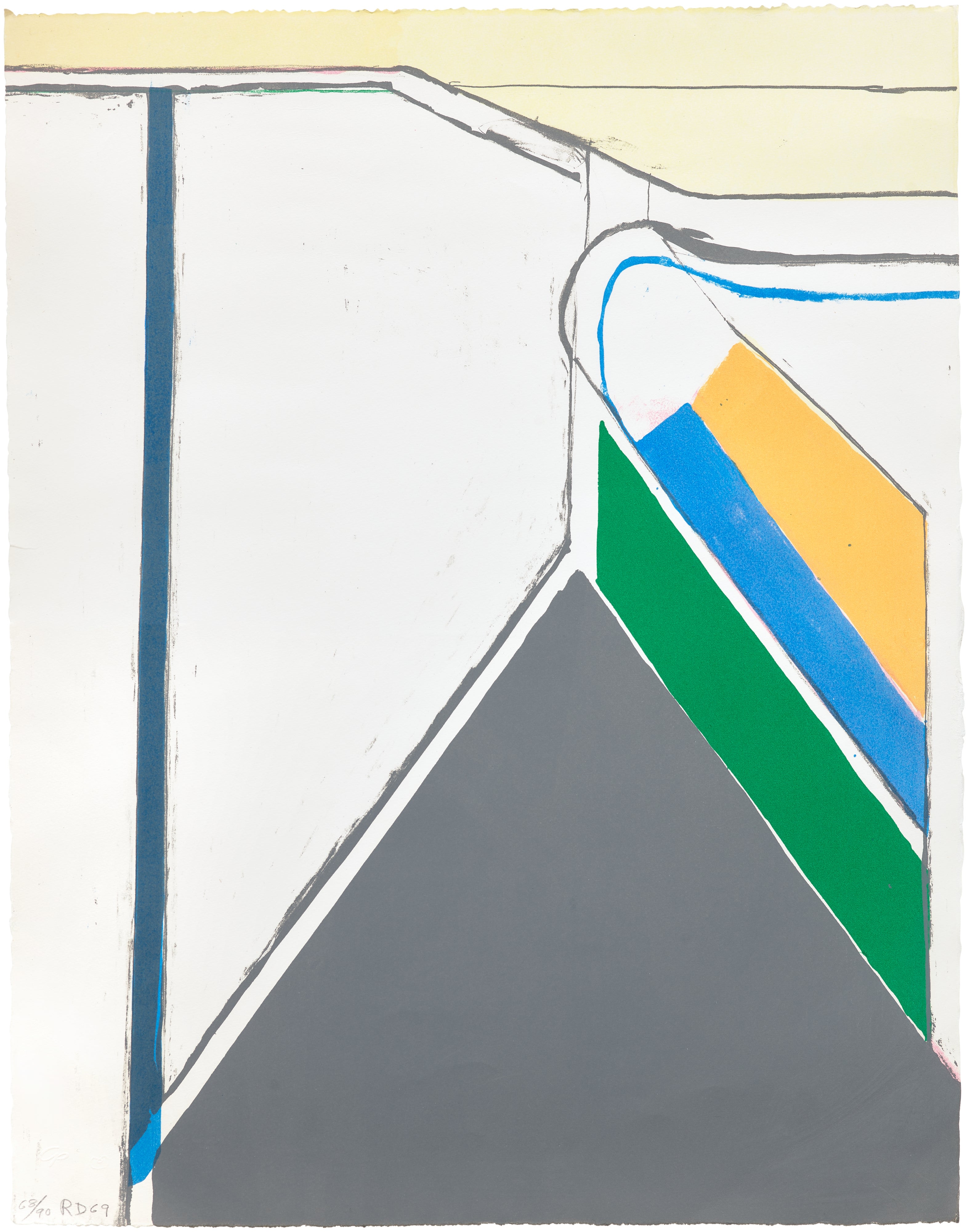
Richard Diebenkorn
Colored Landscape
Works on paper, such as the ink drawings from the early to mid 1950s, offer access to the artist's thinking at its most direct and unmediated. At auction, major Ocean Park oils have achieved prices well into the tens of millions of dollars, with demand consistently outpacing supply. His prints and works on paper are actively sought by serious collectors who understand that they represent not a lesser version of his vision but a complete and rigorous expression of it. Within the broader narrative of American art history, Diebenkorn occupies a position that resists easy categorization, which is precisely what makes him so enduringly interesting.
He is often discussed alongside Mark Rothko for his sensitivity to color as emotional field, and alongside Wayne Thiebaud and David Hockney for his rootedness in California as a subject and a sensibility. His dialogue with Henri Matisse was acknowledged and deliberate: Diebenkorn visited the Barnes Foundation in 1964 specifically to study Matisse's large compositions, and the influence is visible in the flattened planes and joyful color relationships of the Ocean Park works. Yet he remains wholly himself, an artist whose work could only have come from a particular intersection of East Coast training, West Coast light, and a temperament that preferred contemplation to confrontation. The legacy of Richard Diebenkorn grows more significant with each passing decade.
As the art world continues to grapple with questions of place, landscape, and the relationship between abstraction and the observed world, his work feels not historical but urgently alive. The Ocean Park paintings hang in major museums across the country and in collections around the world, and they continue to generate the same response they generated when they were first exhibited: a feeling of having been given more light than you expected, and of being reluctant to leave it.
Explore books about Richard Diebenkorn
Richard Diebenkorn: Paintings and Drawings
Gerald Nordland
Richard Diebenkorn
John Elderfield
The Ocean Park Series: Richard Diebenkorn's Late Work
Jane Livingston
Richard Diebenkorn: Catalogue Raisonné of Prints
William E. Itter and Katsutoshi Takahashi
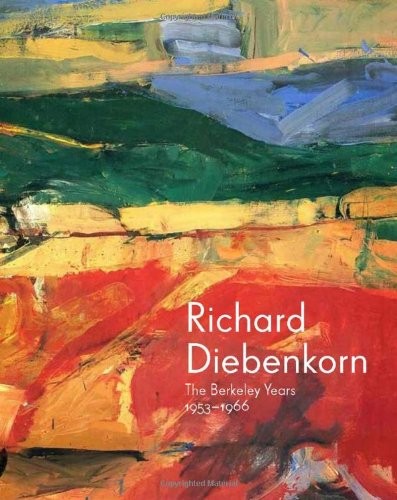
Richard Diebenkorn: The Berkeley Years, 1953-1966
Paul Karlstrom
Richard Diebenkorn: Works on Paper
Richard Kendall

Richard Diebenkorn
Craig Hodgson
Ocean Park Paintings 1967-1988
Michael Auping