Rembrandt Harmensz. van Rijn
Rembrandt: The Eternal Master of Light
Artist Spotlight · The Collection Editorial
“Choose only one master: Nature.”
Rembrandt van Rijn
In the great rooms of the Rijksmuseum in Amsterdam, visitors still press close to the canvas of The Night Watch as though hoping to hear something. The painting, completed in 1642, continues to stop people in their tracks more than three and a half centuries after Rembrandt Harmensz. van Rijn set down his brushes. This is the peculiar power of the Dutch master: he painted with such psychological ferocity, such tenderness toward the human face, that the distance between his century and ours seems to collapse entirely.
Rembrandt Harmensz. van Rijn
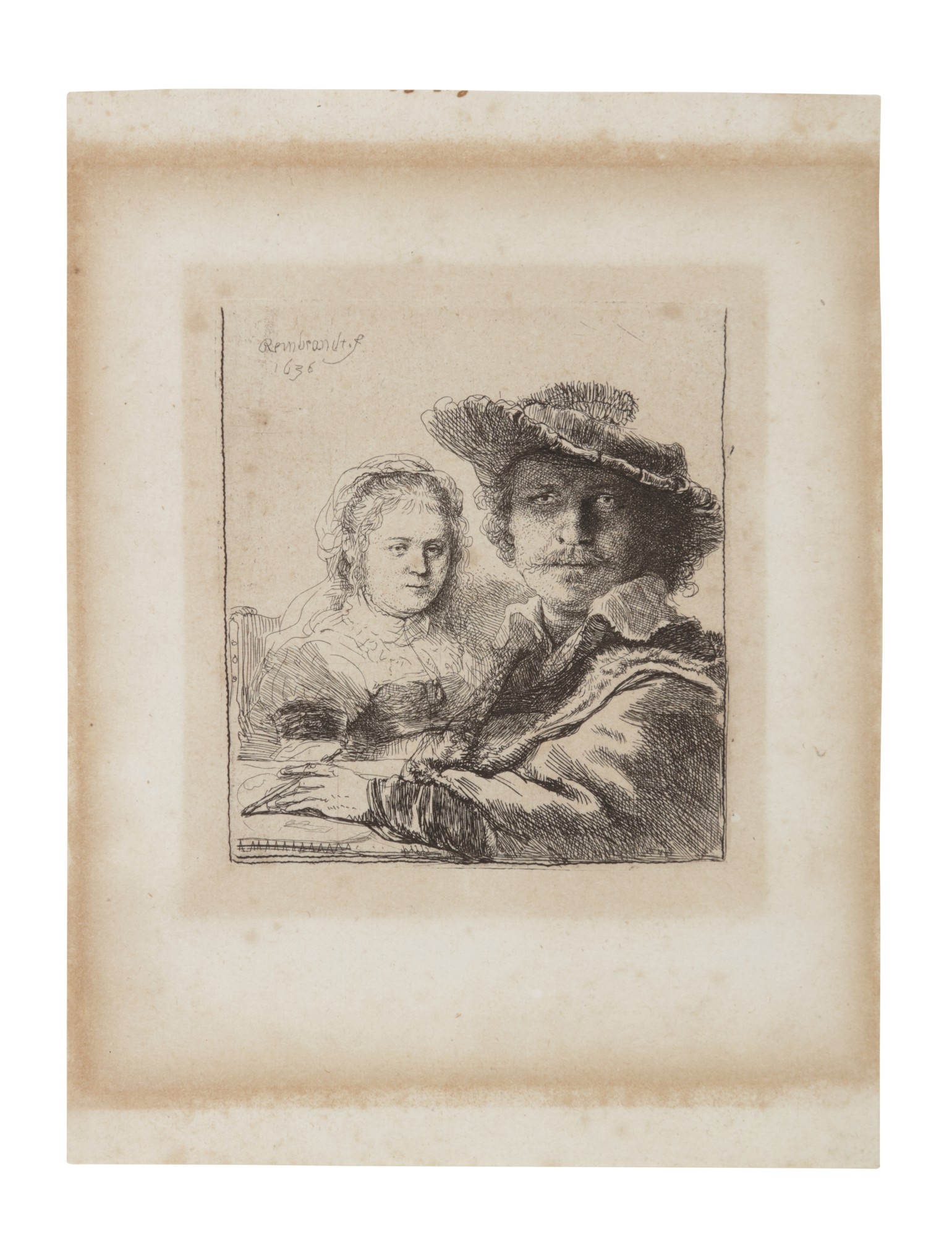
Self Portrait with Saskia (B., Holl. 19, New Holl. 158, H. 144)
Rembrandt is not simply a historical figure to be studied. He is a presence, vivid and immediate, whose work speaks to collectors, curators, and casual admirers with equal and undiminished force. Rembrandt was born in Leiden in 1606, the eighth of nine children in the family of a miller named Harmen Gerritsz. van Rijn.
Leiden was a prosperous, intellectually active city, home to one of the great universities of northern Europe, and young Rembrandt enrolled there briefly before it became clear that his gifts lay elsewhere entirely. He apprenticed first with the Leiden painter Jacob van Swanenburgh and then, crucially, with Pieter Lastman in Amsterdam, who introduced him to the dramatic narrative tradition of Italian history painting. The influence of Lastman, and through him the Caravaggist movement sweeping across Europe, gave Rembrandt early permission to pursue the theatrical deployment of light that would become his defining obsession. By his early twenties he had returned to Leiden and was already attracting serious notice, including the admiration of the diplomat and art connoisseur Constantijn Huygens.
Rembrandt Harmensz. van Rijn
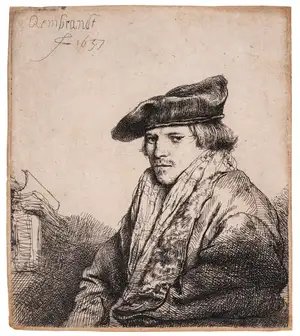
Young man in a velvet cap (Petrus Sylvius?)
The move to Amsterdam in the early 1630s proved transformative. Rembrandt arrived in a city of enormous commercial energy and cultural ambition, and he quickly established himself as the most sought after portrait painter of the Dutch merchant class. The anatomy lesson of Dr. Nicolaes Tulp, painted in 1632, announced his arrival with unforgettable authority, bringing the conventions of the group portrait into startling new life.
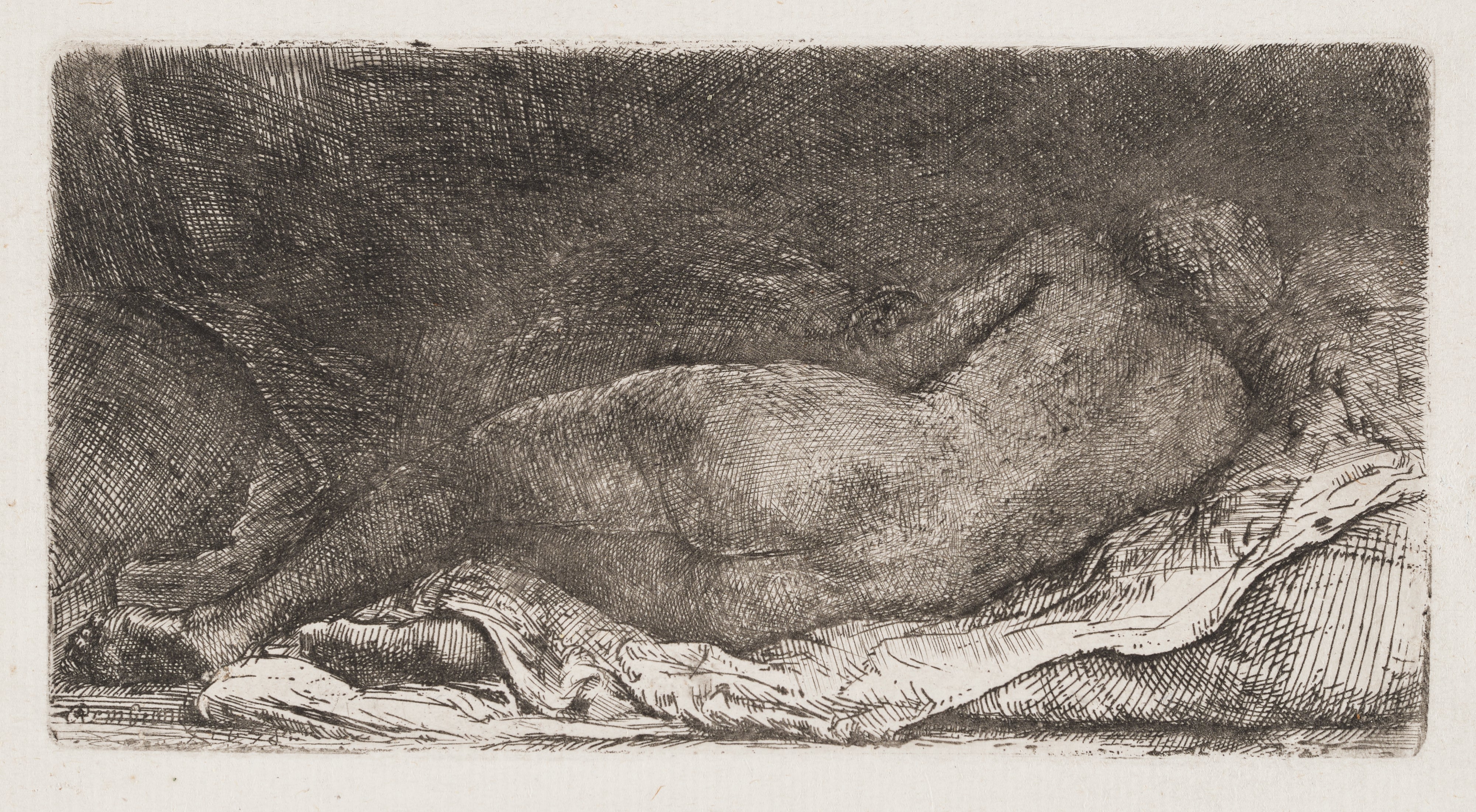
He set up a studio, took on pupils, and in 1634 married Saskia van Uylenburgh, whose presence would illuminate some of his most joyful early works. His output across the 1630s was prodigious and exhilarating, spanning grand commissions, intimate portraits, and a growing body of prints that would prove as important to his legacy as his paintings. It is perhaps in printmaking that Rembrandt's genius reveals itself most directly to the modern collector. His etchings are among the most technically astonishing works in the entire history of the medium, and those that survive in fine early impressions are objects of extraordinary beauty and rarity.
Rembrandt Harmensz. van Rijn
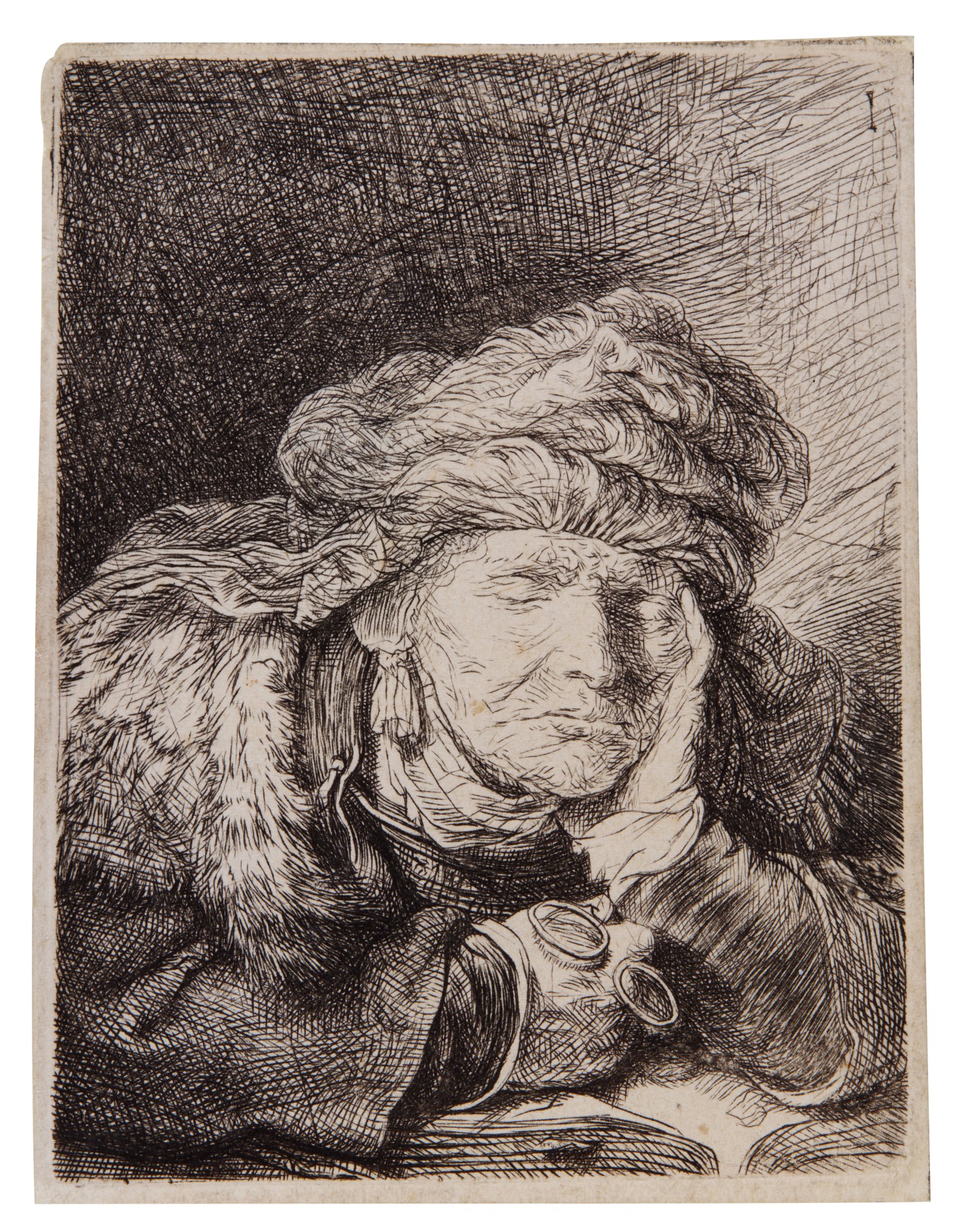
Old Woman Sleeping (B., Holl. 350; New Holl. 160; H. 129)
Works such as The Omval from 1645 demonstrate his ability to render landscape with a lyrical specificity, the etching and drypoint lines conjuring rich burr that gives an almost velvety depth to shadow and foliage. His portrait etchings, including the celebrated Clement de Jonghe, Printseller from 1651, show a psychological penetration equal to anything achieved on canvas. The subject's gaze carries an entire inner life. His self portrait etchings, running across decades, form one of the most extraordinary acts of sustained self examination in Western art, from the raw, experimental plates of the late 1620s where he tested expressions with almost scientific curiosity, to the more composed and searching likenesses of his later years.
The 1636 Self Portrait with Saskia, tender and playful in its intimacy, offers a glimpse of private happiness rare in the formal conventions of the period. The 1640s and 1650s brought personal loss alongside artistic deepening. Saskia died in 1642, the same year The Night Watch was completed. Financial difficulties accumulated through the decade, and by 1656 Rembrandt was forced to declare insolvency, his extraordinary collection of art, curiosities, and prints sold at auction.
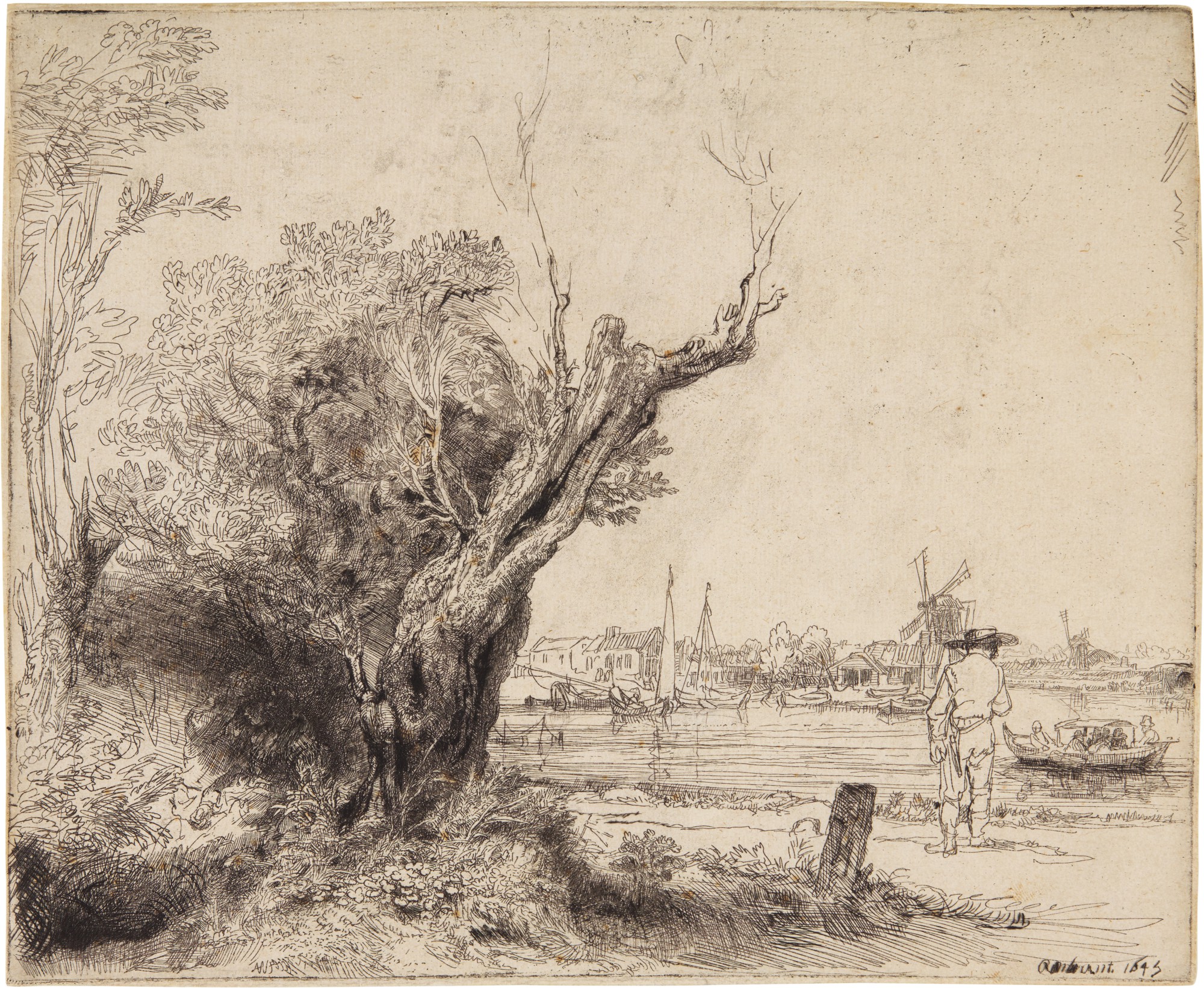
Rembrandt Harmensz. van Rijn
The Omval (B., Holl. 209; New Holl. 221; H. 210)
Yet the paintings and etchings of these years are among the most searching he ever produced. Works like A Scholar in his Study, known as Faust and dated to around 1652, radiate a contemplative mystery, the light arriving through a glowing circular device as though from another dimension entirely. These are works about knowledge, doubt, and the limits of human understanding, rendered with a technical mastery that seems entirely effortless. For collectors, Rembrandt's prints represent one of the great opportunities in the Western canon.
Because he worked his plates across multiple states, returning to them sometimes years after the first printing to refine or dramatically alter the composition, connoisseurship of his etchings is a genuinely rich discipline. Early impressions with visible burr, on period laid paper with identifiable watermarks, command significant premiums and are rightly prized. The scholarship of Erik Hinterding has brought new precision to the identification of papers and states, and collectors today are better equipped than any previous generation to assess what they are looking at. Works catalogued in the New Hollstein and traceable through Bartsch carry well documented provenance and a depth of scholarly support that makes them among the most securely understood works on the market.
Rembrandt etchings appear regularly at the major auction houses in London and New York, and even later impressions of celebrated subjects retain significant value and offer genuine connection to the artist's vision. To place Rembrandt within art history is to understand the full flowering of the Dutch Golden Age, that astonishing concentration of artistic talent in the seventeenth century Netherlands. His contemporaries included Johannes Vermeer, Frans Hals, and Jan Steen, each of them brilliant in their own particular register. But Rembrandt worked on a scale of ambition and emotional range that set him apart even within that exceptional company.
His influence on subsequent generations was vast: from Goya to Delacroix, from the Impressionists who admired his freedom of handling to the twentieth century painters who returned again and again to his self portraits as a model for unflinching self examination. Vincent van Gogh wrote of him with something approaching reverence, and that reverence has only deepened as the centuries have passed. What endures in Rembrandt is not simply technical mastery, though the mastery is genuine and astonishing. It is the quality of attention he brings to every face, every gesture, every fall of light on a sleeve or the corner of an eye.
He looked at people, including himself, with a generosity and seriousness that feels almost radical in its completeness. Collectors who live with his prints describe a quality of companionship, the sense that the work is always offering something new regardless of how long it has been on the wall. That is perhaps the deepest measure of his greatness: not that he belongs to history, but that he keeps arriving in the present, urgent and alive.
Explore books about Rembrandt Harmensz. van Rijn

Rembrandt: His Life, His Paintings
Michael Levey
Rembrandt's Enterprise: The Studio and the Market
Christopher White and Quentin Buvelot
A Corpus of Rembrandt Paintings
J. Bruyn, B. Haak, S.H. Levie, P.J.J. van Thiel, E. van de Wetering
Rembrandt and the Venetian Tradition
David Bomford
The Rembrandt Research Project Essays
Ernst van de Wetering (editor)
Rembrandt: The Master and His Workshop
Christopher White
Rembrandt Prints
David Landau and Peter Parshall
Rembrandt's Bankruptcy: An Examination of his Financial Problems
Florike Egmond