Miquel Barceló
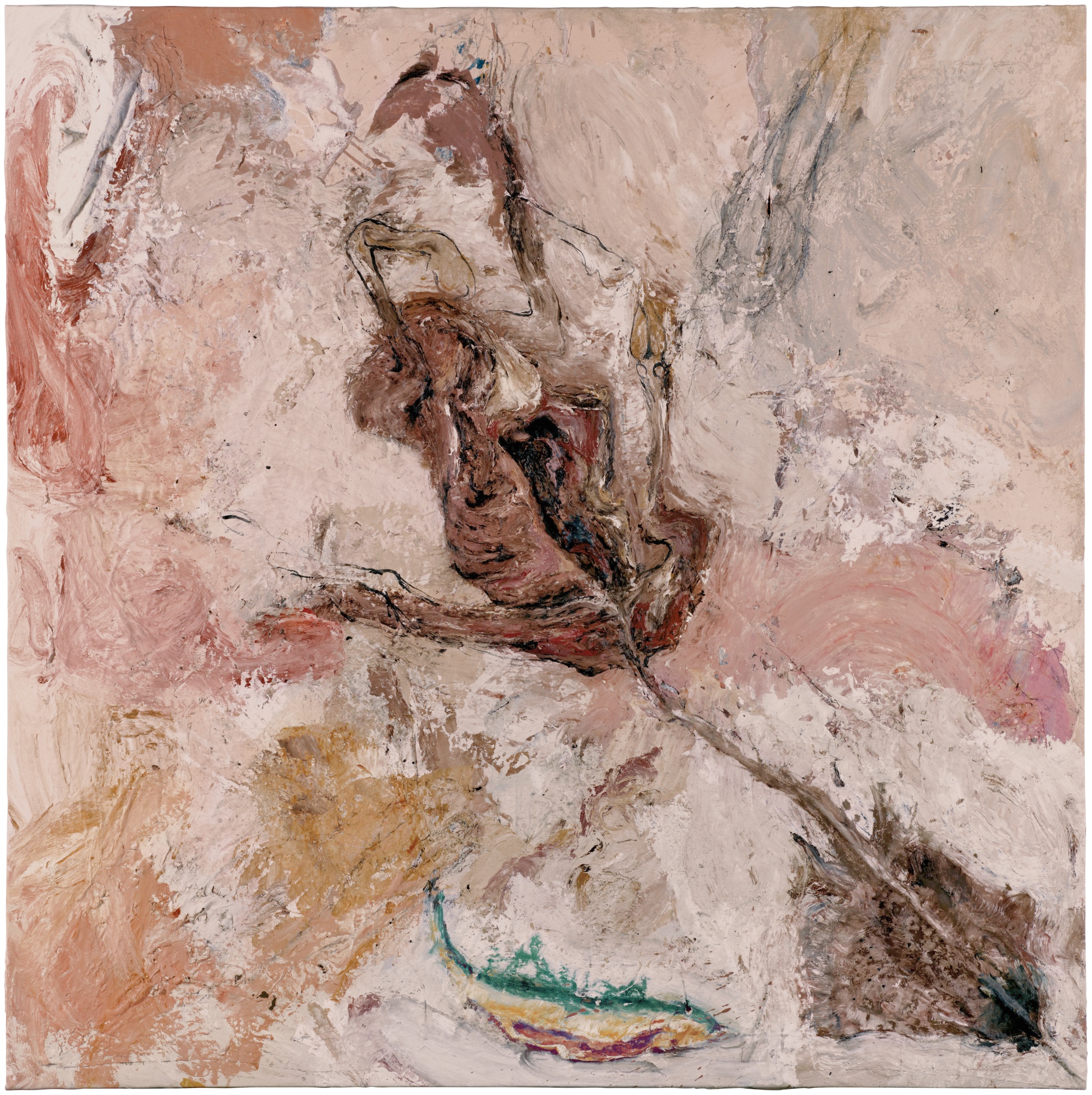
Miquel Barceló: The World as Painted Feast
Artist Spotlight · The Collection Editorial
“I paint to see what things look like when they are painted.”
Miquel Barceló
In the spring of 2023, the Musée d'Orsay in Paris presented a sweeping survey of works that reminded European audiences why Miquel Barceló remains one of the most viscerally alive painters working today. His canvases arrived bearing the smell of the earth, the weight of accumulated material, and the unmistakable sense that someone had wrestled deeply with the physical world before committing it to surface. For collectors and institutions alike, encounters with Barceló's work tend to feel less like viewing and more like being brought into close contact with something ancient and urgent at the same time. Barceló was born in 1957 in Felanitx, a small town in the interior of Mallorca, and the island's light, its chalky earth, its proximity to the sea and to the African continent across the water shaped his sensibility in ways that never left him.
Miquel Barceló
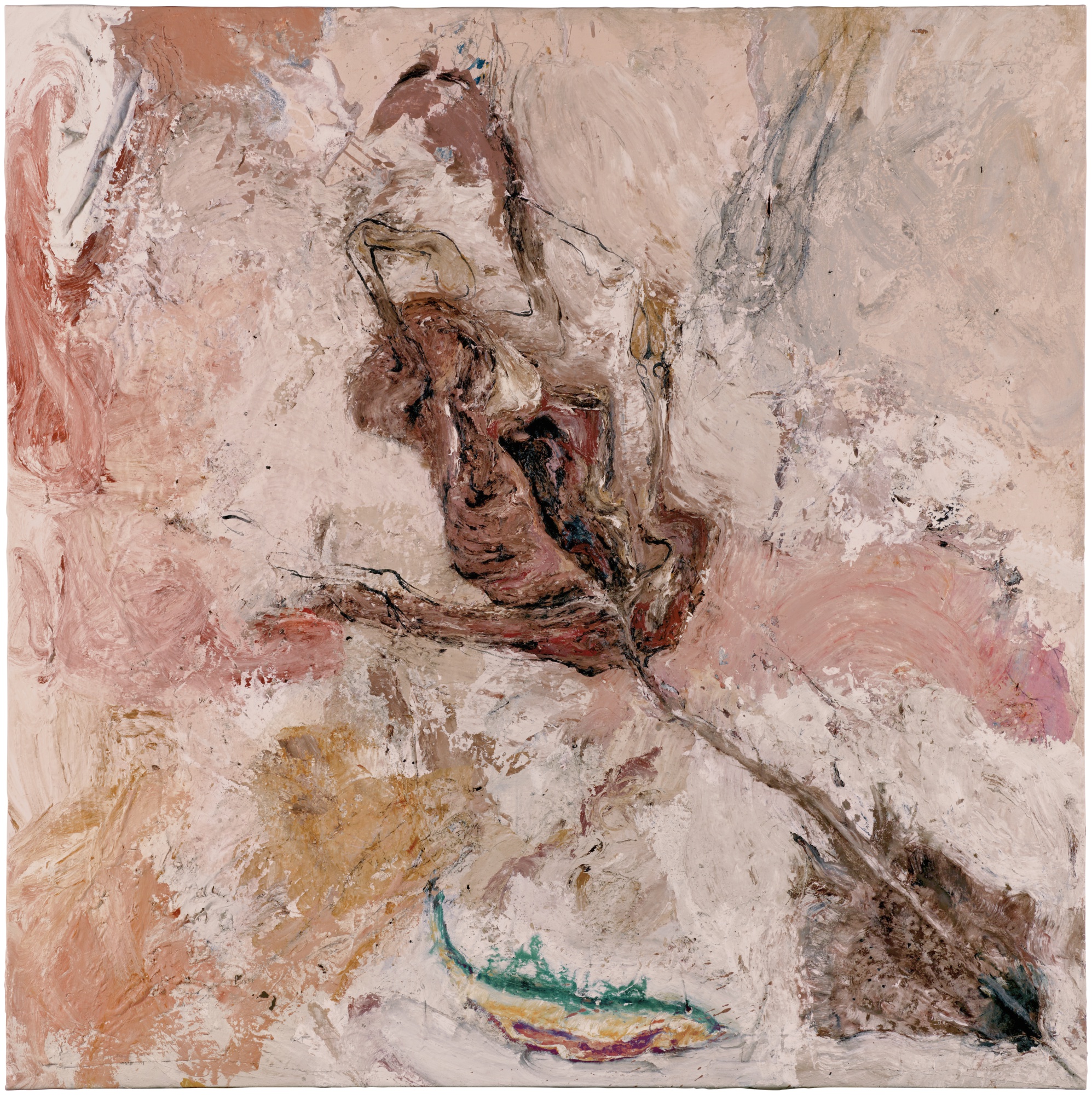
Cabrit i Ratjada
He came of age during the final years of Francoism and the extraordinary cultural ferment of the Spanish Transition, a period when Spanish artists were devouring international movements with enormous appetite while simultaneously reasserting the deep roots of their own visual culture. Barceló studied at the Escola de Belles Arts de Palma and later in Barcelona, where he absorbed the lessons of Arte Povera, German Neo Expressionism, and the raw gestural painting then surging through New York and Berlin. By the early 1980s, Barceló had already attracted serious international attention. His inclusion in the landmark Documenta 7 in Kassel in 1982, at just twenty four years old, announced him as a figure of real consequence within the global conversation around painting's reinvigoration.
This was the moment when the art world was rediscovering the expressive possibilities of the painted surface, and Barceló was in the thick of it alongside contemporaries such as Georg Baselitz, Anselm Kiefer, Jean Michel Basquiat, and Francesco Clemente. What set him apart, even then, was the almost geological quality of his surfaces, canvases that seemed to have been made over long durations, layers accreting like sediment, pigment and organic matter pressed together until they achieved their own internal logic. In 1988, Barceló made a decision that proved transformative: he began spending extended periods in Mali, in the village of Ségou on the Niger River and later in the Dogon country. The African sojourns were not exercises in exoticism but genuine immersions that fundamentally altered his palette, his materials, and his understanding of what painting could do.
Miquel Barceló
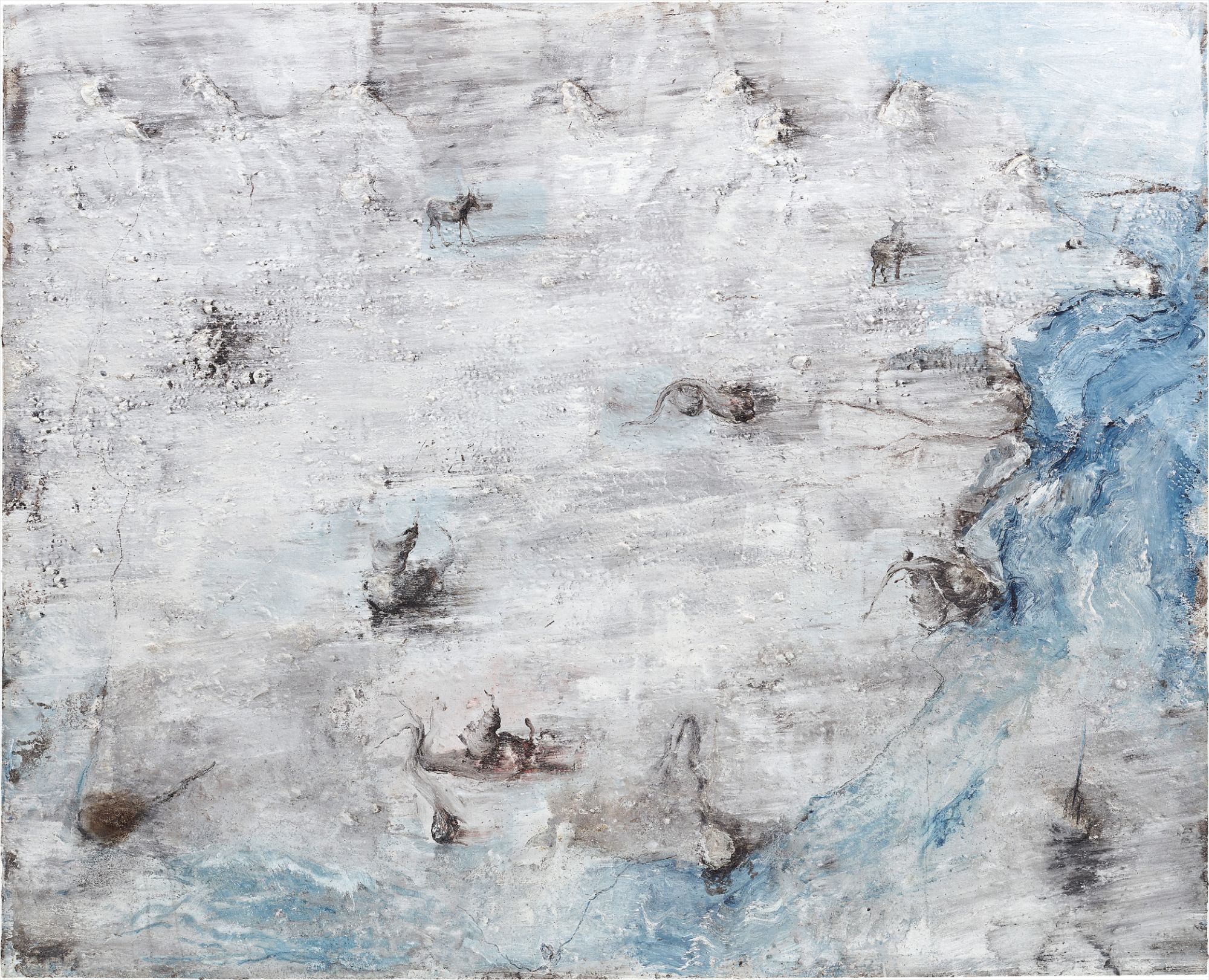
España Económica, 1990
He worked with local pigments, with mud and animal glue, with the light of a continent that had nothing to do with the grey northern studios where so many of his peers made their work. The paintings that emerged from these years carry an intensity of sensation that is almost impossible to achieve by other means: heat, decay, abundance, and transformation compressed into single surfaces. Works from this period are among the most sought after in his catalogue, and when they appear at auction at houses such as Christie's or Sotheby's they routinely attract significant competition from major European and American collections. The works available through The Collection offer a remarkable range through which to understand Barceló's practice across several decades.
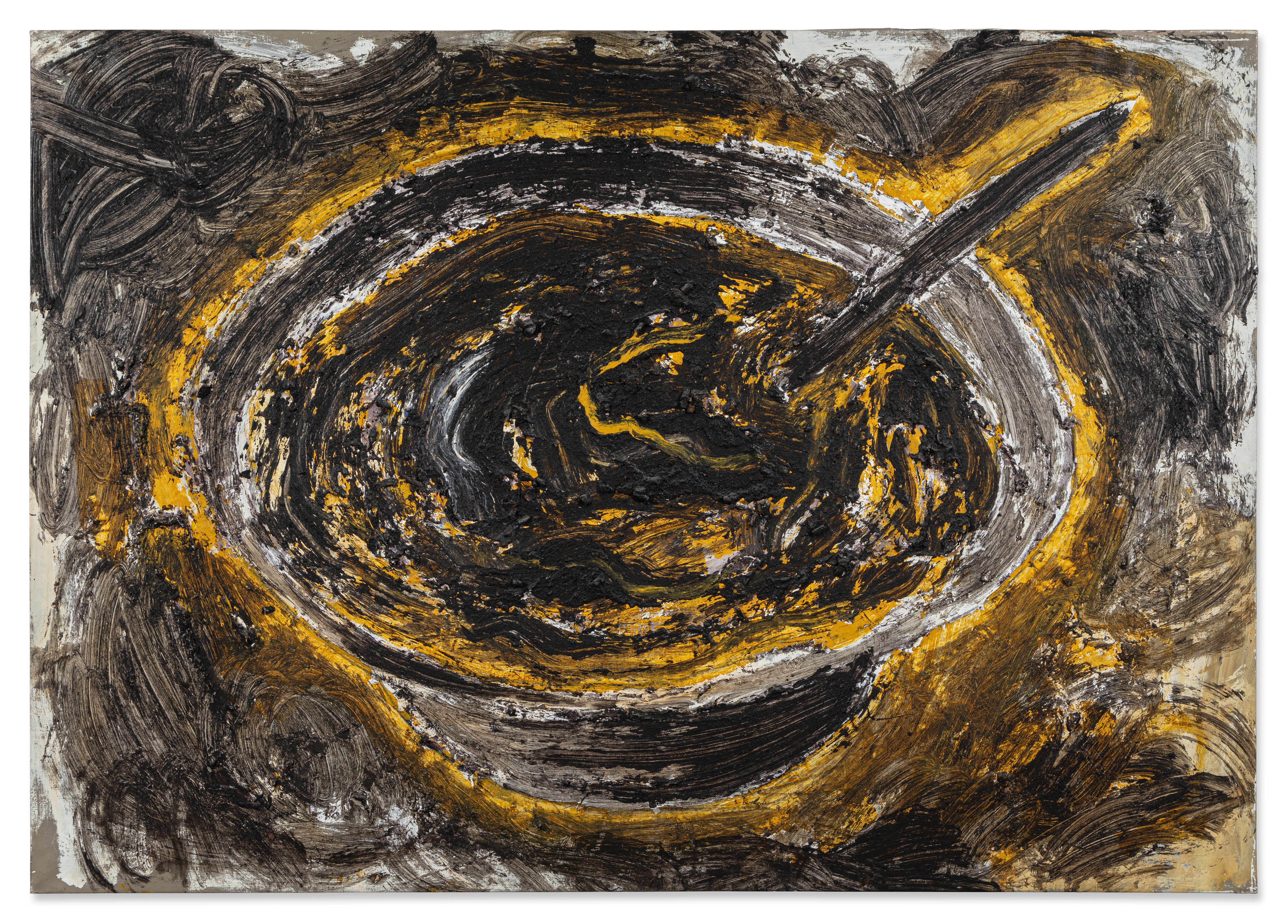
"Soupe noire" from 1984 represents the artist at the height of his early Neo Expressionist period, the surface thick with oil paint applied with that characteristic urgency that made his contemporaries take notice. "España Económica" from 1990 demonstrates his capacity to address political and social realities without sacrificing pictorial richness. Works such as "Crâne aux huitres et allumettes" from 2006 and "La Mer avec Nuages" from 2002 reveal the mature Barceló, an artist who had absorbed decades of lived experience across continents and distilled it into a visual language at once personal and universal. His prints, including the "Lanzarote (Serie Pornografica)" etchings and the "Gran Ciuno" etching with aquatint and carborundum, show that his command of the graphic arts is every bit as assured as his painting: these are not secondary works but fully realized expressions of the same restless sensibility.
Miquel Barceló
Soupe noire, 1984
For collectors, Barceló occupies a genuinely rare position in the market. He is an artist with a deep institutional pedigree, collected by the Musée National d'Art Moderne in Paris, the Reina Sofía in Madrid, the Museum of Modern Art in New York, and numerous other major institutions, yet whose work retains a living, present tense quality that connects it to the great European painting tradition without feeling like mere homage. His prices reflect this dual confidence: works on canvas from the 1980s and 1990s have achieved prices in the high six and seven figure range at auction, while his prints and works on paper offer serious collectors a more accessible entry point into a body of work that art historians will be discussing for generations. The diversity of his output, from large format oil paintings and mixed media canvases to etchings, ceramics, and monumental public works, means there is almost always a meaningful work available for a collector at the right moment.
In 2007, Barceló completed one of the most discussed public commissions in recent European memory: the painted ceramic ceiling of the Human Rights and Alliance of Civilizations Chamber at the United Nations in Geneva, a vast undulating surface in blues and whites that transforms the room into something resembling the interior of a wave or a grotto. The work confirmed what his gallery supporters at Galerie Gmurzynska and Pace Gallery had long argued: that Barceló was an artist who could operate convincingly at any scale, from the most intimate print to an architectural intervention visible to the world. It also cemented his reputation as a public intellectual of the visual arts, someone whose ambitions extended beyond the studio into the larger conversation about what images are for. The art historical context that surrounds Barceló is rich and illuminating.
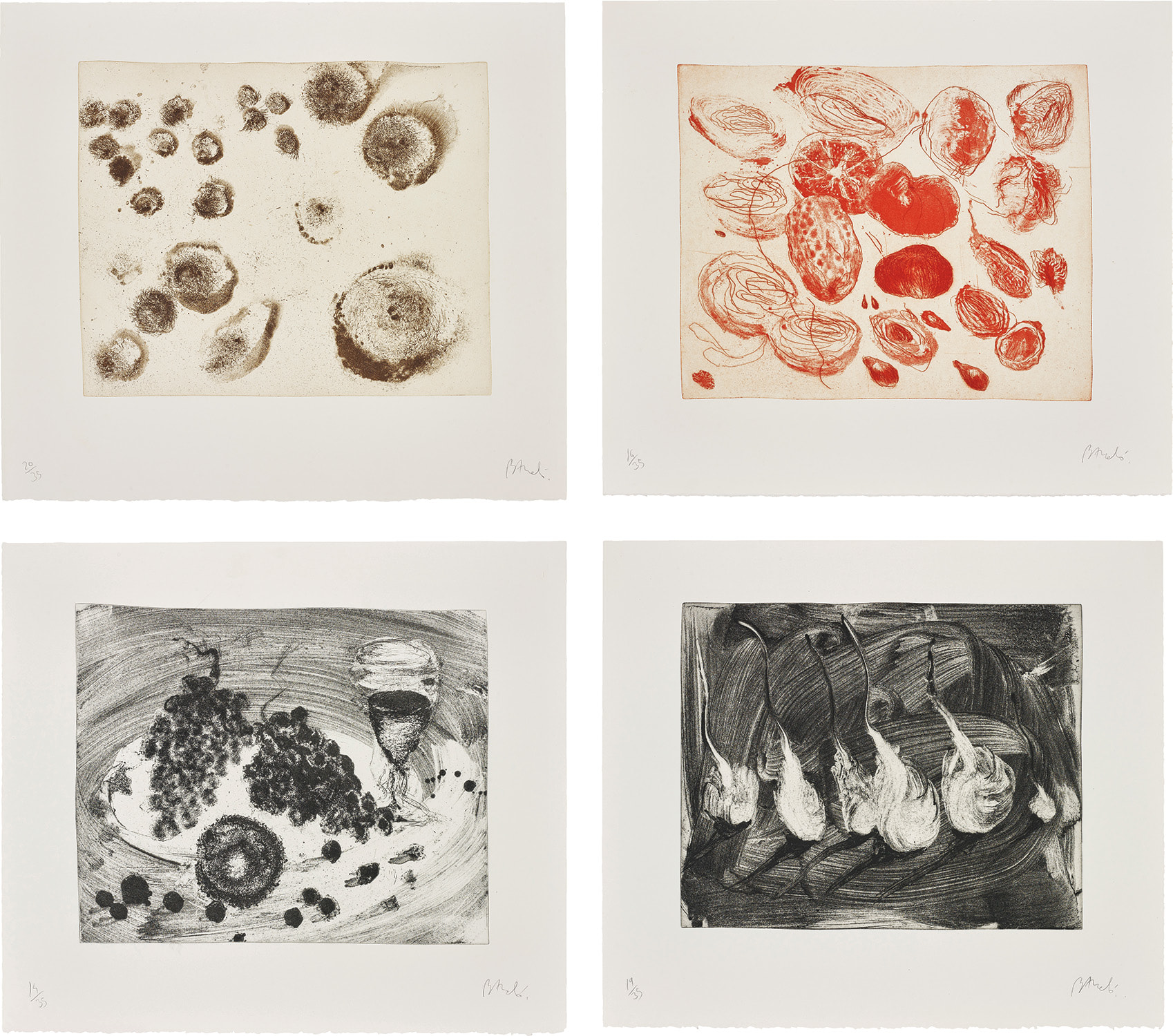
Miquel Barceló
Lanzarote (Serie Pornografica): four plates
Comparisons to Antoni Tàpies, the great Catalan materialist painter, are inevitable and legitimate, though Barceló's sensory world is warmer and more carnivorous than Tàpies's meditative severity. His debt to Francis Bacon in the treatment of organic matter and bodily presence is traceable but transformed. Among his contemporaries, Jean Michel Basquiat and Sigmar Polke offer useful parallels as figures who arrived in the early 1980s carrying enormous energy and who proceeded to build bodies of work dense with reference and surprise. What Barceló possesses that distinguishes him within this company is a rootedness in specific landscapes and ecologies, Mallorca, Mali, Lanzarote, Sicily, that gives even his most abstract surfaces a geographical memory.
To collect Barceló is to bring into a home or institution a kind of condensed world experience. His canvases smell of time, of repeated decisions, of material gathered from places far apart on the earth and brought into conversation on a single surface. He is an artist who has never stopped moving, never stopped looking, and the work bears this out in every passage of paint. For those who follow contemporary painting with genuine curiosity, and The Collection is precisely the community for exactly such people, there are few artists whose work rewards sustained attention more generously.
Explore books about Miquel Barceló
Miquel Barceló
Jean Leymarie
Miquel Barceló: Paintings, Sculptures, Drawings
Germano Celant
Miquel Barceló
Paul Bowles
Barceló: Travels to Mali
Various Authors
Miquel Barceló: Catalogue Raisonné 1973-1988
Sam Hunter
Miquel Barceló: Recent Works
Pierre Restany
Barceló: Works on Paper
Coloquio Editorial