Mel Bochner
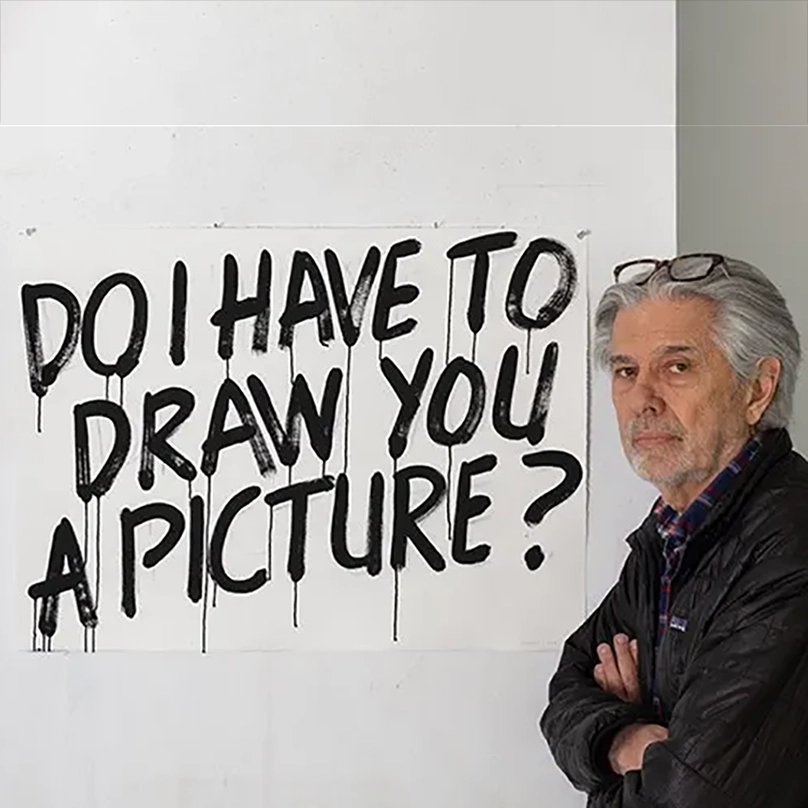
Mel Bochner: Words That Rewrote Art History
Artist Spotlight · The Collection Editorial
“Measurement is the basis of all painting. It is also the basis of all doubt.”
Mel Bochner, artist statement
In the spring of 2023, Mel Bochner unveiled new work that reaffirmed something collectors and curators have known for decades: at over eighty years old, he remains one of the most vital and formally daring artists working in America today. His recent monoprints, including the audacious "Right On" series, demonstrate a practice that has never stopped evolving, moving with the same restless intellectual energy that first distinguished him in the late 1960s. Museums, galleries, and private collectors across the world continue to seek out his work with urgency, drawn to a sensibility that is at once philosophically rigorous and viscerally immediate. Bochner is, in the truest sense, a living institution.
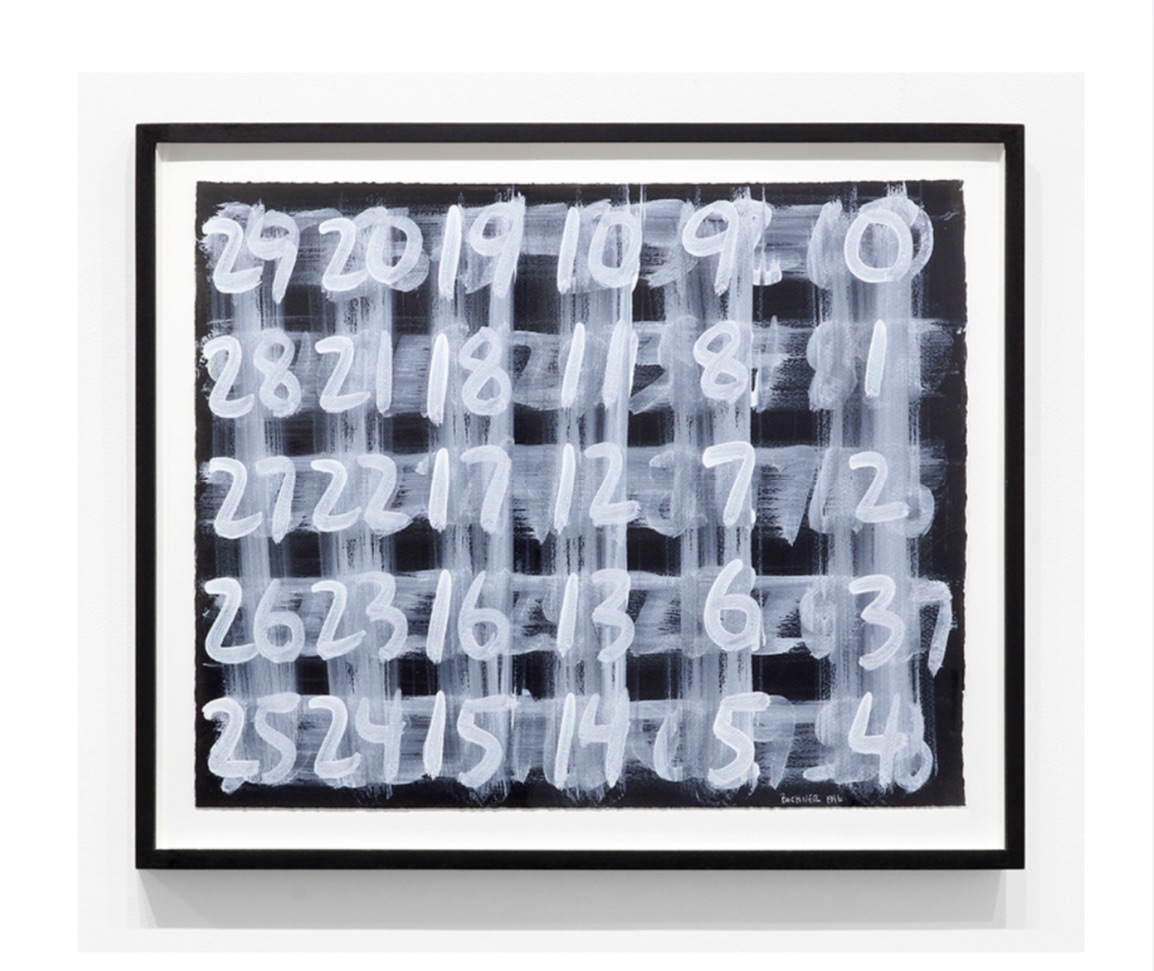
Mel Bochner
Untitled, 1996
Born in Pittsburgh, Pennsylvania in 1940, Bochner came of age in a city shaped by industry, craft, and a certain working class pragmatism that would quietly inform his approach to materials and meaning throughout his career. He studied at Carnegie Mellon University, then known as the Carnegie Institute of Technology, where he trained in painting and absorbed the formal traditions of Western art before beginning to question them from the inside out. By the mid 1960s, he had relocated to New York City, arriving at precisely the moment when the art world was cracking open and reinventing its own assumptions. He took a job as a guard at the Jewish Museum, a position that placed him in proximity to some of the most radical artistic minds of the era, and he used every moment of it to look, think, and plan.
Bochner's early breakthrough came with his 1966 exhibition "Working Drawings and Other Visible Things on Paper Not Necessarily Meant to Be Viewed as Art" at the School of Visual Arts in New York. The show, often cited as one of the first conceptual art exhibitions in the United States, featured photocopied documents, studio notes, and diagrams displayed in binders on pedestals, a gesture that stripped the art object of its traditional aura and replaced it with process and information. This move was not merely provocative; it was a foundational act that helped define an entirely new artistic grammar. Alongside peers such as Robert Smithson, Sol LeWitt, and Eva Hesse, Bochner was charting territory that would take decades for the broader culture to fully absorb.
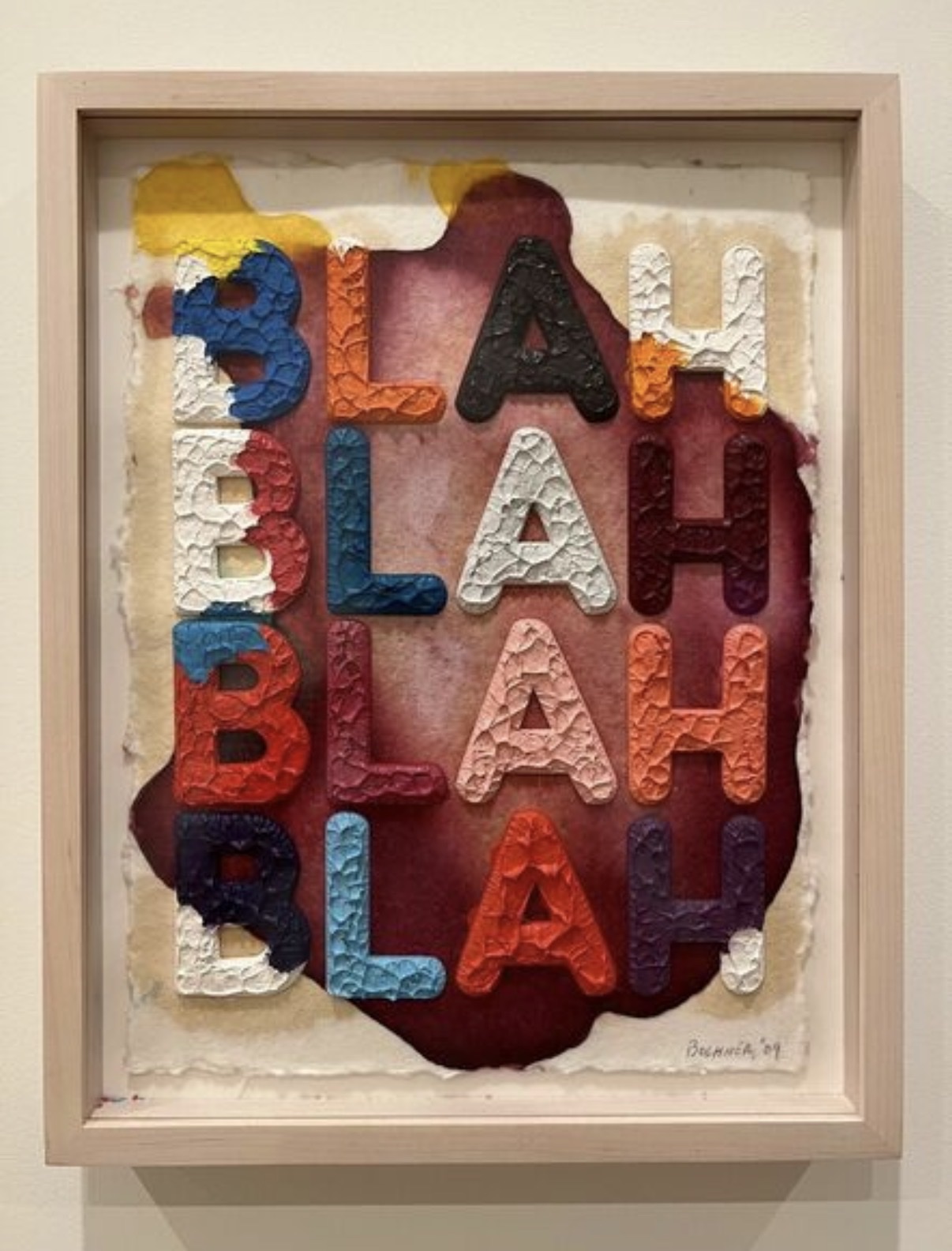
Mel Bochner
Blah Blah Blah, 2009
Through the 1970s and into the 1980s, Bochner expanded his investigation of measurement, language, and perception. His "Measurement" series, in which he applied numerical dimensions directly onto gallery walls, floors, and ceilings, challenged the neutrality of the exhibition space itself and anticipated the institutional critique that would preoccupy a generation of artists after him. He was working simultaneously with painting, and unlike many of his conceptual peers who turned away from the medium entirely, Bochner insisted on holding both impulses together, the analytic and the sensory, the linguistic and the painterly. This refusal to resolve the tension between thinking and feeling became one of the most distinctive qualities of his practice.
“Language is not transparent.”
Mel Bochner, working note, 1969
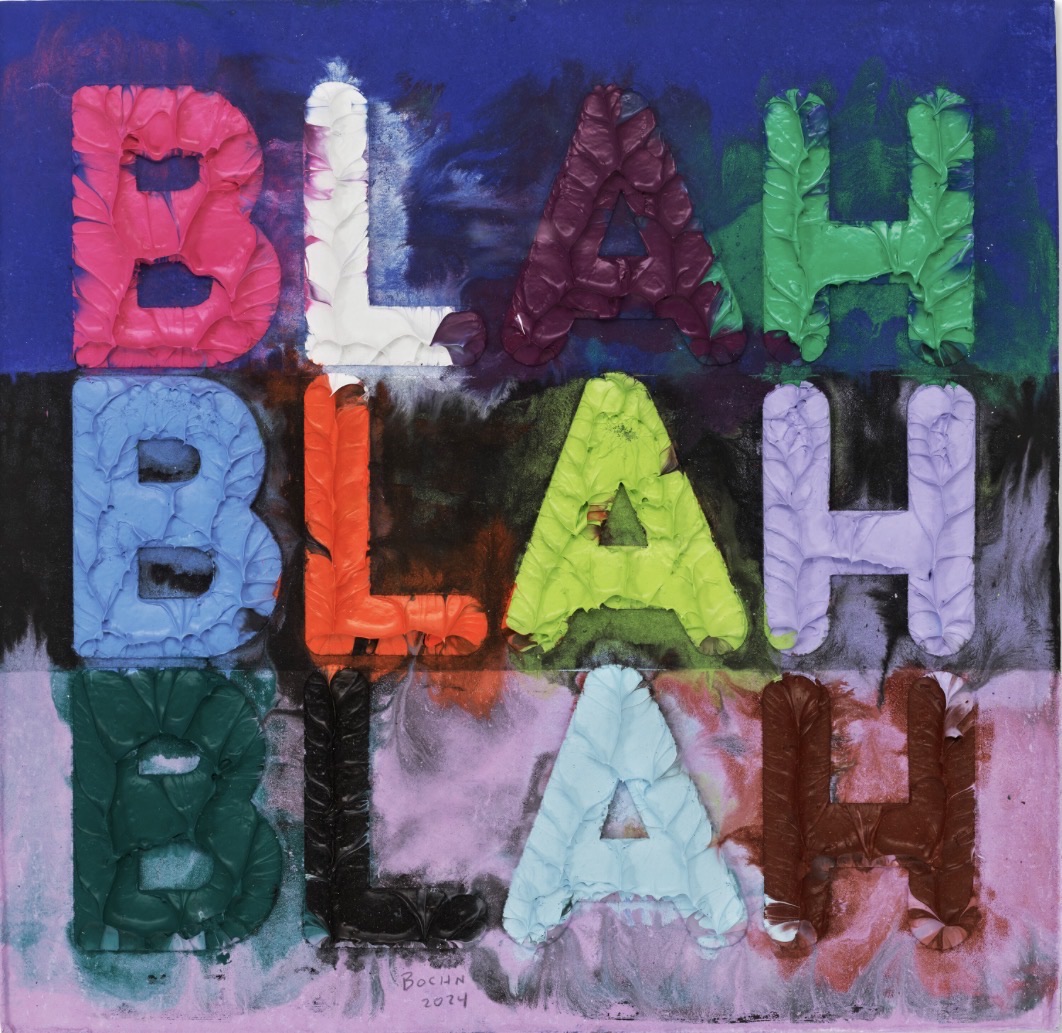
The thesaurus paintings, which Bochner began developing in earnest in the late 1990s and early 2000s, are among the most celebrated and immediately recognizable works of his career. Using oil and acrylic on velvet, a material chosen for its luxurious and slightly theatrical quality, he filled canvases with clusters of synonyms sourced from Roget's Thesaurus, words cascading and accumulating until meaning begins to buckle under its own weight. Works like "Blah Blah Blah" and "Amazing" are formally exhilarating objects, commanding in their scale and their strange beauty, but they also carry a sharp conceptual edge. They ask how language shapes and distorts our experience of reality, what it means when words proliferate beyond usefulness, and whether communication ever fully achieves what it promises.
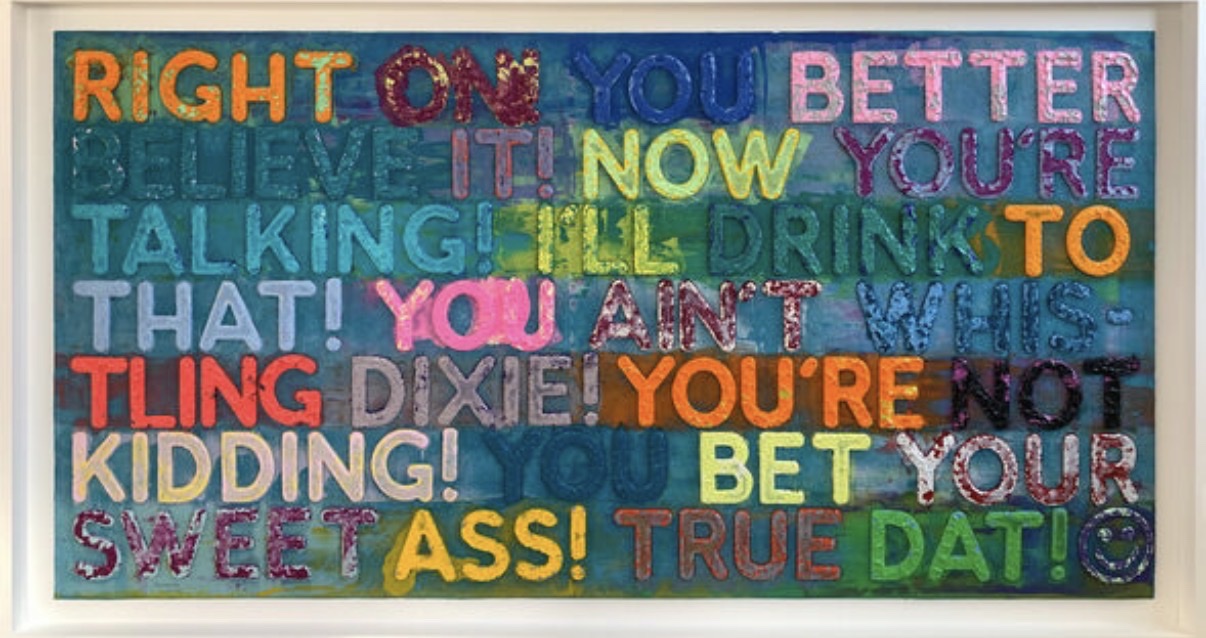
Mel Bochner
Right On, 2023
These are not paintings that settle quietly on a wall; they insist on a response. For collectors, Bochner's work offers a rare combination of art historical significance and sustained visual pleasure. His prints and monoprints, many produced in collaboration with the highly respected Two Palms Press in New York, represent some of the most technically accomplished editions being made today. Works such as the "Blah Blah Blah" monoprints on hand dyed Twinrocker handmade paper, with their intricate layering of engraving, embossment, and oil pigment, demonstrate a command of printmaking that elevates the medium to something genuinely exceptional.
Edition works like "Everybody is Full of Shit" carry all of Bochner's wit and formal intelligence in a more accessible format, making them an intelligent entry point for collectors who wish to engage with a blue chip conceptual voice without waiting for a major canvas to appear at auction. His market has been steadily supported by serious institutional validation, with works held in the collections of the Museum of Modern Art, the Whitney Museum of American Art, the Tate, and dozens of major museums worldwide. To understand Bochner's place in art history is to understand the full arc of American conceptualism. He shares intellectual territory with the systematic rigor of Sol LeWitt, the language based investigations of Lawrence Weiner, and the material skepticism of Robert Morris, yet his commitment to painting and to visual seduction sets him apart from all of them.
Mel Bochner
Blah Blah Blah, 2024
He also anticipates the word based practices of artists like Jenny Holzer and Barbara Kruger, though his relationship to language is less rhetorical and more philosophical, less a declaration than a meditation. He is, in this sense, a bridge figure: someone whose work connects the austere experimental energy of the 1960s to the more pluralistic, affect rich art world of the present. What makes Bochner so important today is precisely the quality that has always made him difficult to categorize: his absolute refusal to simplify. His work trusts the viewer to hold complexity, to sit with ambiguity, to find humor and melancholy and formal joy in the same gesture.
In an era when art is often expected to deliver its meaning quickly and loudly, Bochner's practice offers something rarer and more rewarding, a sustained conversation between the mind and the eye, conducted over decades with extraordinary consistency and grace. To collect his work is to participate in one of the most significant ongoing inquiries in contemporary art, and to bring into your life an object that will never stop speaking.
Explore books about Mel Bochner

Mel Bochner: Thought Made Visible
Robert C. Morgan
Mel Bochner: Drawings 1965-2000
Lisa Turvey
Mel Bochner: Photographs 1966-1969
Various
Mel Bochner: Working Drawings and Other Visible Things
Lucy Moore
Mel Bochner: Thesaurus
Peter Halley