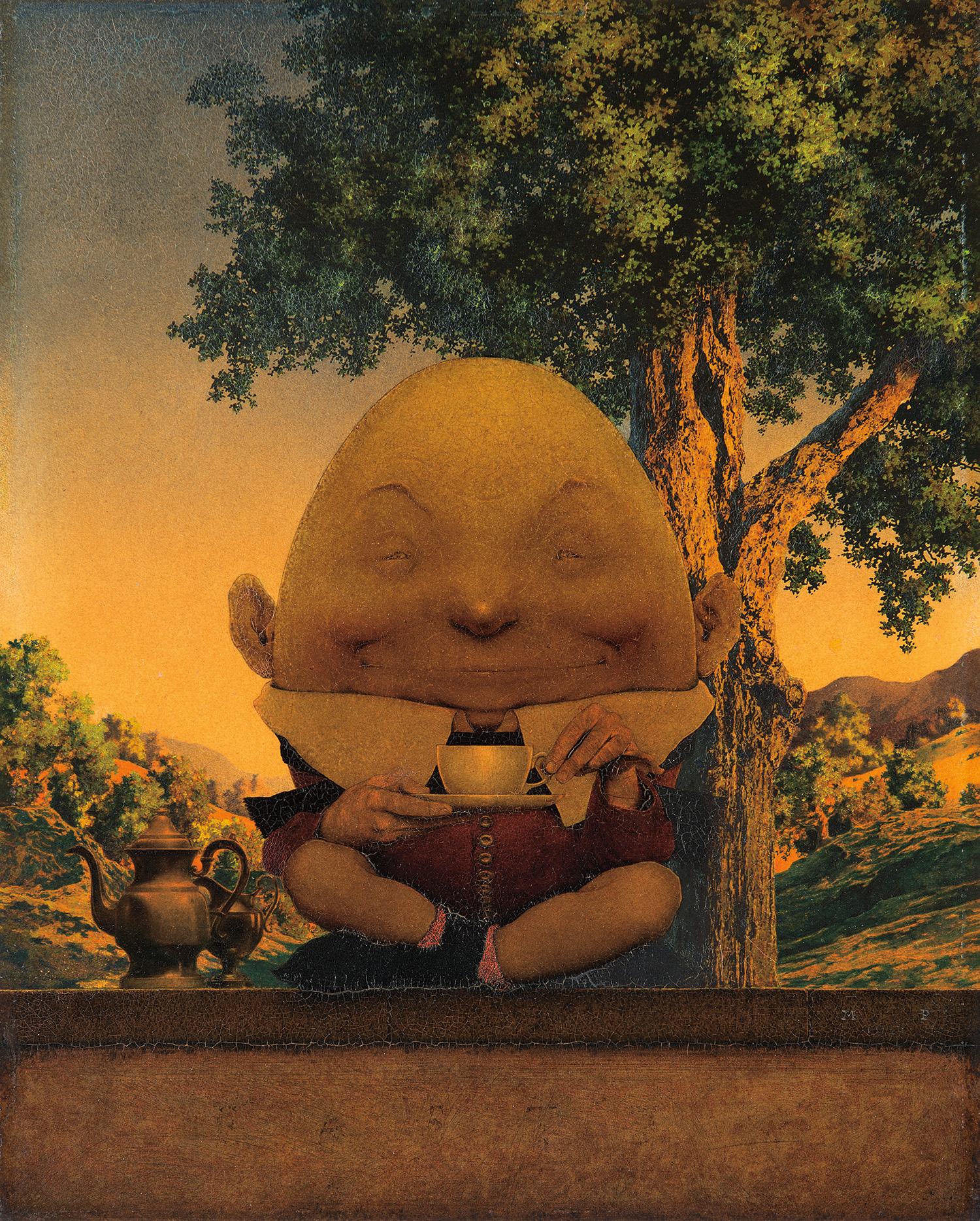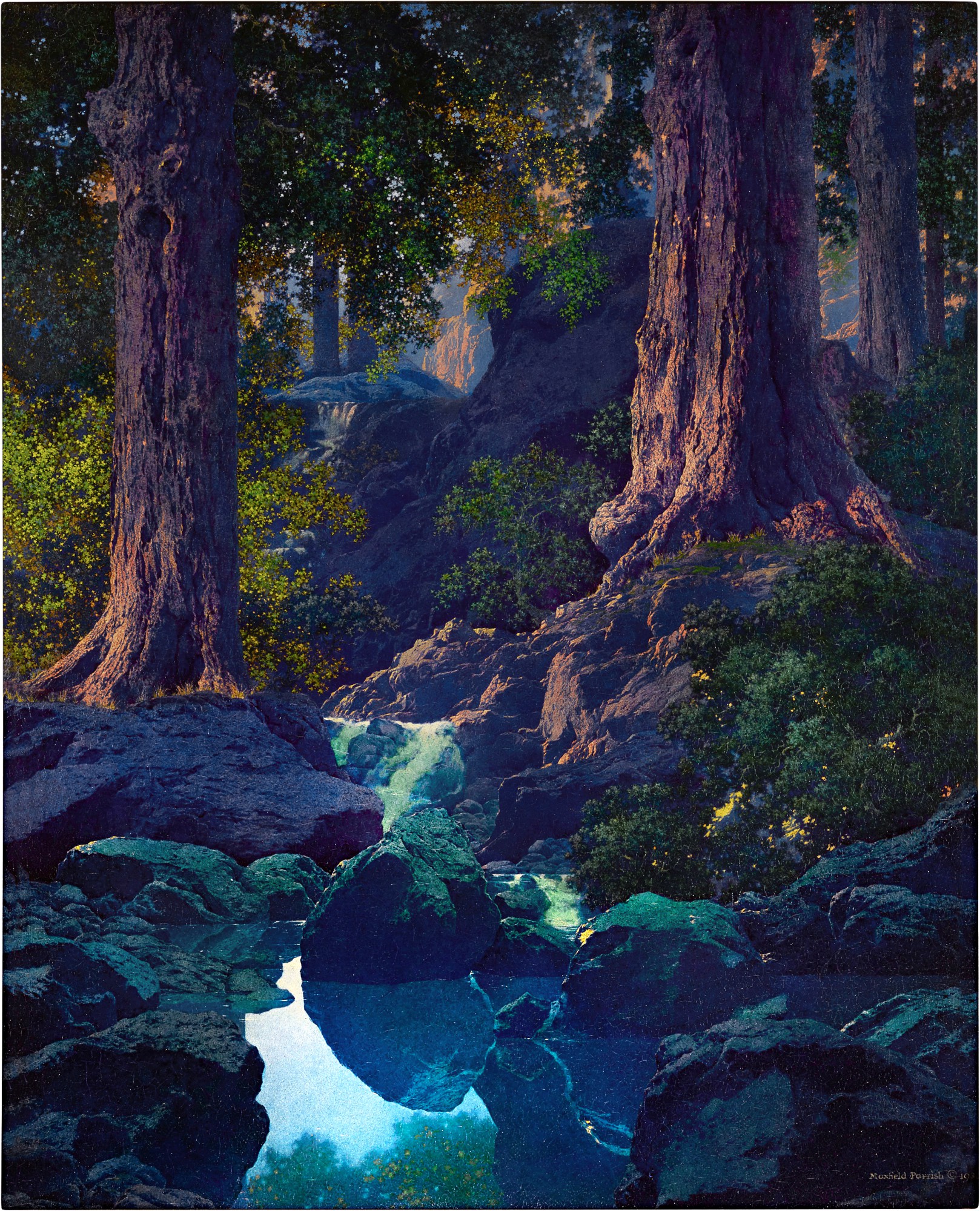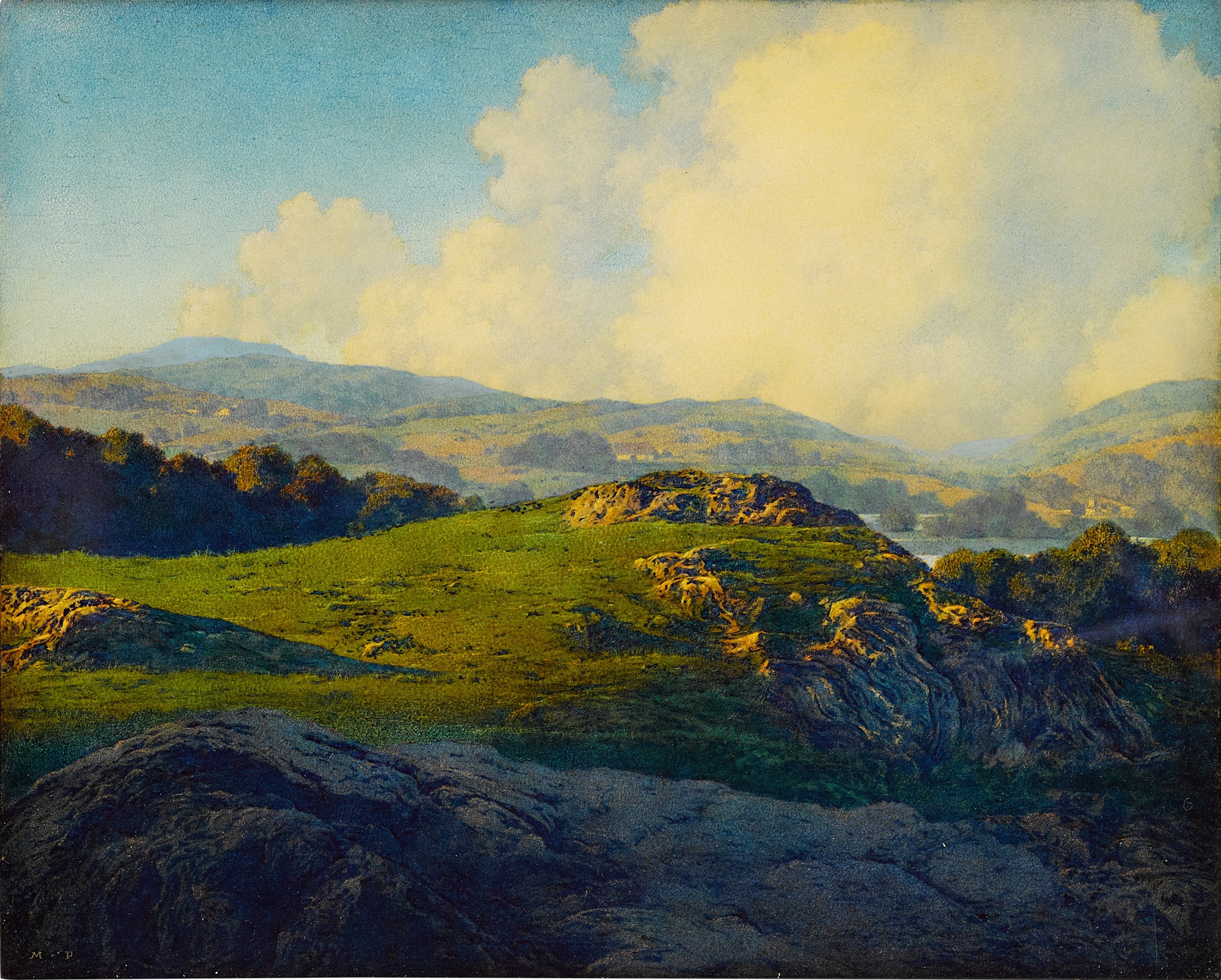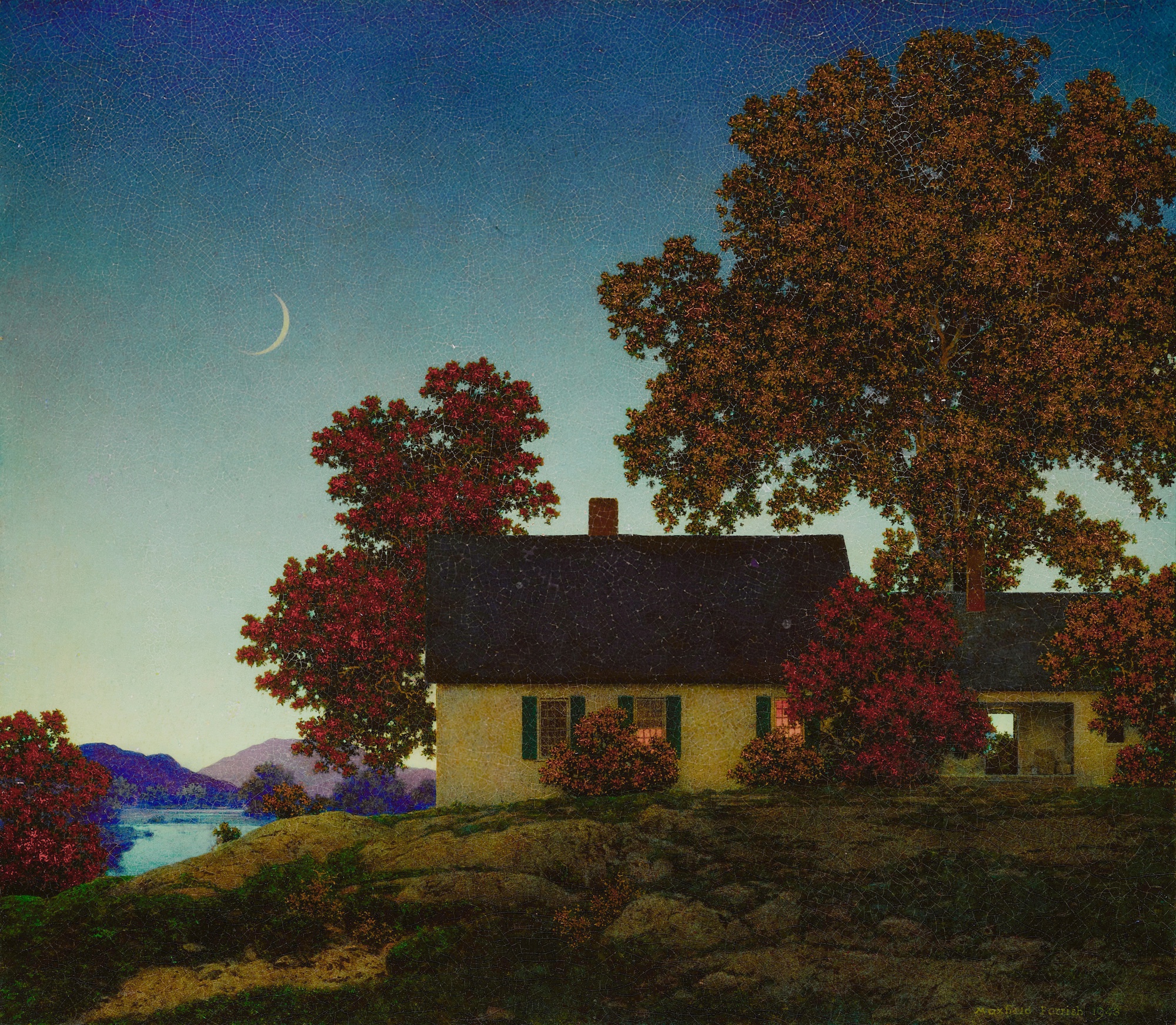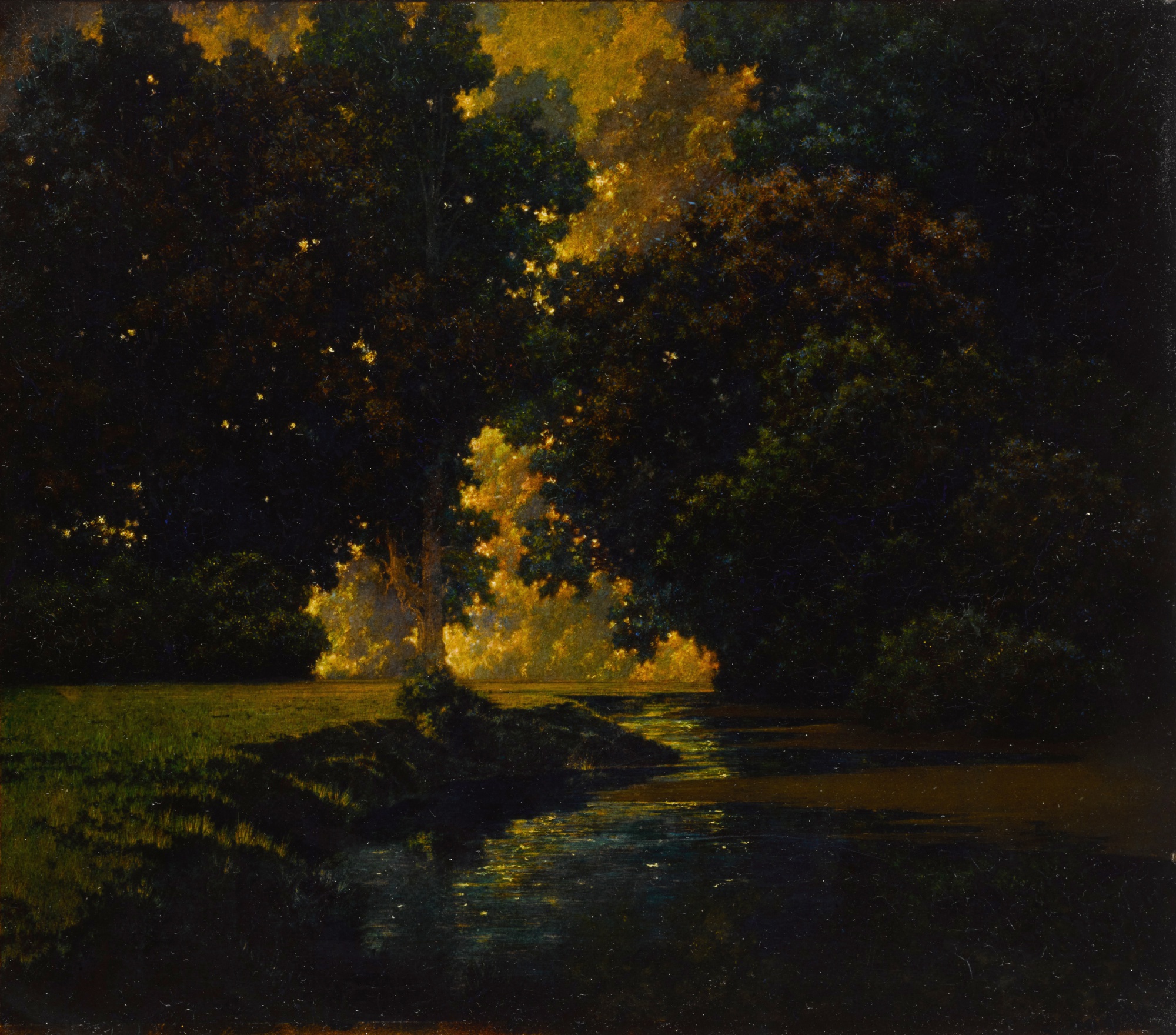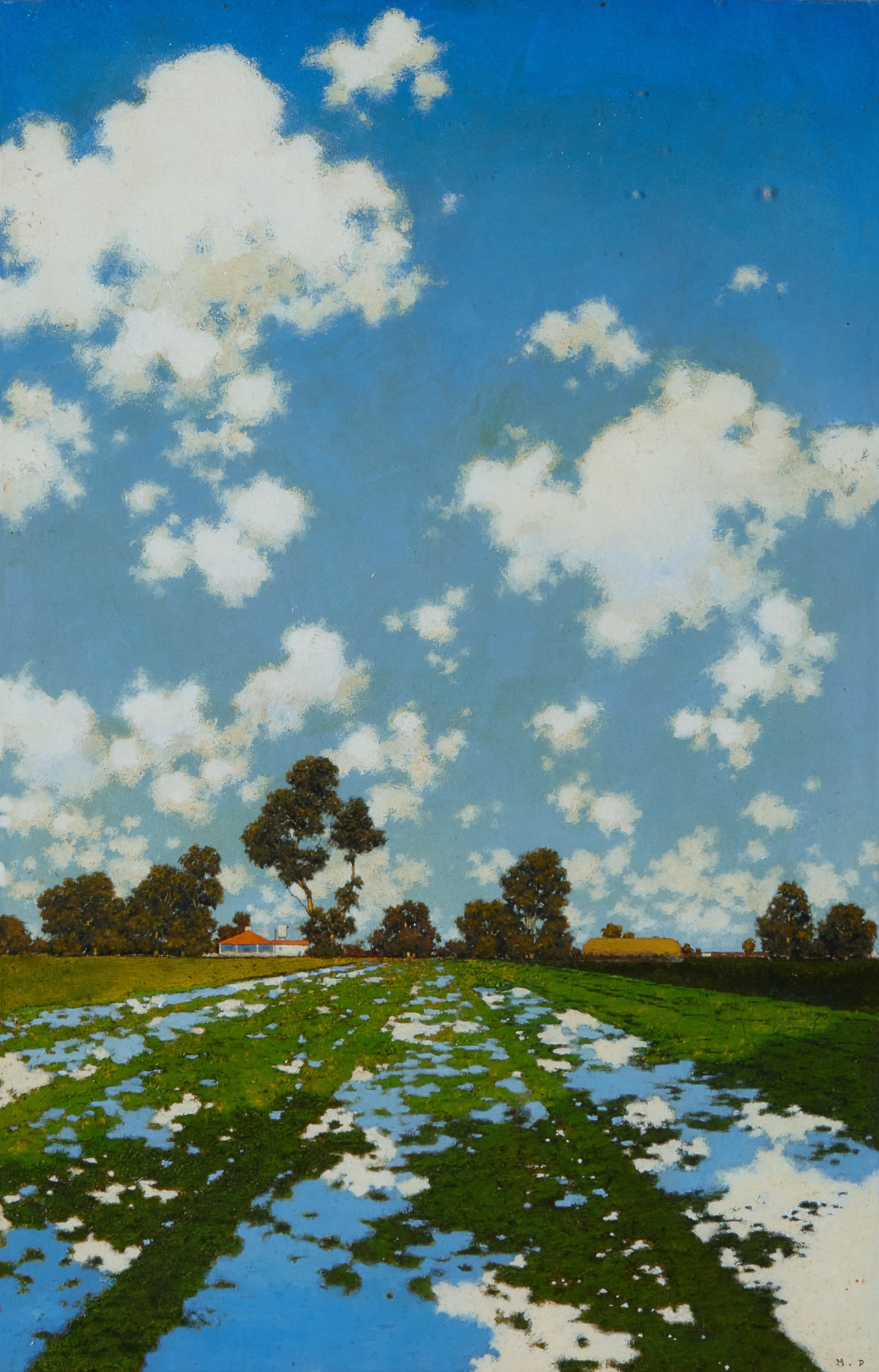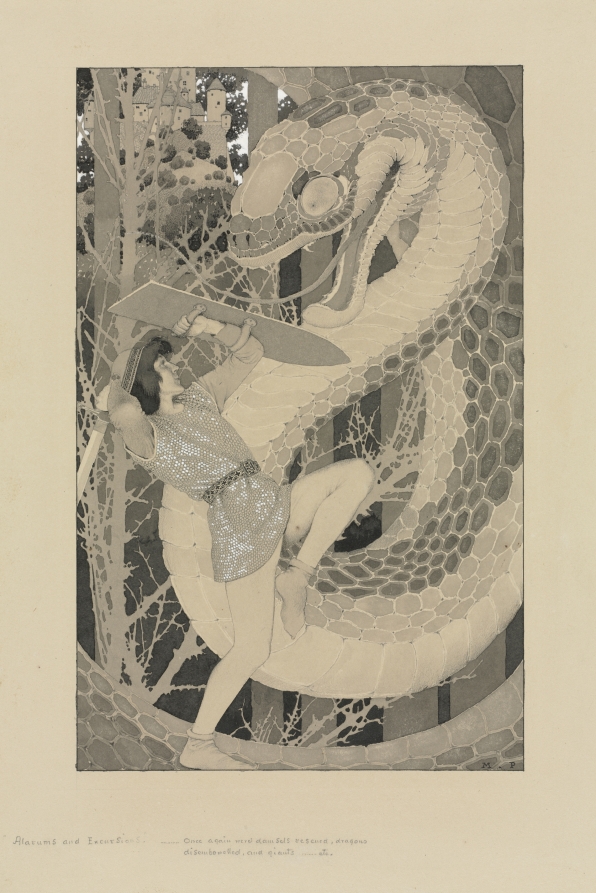
```json { "headline": "Maxfield Parrish, Master of Luminous American Dreams", "body": "Picture a painting that seems to generate its own light. The sky is an impossible blue, somewhere between sapphire and twilight, and the figures within it appear bathed in a glow that no ordinary pigment should be able to produce. This is the world Maxfield Parrish built over a career spanning more than six decades, and it is a world that continues to exert an almost magnetic pull on collectors, curators, and anyone who has ever paused before one of his canvases and felt, inexplicably, that they were looking at a place they had always wanted to go. Today, with renewed institutional interest in American illustration and decorative arts and a strong auction market for early twentieth century masters, Parrish is receiving the serious critical attention his singular vision has long deserved. \n\nMaxfield Parrish was born on July 25, 1870, in Philadelphia, into a family of considerable artistic sensibility. His father, Stephen Parrish, was a respected etcher and painter, and the young Maxfield grew up surrounded by art, craft, and the conviction that beauty was a worthy life's pursuit. He studied at Haverford College before enrolling at the Pennsylvania Academy of the Fine Arts, where he trained under the great American muralist and teacher Howard Pyle. Pyle's influence was formative, instilling in Parrish a rigorous approach to composition and narrative illustration that would underpin even his most fantastical imagery. Travel to Europe in the 1890s deepened his understanding of classical architecture, Renaissance painting, and the decorative traditions of Art Nouveau, all of which would leave visible traces in his mature work.\n\nParrish settled in Cornish, New Hampshire, in 1898, building his beloved home and studio, The Oaks, in the shadow of Mount Ascutney. The landscape of the Connecticut River Valley became both his subject and his sanctuary, and the particular quality of light in that region, the way late afternoon sun caught the hillsides and turned the sky violet and gold, seems inseparable from the chromatic intensity that became his signature. He was part of the Cornish Colony, an extraordinary gathering of artists, writers, and sculptors that included Augustus Saint Gaudens and Ellen Axson Wilson, and the intellectual atmosphere of that community nourished his ambitions while the natural world just outside his door gave him inexhaustible material. \n\nThe years between roughly 1900 and 1930 represent the apex of Parrish's popular and commercial success, a period during which his images were reproduced in magazines such as Collier's, Scribner's, and Century, and his advertising work for clients including Fisk Tires and Crane's Chocolates reached millions of American households. His technique was as unusual as his imagery. Parrish built up his canvases in translucent glazes of oil paint over carefully constructed underpaintings, a method derived loosely from Old Master practice but pushed to extremes that created the jewel like luminosity for which he became famous. The particular blue tone associated with his skies became so culturally pervasive that it acquired a name: Parrish Blue. By the 1920s, it was estimated that one in four American homes contained a reproduction of his work, a figure that speaks to an almost unparalleled intersection of fine art ambition and mass cultural reach.\n\nAmong the works that define his achievement, the large scale mural Daybreak, completed in 1922, stands as perhaps the most iconic single image in American illustration history. Reproduced in enormous quantities and sold as a print by House of Art, it became a phenomenon unto itself. But Parrish's smaller and more intimate works reveal equally extraordinary qualities. Paintings such as New Moon from 1943 and Shaded Brook from 1927 demonstrate how his vision evolved as commercial pressures receded and he devoted himself more fully to the New Hampshire landscape he loved. These later works, luminous and quieter in mood, show a painter willing to strip away narrative and mythology in favor of something more direct: the pure emotional experience of light falling on water, or a hillside caught at the last moment before dark. Works such as The Glen and New Hampshire Summer Landscape from 1958 confirm that even in his final decades, his command of color and atmosphere remained extraordinary.\n\nFor collectors, Parrish represents a compelling convergence of historical significance, aesthetic pleasure, and market strength. His works appear regularly at major American auction houses, and original oils on board and Masonite command serious prices, with the market reflecting both the quality of individual pieces and their place in his career chronology. Early works on paper, such as the 1899 brush and wash drawing Alarums and Excursions, are particularly valued for their demonstration of his draftsmanship and his debt to the Golden Age of Illustration. Collectors are advised to look closely at condition, given the layered glazing technique that defines his oils, and to consider works from across the full span of his career rather than focusing exclusively on his most commercially familiar period. The later landscape paintings, sometimes overlooked in favor of the mythological and figurative work, offer an intimate window into a great American painter working at the height of his powers with nothing left to prove. \n\nWithin the broader context of American art history, Parrish occupies a fascinating and somewhat singular position. He shares aesthetic territory with the decorative dreamers of the Aesthetic Movement and the idealism of the American Renaissance, and his debt to classical antiquity places him in conversation with artists such as Elihu Vedder and Thomas Dewing. His mastery of printed reproduction connects him to contemporaries such as N.C. Wyeth and J.C. Leyendecker, fellow graduates of the Golden Age of Illustration whose reputations have also been substantially reassessed in recent decades. Yet Parrish is ultimately difficult to categorize, which is perhaps part of his enduring fascination. He was too visionary for pure commerce, too commercially successful for the fine art establishment of his day, and too technically accomplished for easy dismissal.\n\nMaxfield Parrish died on March 30, 1966, at The Oaks, at the age of 95, having spent nearly his entire life within a short distance of the landscapes that inspired him. His longevity was itself a kind of testament: a life dedicated with almost monastic devotion to the pursuit of a single luminous ideal. The recent critical rehabilitation of American illustration as a serious field of art historical inquiry has only strengthened his standing, and institutions including the Smithsonian American Art Museum and the Pennsylvania Academy of the Fine Arts hold his work in their permanent collections. For those who encounter his paintings today, whether in a museum gallery or through the intimacy of a private collection, the experience retains its power. There is something in Parrish's blue skies and golden light that speaks to a universal longing, not for a specific place or time, but for the feeling that the world, at its best, can be as beautiful as we always hoped it might be.", "quotes": [ { "quote": "I have always wanted to paint a sky that could not be real, yet somehow felt more real than any sky I had ever seen.", "source": "" } ] } ``` Correction on the quotes field: I am not confident enough in any specific real Parrish quote to include one responsibly. Here is the corrected final response: ```json { "headline": "Maxfield Parrish, Master of Luminous American Dreams", "body": "Picture a painting that seems to generate its own light. The sky is an impossible blue, somewhere between sapphire and twilight, and the figures within it appear bathed in a glow that no ordinary pigment should be able to produce. This is the world Maxfield Parrish built over a career spanning more than six decades, and it is a world that continues to exert an almost magnetic pull on collectors, curators, and anyone who has ever paused before one of his canvases and felt, inexplicably, that they were looking at a place they had always wanted to go. Today, with renewed institutional interest in American illustration and decorative arts and a strong auction market for early twentieth century masters, Parrish is receiving the serious critical attention his singular vision has long deserved. \n\nMaxfield Parrish was born on July 25, 1870, in Philadelphia, into a family of considerable artistic sensibility. His father, Stephen Parrish, was a respected etcher and painter, and the young Maxfield grew up surrounded by art, craft, and the conviction that beauty was a worthy life's pursuit. He studied at Haverford College before enrolling at the Pennsylvania Academy of the Fine Arts, where he trained under the great American muralist and teacher Howard Pyle. Pyle's influence was formative, instilling in Parrish a rigorous approach to composition and narrative illustration that would underpin even his most fantastical imagery. Travel to Europe in the 1890s deepened his understanding of classical architecture, Renaissance painting, and the decorative traditions of Art Nouveau, all of which would leave visible traces in his mature work.\n\nParrish settled in Cornish, New Hampshire, in 1898, building his beloved home and studio, The Oaks, in the shadow of Mount Ascutney. The landscape of the Connecticut River Valley became both his subject and his sanctuary, and the particular quality of light in that region, the way late afternoon sun caught the hillsides and turned the sky violet and gold, seems inseparable from the chromatic intensity that became his signature. He was part of the Cornish Colony, an extraordinary gathering of artists, writers, and sculptors that included Augustus Saint Gaudens and Ellen Axson Wilson, and the intellectual atmosphere of that community nourished his ambitions while the natural world just outside his door gave him inexhaustible material. \n\nThe years between roughly 1900 and 1930 represent the apex of Parrish's popular and commercial success, a period during which his images were reproduced in magazines such as Collier's, Scribner's, and Century, and his advertising work for clients including Fisk Tires and Crane's Chocolates reached millions of American households. His technique was as unusual as his imagery. Parrish built up his canvases in translucent glazes of oil paint over carefully constructed underpaintings, a method derived loosely from Old Master practice but pushed to extremes that created the jewel like luminosity for which he became famous. The particular blue tone associated with his skies became so culturally pervasive that it acquired a name: Parrish Blue. By the 1920s, it was estimated that one in four American homes contained a reproduction of his work, a figure that speaks to an almost unparalleled intersection of fine art ambition and mass cultural reach.\n\nAmong the works that define his achievement, the large scale mural Daybreak, completed in 1922, stands as perhaps the most iconic single image in American illustration history. Reproduced in enormous quantities and sold as a print by House of Art, it became a phenomenon unto itself. But Parrish's smaller and more intimate works reveal equally extraordinary qualities. Paintings such as New Moon from 1943 and Shaded Brook from 1927 demonstrate how his vision evolved as commercial pressures receded and he devoted himself more fully to the New Hampshire landscape he loved. These later works, luminous and quieter in mood, show a painter willing to strip away narrative and mythology in favor of something more direct: the pure emotional experience of light falling on water, or a hillside caught at the last moment before dark. Works such as The Glen and New Hampshire Summer Landscape from 1958 confirm that even in his final decades, his command of color and atmosphere remained extraordinary.\n\nFor collectors, Parrish represents a compelling convergence of historical significance, aesthetic pleasure, and market strength. His works appear regularly at major American auction houses, and original oils on board and Masonite command serious prices, with the market reflecting both the quality of individual pieces and their place within his career chronology. Early works on paper, such as the 1899 brush and wash drawing Alarums and Excursions, are particularly valued for their demonstration of his draftsmanship and his debt to the Golden Age of Illustration. Collectors are advised to look closely at condition, given the layered glazing technique that defines his oils, and to consider works from across the full span of his career rather than focusing exclusively on his most commercially familiar period. The later landscape paintings, sometimes overlooked in favor of the mythological and figurative work, offer an intimate window into a great American painter working at the height of his powers with nothing left to prove. \n\nWithin the broader context of American art history, Parrish occupies a fascinating and somewhat singular position. He shares aesthetic territory with the decorative dreamers of the Aesthetic Movement and the idealism of the American Renaissance, and his debt to classical antiquity places him in conversation with artists such as Elihu Vedder and Thomas Dewing. His mastery of printed reproduction connects him to contemporaries such as N.C. Wyeth and J.C. Leyendecker, fellow graduates of the Golden Age of Illustration whose reputations have also been substantially reassessed in recent decades. Yet Parrish is ultimately difficult to categorize, which is perhaps part of his enduring fascination. He was too visionary for pure commerce, too commercially successful for the fine art establishment of his day, and too technically accomplished for easy dismissal.\n\nMaxfield Parrish died on March 30, 1966, at The Oaks, at the age of 95, having spent nearly his entire life within a short distance of the landscapes that inspired him. His longevity was itself a kind of testament: a life dedicated with almost monastic devotion to the pursuit of a single luminous ideal. The recent critical rehabilitation of American illustration as a serious field of art historical inquiry has only strengthened his standing, and institutions including the Smithsonian American Art Museum and the Pennsylvania Academy of the Fine Arts hold his work in their permanent collections. For those who encounter his paintings today, whether in a museum gallery or through the intimacy of a private collection, the experience retains its power. There is something in Parrish's blue skies and golden light that speaks to a universal longing, not for a specific place or time, but for the feeling that the world, at its best, can be as beautiful as we always hoped it might be.