Matias Faldbakken
Matias Faldbakken Makes Beautiful Wreckage Sing
Artist Spotlight · The Collection Editorial
“I am a spokesperson for totally anarchistic mayhem on a bed of traditional family values.”
Matias Faldbakken, 2013
Something shifted in the conversation around institutional critique when Matias Faldbakken's work landed at the Palais de Tokyo in Paris. The Norwegian artist, born in 1973, had already built a reputation across Scandinavia and the broader European contemporary art world as a figure who operated at the friction point between destruction and form, between refusal and seduction. But in that grand, cavernous space, his installations of crushed consumer goods, taped cardboard, and defaced plastic bags felt less like provocations and more like a kind of compressed poetry. Visitors who expected confrontation found themselves slowing down, drawn in by the strange tenderness of objects pushed to their limit.
Matias Faldbakken
“I am a spokesperson for totally anarchistic mayhem on a bed of traditional family values.” Matias Faldbakken, 2013
Faldbakken grew up in Norway at a moment when the country's cultural self image was undergoing significant revision. The wealth brought by North Sea oil had created a new institutional infrastructure for the arts, with museums and kunsthalles multiplying through the 1980s and 1990s, and a generation of Norwegian artists found themselves both supported by and slightly suspicious of that apparatus. Faldbakken absorbed that ambivalence early and made it central to his practice. He came of age intellectually in an environment where punk and post punk culture intersected with serious theoretical engagement, and where writers and artists were expected to move fluidly between disciplines.
That fluid, cross disciplinary sensibility has never left him. His development as a visual artist ran parallel to a significant literary career. Under the pen name Abo Rasul, Faldbakken published a series of novels in the early 2000s that dealt with nihilism, subcultural codes, and the aesthetics of failure in ways that prefigured his visual work. This literary grounding gives his art an unusually dense conceptual texture.
Matias Faldbakken
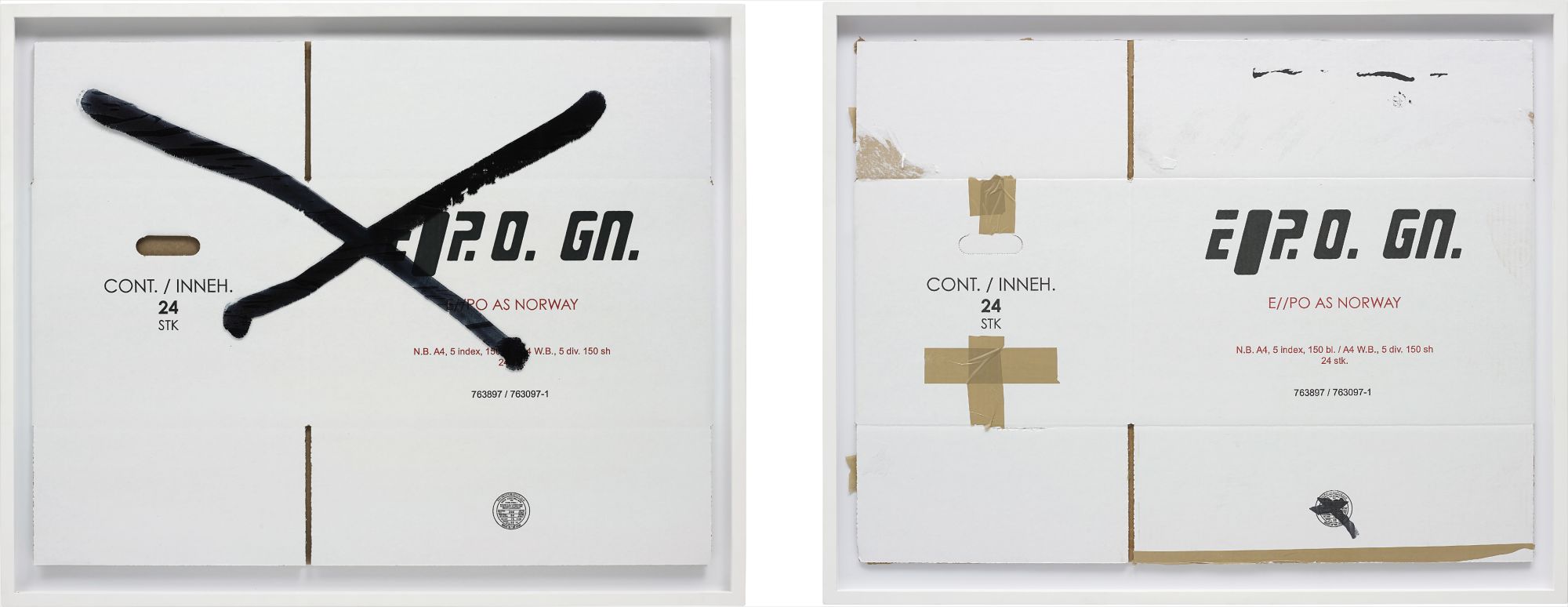
Two Works: (i) Flat Box 9; (ii) Flat Box 2
Where other practitioners of institutional critique can feel dry or programmatic, Faldbakken's objects carry a kind of narrative charge, as though each crumpled bag or screw piece is a character with a history. His understanding of language and text informs the way he uses found materials, treating them as carriers of meaning that can be amplified, undermined, or simply allowed to speak. The breakthrough into wide European recognition came through a series of exhibitions at institutions that understood how to frame genuinely difficult work. The Kunsthalle Zürich gave his practice the kind of rigorous contextualisation it deserved, situating his sculptures and installations within a lineage that runs from Fluxus through Arte Povera and into the more recent conceptual strands of Scandinavian contemporary art.
The Astrup Fearnley Museum of Modern Art in Oslo, one of Europe's most adventurous private collecting institutions, has also been central to his story, recognising in his work a seriousness that rewarded sustained attention. These are not spaces that exhibit fashionably difficult art for its own sake. Their endorsement carried real weight. To stand in front of one of Faldbakken's paintings is to encounter a surface that refuses easy resolution.
Matias Faldbakken
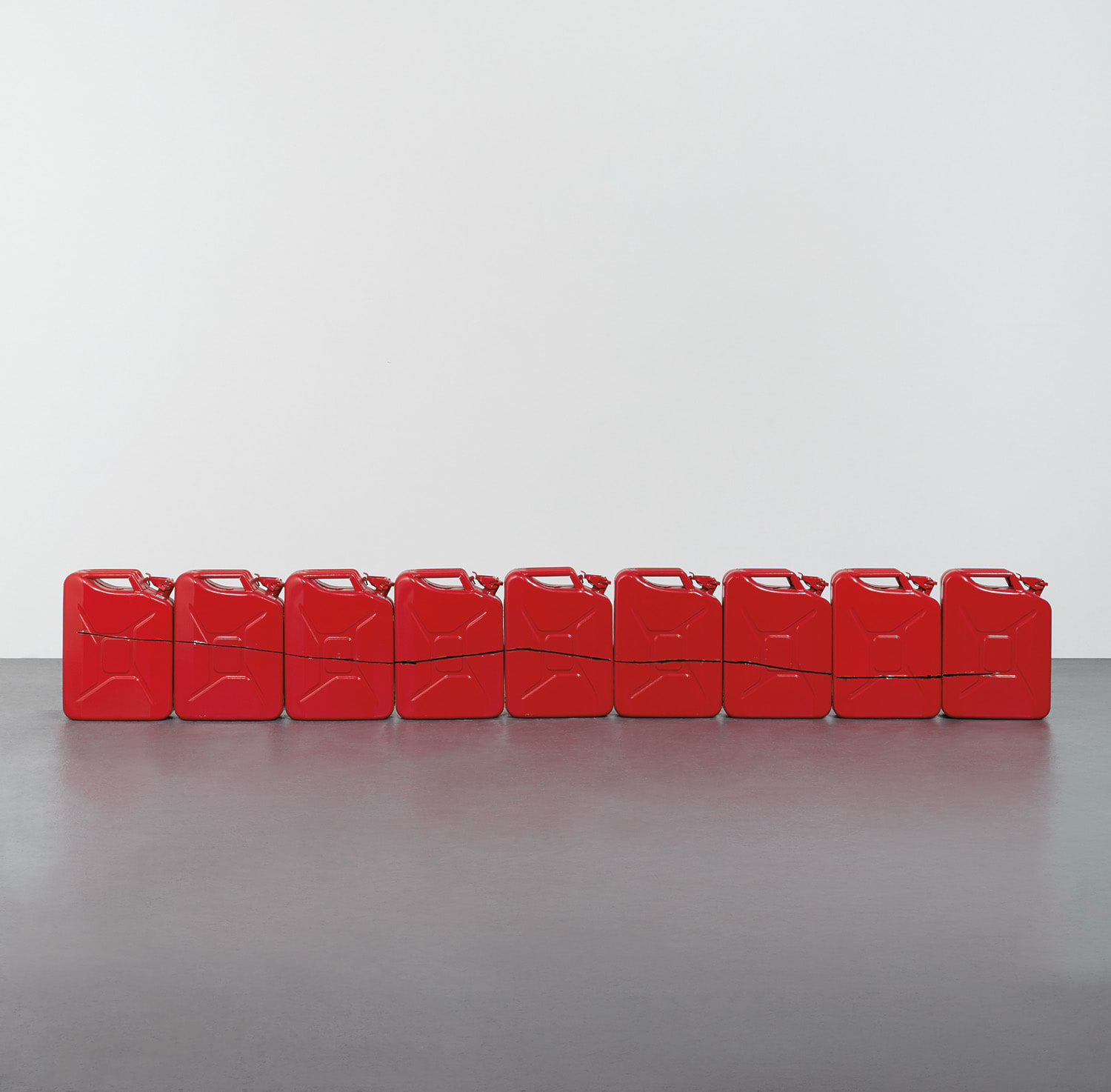
Jerry Can Cut
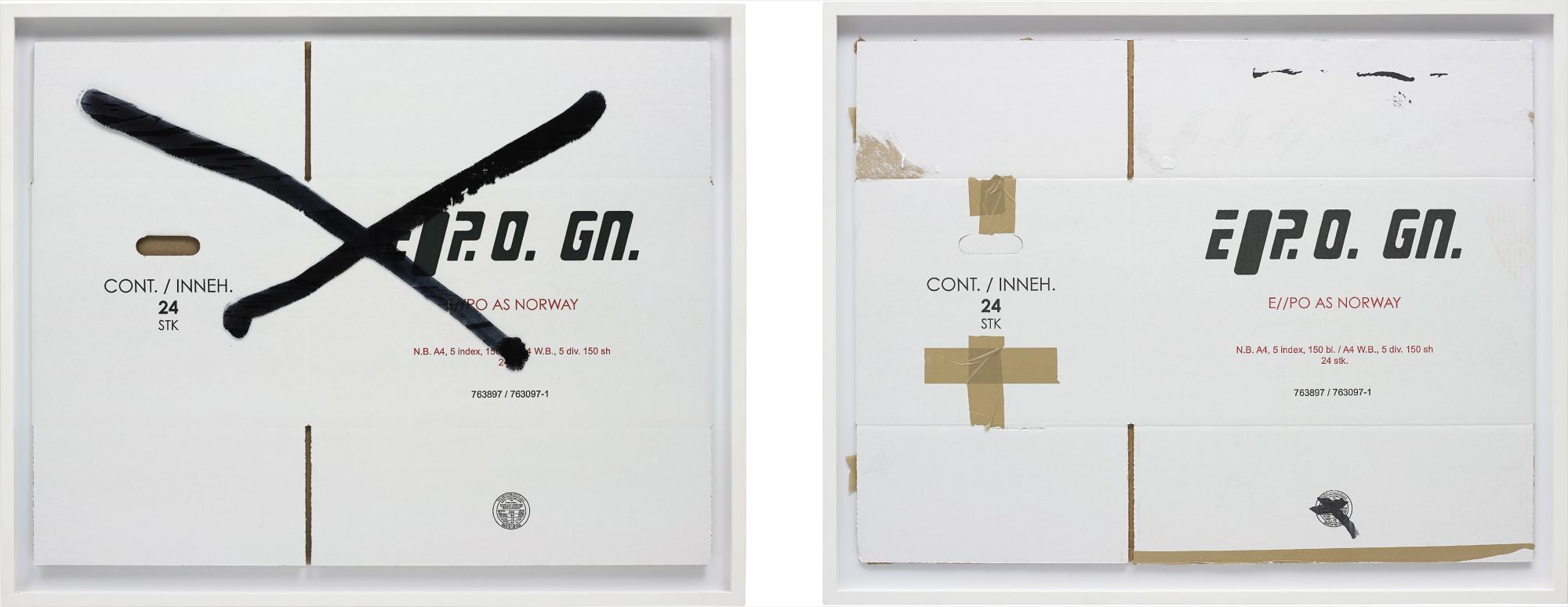
Works in graphite on linen, for instance from 2009, achieve something remarkable: they look simultaneously like the residue of an action and like a carefully considered abstract composition. The linen ground speaks to painting's oldest traditions while the graphite marks suggest improvisation, pressure, even erasure. His cardboard box works, assembled with tape and ink and presented in artist's frames, elevate materials that the world discards to the status of considered objects. The frame is crucial here.
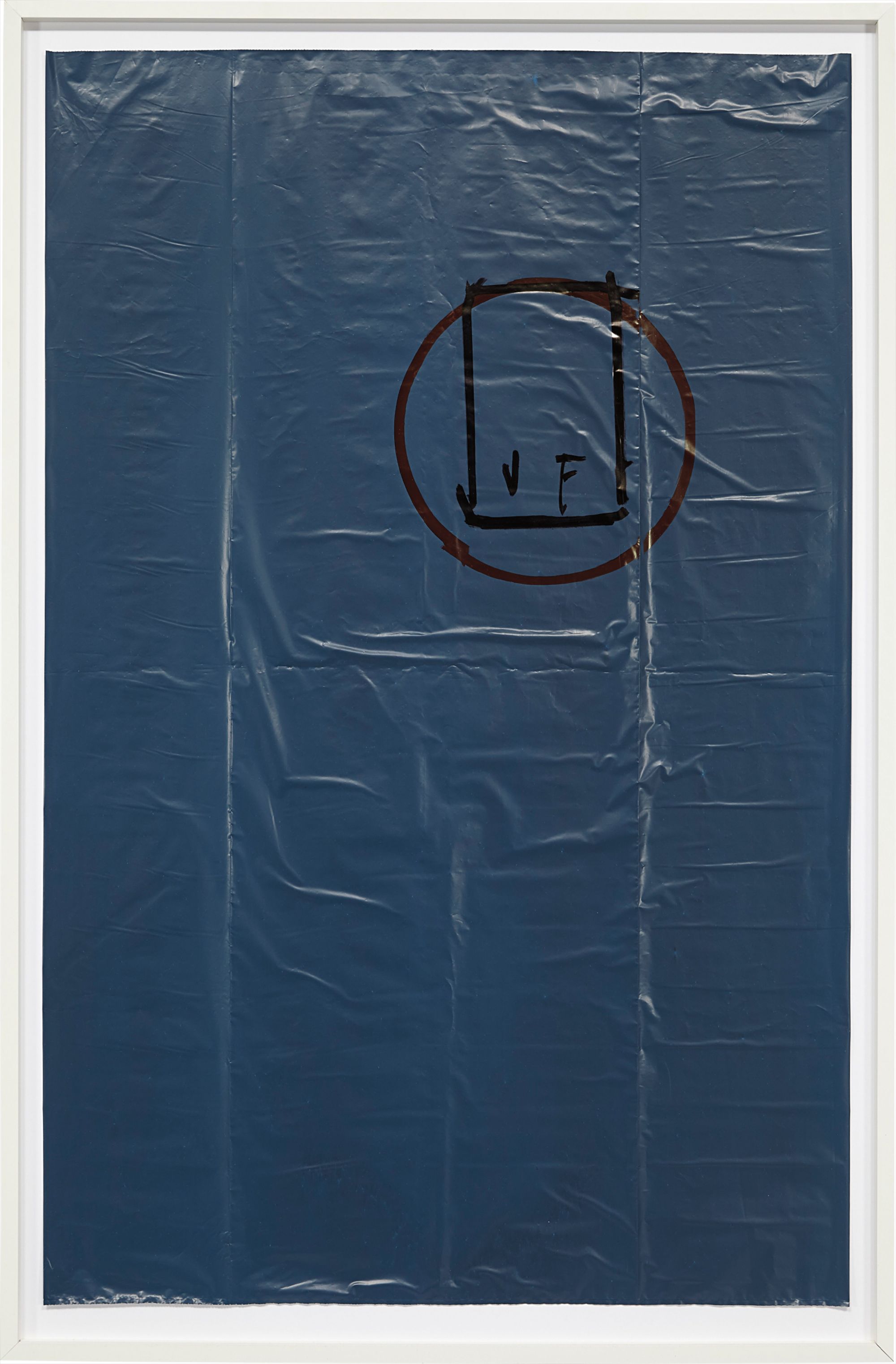
It is an act of framing in both senses: the physical presentation and the conceptual declaration that this is worth looking at. Among his most discussed works are the plastic bag pieces, in which marker pen or felt tip pen is applied to surfaces that are themselves ephemeral and unloved. One work, whose title quotes the artist's own provocative statement about anarchistic mayhem and traditional family values, turns a piece of text into a sculptural object, blurring the line between language and material. There is genuine wit in this, and genuine edge.

Matias Faldbakken
seven LightJet prints on Fuji archival grade paper
The works on paper and plastic from around 2010 have a particular rawness that collectors respond to strongly, a sense that the artist's thinking and the object's making happened almost simultaneously. That quality of immediacy, held within a rigorous conceptual framework, is rare. From a collecting perspective, Faldbakken represents one of those artists whose institutional trajectory and critical standing have consistently outpaced his market profile, which is precisely the kind of asymmetry that serious collectors understand as opportunity. His works exist across a range of media and scale, making the practice accessible to collections of varying scope.
The smaller works on plastic and paper carry the full intellectual weight of his larger installations while living comfortably in domestic or office environments. The framing choices, always made by the artist, mean that even modest works arrive with a strong sense of intentionality and completeness. Collectors who came to him early, drawn by shows at institutions like the Astrup Fearnley, have watched his reputation deepen steadily. In the broader context of art history, Faldbakken operates in productive dialogue with a range of predecessors and contemporaries.
One hears echoes of Martin Kippenberger's irreverent relationship to art world convention, of Dieter Roth's treatment of perishable and everyday materials, and of the Situationist tradition's insistence on the radical potential of ordinary life. Among living artists, his practice rhymes with figures working in the space between painting, sculpture, and conceptual gesture, artists who treat the studio not as a sanctuary but as a site of ongoing interrogation. What distinguishes Faldbakken is the particular Nordic gravity he brings to these conversations, a seriousness that never tips into solemnity. The reason Faldbakken matters today is precisely because the questions his work poses have not been resolved by culture at large.
What does it mean to make objects within a system that commodifies everything? How does an artist speak through negation without simply producing more content? His answers are not comfortable, but they are not nihilistic either. There is care in every crumpled surface, every taped edge, every bag marked with a pen.
That care is what makes the work last, and what makes it genuinely worth living with.