Mason Storm
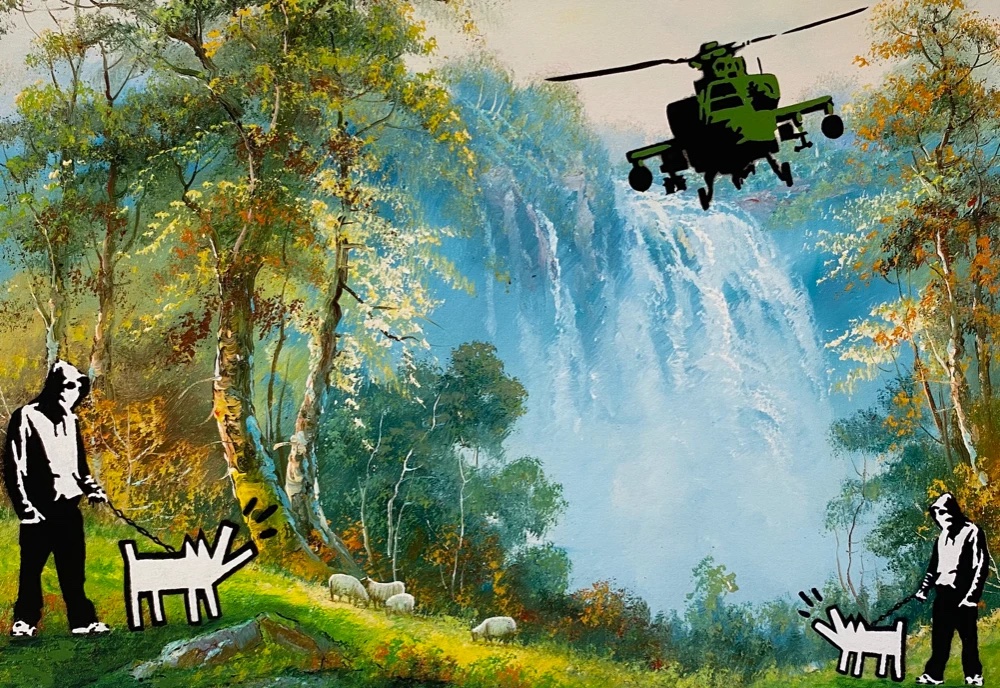
Mason Storm Lights Up the Canvas
Artist Spotlight · The Collection Editorial
Something is stirring in the Los Angeles art world, and the name on everyone's lips is Mason Storm. His 2021 print "Haring of the Dog" arrived as a kind of declaration, a work that fuses the irreverent spirit of post graffiti lineage with the painterly confidence of a mature voice still hungry for discovery. It is the kind of piece that stops collectors mid scroll and holds them there, asking questions about where urban experience ends and pure feeling begins. Storm is, by any measure, an artist whose moment is arriving with unmistakable force.
Mason Storm
Haring of the Dog, 2021
Born in 1986, Storm came of age in an America shaped by the visual noise of cities in flux, where billboard culture, freight train murals, and the crumbling grandeur of industrial infrastructure formed an accidental gallery stretching coast to coast. That sensibility took root early and never let go. By the time he settled in Los Angeles, the city had become both subject and collaborator, its sprawling geography of freeways, dried riverbeds, and neon lit commercial corridors feeding directly into the visual language he would spend years refining. Los Angeles, with its particular quality of light and its willingness to hold beauty and decay in the same frame, proved to be exactly the right home for an artist with Storm's preoccupations.
His development as an artist reflects the disciplined restlessness of someone who absorbs influences without surrendering to them. The post graffiti movement, which counted Jean Michel Basquiat and Keith Haring among its most luminous figures, clearly left its mark on Storm's understanding of scale, urgency, and the democratizing power of public imagery. But Storm pushed further into the territory of Neo Expressionism, bringing the emotional directness of painters like Julian Schnabel and Georg Baselitz into conversation with the street, the factory floor, and the eroded edge of the American West. The result is a practice that feels simultaneously inherited and entirely his own.
What distinguishes Storm's work most immediately is his command of surface and tension. His large scale abstract paintings are built up through layers of gestural brushwork that carry the physical memory of the making, each stroke legible as a decision, an action, a moment of commitment. The palette he has developed is genuinely distinctive: muted ochres, raw umbers, and weathered grays form a structural base that suddenly opens into passages of electric neon, acid green, or fierce magenta. This combination is not decorative contrast but something closer to an argument, the push and pull between entropy and vitality that defines the urban environments he studies so closely.
Standing before one of his large canvases, the viewer feels the city without seeing it literally, which is precisely the achievement. "Haring of the Dog," his 2021 print, demonstrates that Storm's power translates across media with no loss of voltage. The work carries a knowing nod to the energy of Keith Haring while asserting its own visual logic, a reminder that the best art in this lineage honors its ancestors by transforming rather than repeating them. His mixed media installations extend the conversation further, bringing three dimensional texture and material weight into spaces where painting alone might feel insufficient.
Storm is an artist who thinks spatially, who understands that a body moving through a room is also a viewer being changed by what surrounds them. For collectors, Storm represents a genuinely compelling proposition. He occupies a position within the emerging tier of American contemporary art where critical attention and market momentum are beginning to align in the way that, with the right stewardship, precedes a lasting reputation. His work connects to several of the most durable collecting categories of the current moment: street art adjacent painting with fine art ambitions, environmentally engaged practice, and Neo Expressionist gesture reimagined for a generation that came of age after the digital revolution.
Collectors drawn to the market trajectories of artists like Rashid Johnson, Mark Bradford, or the later reception of Basquiat will recognize in Storm the qualities that make a practice worth sustained attention: a coherent vision, a distinctive material language, and genuine things to say about the world. Within the broader context of art history, Storm sits at a productive intersection. The Neo Expressionist painters of the 1980s demonstrated that gestural abstraction could carry cultural and political weight without sacrificing its formal ambitions. The post graffiti artists of the same era proved that the street was as legitimate a crucible for serious art as any academy.
Storm inherits both traditions and asks what they look like when filtered through the environmental anxieties and urban realities of the 2020s. His industrial and environmental themes place him in dialogue with artists attentive to landscape as a site of human consequence, but his method remains stubbornly, beautifully painterly, rooted in the physical act of making marks that matter. Mason Storm is an artist at the beginning of what promises to be a significant and growing body of work. The collectors and institutions who engage with his practice now are not simply acquiring objects of aesthetic merit, though the merit is real and considerable.
They are participating in the formation of a voice that has something urgent and particular to say about American life, American cities, and the strange beauty that survives in places we have built up and worn down in equal measure. That is a rare thing, and it is worth paying close attention.