Liza Lou
Liza Lou: Beauty Built Bead by Bead
Artist Spotlight · The Collection Editorial
“I wanted to make something that honored the invisible labor of women, and beads seemed like the right material because each one is a unit of time.”
Liza Lou, interview with the Whitney Museum of American Art
When the Whitney Museum of American Art presented Liza Lou's monumental installation 'Kitchen' to a stunned public, it was clear that something genuinely new had entered the conversation of contemporary art. Every surface of a fully realized domestic kitchen, from the linoleum floor to the grease splattered stovetop, was encrusted in millions of tiny glass beads, transforming the most mundane room in the American home into a shimmering, almost hallucinatory shrine. The work had taken Lou five years to complete, a period running from 1991 to 1996, and the sheer labor embedded in every square inch announced an artist who understood that devotion itself could be a formal strategy. That single installation made her reputation and, more importantly, asked questions about labor, femininity, and value that the art world is still working to answer.
Liza Lou
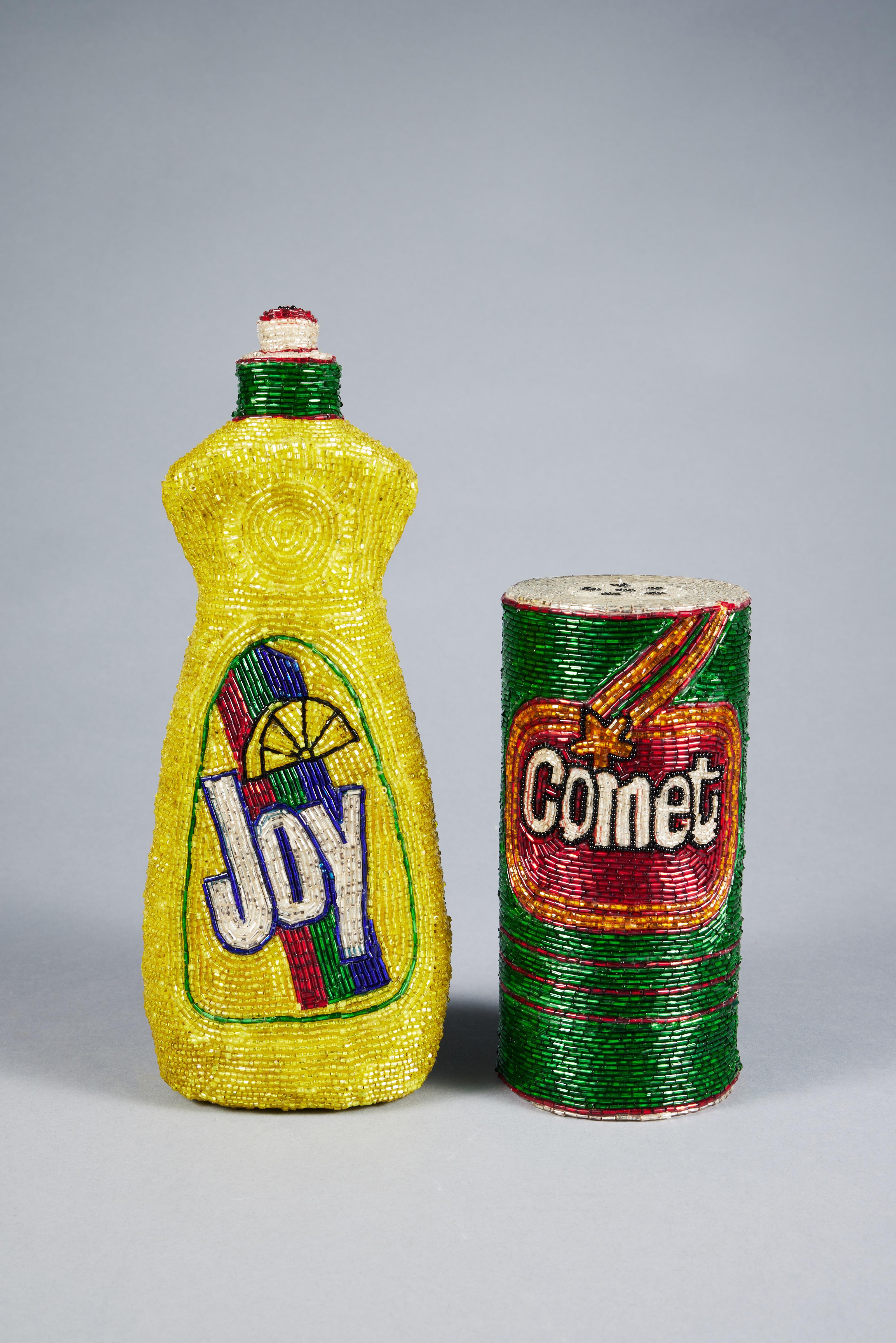
Comet & Joy , 1996
Lou was born in New York in 1969 and grew up largely in the Midwest, where she developed an early fascination with the decorative and the handmade. She was largely self taught as an artist, which gave her practice an independence from academic convention that proved to be one of its greatest strengths. Without the inherited hierarchies of a formal fine arts education, she approached materials with genuine curiosity rather than received wisdom, and she refused the unspoken rule that distinguished so called high art from craft. That refusal became the philosophical engine of everything she has made since.
The completion of 'Kitchen' in 1996 launched Lou into a different register of attention entirely. The work toured extensively and entered serious critical discourse, with scholars and curators recognizing that she had found a way to make visible the invisible labor of women in domestic life by ironically and tenderly celebrating it through obsessive, jewel like embellishment. Works from this period, including 'Comet and Joy' from 1996 and 'Golden Tiger Panties' from 1995, show the same irreverent wit combined with an almost religious seriousness of craft. The 'Cup and Saucer' of 1999, rendered in polyester, resin, and glass beads, extends this language into smaller, more intimate objects that reward close looking with the same intensity as the large installations.
Liza Lou
Liza Lou
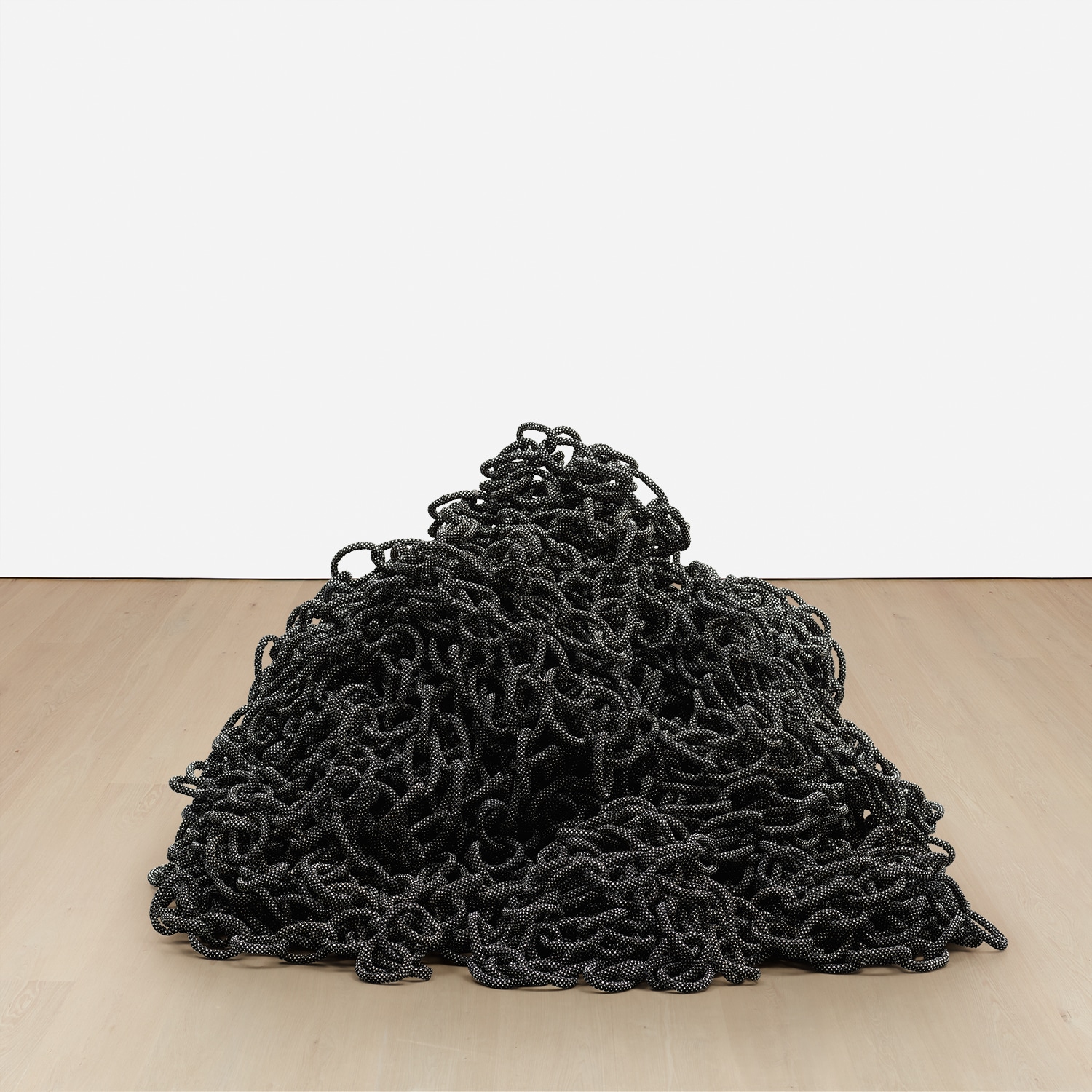
In 2005, Lou made a decision that would reshape her practice entirely and expand its ethical and social dimensions. She moved to Durban, South Africa, and began collaborating with Zulu beadworkers, drawing on a tradition of beadwork that carries deep cultural meaning in that community. The collaboration was not extractive but genuinely reciprocal, with Lou working alongside artisans whose technical mastery far exceeded anything achievable by a single pair of hands working in isolation. Works produced through this ongoing partnership, including the powerful 'Security Fence' and the extraordinary 'Chain' of 2010, use the bead not as a decorative flourish but as a unit of collective human time.
Each bead placed by a collaborator in KwaZulu Natal represents an act of presence, and the cumulative effect of thousands of such acts produces something that transcends any single authorship. 'Stairway to Heaven I' from 2005, composed of synthetic resin, steel, fiberglass, glass pearls, and a bucket and rope in two parts, captures the transitional energy of this new phase perfectly. The evolution toward pure abstraction became fully realized in works like 'Chromium' from 2016, in which woven glass beads on canvas produce a surface that vibrates with color and light in ways that put Lou in conversation with the history of painting as much as with the history of craft. These canvases, created in collaboration with the Zulu beadworkers, are among the most formally rigorous and visually arresting objects in contemporary art.
Liza Lou
Chain, 2010
They sit comfortably alongside the work of artists such as El Anatsui, whose large scale collaborative tapestries of repurposed metal also interrogate the boundaries between craft and fine art, and Kara Walker, whose work similarly reclaims marginalized labor traditions as a vehicle for major artistic statement. One might also think of Judy Chicago, whose 'Dinner Party' similarly marshaled craft traditions in the service of feminist art historical revision, or of the textile based practice of Sheila Hicks, who has spent decades arguing for the intellectual seriousness of fiber and thread. From a collecting perspective, Lou's work occupies a particularly compelling position. Her pieces span an enormous range of scale and price point, from the intimate and wearable glamour of 'Tiara' from 2006 in cast resin and quartz crystals to large scale installations that require significant architectural commitment.
The editions published by Edition Jacob Samuel in Santa Monica represent an accessible entry point for serious collectors, produced with the same care and intention as her unique works. What draws collectors to Lou is a combination of sensory immediacy and intellectual depth that is genuinely rare: her objects are beautiful in a way that requires no theoretical context to appreciate, yet they reward sustained engagement and scholarly attention in equal measure. Her presence in the permanent collections of the Metropolitan Museum of Art, the Smithsonian Institution, and the Victoria and Albert Museum in London confirms that institutional recognition has kept pace with her critical reputation. The legacy of Liza Lou is still being written, which is part of what makes collecting her work so exciting right now.
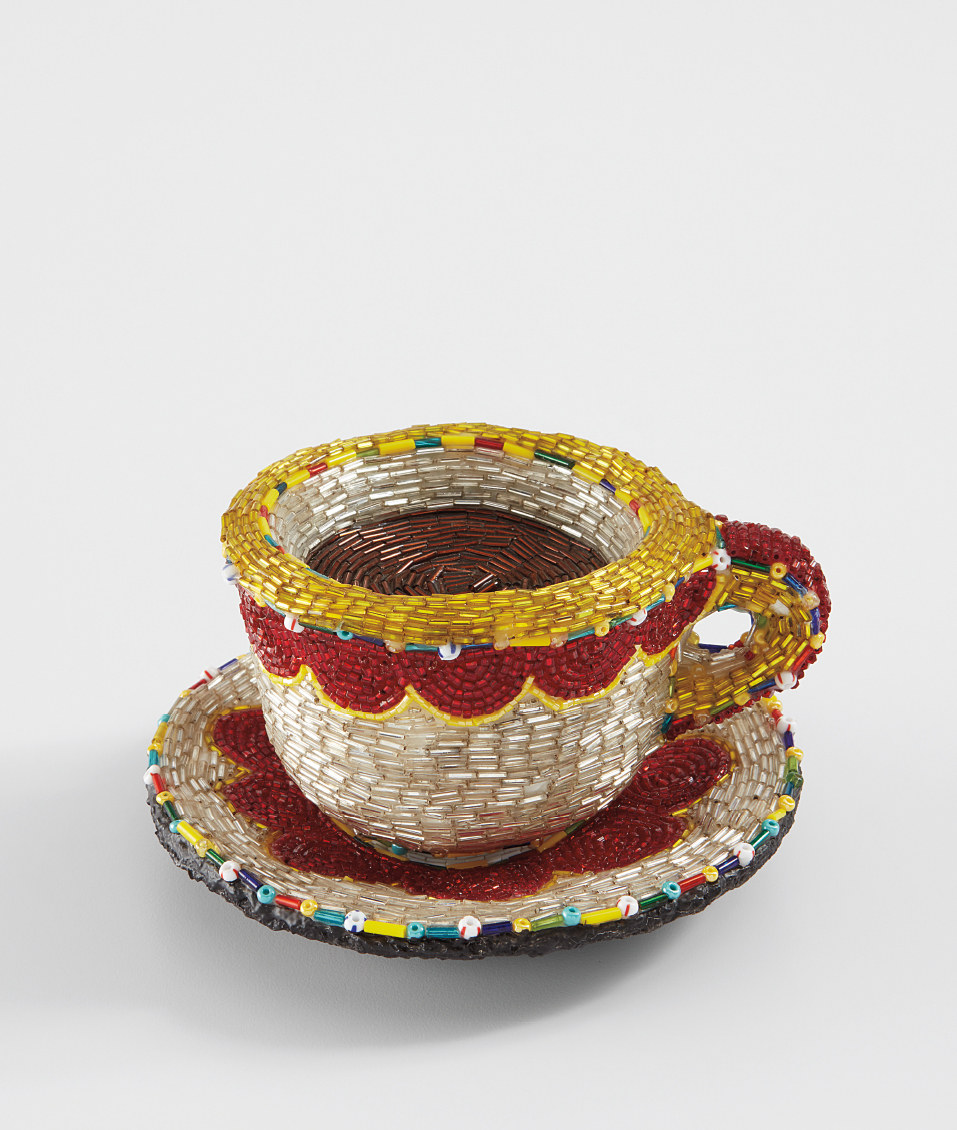
Liza Lou
Cup and Saucer, 1999
She has spent three decades making a case that the boundary between fine art and craft is a political construction rather than an aesthetic reality, and that case has largely been won. Younger artists working in textiles, ceramics, beadwork, and other historically undervalued materials owe a significant debt to the ground Lou cleared. More than that, her ongoing collaboration with Zulu beadworkers in South Africa represents one of the most sustained and thoughtful engagements with questions of authorship, labor, and cross cultural making in contemporary practice. At a moment when the art world is rightly interrogating who gets to make what and under what conditions, Lou's work offers not a polemical argument but a living demonstration of how beauty and justice can be woven together, bead by patient bead.
Explore books about Liza Lou