Lin Tianmiao
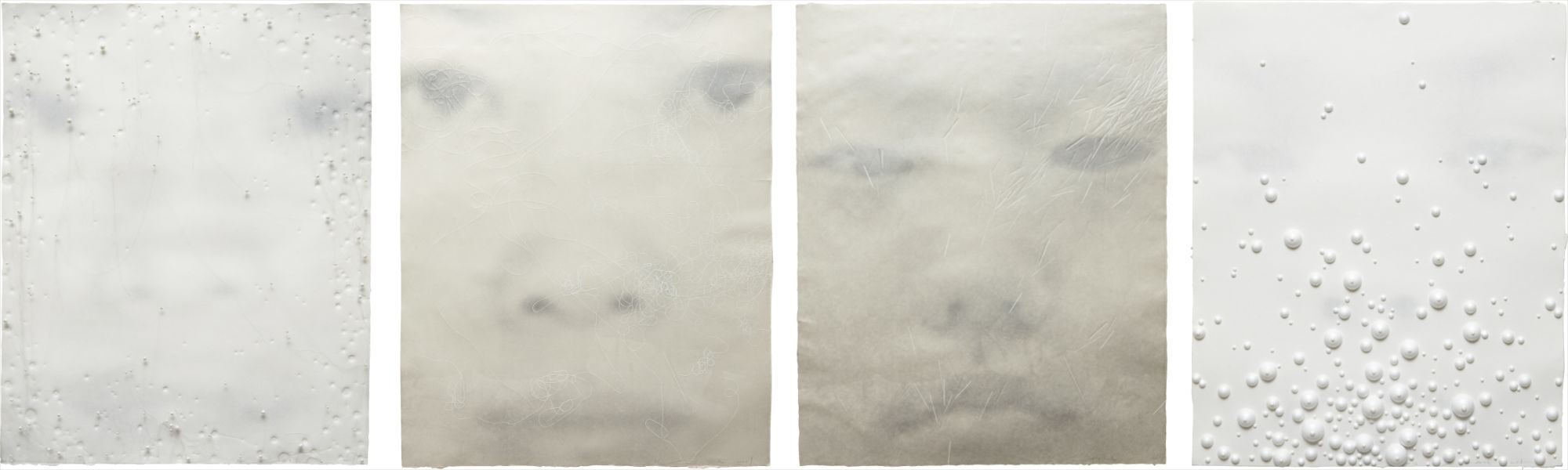
Lin Tianmiao Wraps the World in Thread
Artist Spotlight · The Collection Editorial
When M+ Museum in Hong Kong opened its doors to the public in 2021, it did so as one of the most anticipated cultural institutions of the decade, a vast new home for twentieth and twenty first century visual culture from Asia and beyond. Among the works entering its permanent collection was work by Lin Tianmiao, an artist whose practice had, for nearly three decades, been quietly reshaping the conversation around Chinese contemporary art, gender, and the weight of domestic life. Her presence in that founding collection was not incidental. It was a recognition that her vision had long been essential to understanding what art made in China could mean on a global stage.
Lin Tianmiao
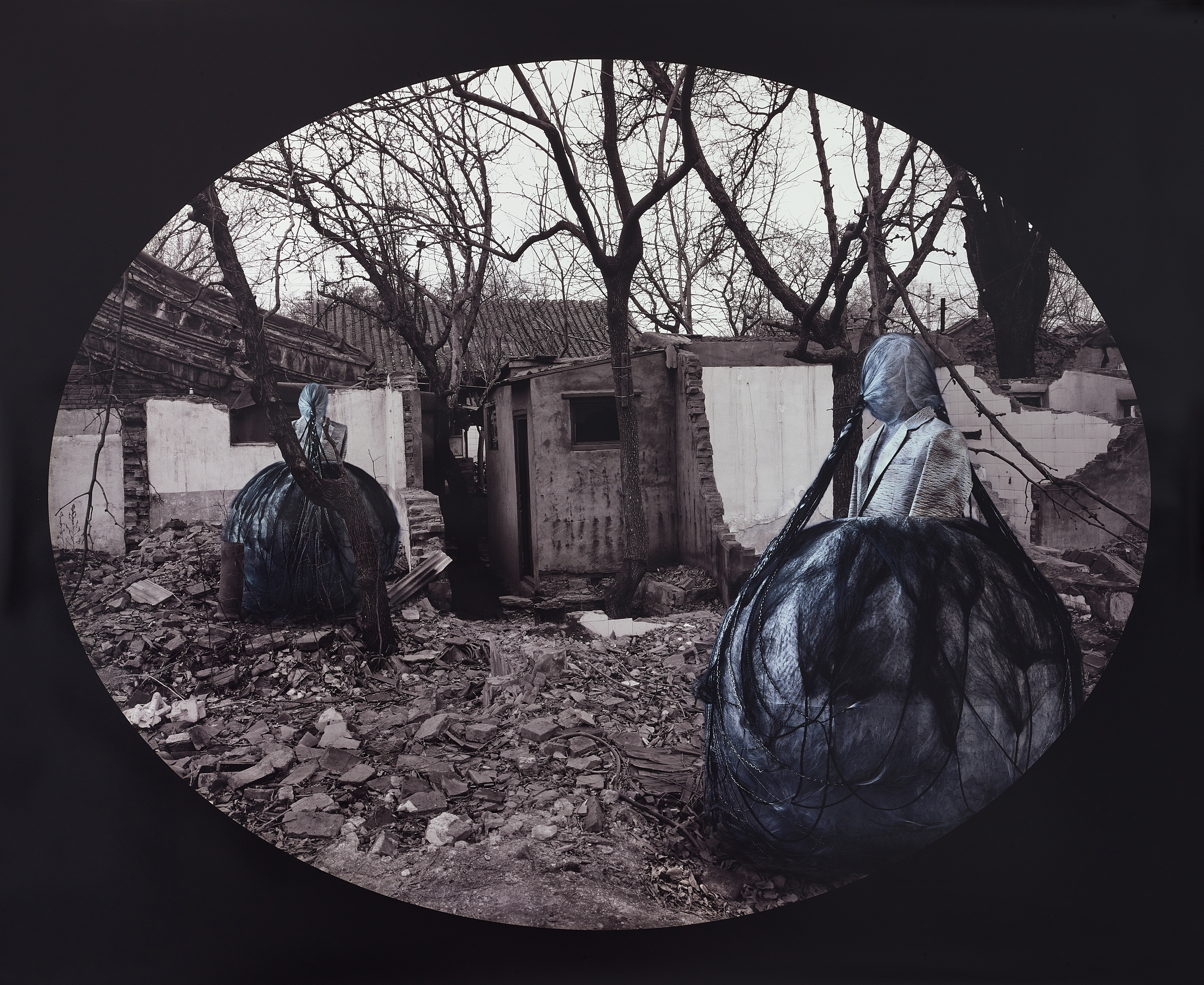
Here? or There? (Set of 7) 這裡? 或那裡? (一組七張), 2002
Lin Tianmiao was born in 1961 in Taiyuan, in the Shanxi province of northern China, a region shaped by coal, industry, and deep historical memory. She studied textile design in Beijing before moving to New York in the mid 1980s, where she spent nearly a decade absorbing the intensity of the Western contemporary art world while also reckoning with what it meant to be Chinese, to be a woman, and to be far from home. That experience of dislocation and observation proved formative. When she returned to Beijing in 1995, she brought with her a clarity of purpose and a vocabulary that felt genuinely new within the Chinese context: intimate, bodily, and threaded through with feminist consciousness.
Her earliest major works announced her intentions unmistakably. In the mid 1990s, Lin began wrapping ordinary domestic objects in white thread, thousands of meters of it, applied with extraordinary patience and physical devotion. The resulting sculptures transformed telephones, scissors, bones, shoes, and other everyday items into something both familiar and deeply strange, objects held in a kind of suspension between recognition and erasure. The labor embedded in those works was inseparable from their meaning.
Lin Tianmiao
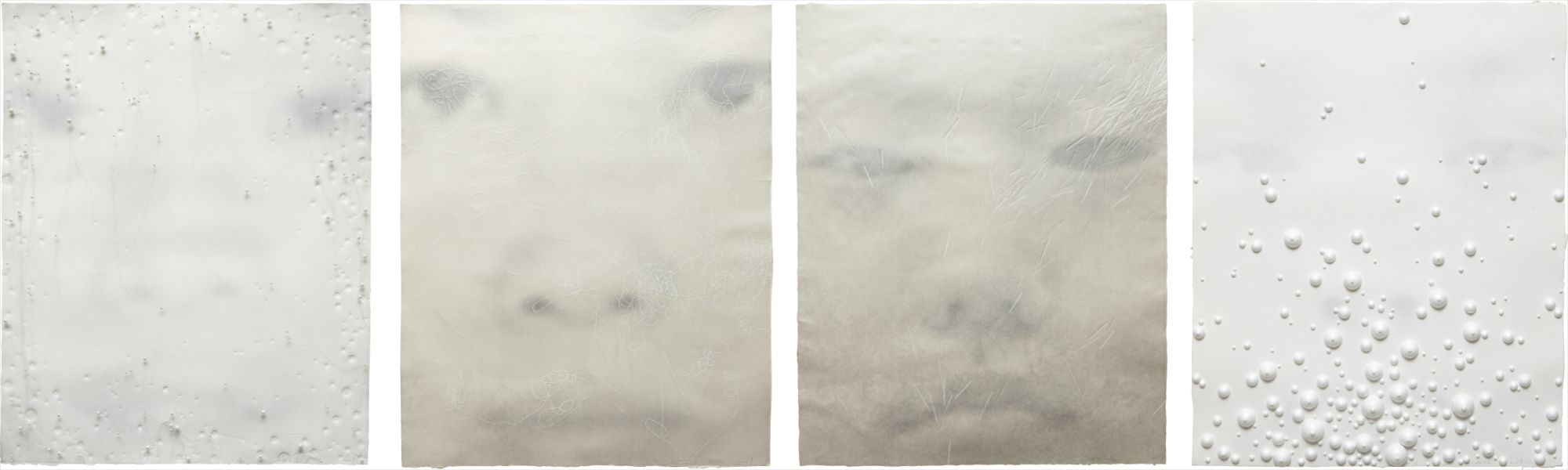
Four works: (i) Focus II A; (ii) Focus III A; (iii) Focus XV A; (iv) Focus XVI A
Thread, in Chinese domestic culture, has long been associated with the work of women, with mending and making and the invisible maintenance of household life. By taking that thread and using it to obscure, to cocoon, to monumentalize, Lin was simultaneously honoring and interrogating the terms of female existence. A major breakthrough in her international profile came through her participation in exhibitions at institutions including the Asia Society in New York, where her installations drew serious critical attention and introduced her practice to a new generation of collectors and curators outside China. The Venice Biennale further cemented her standing, placing her within the global conversation at the moment when Chinese contemporary art was beginning to attract the sustained attention of the Western art world.
What distinguished Lin from many of her contemporaries was her insistence on the personal as a site of political meaning. While some artists were engaging spectacle and scale, she was working with the grain of domestic intimacy, making work that asked viewers to slow down, to look closely, and to feel the accumulation of hours. The works on offer through The Collection offer a remarkable window into a specific and particularly rich chapter of Lin's career. The two sets from the series "Here?
Lin Tianmiao
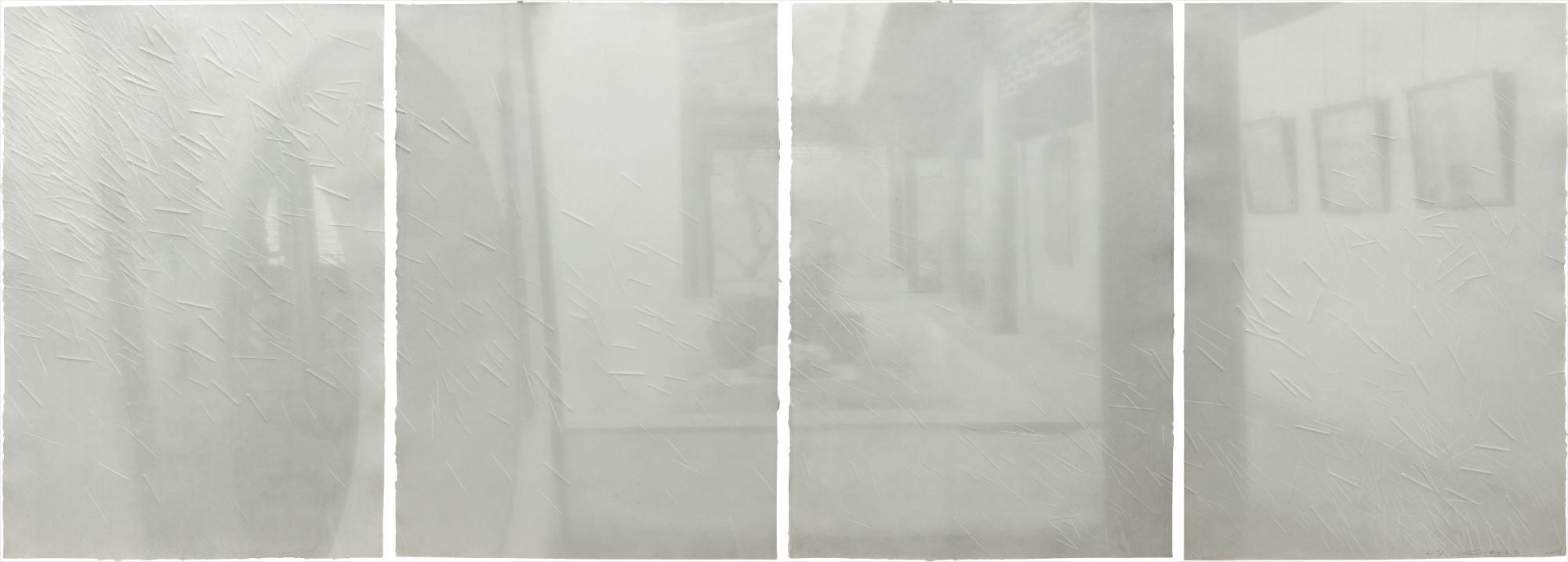
Seeing Shadows II A
or There?" created in 2002 and rendered as chromogenic prints in multiple parts, are among the most searching photographic works of her practice. In these images, Lin turns the camera on her own body, presenting it in ways that are at once vulnerable and controlled, asking with characteristic directness where a woman is permitted to exist and on whose terms. The question posed in the title is not rhetorical.
It reverberates through every decision of framing, of light, of the female form in space. The duality of the sets, one of seven parts and one of eight, suggests an open ended inquiry rather than a resolved argument, which is entirely in keeping with Lin's intellectual sensibility. The Focus series works and the Seeing Shadows pieces represent another dimension of her practice, one developed in close collaboration with the Singapore Tyler Print Institute, known widely as STPI. These are technically intricate works that combine lithography, embossing, screenprinting, hand coloring, insect pins, thread, and handmade paper into objects that feel almost archaeological in their density of material and meaning.
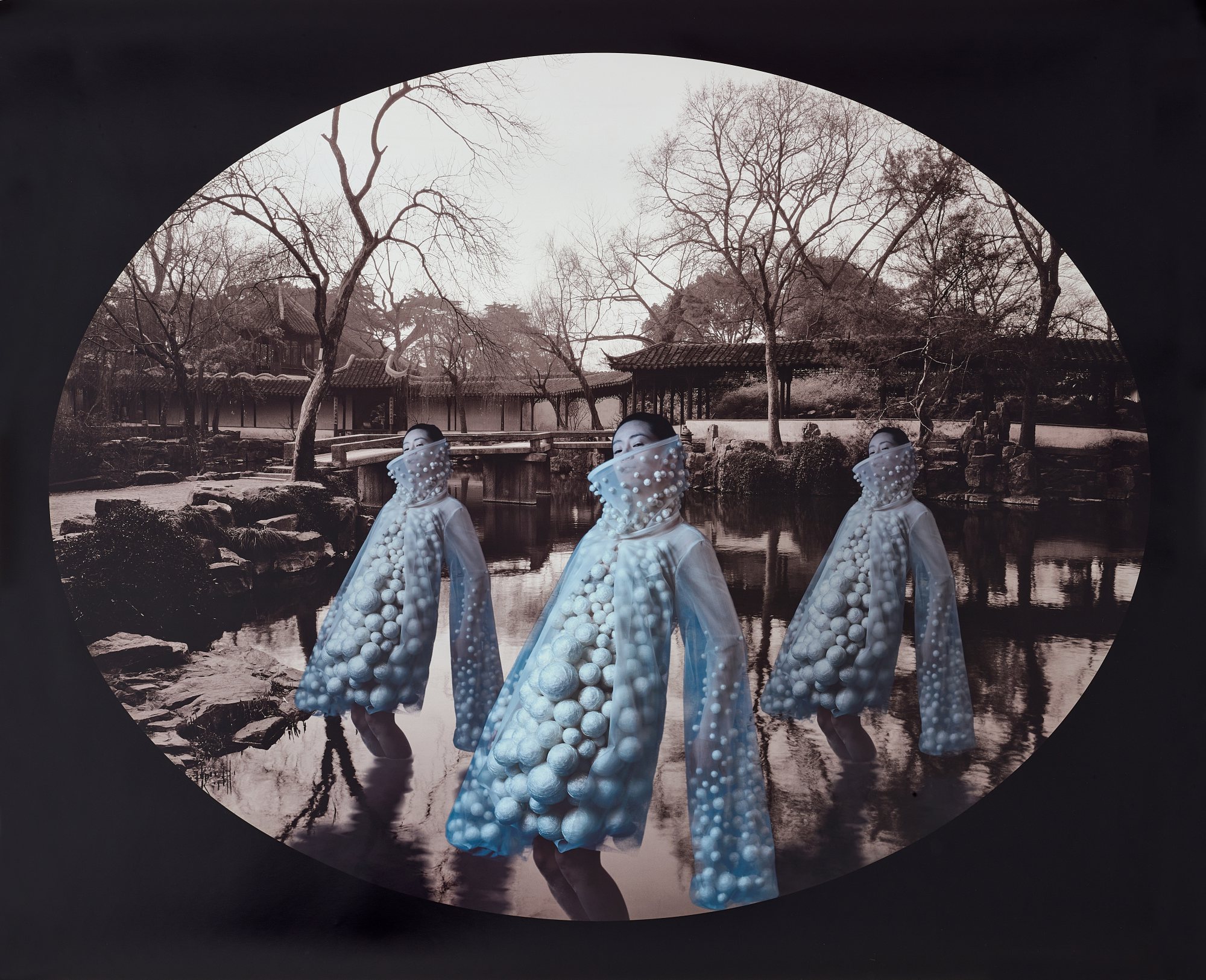
Lin Tianmiao
Here? or There? (Set of 8) 這裏? 或那裏? (一組八張), 2002
The use of insect pins alongside thread in the Focus works is characteristic of Lin's willingness to let menace and tenderness coexist within a single frame. These are not gentle works, even when they are quiet. They ask something of the body of the viewer as much as they record the labor of the artist's own hands. For collectors, Lin Tianmiao represents a compelling and increasingly important holding.
She occupies a position that very few artists can claim: a pioneer of Chinese feminist art whose work was made during a period of genuine urgency and creative risk, now held in major institutional collections including the San Francisco Museum of Modern Art as well as M+. The print and photographic works available through The Collection offer an accessible point of entry into a practice that has historically commanded serious attention at auction and in the secondary market, particularly as interest in Chinese women artists of her generation has grown substantially among both Asian and Western collectors. Works on paper and photographic editions by Lin reward close living with; they reveal more over time rather than less. Within art history, Lin Tianmiao's closest affinities are with artists who have used craft, the body, and domestic material to challenge the hierarchies of gender and culture.
One thinks of artists like Kiki Smith, whose explorations of the female body through unconventional materials share a certain spiritual kinship with Lin's thread works, or of Louise Bourgeois, whose lifelong excavation of domestic anxiety and female experience in sculpture established a lineage that Lin extends in distinctly Chinese terms. She might also be considered alongside her contemporary and compatriot Gu Wenda, though where his work tends toward the monumental and linguistic, Lin's remains anchored in the tactile and the intimate. Lin Tianmiao's legacy is still being written, which is part of what makes her such a vital figure to collect and follow right now. She has spent thirty years asking what it means to be a woman in a society undergoing transformation at a speed almost too great to comprehend, and she has asked those questions not through polemic but through the slow, disciplined, deeply felt accumulation of material and meaning.
That is a rare thing. Her work does not shout. It insists, patiently and precisely, in the way that only the most confident art can.