Lalla Essaydi
Lalla Essaydi Writes Her Own Story
Artist Spotlight · The Collection Editorial
“I want to reclaim the space of the harem, not as a place of confinement, but as a space of female power.”
Lalla Essaydi
When the Los Angeles County Museum of Art and the British Museum both hold your work in their permanent collections, it signals something beyond critical approval. It signals that the art world has recognized a voice that fundamentally reshaped how we see Arab women, domestic space, and the long shadow of Orientalist fantasy. Lalla Essaydi, the Moroccan American photographer whose elaborately staged tableaux blend centuries of art history with urgent contemporary politics of identity, has arrived at a moment of sustained institutional and collector recognition that feels entirely deserved. Her photographs now occupy the kind of wall space, in museums and in private homes alike, that her earliest subjects could never have imagined.
Lalla Essaydi
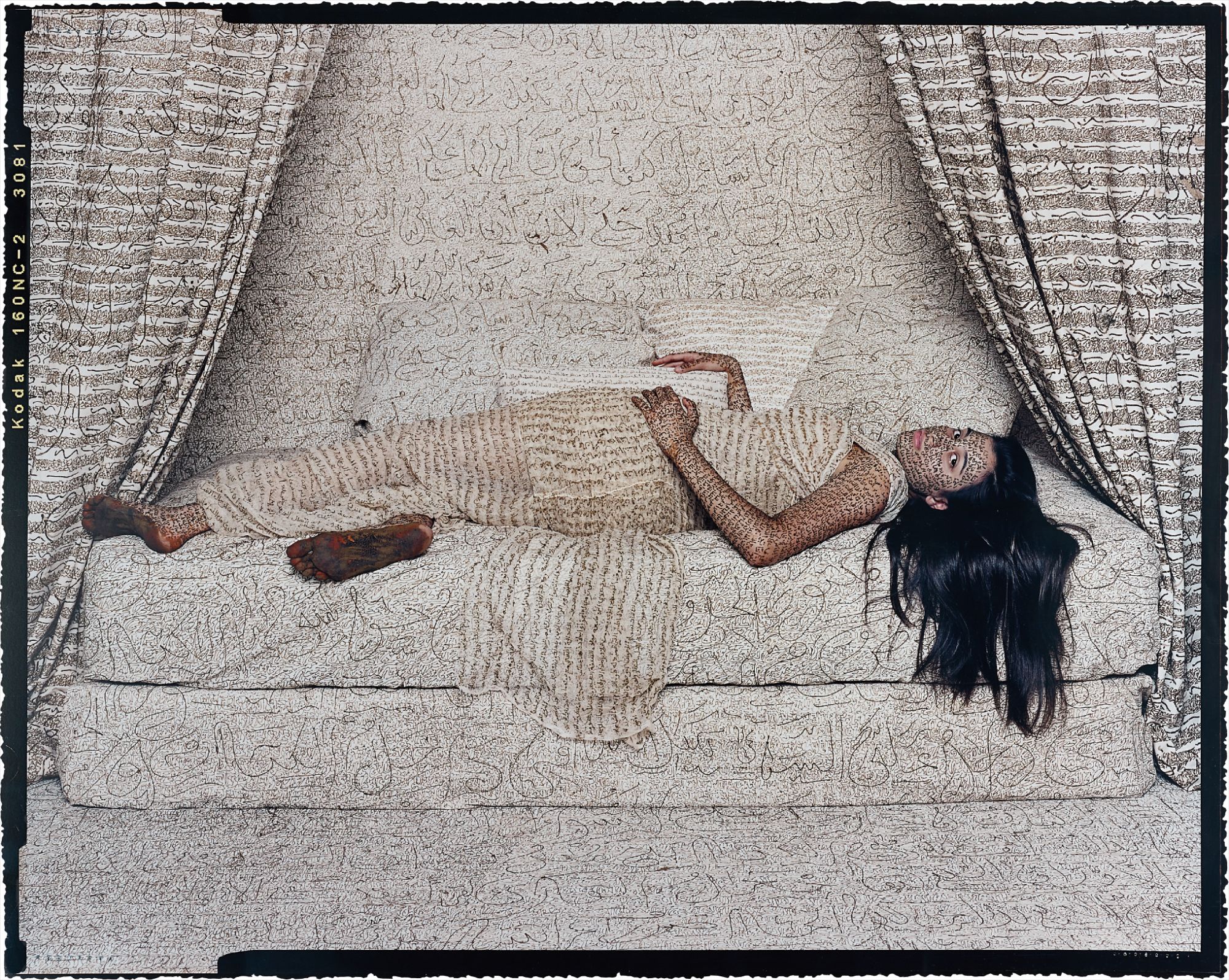
Les Femmes du Maroc: Harem Beauty #2
Essaydi was born in Morocco in 1956, and the world she grew up in carried its own complex negotiations between tradition and modernity, between the private sphere of women and the public world of men. She spent time as a young woman living in Saudi Arabia and later moved to the United States, where she studied at the School of the Museum of Fine Arts in Boston and later at Harvard University. This dual formation, rooted in the lived realities of Arab domestic culture and sharpened by rigorous Western art historical training, gave her a perspective that few artists working in either tradition could claim. She understood Orientalism from the inside and from the outside simultaneously, which is precisely what makes her work so charged.
Her artistic practice emerged fully formed around the early 2000s, when she began the photographic series that would become her signature: large scale chromogenic prints featuring women, often herself or women from her family and community, arranged in spaces drawn directly from the visual vocabulary of nineteenth century Orientalist painting. Think Jean Leon Gerome, think Ingres, think the Western male fantasy of the harem as a space of passive, available femininity. Essaydi knew that vocabulary intimately, and she chose to enter it not by rejecting its visual grammar but by inhabiting and transforming it from within. The effect is startling and deeply considered.
Lalla Essaydi
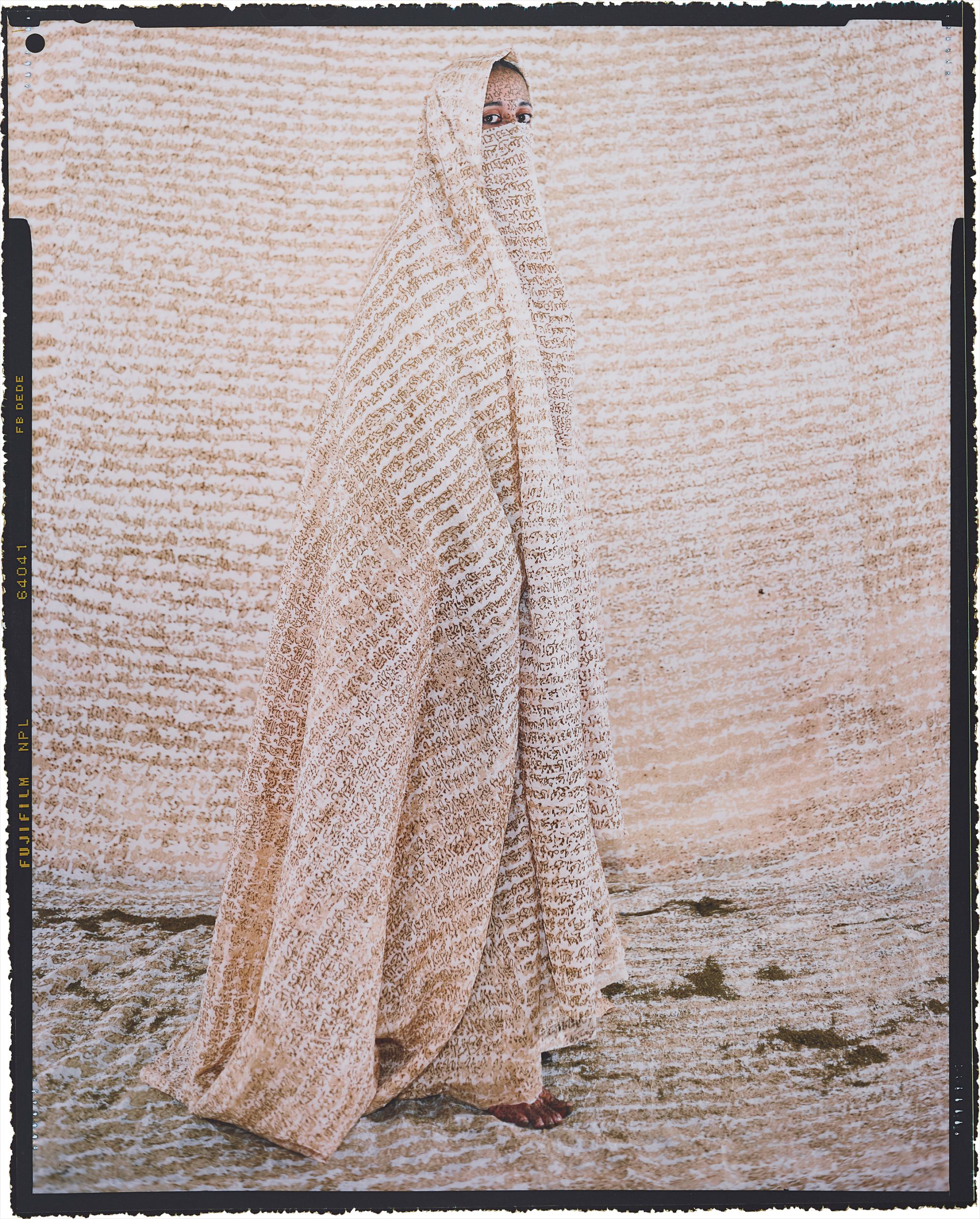
Converging Territories #2
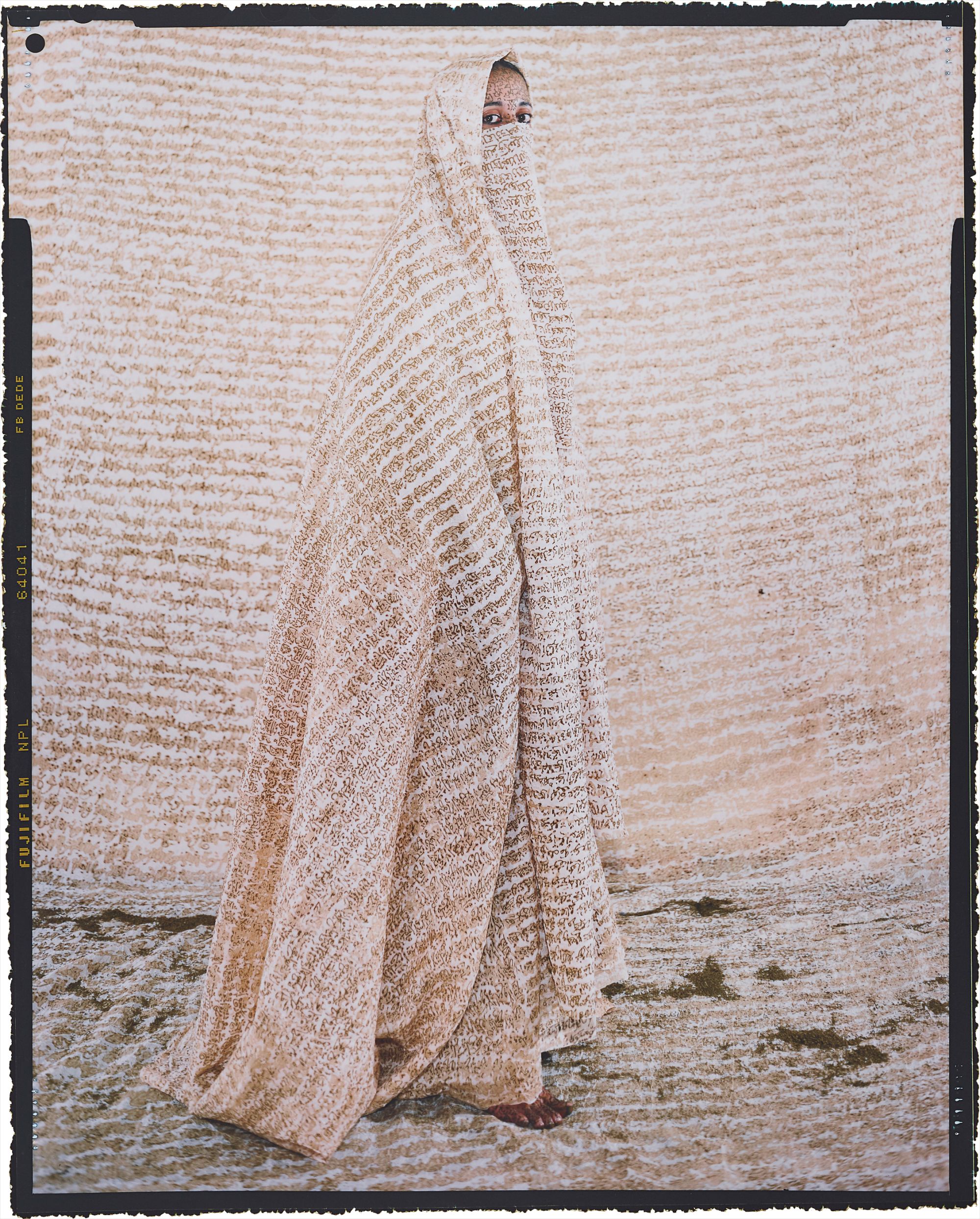
What distinguishes her photographs above all else is the use of Arabic calligraphy, written directly onto the skin, the clothing, and the architectural surfaces of her subjects. The text, drawn from her own writings and meditations on womanhood, memory, and belonging, covers everything. Skin becomes page. Wall becomes manuscript.
The women in her images are not passive objects of the Western gaze but active bearers of language, of meaning, of self authored narrative. In works such as Converging Territories #2 and Converging Territories #10, face mounted to Plexiglas in a manner that gives the image an almost liquid luminosity, the interplay between the body and the written word creates a visual density that rewards extended looking. Each viewing reveals new layers of inscription and intention. The series Les Femmes du Maroc, represented on the platform by works including Harem Beauty #2, Les Femmes du Maroc no.
Lalla Essaydi
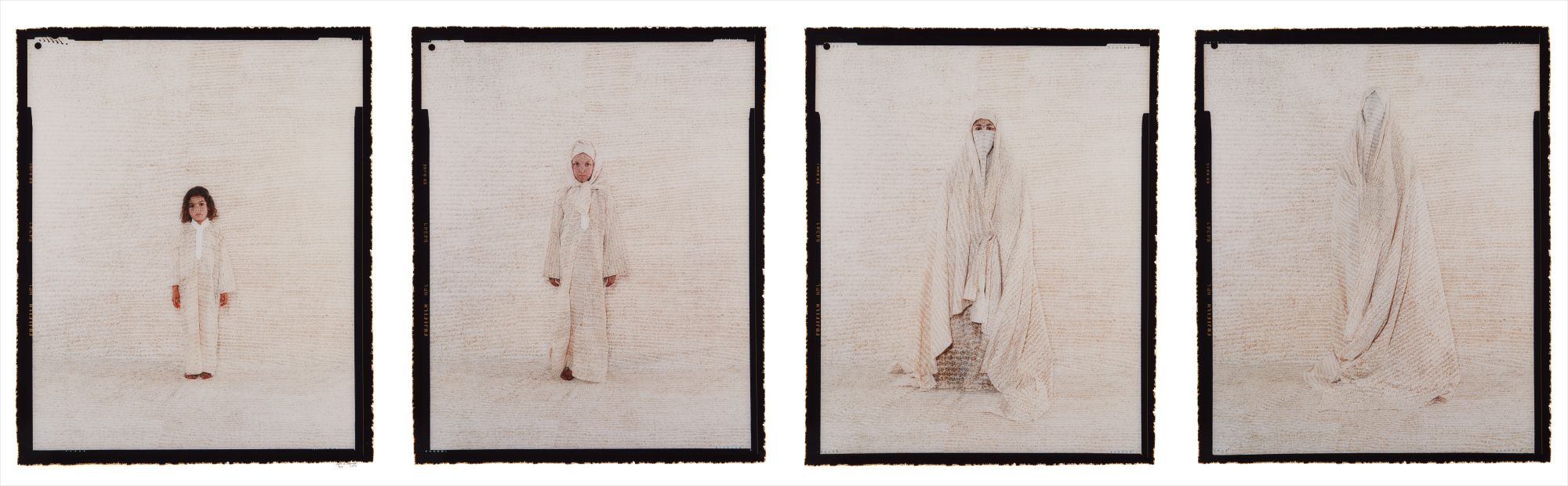
Converging Territories #21
21B, and the quietly stunning Kenza, deepened this investigation by drawing more explicitly on the specific conventions of Moroccan domestic interiors, with their intricate tilework, their embroidered textiles, their carefully demarcated gendered spaces. In Harem Beauty, presented as a chromogenic print triptych flush mounted to the wall, the format itself becomes part of the argument: the triptych echoes the devotional altarpieces of Western religious painting, elevating these women into a register that feels both sacred and political. The Bullet Revisited series extended her practice into even more overtly charged territory, introducing imagery that references conflict and resilience in ways that feel entirely consistent with her broader project. For collectors, Essaydi's work offers something increasingly rare in the contemporary photography market: a body of work that is both visually magnificent and intellectually irreducible.
Her chromogenic prints, many of them face mounted to Plexiglas in a technique that gives the color an extraordinary depth and saturation, are physically beautiful objects. But the beauty is never merely decorative. It is argumentative, it is structural, it is the point. Collectors who have acquired her work, and the institutional holdings at LACMA and the British Museum suggest that both private and public collectors have moved with conviction, tend to speak about her photographs as objects they cannot stop thinking about.
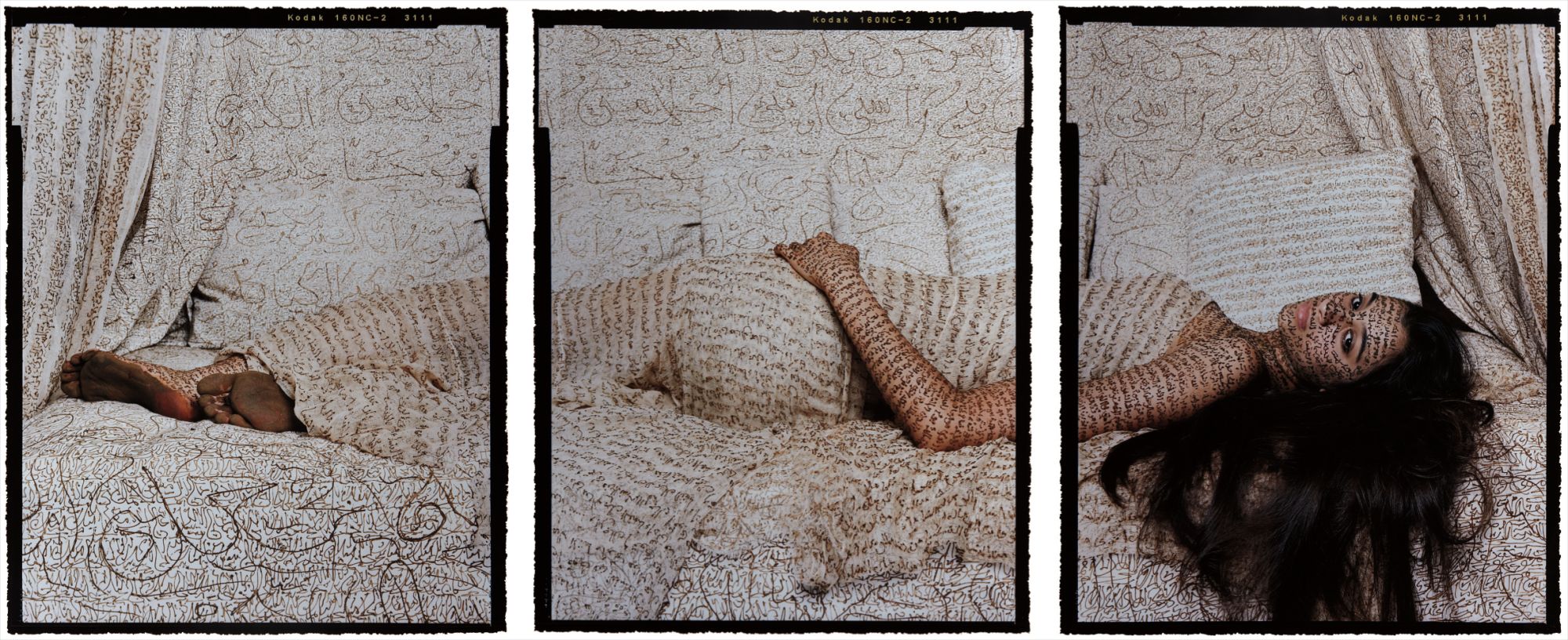
Lalla Essaydi
Harem Beauty
That quality of persistent intellectual engagement is something the secondary market consistently rewards over time. Essaydi belongs to a broader generation of artists who emerged in the 1990s and 2000s to challenge the representational legacy of colonialism through photography and staged imagery. Her work invites comparison with artists such as Shirin Neshat, whose photographs and films similarly interrogate the place of women in Islamic societies through the lens of calligraphy and the body, and with Yinka Shonibare, who approaches the visual culture of empire through an entirely different material vocabulary but with a similarly forensic intelligence. Like both of those artists, Essaydi operates in the space where beauty and critique become inseparable, where the pleasure of looking is bound up with the demand to think.
What makes Essaydi's legacy feel so secure, and so alive, is the way her work refuses to age into mere historical document. The questions she poses about who gets to represent whom, about the gap between fantasy and lived experience, about the relationship between the female body and the written word, remain as pressing today as they were when she made her first major series. In a cultural moment that continues to grapple with representation, with the politics of visibility, and with the enduring distortions of colonial imagery, her photographs function as both corrective and celebration. They insist on the full humanity, the full complexity, and the full expressive power of the women they portray.
That insistence, rendered in some of the most visually arresting photographs of the past two decades, is a gift to anyone fortunate enough to live with them.