Kim Tschang-Yeul
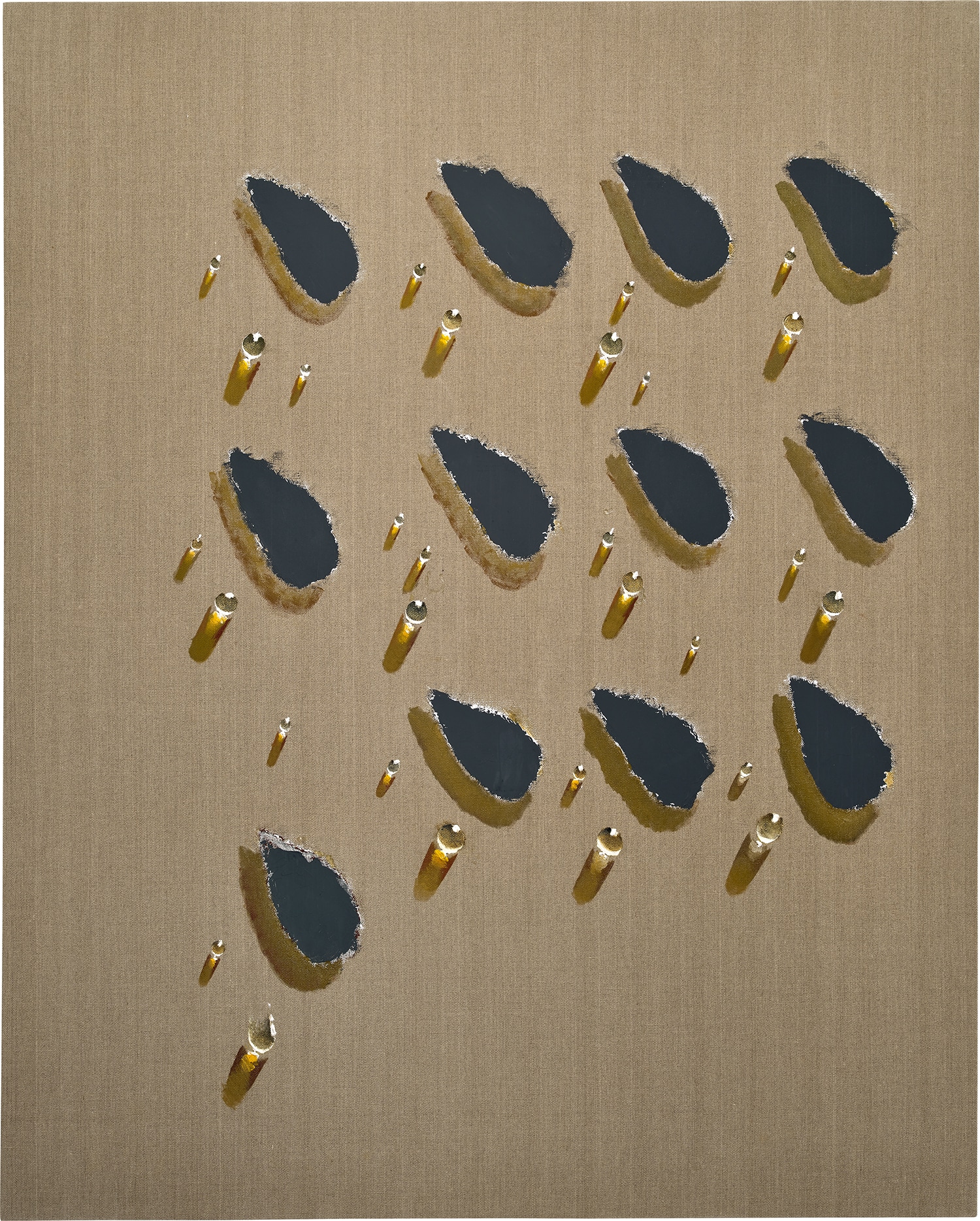
Kim Tschang-Yeul: Every Drop a Universe
Artist Spotlight · The Collection Editorial
“I paint water drops as a means of achieving spiritual purification, to wash away the wounds of history.”
Kim Tschang-Yeul, interview with Galerie Bhak
In the spring of 2022, the Musée d'Art Moderne de Paris mounted a landmark retrospective honoring the life and work of Kim Tschang Yeul, who had passed away in January 2021 at the age of ninety one. The exhibition drew crowds of collectors, curators, and devoted admirers from across Europe and Asia, many of whom stood in long silence before canvases covered in luminous, impossibly precise water droplets. For those encountering his work for the first time, the experience was quietly revelatory. For those who had followed him for decades, it was a farewell tinged with deep gratitude.
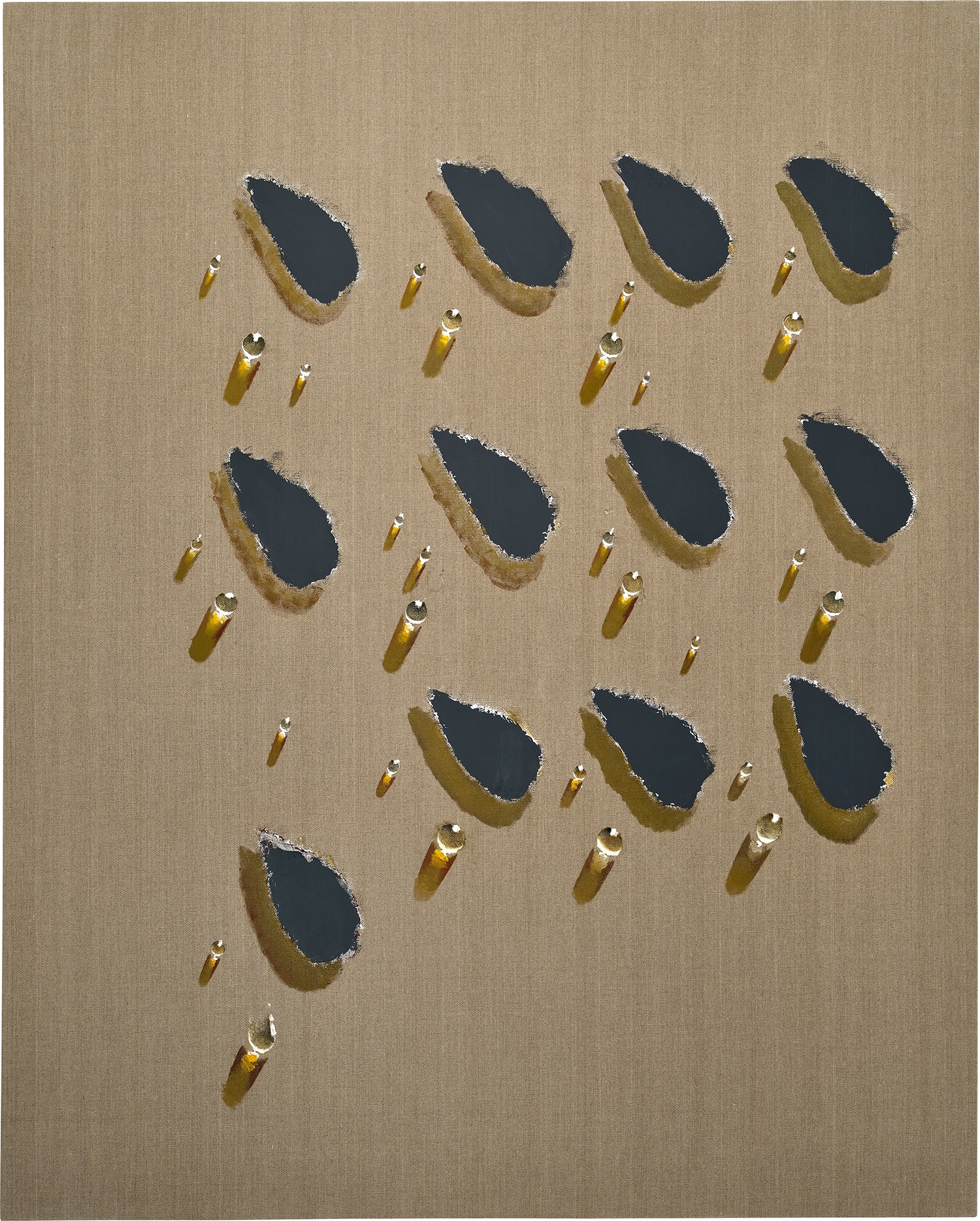
Kim Tschang-Yeul
Colorplate 75, 1988
Kim Tschang Yeul was born in 1929 in Maengsan, in what is now North Korea, a region of cold mountains and spare beauty that shaped his sense of stillness from an early age. His childhood and young adulthood were defined by successive upheavals: Japanese colonial rule, the division of the Korean peninsula, and the catastrophic violence of the Korean War in the early 1950s. He studied painting at the Seoul National University College of Fine Arts, where he came of age alongside a generation of Korean artists grappling with the tension between inherited traditions and the urgent pressures of modernism arriving from the West. These formative years planted in him a desire for an art that could hold both devastation and transcendence simultaneously.
In 1965, Kim moved to New York, where he encountered the full force of the American avant garde. He showed work at the Galerie Arnaud in Paris and moved in circles that brought him into contact with Abstract Expressionism and the emerging Minimalist movements that were reshaping contemporary art. Yet he felt increasingly that these movements, for all their power, could not fully accommodate what he needed to say. It was in New York that he began to move toward the image that would define his entire subsequent career.
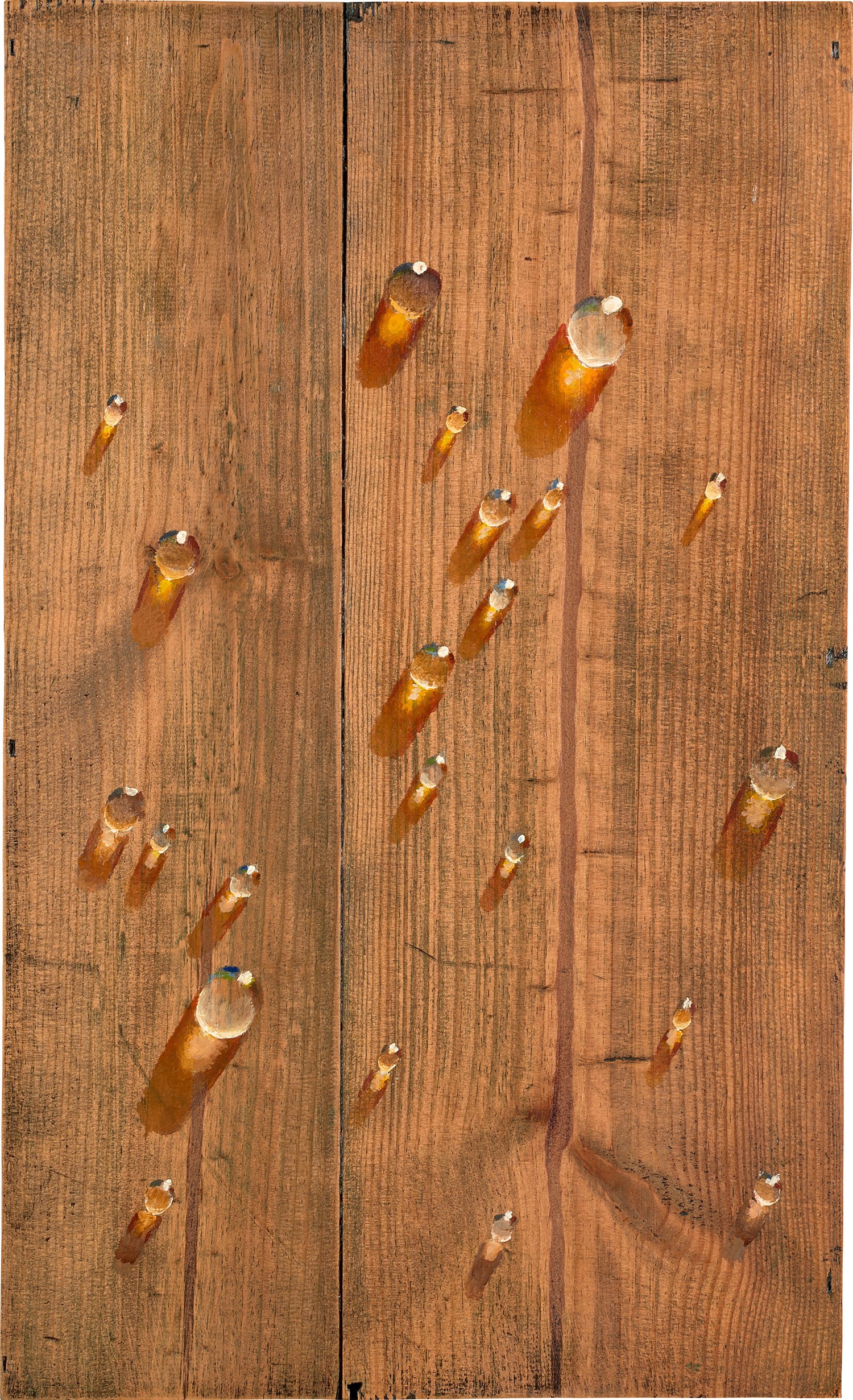
Kim Tschang-Yeul
Bacchus, 1998
Around 1970, after witnessing the trauma of the Vietnam War protests and reflecting on his own history of displacement and loss, he painted his first water droplets. The gesture felt instinctive, almost involuntary, as though the image had been waiting inside him all along. In 1969, Kim settled permanently in Paris, a city that offered both the artistic community he craved and a certain productive distance from the weight of Korean history. It was in his Paris studio that the water drop practice deepened into something approaching spiritual discipline.
He worked on hemp cloth and canvas, layering oil paint with extraordinary patience to achieve surfaces of almost photographic fidelity. Each droplet was rendered with a precise highlight, a curved shadow, a sense of cool weight suspended on the verge of falling. The works were grouped under the recurring title Recurrence, a word that captured his belief that the act of painting these drops over and over was itself the meaning. Repetition was not limitation.
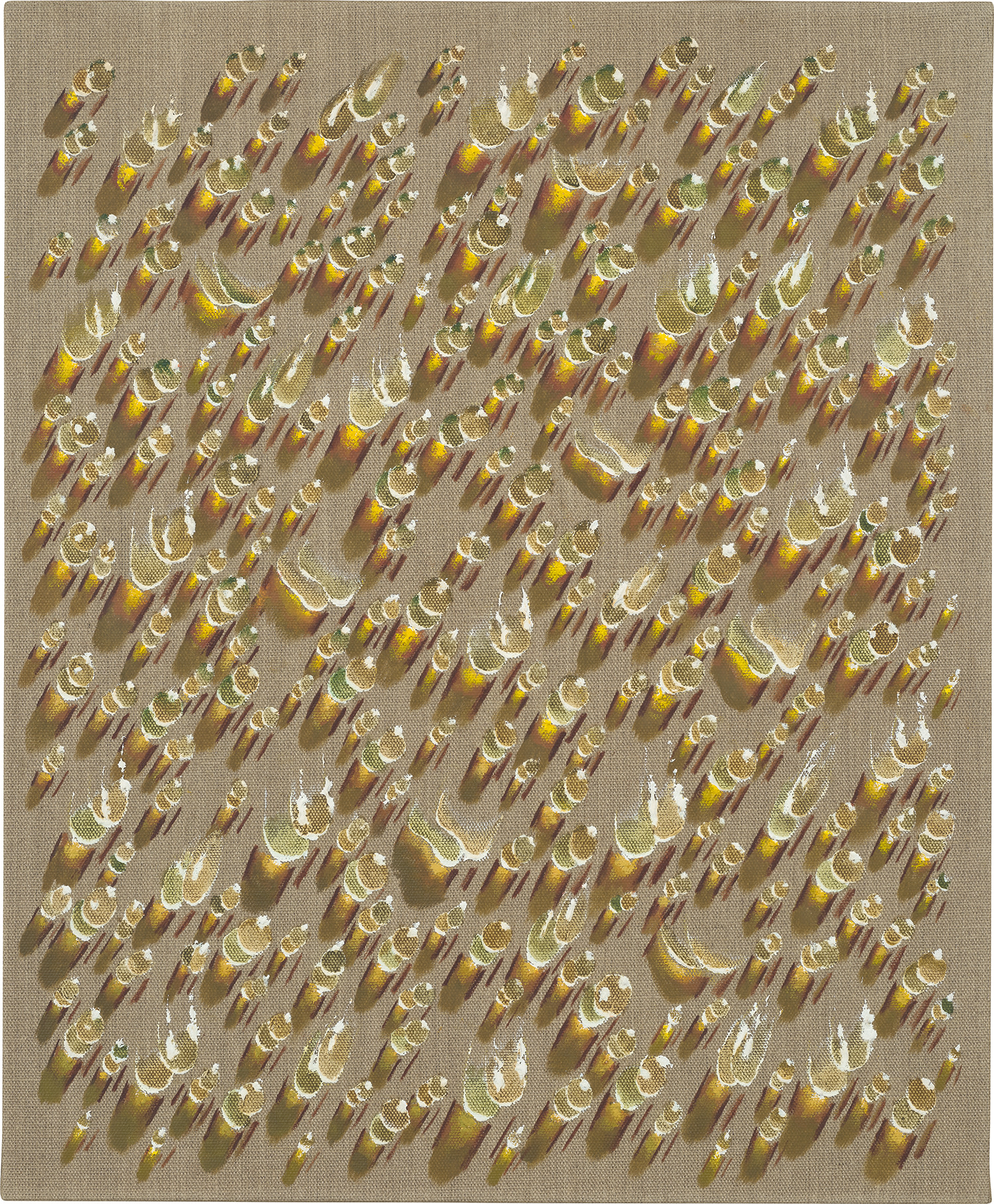
Kim Tschang-Yeul
Water Drops, 1986
It was liberation. The signature works from his mature period reveal the full range of his ambition. Works such as Gouttes d'eau from 1973, painted in oil and mineral pigment on hemp cloth, established the essential visual vocabulary: a field of translucent spheres hovering against a ground that is at once material and atmospheric. His 1981 canvas Recurrence CTM818 introduced ink alongside oil, giving the surface a calligraphic tension that connected his practice explicitly to East Asian painting traditions.
By the late 1980s, works like Waterdrops S.H.87026 incorporated gold foil beneath the droplets, transforming the surface into something devotional, closer to an icon than a still life. The 1988 oil on canvas Colorplate 75 showed his mastery at its most confident, the drops arranged with a compositional intelligence that feels both inevitable and deeply considered.
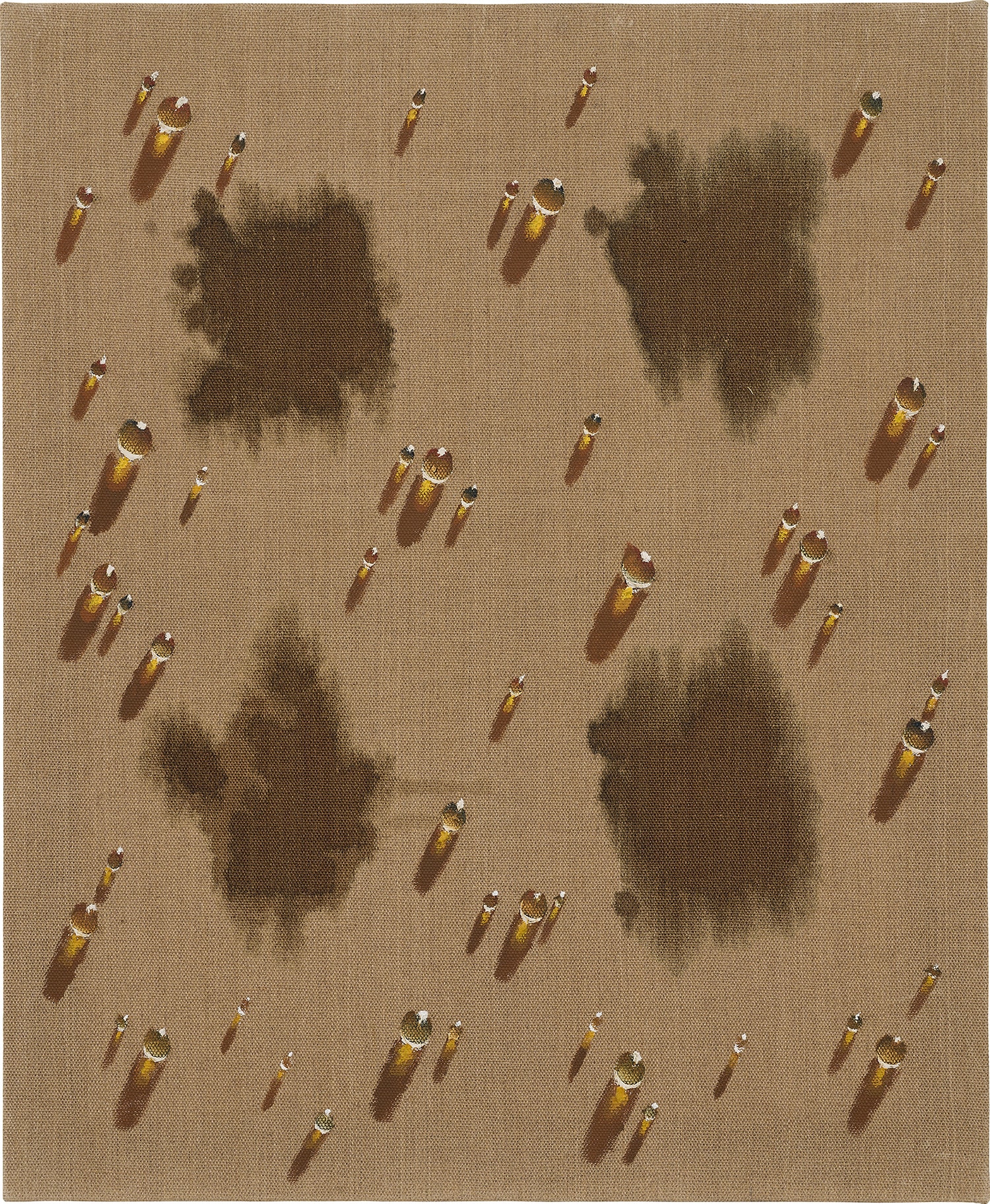
Kim Tschang-Yeul
Recurrence CTM818, 1981
These are not paintings about water. They are paintings about memory, about the persistence of the past in the present moment, about the way sorrow and beauty inhabit the same fragile form. For collectors, Kim Tschang Yeul occupies a position of rare distinction: an artist whose work is both intellectually rigorous and immediately, viscerally beautiful. His paintings appeal to those drawn to the monochrome restraint of Dansaekhwa, the Korean abstract movement of the 1970s with which he shares important affinities, even as his own practice remained distinct in its figurative precision.
Artists such as Park Seo Bo, Lee Ufan, and Chung Sang Hwa are natural points of comparison, all figures who pursued a similarly meditative relationship with their materials and with repetition as a formal strategy. Kim's market has grown steadily over the past decade, with major auction houses in Hong Kong, Paris, and New York recording strong results for his works, particularly those on hemp cloth and those incorporating metallic grounds. Collectors who seek works that hold meaning across cultural contexts, that speak to both Western modernism and Asian philosophical traditions, find in Kim a singularly satisfying answer. What to look for when considering a work by Kim Tschang Yeul is above all a sense of atmosphere.
The finest examples have a quality of inner light, as though the droplets are not painted on the surface but are somehow suspended just above it. Works on hemp cloth, particularly those from the 1970s and 1980s, carry a warmth and material richness that later works on canvas sometimes trade for greater clarity. The presence of mineral pigments, gold foil, or ink alongside oil paint generally signals a work of particular ambition. Size matters too: larger compositions allow the full immersive effect of his vision, the sense that one has stepped into a world governed by entirely different rules of time and weight.
Kim Tschang Yeul matters today not only as a master of a singular technique but as a figure who demonstrated that painting could be an ethical practice, a way of processing history without being crushed by it. He survived colonial occupation, war, exile, and loss, and he responded by spending five decades making images of water. Water that washes clean. Water that reflects.
Water that falls and rises again. In an art world that often prizes rupture and shock, his life's work stands as a testament to the radical power of returning, day after day, to the same quiet image and finding it inexhaustible. The drops continue to fall, and in falling, they renew everything they touch.