Jules Joseph Lefebvre
Grace, Light, and the Ideal Form
Artist Spotlight · The Collection Editorial
There is a moment, standing before a Jules Joseph Lefebvre canvas, when the boundary between paint and life seems genuinely to dissolve. The skin glows. The drapery breathes. The gaze of his figures holds something at once timeless and deeply human.
Jules Joseph Lefebvre
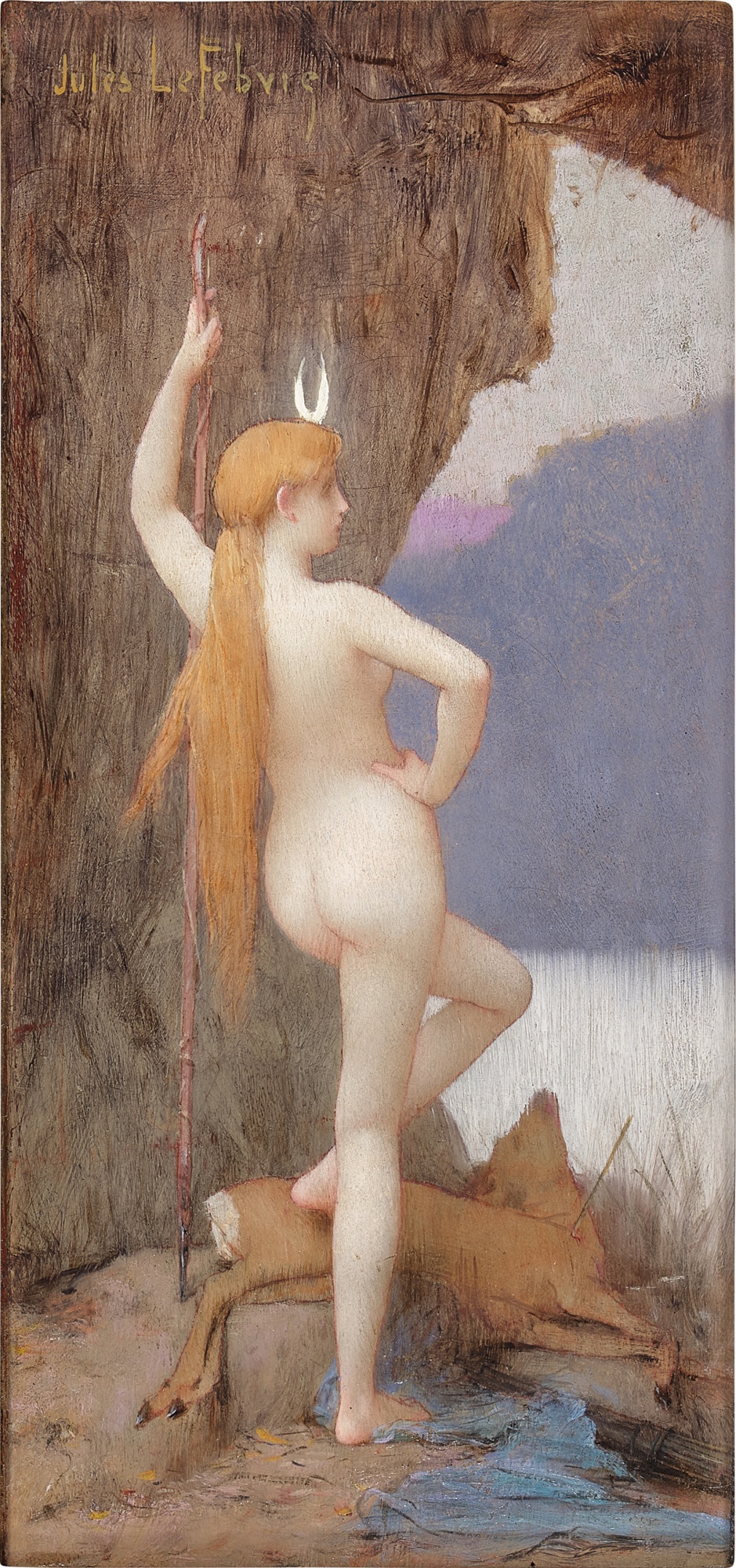
Diana, The Huntress
It is this quality that has drawn renewed attention to Lefebvre in recent years, as auction houses in Paris and New York have recorded steady and growing interest in Academic figurative painting, with collectors and curators alike reassessing the technical brilliance that the twentieth century so swiftly dismissed. Lefebvre stands at the very summit of that tradition, and the art world is remembering why. Jules Joseph Lefebvre was born in Tournan en Brie, a small town southeast of Paris, in 1836. He arrived in the capital as a young man with ambitions that matched the grandeur of the city itself, enrolling at the École des Beaux Arts under the celebrated painter Léon Cogniet.
Cogniet was himself a master of the Academic method, and in his studio Lefebvre absorbed the rigorous discipline of drawing from life, studying anatomy, and composing with the structural logic that the French Academic tradition held as the highest expression of artistic intelligence. The training was demanding, methodical, and transformative. The crowning validation of his formation came in 1861, when Lefebvre won the Prix de Rome, the most coveted prize in French academic art. This distinction sent him to the Villa Medici in Rome for several years, where he could study the masterworks of the Italian Renaissance and Antiquity at close range.
Jules Joseph Lefebvre
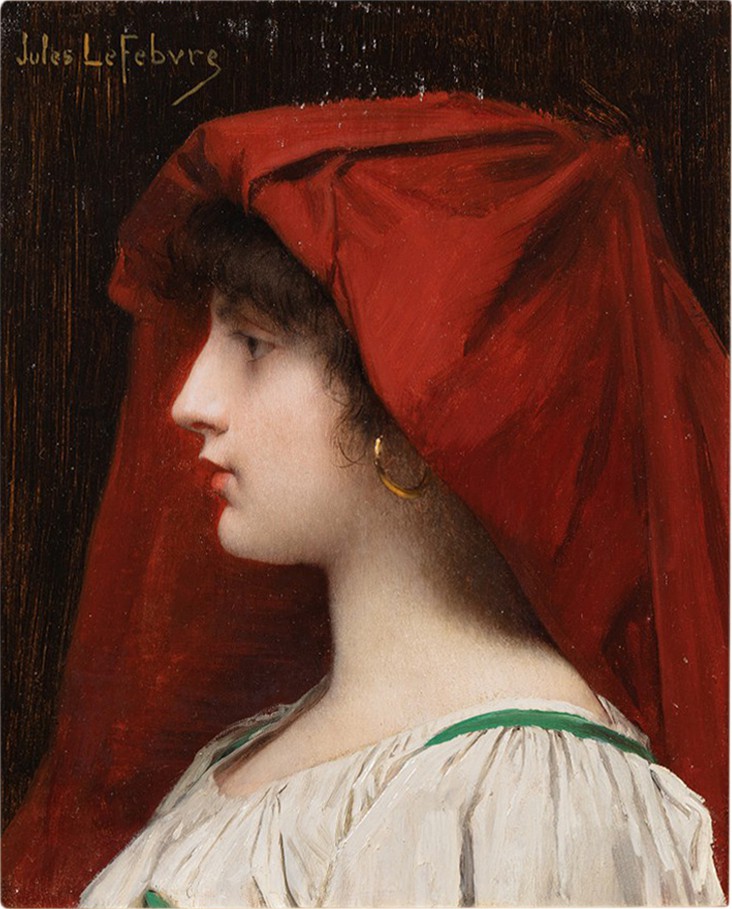
Graziella
The experience deepened his understanding of idealized form, of the way great painters from Raphael to Titian constructed the human figure not as a photographic record but as an aspiration toward something eternal. When he returned to Paris, his ambitions and his technique had both been enlarged considerably. Back in France, Lefebvre established himself at the Salon, the official annual exhibition that was then the central arena of French artistic life. He debuted with historical and mythological subjects before finding his true register in the idealized female nude, a genre he pursued with extraordinary consistency and refinement throughout his long career.
His Salon entries won him medals and critical praise, and works such as La Vérité, shown at the Salon of 1870, announced him as one of the preeminent figure painters of his generation. The composition of a nude figure emerging from shadow into light became something of a signature gesture, one he returned to with subtle variations across decades of work. Among the works that collectors and scholars return to most often is Diana, The Huntress, a luminous oil on panel that captures the goddess in a moment of poised, alert stillness. The surface handling is extraordinary, with the cool light playing across her figure in a way that recalls both Ingres in its precision and Bouguereau in its softness, yet remains unmistakably Lefebvre.
Jules Joseph Lefebvre
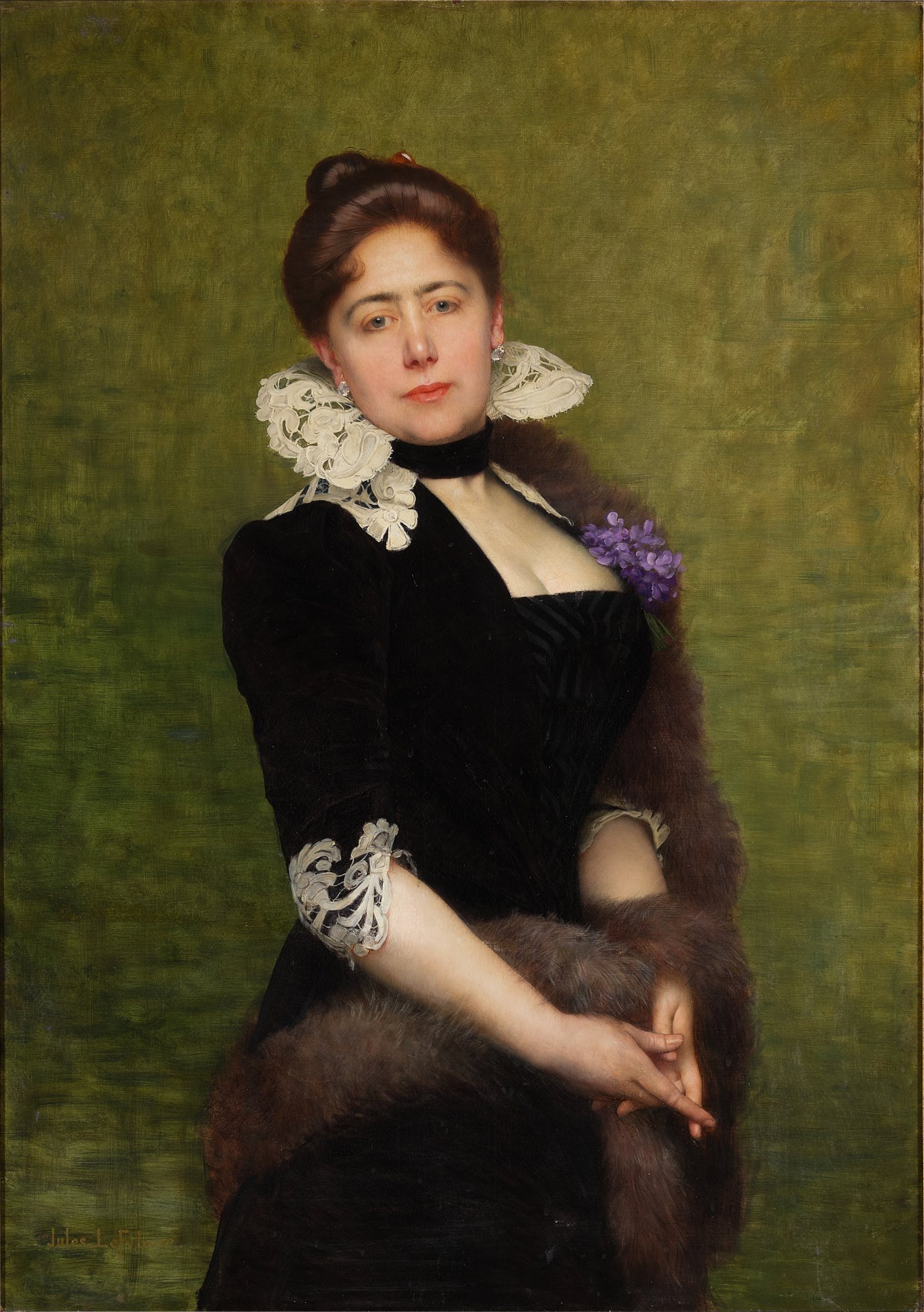
Portrait of a Lady
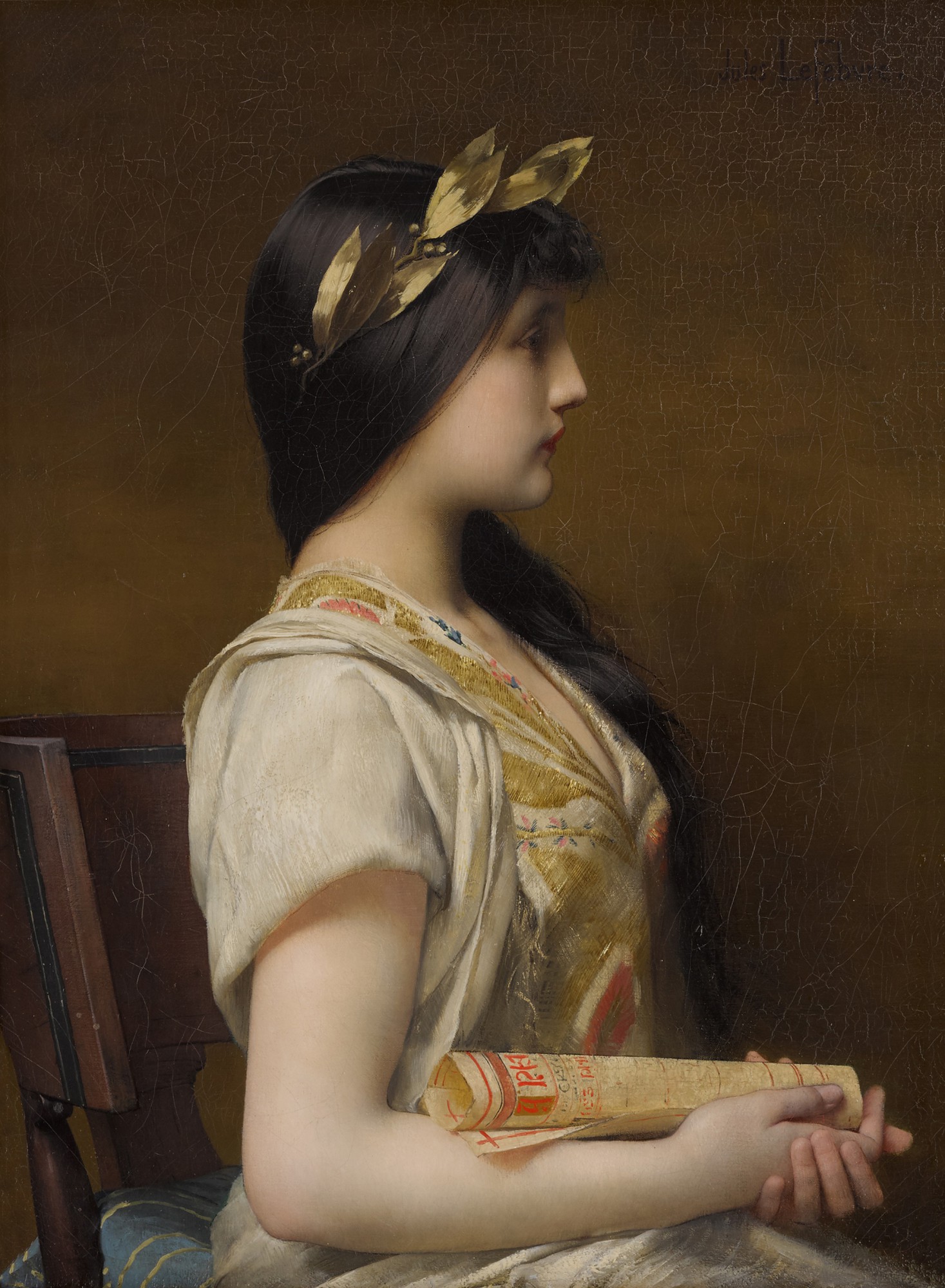
His Graziella, another oil on panel, presents a young Italian woman with the warmth and directness that characterized his best portraits of ordinary people elevated by his brush to something approaching the divine. The Red Fan and An Italian Girl with an Orange reveal the same quality, a tenderness toward his subjects that prevents even his most idealized works from feeling cold or merely academic. His Sappho, rendered in oil on canvas, demonstrates his command of psychological interiority, the poet depicted not in triumph but in a moment of private feeling that lifts the work beyond mere virtuosity. For collectors approaching Lefebvre today, the works on panel represent a particularly compelling point of entry.
The panel support lends his surfaces a smoothness and luminosity that canvas cannot quite replicate, and the intimate scale of many such works makes them suited to distinguished private collections where they can be encountered at close range and over time. His portraits, too, reward sustained attention. Portrait of a Lady and An Elderly Greek Woman are both examples of Lefebvre stepping beyond the idealized nude and demonstrating a psychological acuity that sometimes goes unacknowledged in broader assessments of his achievement. These works show a painter genuinely interested in the specificity of a human face and the story it tells.
Jules Joseph Lefebvre
Sappho
In terms of art historical context, Lefebvre belongs to a rich generation of French Academic painters whose work is now being meaningfully rehabilitated after decades of critical neglect. Artists such as William Adolphe Bouguereau, Alexandre Cabanel, and Gustave Moreau were his contemporaries, and together they represent the full range of what French Academic painting could achieve at its height. Like Bouguereau, Lefebvre brought an almost overwhelming technical perfectionism to the human figure. Like Cabanel, he understood the Salon as a space of cultural ambition as much as artistic display.
Collectors who admire any of these painters will find in Lefebvre a kindred sensibility, one that prizes beauty, craft, and the patient accumulation of pictorial intelligence. Perhaps the most lasting dimension of Lefebvre's legacy is not his own paintings but his teaching. From his position at the Académie Julian, one of the most progressive and influential private art schools in Paris during the late nineteenth century, he shaped the development of dozens of artists who went on to define the following generation. The Académie Julian was remarkable in part for accepting women students at a time when the École des Beaux Arts did not, and Lefebvre taught both with equal seriousness.
His influence spread across national borders and artistic movements in ways that are still being mapped by art historians today. Jules Joseph Lefebvre died in Paris in 1911, at the close of a career that had spanned the Franco Prussian War, the Belle Époque, and the first tremors of the modern avant garde. He witnessed the rise of Impressionism and the emergence of movements that would eventually displace everything his tradition valued, yet he never wavered in his commitment to the figure, to craft, and to the ideal. That steadfastness now reads not as conservatism but as conviction.
For collectors who understand that beauty is its own argument, and that technical mastery is a form of generosity to the viewer, Lefebvre remains one of the great rewards French painting has to offer.
Explore books about Jules Joseph Lefebvre
Jules Joseph Lefebvre: Sa vie et son oeuvre
Arsène Alexandre
The Academic Vision: Nineteenth-Century Salon Painting
Albert Boime
Jules Joseph Lefebvre 1836-1911
François Garnier
The Dictionary of Art
Jane Turner
Academic Drawing in Nineteenth-Century France
Susan P. Casteras and Alicia Craig Faxon