Jules Breton
Jules Breton: Poetry Blooming in Every Field
Artist Spotlight · The Collection Editorial
“Nature is not only all that is visible to the eye. It also includes the inner pictures of the soul.”
Jules Breton
Imagine standing at the edge of a wheat field in the Pas de Calais at the close of day. The last amber light rakes across the grain, and a young woman pauses in her labor, her figure silhouetted against a sky that seems almost too beautiful to be real. This is the world Jules Breton spent his life rendering with patience, devotion, and an uncommon gift for finding the sacred within the ordinary. More than a century after his death in 1906, his canvases continue to command serious attention from collectors, museum curators, and anyone who believes that painting can be simultaneously truthful and transcendent.
Jules Breton
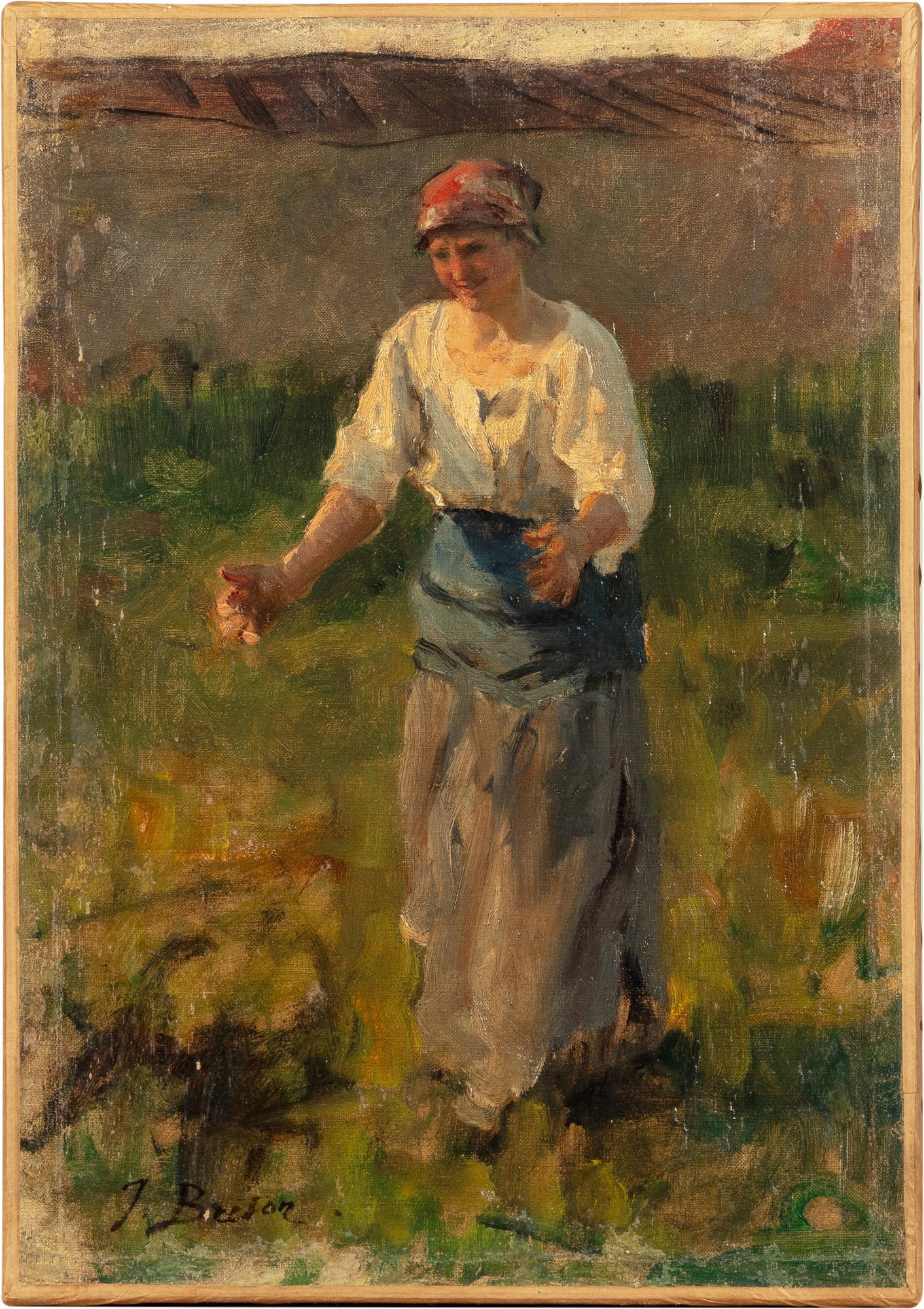
Etude pour Le Dernier Rayon
Jules Adolphe Aimé Louis Breton was born in 1827 in Courrières, a small agricultural village in the Artois region of northern France. The landscape of his childhood was one of rolling fields, seasonal harvests, and communities whose lives were governed entirely by the rhythms of the land. His mother died when he was four years old, a loss that shaped his tender, searching sensibility from an early age. Raised by his father and an aunt, he showed an aptitude for drawing that was recognized and encouraged, leading him eventually to study in Ghent and later in Paris under Michel Martin Drolling at the École des Beaux Arts.
These formative years gave him a rigorous academic foundation, but it was always the memory of Courrières, its light and its people, that called him back and defined his vision. Breton made his Salon debut in 1849 and found his footing as an artist throughout the 1850s, a decade in which French painting was being dramatically reshaped by Gustave Courbet's uncompromising realism. Breton engaged with this energy but steered it toward something warmer and more lyrical. Where Courbet confronted the viewer with the weight and grit of rural existence, Breton sought its quiet dignity and latent grace.
Jules Breton
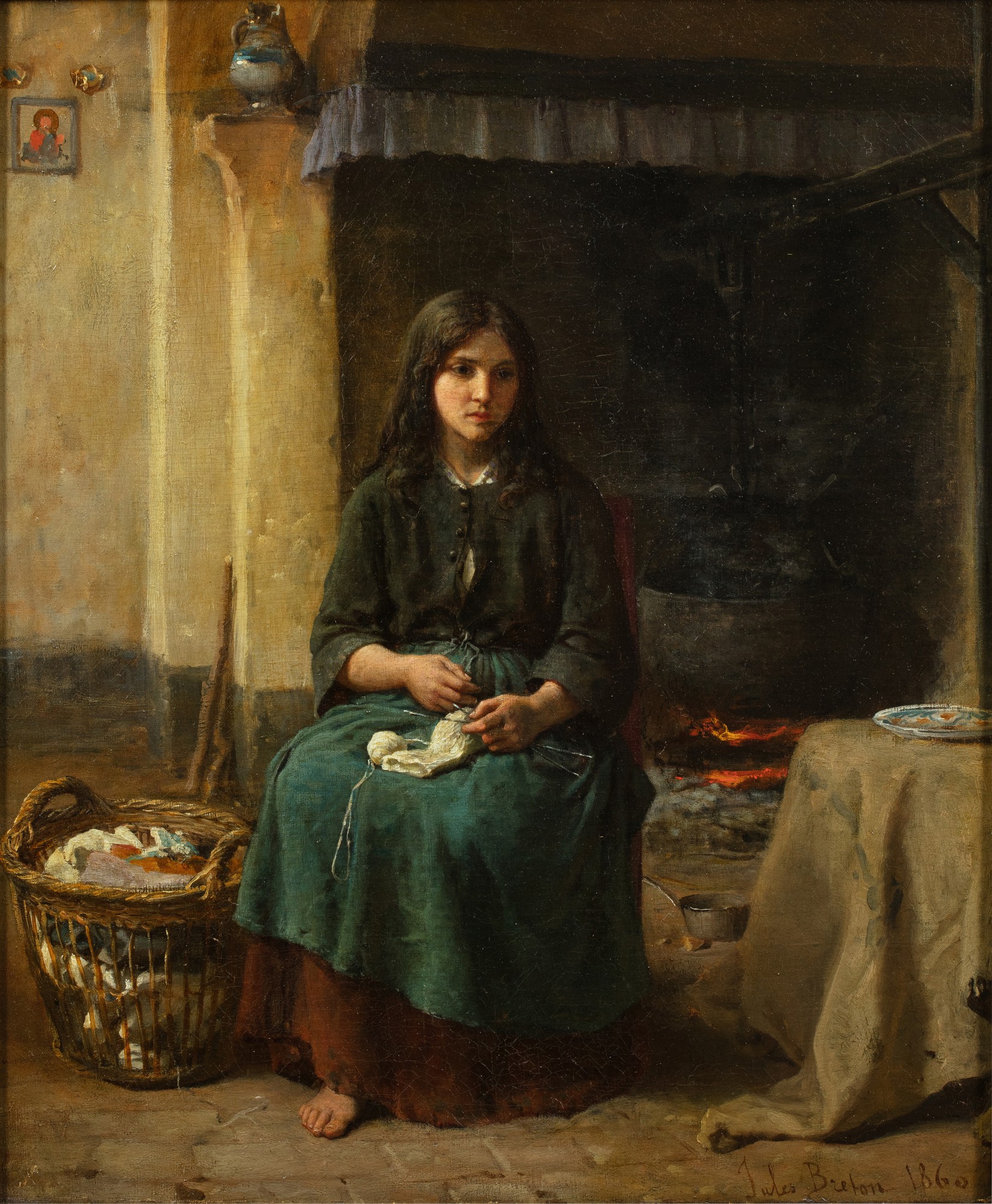
Jeune fille auprès de l'âtre
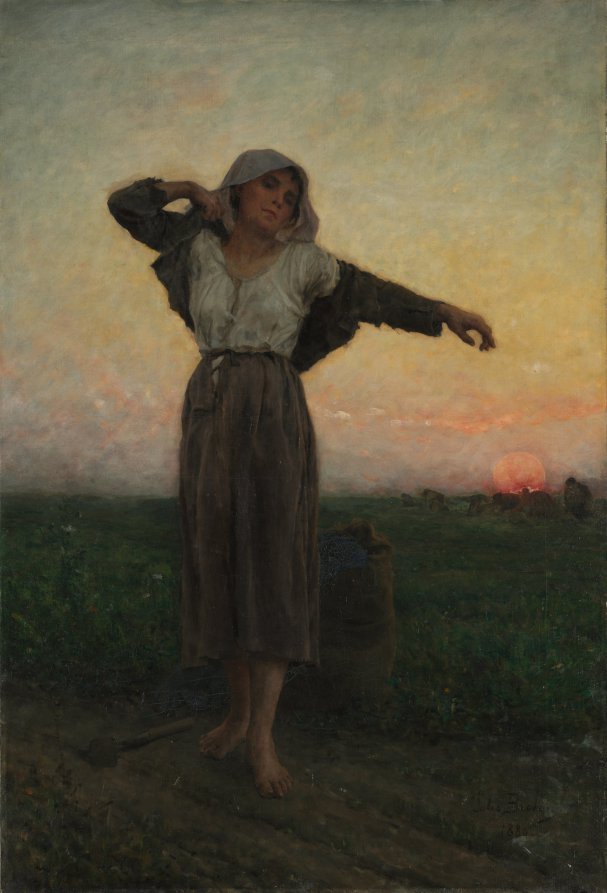
By the late 1850s and into the 1860s, he was producing the large scale Salon paintings that would define his reputation, works that depicted gleaning, harvesting, and the communal rituals of agricultural life with an almost religious reverence. His 1859 painting The Recall of the Gleaners earned him the Legion of Honor and announced him as one of the preeminent painters of rural France. The works available through The Collection offer an instructive cross section of his practice across different scales and moods. The Tired Gleaner from 1880 is a quietly powerful piece, a figure study that concentrates all of Breton's empathy into a single paused moment of fatigue and endurance.
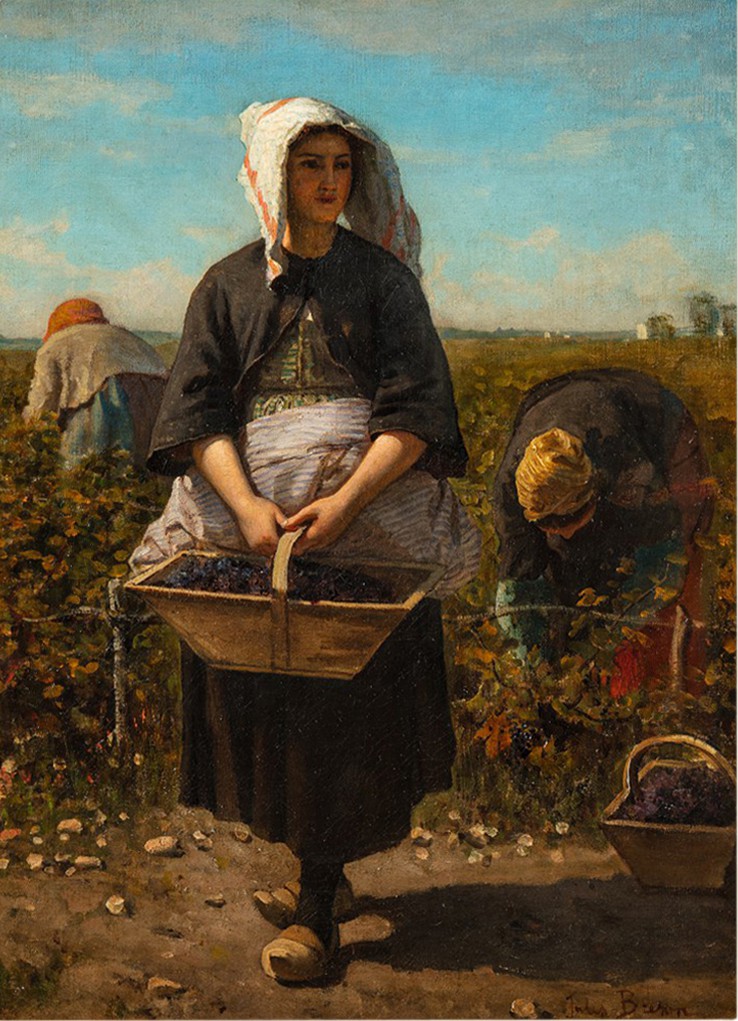
Etude pour Le Dernier Rayon, a preparatory oil study, reveals the working intelligence behind his finished compositions, showing how carefully he calibrated the fall of late light across a human form. Jeune fille auprès de l'âtre brings the viewer indoors, into the warmth of a domestic hearth, demonstrating a range that went beyond the open field. The study for Les vendanges à Château Lagrange extends his pastoral vision southward into vine country, and Le Matin captures the crystalline stillness of early morning with a delicacy that feels almost musical. Tempête sur la côte is a striking departure, showing a coastal storm with atmospheric force, proof that his sensitivity to light and weather extended well beyond the agricultural landscapes for which he is best known.
Jules Breton
Study for 'Les vendanges à Château-Lagrange'
For collectors, Breton occupies a particularly compelling position in the nineteenth century French market. His finished Salon paintings, when they appear at auction, regularly attract strong international interest, particularly from American institutions and private collectors. This transatlantic dimension to his appeal has deep historical roots. Breton was enormously admired in the United States during his lifetime, with major American collectors acquiring his work from the 1870s onward, and several of his most important canvases found their way into collections that later became the foundations of great public museums.
At the same time, the oil studies and preparatory works that occasionally enter the market offer a more accessible point of entry into his practice, often revealing a spontaneity and directness that the large finished paintings, with their careful decorum, deliberately conceal. For the discerning collector, these studies represent exceptional value: intimate proximity to the artist's thinking at its most unguarded. Breton's place within art history is best understood in relation to a broad circle of painters who shared his commitment to rural subject matter but approached it from different angles. Jean François Millet, his most obvious peer, brought a more austere and monumental gravity to the peasant figure.
Jules Breton
The Tired Gleaner, 1880
Camille Corot, who was a generation older, influenced Breton's feeling for landscape atmosphere and silvery light. Léon Lhermitte, a close friend and admirer, carried certain aspects of Breton's practice forward into the final decades of the century with increasing naturalistic confidence. In the Anglo American world, the pastoral tradition Breton helped define resonated deeply with artists such as George Clausen and even, at a greater remove, with the early Winslow Homer, who was drawn to comparable themes of labor, land, and light. Breton was also a poet of genuine accomplishment, publishing several volumes of verse, and this literary sensibility is inseparable from the meditative quality that distinguishes his painted surfaces.
What makes Breton matter today is precisely what made him matter in his own time: his insistence that ordinary working lives are worthy of the most serious and beautiful artistic treatment. In an era when art markets and critical discourse tend to reward novelty and disruption, his canvases offer something rarer and more sustaining. They ask for attention that is slow, patient, and willing to be moved. The golden fields and twilight figures of his imagination are not nostalgic in any cheap sense; they are meditations on dignity, endurance, and the consolations of the physical world.
To collect Breton is to align oneself with a tradition that values craft, humanity, and the long view, qualities that never go out of fashion for those who understand what painting at its deepest can do.
Explore books about Jules Breton
Jules Breton and the Poets
Peter Fusco
Jules Breton: 1827-1906
Denise Noce
The Art of Jules Breton
Gabriel P. Weisberg
Jules Breton: Peasant Dreams
Susan Casteras
Breton and the Academic Tradition
Laurence des Cars