Jörg Immendorff
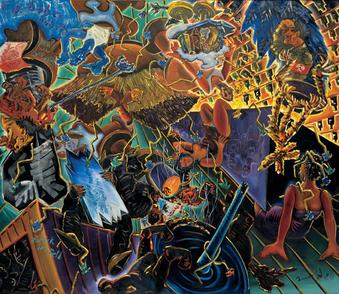
Jörg Immendorff: Painting the World Ablaze
Artist Spotlight · The Collection Editorial
“I paint because I want to change something. Painting is a political act.”
Jörg Immendorff, interview, 1970s
Few moments in recent art history capture the urgency of Immendorff's legacy quite like the 2019 retrospective at the Kunstsammlung Nordrhein Westfalen in Düsseldorf, a city he called home and which he transformed into a mythological stage. That exhibition, drawing visitors from across Europe, reaffirmed what collectors and curators had long known: Immendorff was one of the most politically charged, visually electric painters of the postwar German generation, an artist whose work crackled with the tensions of a divided Europe and the moral weight of art made under pressure. Standing before his vast canvases, one understood that painting for Immendorff was never a passive act. It was a declaration.
Jörg Immendorff
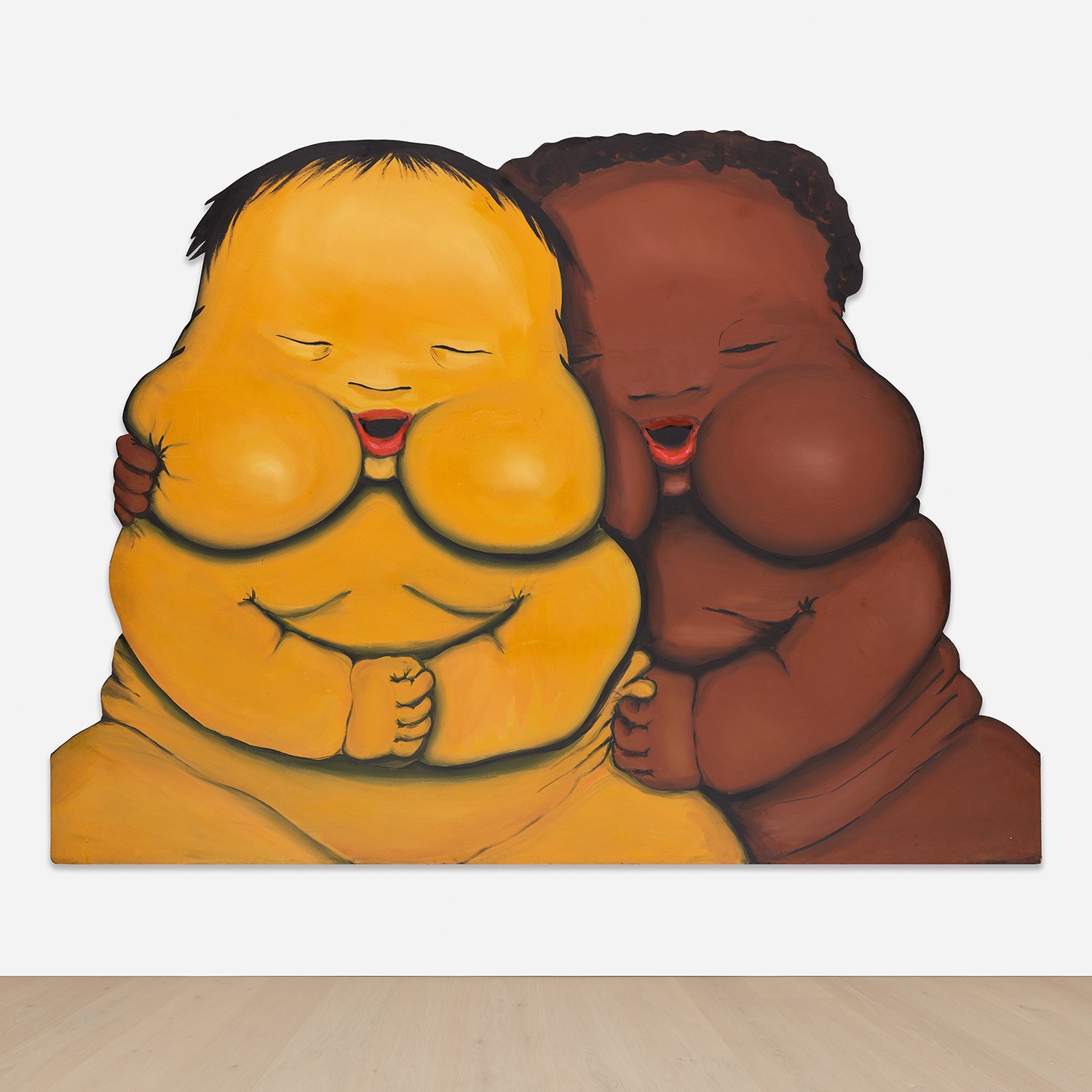
Gelbe und braune Babies (Yellow and Brown Babies), 1966
Jörg Immendorff was born in 1945 in Bleckede, a small town near the Elbe river in Lower Saxony, just months after the end of the Second World War. He came of age in a Germany still sorting through the rubble of its recent past, and that historical condition shaped everything that followed. He studied at the Kunstakademie Düsseldorf, where he encountered Joseph Beuys, a meeting that proved formative. Beuys instilled in his students a belief that art was inseparable from social responsibility, a conviction Immendorff absorbed and radicalized in his own way.
Where Beuys dealt in myth and material, Immendorff reached for the street, the pub, the political pamphlet. In the late 1960s and early 1970s, Immendorff moved through a period of committed political activism, creating agitprop works and performances under the banner of his self declared LIDL movement, a deliberate provocation against the established art world. Works from this period, including the extraordinary early piece "Gelbe und braune Babies" from 1966, made with synthetic resin and acrylic on shaped chipboard, show a young artist already willing to depart from conventional formats and push painting into uncomfortable, confrontational territory. The shaped support, the raw material choices, the blunt imagery: everything signals an artist who understood that form was argument.
Jörg Immendorff
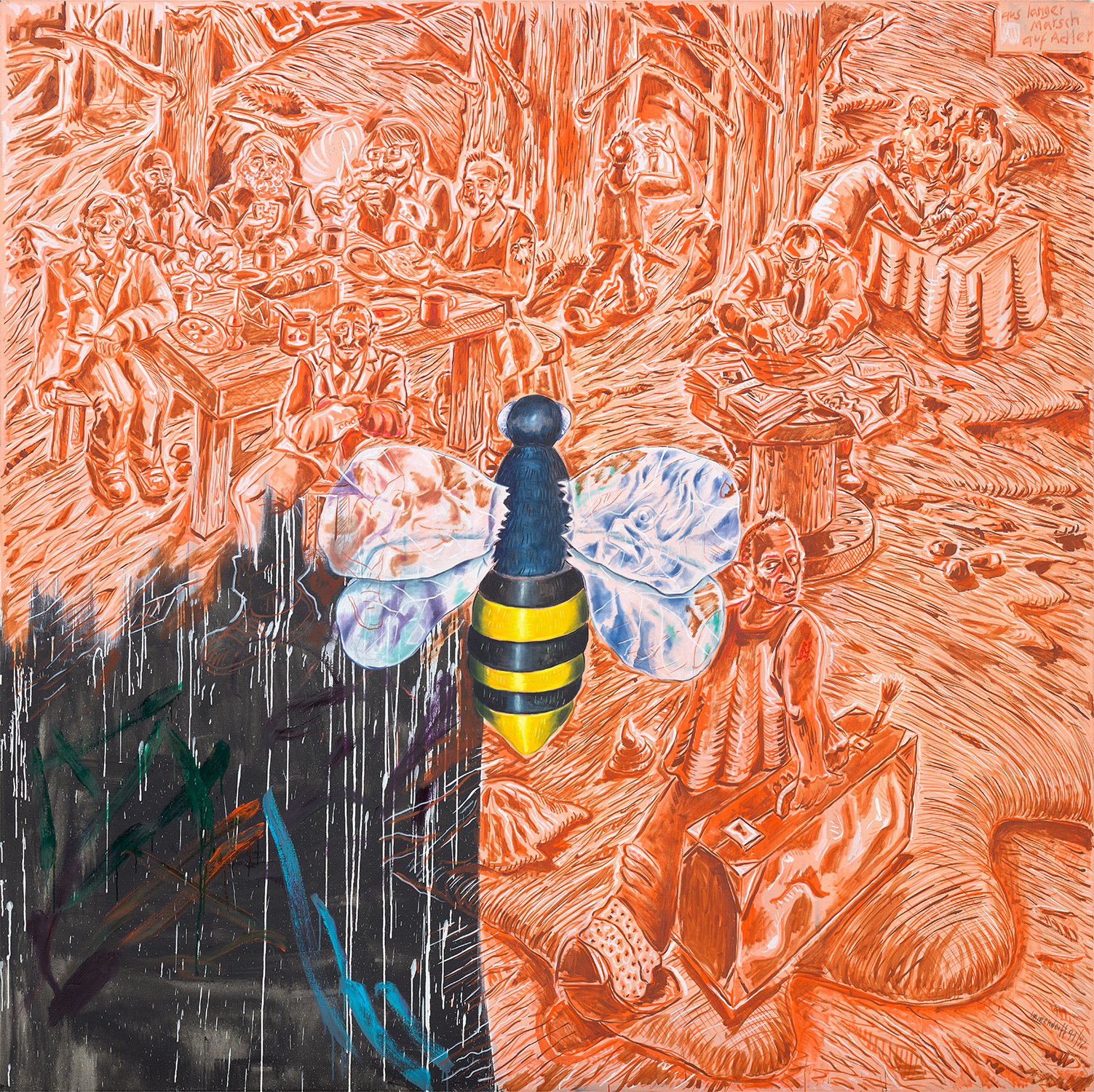
Kampfbiene, 1991
These early works are now recognized as remarkable documents of a radical artistic sensibility finding its footing. Immendorff's crowning achievement remains the Café Deutschland series, begun in 1977 and extending through much of the following decade. These monumental oil paintings depict a fictional nightclub straddling the border between East and West Germany, a space where figures from both sides of the Iron Curtain mingle, argue, and dance in a fever dream of political longing. The series, which drew on conversations with his East German counterpart and close friend A.
R. Penck, is among the most sustained and ambitious bodies of work produced by any European painter in the late twentieth century. "Café Deutschland 2 Sind Nötig" from 1978, rendered in gouache on paper and held in significant private collections, gives a sense of the charged, dense imagery that defines this period: crowds, symbols, flags, and figures locked in perpetual confrontation and conversation. The series placed Immendorff at the center of Neo Expressionism alongside Georg Baselitz, Markus Lüpertz, and Sigmar Polke, artists who collectively restored the authority of figurative painting at a moment when conceptual and minimal art had dominated critical discourse.
Jörg Immendorff
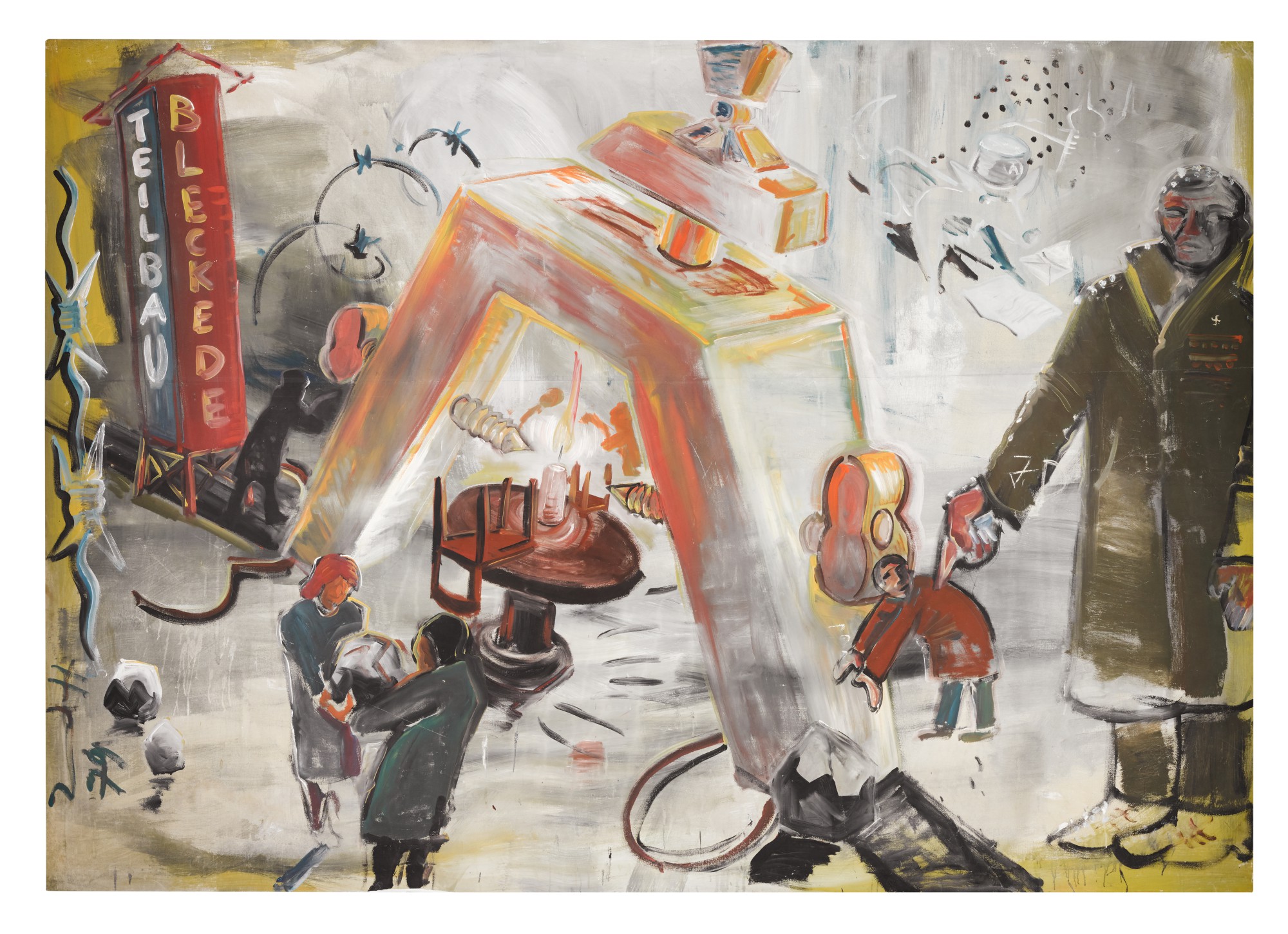
《分裂的布萊克德》
By the 1990s, Immendorff's work had evolved while retaining its characteristic intensity. Paintings such as "Kampfbiene" from 1991 demonstrate a richer, more layered pictorial language, one that absorbed the lessons of art history while remaining unmistakably personal. The imagery grew denser and more allegorical, drawing on sources ranging from old master painting to popular culture. His 1999 canvas "Gruppenbild," executed in oil, acrylic, and coloured pencil, exemplifies this late synthesis: the painting pulses with grouped figures, layers of meaning, and a compositional confidence earned over decades of sustained practice.
Immendorff also worked extensively in sculpture, and the 2002 bronze "Malerstamm Anselm" stands as a touching tribute to his friend and peer Anselm Kiefer, a reminder that Immendorff understood the art world as a community of fellow travelers rather than competitors. For collectors, Immendorff represents a compelling and historically significant proposition. His major paintings from the Café Deutschland series have achieved substantial results at auction, with works passing through Christie's and Sotheby's at prices reflecting their canonical status. Works on paper and gouaches from the late 1970s, such as the "Café Deutschland" studies, offer a more accessible entry point into a practice that spans decades and media.
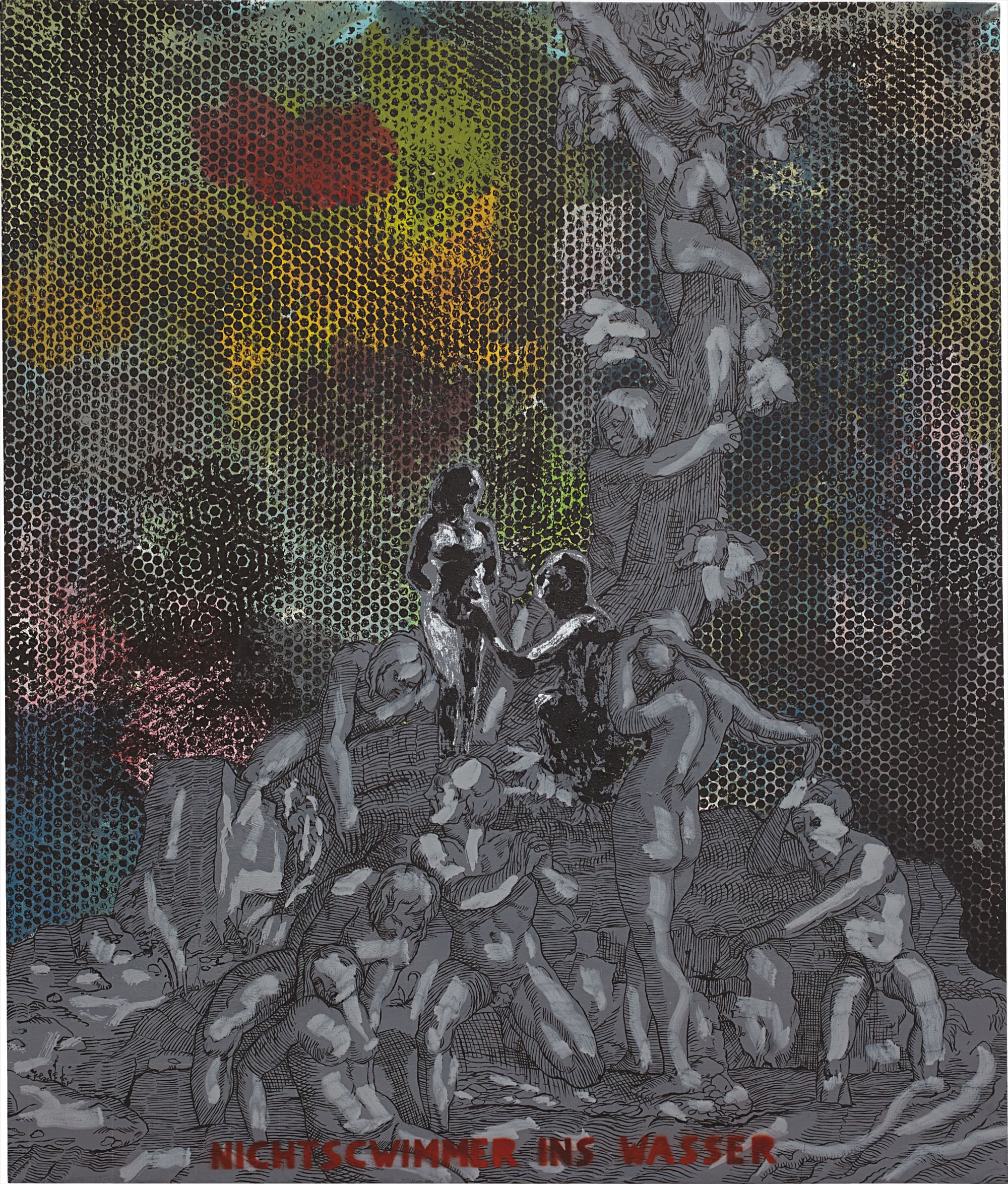
Jörg Immendorff
Nichtschwimmer ins Wasser
Sculptures in bronze, produced in collaboration with skilled foundries, have found homes in both private collections and public institutions. Collectors drawn to the German Neo Expressionist generation, to the political painting traditions of the Cold War era, or simply to work that carries the weight of history without flinching, consistently find in Immendorff an artist whose output rewards close and sustained attention. Immendorff belongs to a generation of German painters who collectively redeemed figurative painting on the world stage. He is most naturally understood alongside Baselitz, Lüpertz, Penck, and Kiefer, artists who emerged from the specific psychic and political landscape of postwar Germany and made that landscape their subject.
But Immendorff was in certain respects more directly polemical than any of them. He named the wound. His work engaged with partition, ideology, and the role of the artist in political life with a directness that was sometimes uncomfortable and always honest. His friendship and artistic dialogue with A.
R. Penck, conducted across the actual border dividing their country, gives the Café Deutschland series a dimension of lived reality that elevates it beyond mere allegory. Immendorff died in Düsseldorf in 2007, having battled ALS for the final years of his life, continuing to work with extraordinary determination even as his physical capacities diminished. His death prompted widespread tributes from the art world, and in the years since, his reputation has only deepened.
Institutions across Germany and internationally continue to revisit his work, finding in it not just a record of a specific historical moment but a template for how painting can engage with the world without surrendering its humanity or its visual ambition. To live with an Immendorff is to live with history in motion, with color and argument and conviction pressed into paint. That is a rare thing, and it endures.
Explore books about Jörg Immendorff
Jörg Immendorff: Catalogue Raisonné
Detlef Blusch
Jörg Immendorff: Retrospektive
Museum Ludwig Köln
Immendorff: Café Deutschland
Siegfried Gohr
Jörg Immendorff: The Nightwatchman
Klaus Kertess
Jörg Immendorff: Malerei, Zeichnungen, Graphik
Dietmar Elger