Jonathan Meese
Jonathan Meese, Art's Most Joyful Revolutionary
Artist Spotlight · The Collection Editorial
“Art is the only dictatorship that sets us free.”
Jonathan Meese, interview, Monopol Magazine
In the vast, cacophonous cathedral of contemporary German art, few figures command a room quite like Jonathan Meese. His recent survey presentations at institutions including the Hamburger Bahnhof in Berlin and the Deichtorhallen in Hamburg have drawn audiences eager to witness something genuinely rare in today's art world: a total believer. Meese does not dabble. He does not hedge.
Jonathan Meese
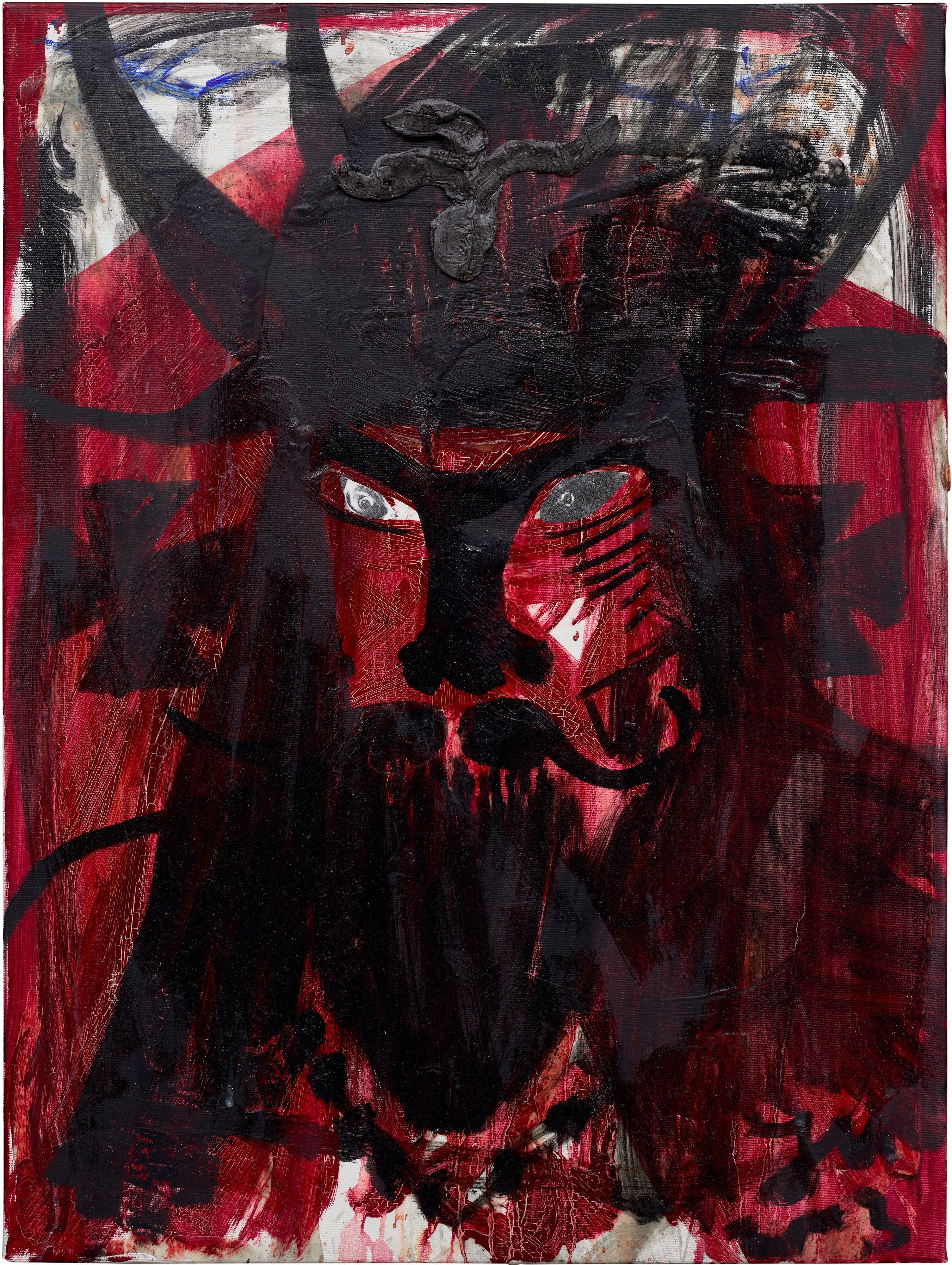
Dr. Phantomeese 1911 de Squawwar, 2003
He arrives at the canvas, the stage, and the sculpture plinth with the conviction of someone who has staked everything on a single, luminous idea, that art is not merely a practice but a governing principle, the only one worth surrendering to absolutely. Born in Tokyo in 1970 and raised in Hamburg, Meese came of age in a Germany still processing the enormous psychic weight of its twentieth century history. He studied at the Hochschule für Bildende Künste Hamburg in the 1990s, entering a postwar cultural landscape that was simultaneously hungry for new myth and deeply wary of anything that smelled of grandiosity or ideological fervour. Meese absorbed that tension and transformed it into fuel.
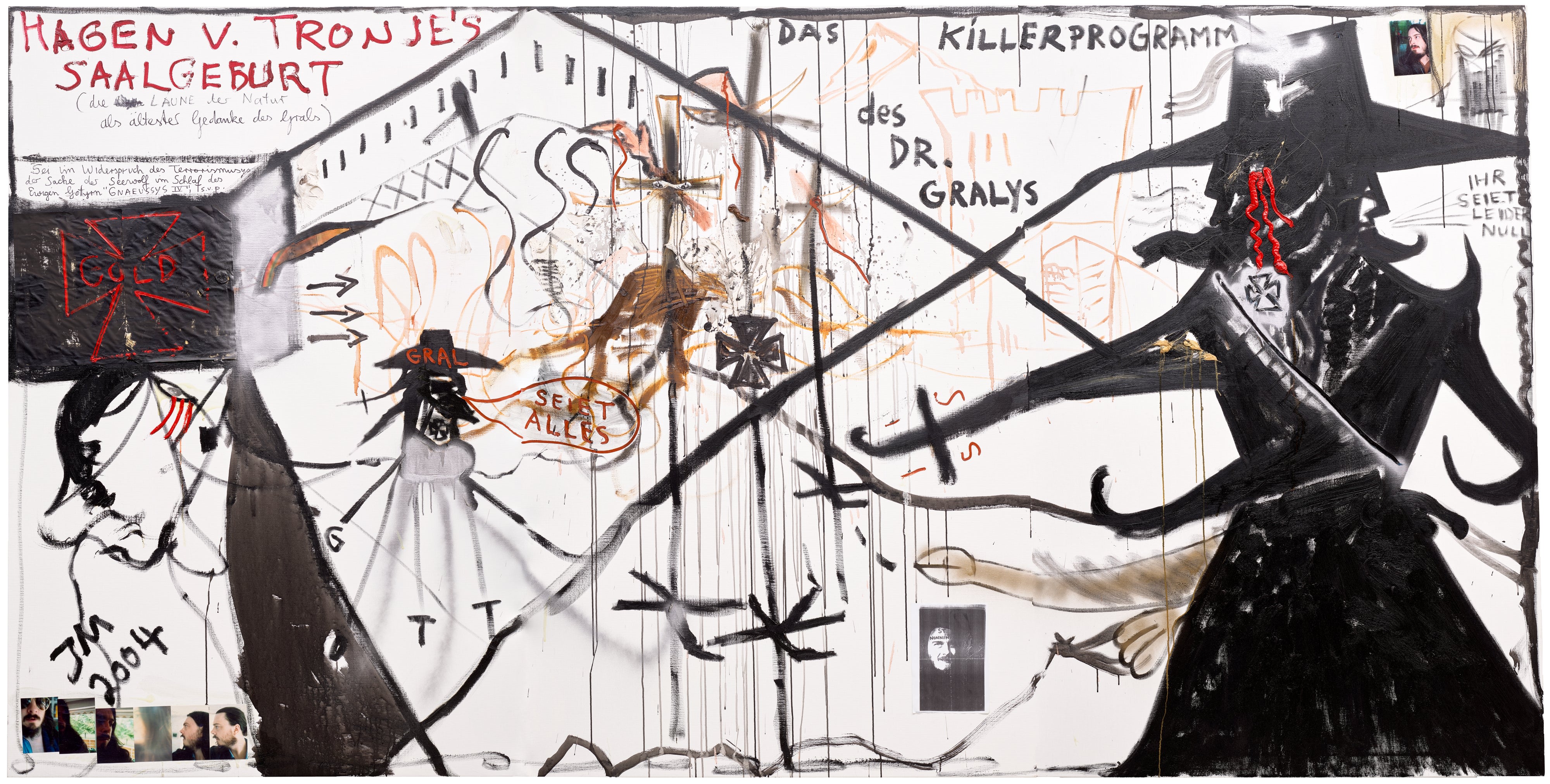
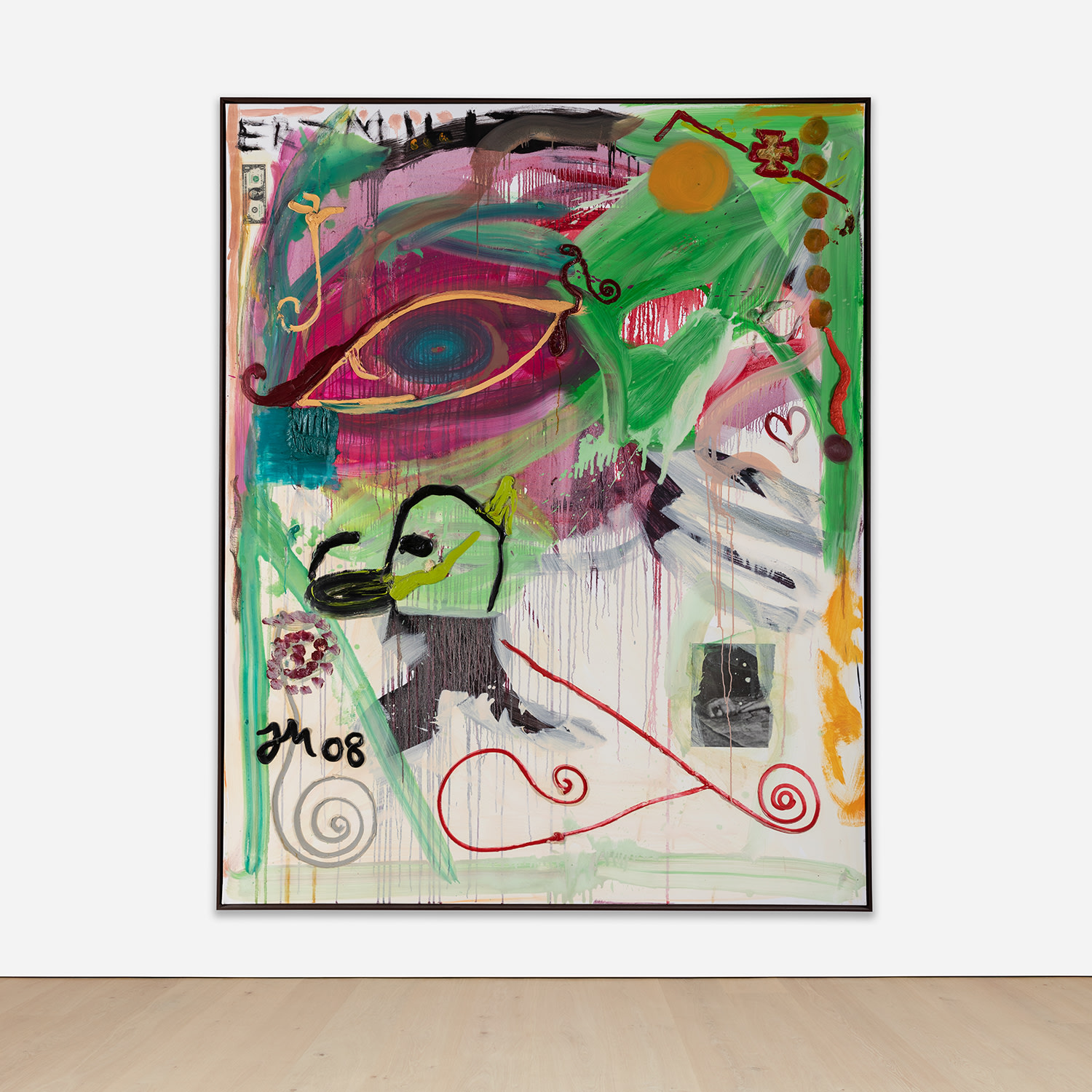
Where others trod carefully around symbols of power, spectacle, and historical darkness, he plunged directly into that archive, not to celebrate it but to detonate it from within through sheer aesthetic excess. His early paintings from around 2001, works such as the densely layered "Innerer Kreis" from that year, already announced the essential grammar of his practice. Surfaces thick with brushwork, text, collaged fragments, and photographic material press against one another in compositions that feel simultaneously apocalyptic and exuberant. The paintings refuse the idea that coherence is a virtue.
Jonathan Meese
Das ÜBELDING aus dem NIBELUNGENRING, da kann man nicht meckern, 2008
They propose instead that abundance, overflow, and the collision of references across time and culture are themselves a kind of argument. By the mid 2000s Meese had fully developed what he calls the "Dictatorship of Art," a philosophical framework that advocates for total aesthetic governance, the submission of all human activity, including politics, identity, and history, to the sovereign authority of the creative act itself. The works from this period remain among the most vital of his career and are among the pieces most sought after by serious collectors today. "Dr.
Phantomeese 1911 de Squawwar" from 2003 exemplifies his approach to oil and paper collage on canvas: the surface is a theatre of competing energies, where mythological archetypes jostle with cartoon logic and the residue of art history. "Getreidemutter" from 2005 and "Mama Johnny (Noel Coward is Back)" also from 2005, the latter a bronze sculpture that demonstrates his easy passage between media, show an artist at the height of his inventive powers. The triptych "Pony, Blankfisch, und Tschüss" from 2007 extends this language into a sprawling, three panel meditation on excess and form that rewards sustained looking. His titles alone constitute a minor literature: playful, untranslatable, resistant to the kind of earnest explicatory framework that the art world often imposes on work it does not quite know how to place.
Jonathan Meese
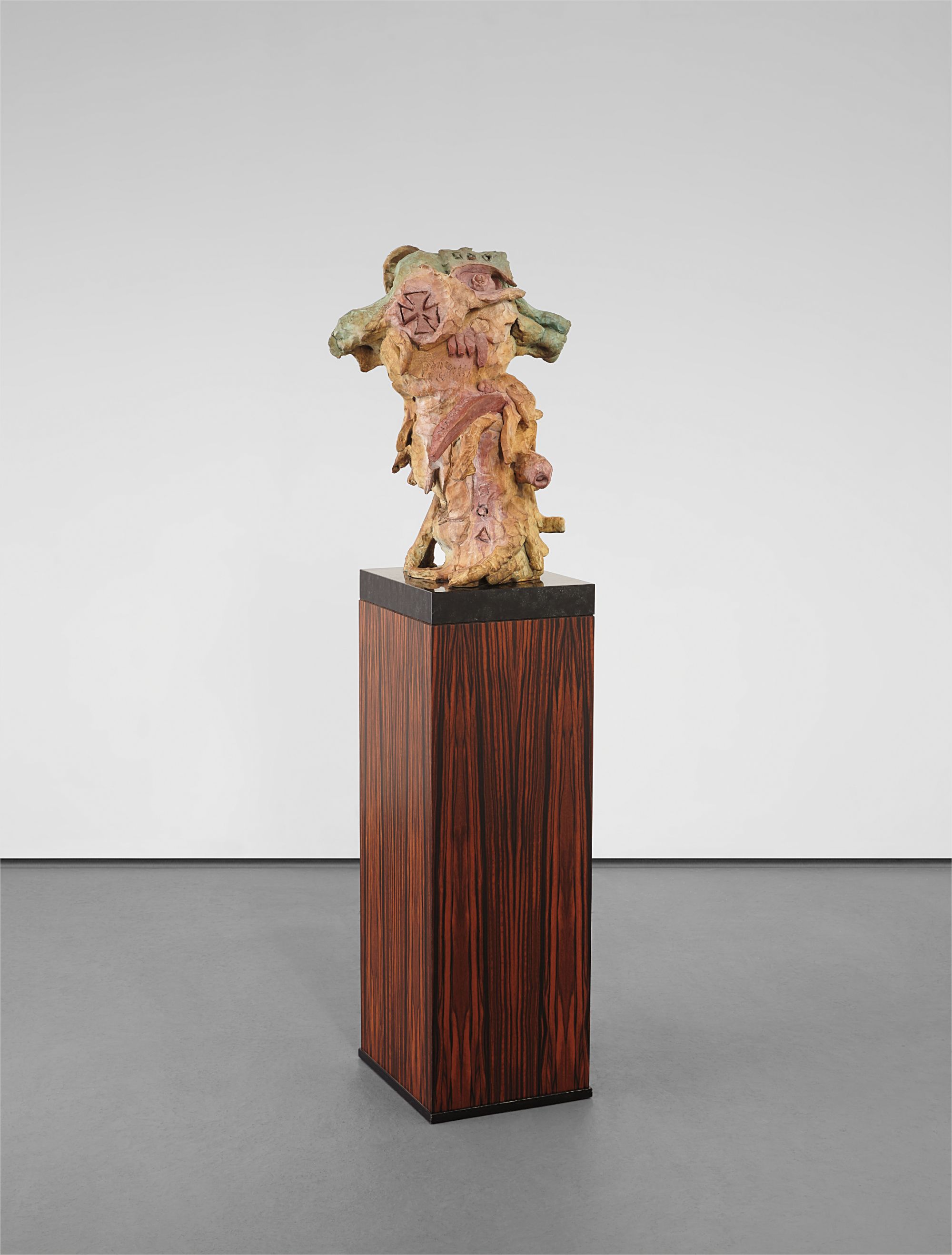
Napoleon II
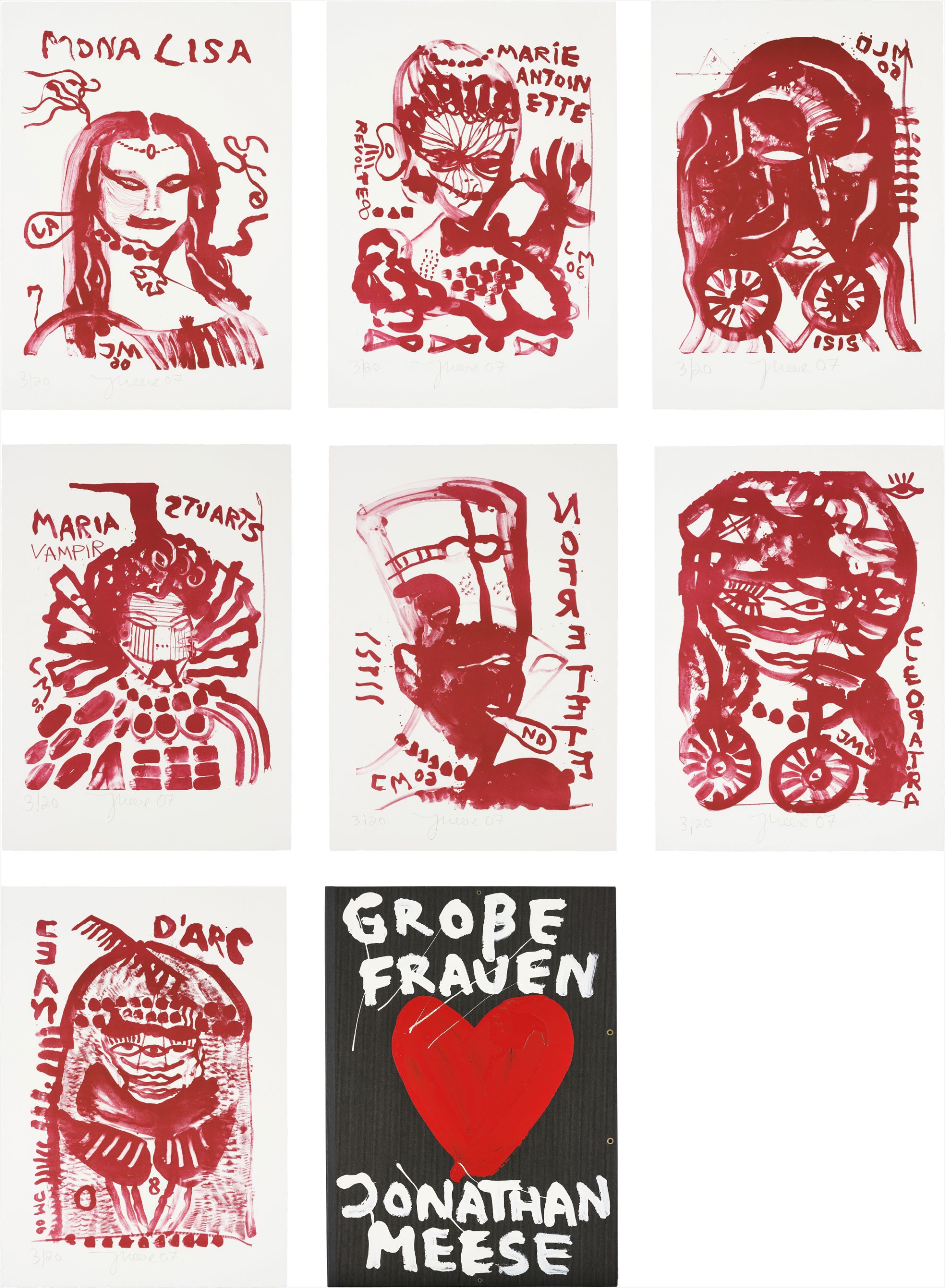
His sculpture practice deserves particular attention from collectors considering where the deepest long term value in his work may lie. Bronzes such as "Napoleon II" and "Jean," the latter presented on a granite and wooden plinth, reveal a Meese entirely at home with the formal traditions of European sculpture while remaining absolutely committed to subverting their hierarchies. These objects carry a curious gravitas, they are funny and monumental at once, which is a combination far harder to achieve than it appears. His print work, including the complete portfolio "Große Frauen (Great Women)," a set of seven lithographs in red on Magnani paper contained in a hand painted card portfolio, represents an ideal entry point for collectors beginning to engage with his practice.
The portfolio format suits him well: repetition, variation, and the accumulation of gesture are native to his sensibility. Within the broader landscape of contemporary art, Meese occupies a position that is genuinely singular. His maximalist approach to painting places him in productive conversation with the neo expressionist energies that surged through German art in the 1980s, with figures such as Georg Baselitz and A.R.
Jonathan Meese
Große Frauen (Great Women)
Penck as important precursors, though Meese's relationship to that inheritance is irreverent rather than reverential. His theatrical and performative dimensions connect him to the legacy of Joseph Beuys, whose concept of social sculpture as a total artistic system clearly echoes in the "Dictatorship of Art" philosophy, even as Meese reimagines that legacy through an entirely contemporary and distinctly anarchic lens. International collectors have increasingly recognised that German art's most interesting current practitioners are those who take the full weight of that tradition seriously enough to play with it. For collectors, Meese's market presents an opportunity that rewards both connoisseurship and conviction.
Works on canvas from the mid 2000s represent the core of his critical reputation and have demonstrated steady institutional interest over two decades. The bronze sculptures offer a different quality of presence in a home or collection context, objects that hold their ground in any company. The availability of works across media and scales means that a thoughtful collection of Meese can be built with genuine depth, from the intimacy of works on paper to the commanding presence of large scale paintings. Auction appearances of his work at major European houses have confirmed consistent demand among collectors who understand that the density and ambition of his canvases repay years of living with them.
What Jonathan Meese ultimately offers is the rarest of gifts in contemporary art: an artist who has built a complete world and invites you to inhabit it. His insistence that art must be given total authority, that it must not be subordinated to politics, commerce, or biography, is not a provocation for its own sake but a genuine aesthetic conviction sustained across three decades of extraordinary productivity. To collect Meese is to align yourself with that conviction, to bring into your life a body of work that refuses quietude, demands engagement, and never, under any circumstances, allows you to look away.
Explore books about Jonathan Meese