John George Brown
Brown's Golden Streets, Gloriously Rediscovered
Artist Spotlight · The Collection Editorial
There is a particular painting that stops visitors in their tracks. A young boy, no older than ten, stands on a cobblestone street corner in New York City, his boots worn and his expression caught somewhere between defiance and hope. The canvas practically hums with life, with the ambient noise of a city that never quite slept even in the 1870s. This is the world of John George Brown, and it is a world that collectors, curators, and scholars are returning to with fresh eyes and genuine admiration.
John George Brown
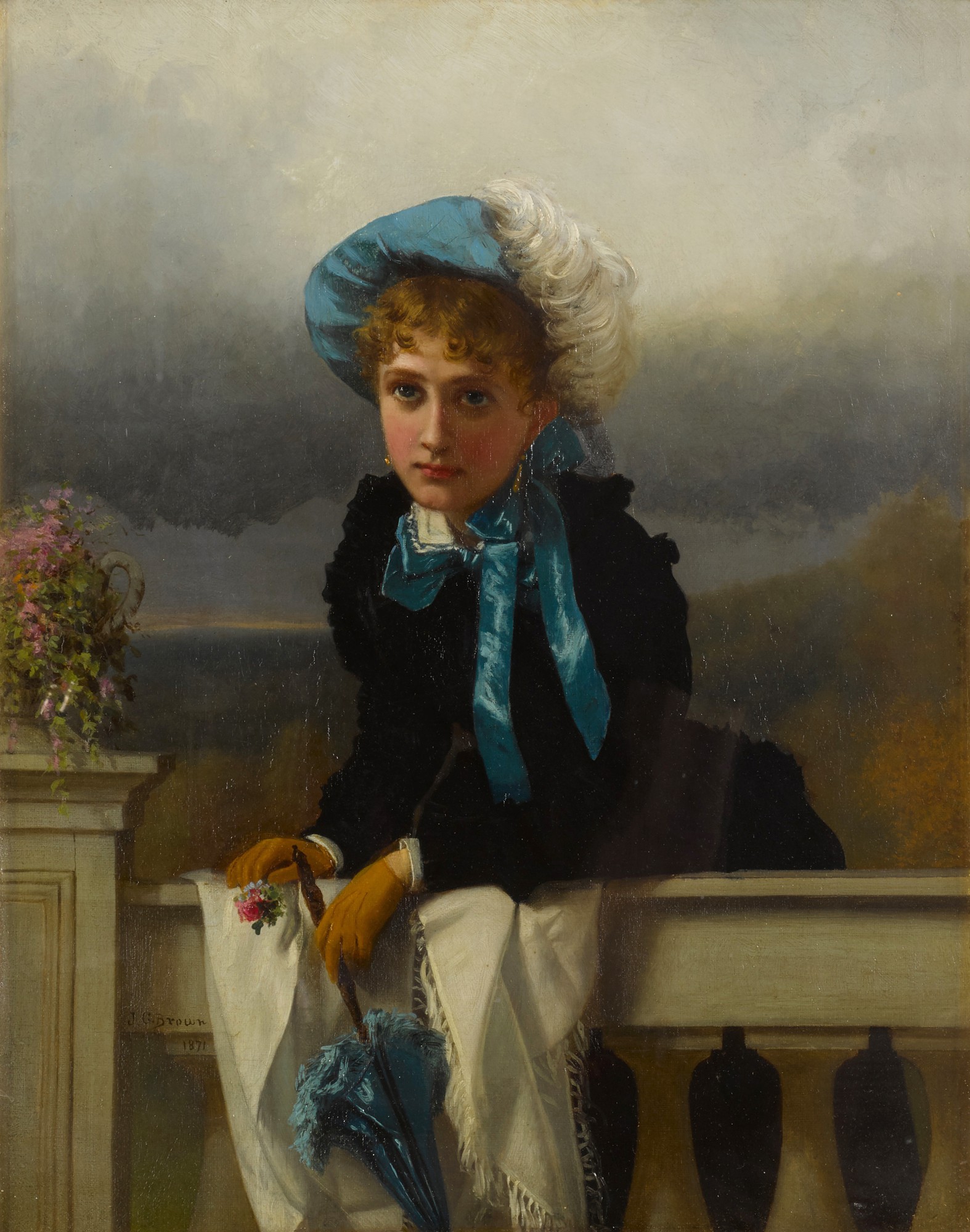
Waiting for Her Suitor, 1871
Brown was born in Durham, England in 1831, the son of a working family with no particular connection to the fine arts. He trained initially as a glassworker in Newcastle upon Tyne before his obvious talent for drawing and observation led him toward a more formal artistic education. He studied at the Newcastle School of Design and later, after emigrating to the United States in the early 1850s, enrolled at the National Academy of Design in New York City, where he would eventually become a full Academician. The journey from glassworker's apprentice to one of the most celebrated genre painters in America is, in itself, a story worthy of one of his own canvases.
New York City in the second half of the nineteenth century was a place of staggering contrasts, and Brown found his subject matter not in the parlors of the wealthy but on the streets below. He became fascinated by the city's working children, the bootblacks, the newsboys, the small vendors who carved out livelihoods from the margins of Gilded Age prosperity. These children were a visible and often discussed feature of urban American life, and Brown approached them with a combination of sharp observation and genuine warmth. He spent considerable time among them, sketching from life, learning their gestures and expressions, earning enough of their trust to capture something authentic in their faces.
John George Brown
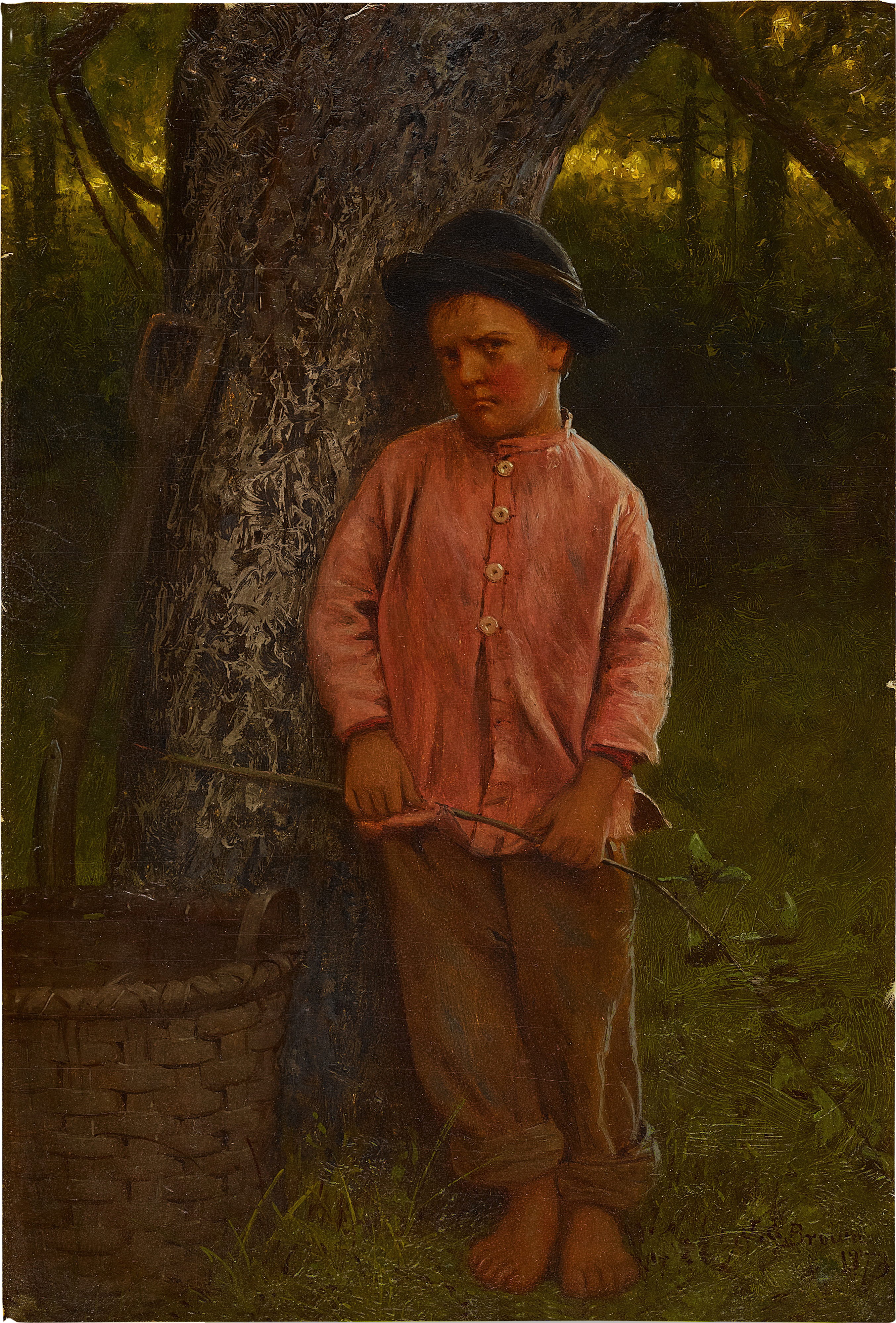
I Won't Go, 1873
His artistic development through the 1860s and 1870s reflects a painter who was simultaneously commercially savvy and deeply committed to his craft. Brown's technique is rooted in the realist tradition, influenced by the careful observation of Dutch Golden Age genre painters and shaped by his own rigorous training. His surfaces are smooth and luminous, his colors warm without being saccharine, and his compositions achieve a kind of natural balance that feels effortless but is in fact the product of considerable skill. Works such as "Waiting for Her Suitor" from 1871 and "Winter Games" also from 1871 demonstrate his range: the former intimate and tender, the latter animated with the physical energy of children at play in a winter landscape.
Both reveal a painter who understood narrative, who trusted the viewer to complete the emotional story he had begun. "I Won't Go" from 1873 is among the most telling of his works. Painted on panel, it captures a small child in a moment of cheerful stubbornness, feet planted, expression resolute. There is nothing condescending in Brown's handling of the subject.
John George Brown
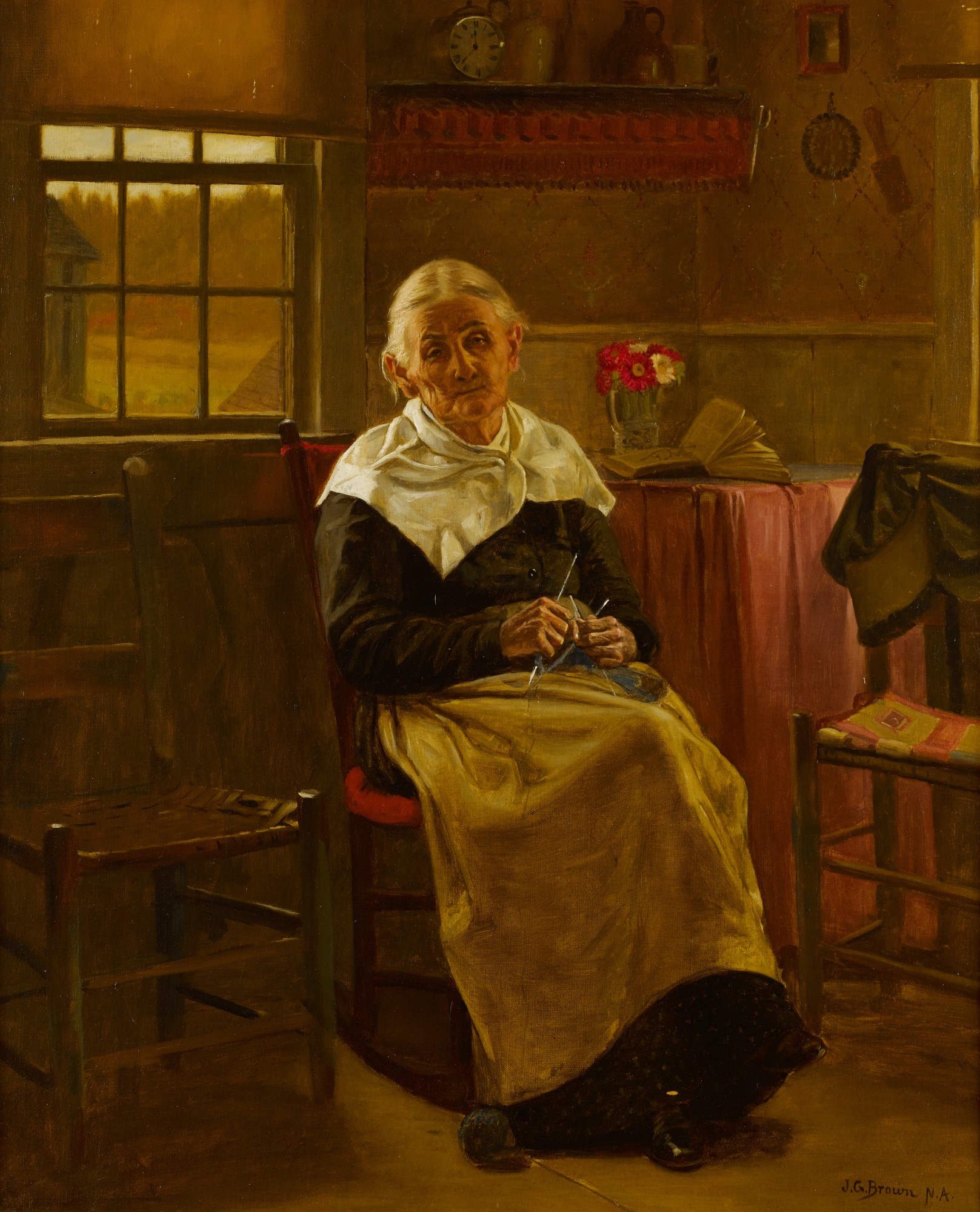
Dear Old Grannie
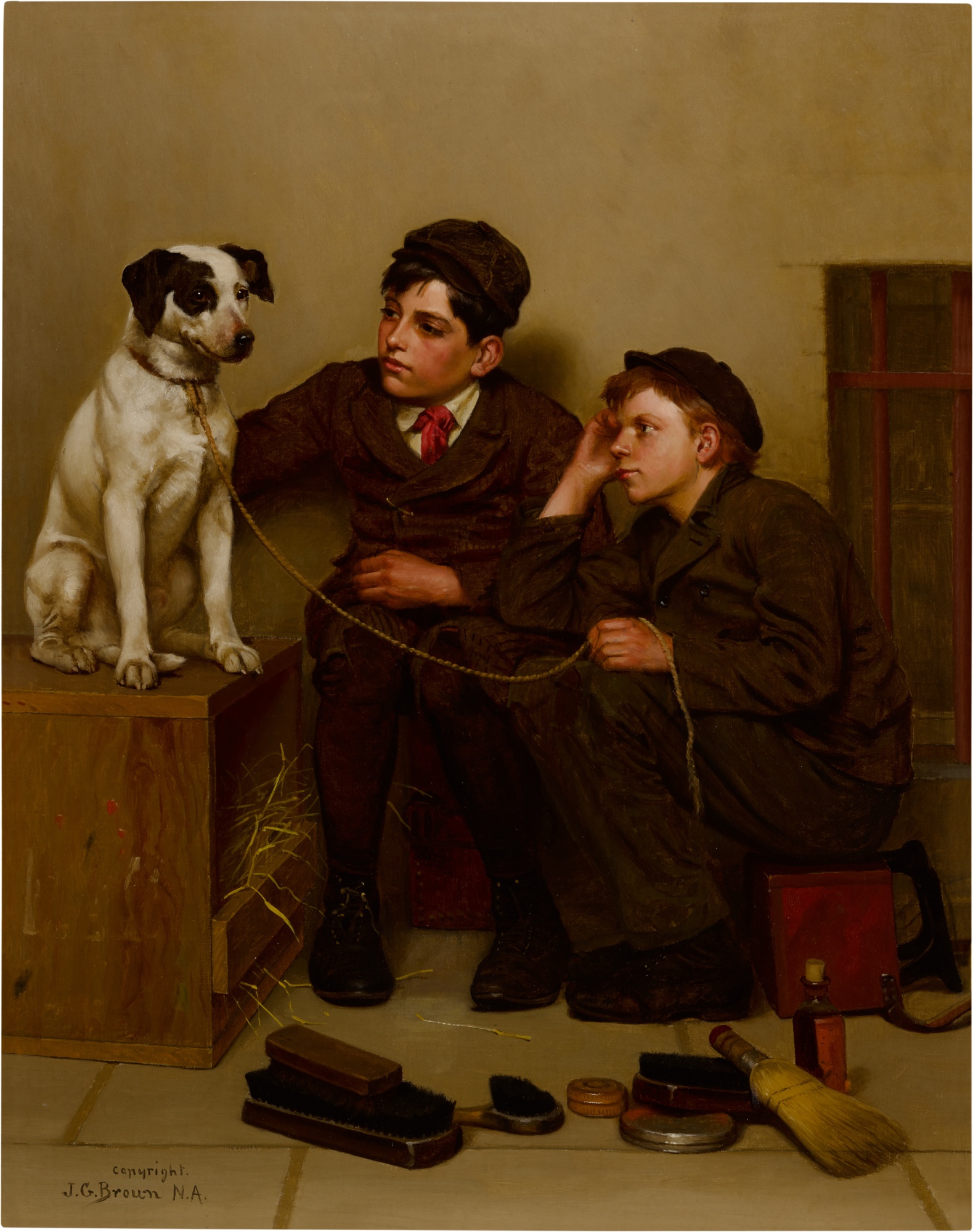
The child is presented with full dignity, as a personality rather than a type, and this quality distinguishes Brown from many of his contemporaries who depicted poverty as either picturesque misery or moralizing cautionary tale. "In the Hands of the Enemy" from 1901 shows Brown still at the height of his powers well into his mature years, his touch undiminished, his empathy intact. "A Builder of Boats" from 1889 and "Fisherman Bringing in His Sails" from 1877 reveal a different and often overlooked dimension of his practice, his interest in working men of the coast and his ability to render the physical world of labor with the same affection he brought to the city streets. For collectors, Brown represents one of the most compelling propositions in American nineteenth century painting.
His works appear regularly at Christie's and Sotheby's, where they consistently attract strong bidding from both institutional buyers and private collectors. The qualities that drive this sustained interest are not difficult to identify. Brown's paintings are exceptionally well executed, with a finish and technical assurance that holds up under close examination. They are also, crucially, emotionally legible across cultural and historical distance.
John George Brown
In the Hands of the Enemy, 1901
A viewer in the twenty first century encounters these children and recognizes something immediate and human, something that requires no scholarly apparatus to appreciate. That accessibility, paired with genuine artistic quality, is a combination that the market rewards reliably over time. Collectors seeking works of this period who have not yet looked seriously at Brown would do well to pay attention now, as institutional recognition of his importance continues to grow. Brown's place in art history becomes clearer when considered alongside his contemporaries and near contemporaries.
He shares a humanist approach to genre painting with Eastman Johnson, whose own depictions of American life across class and race occupy a similarly respected position in the canon. Winslow Homer, who also began his career documenting the lives of ordinary Americans in the 1860s, offers a useful point of comparison: both men were realists with a gift for narrative, though Homer's work moved toward a more austere and elemental vision while Brown remained committed to the warmth of close human observation. Within the broader tradition of sentimental genre painting, Brown stands out for the genuine skill beneath the surface appeal, a quality that separates enduring work from mere period charm. Brown died in New York City in 1913, having witnessed the city he loved transform almost beyond recognition during his lifetime.
He had arrived in a place of gas lamps and cobblestones and lived to see automobiles and electric light. Through it all, he remained committed to the human figure, to the street corner, to the small dramas of everyday life. His legacy is that of an artist who looked at the people his society most easily overlooked and found in them subjects worthy of the finest technical attention and the deepest compassion. In an era of renewed interest in the social textures of American history, and in the art that honestly recorded them, Brown's moment is very much now.