John Armleder

John Armleder: Where Everything Becomes Art
Artist Spotlight · The Collection Editorial
“I like to think that everything is possible and that nothing is excluded.”
John Armleder
Few artists working today occupy quite the same position as John Armleder, a figure who has spent more than five decades dismantling the boundaries between art and life, between the rarefied and the everyday, between sincerity and play. In recent years, major European institutions have returned to his work with renewed enthusiasm, recognizing in his practice a prescience that feels more urgent than ever. His solo exhibitions at the Mamco in Geneva, the museum that has long championed his contribution to Swiss and international art, alongside group presentations at institutions across Europe and North America, have introduced his ideas to a generation of collectors and curators who are only now catching up to what Armleder understood long ago: that art is most alive when it refuses to take itself too seriously. Armleder was born in Geneva in 1948, into a city that was at once cosmopolitan and quietly provincial, a place where the bourgeois comforts of postwar Europe coexisted with a lively undercurrent of countercultural possibility.
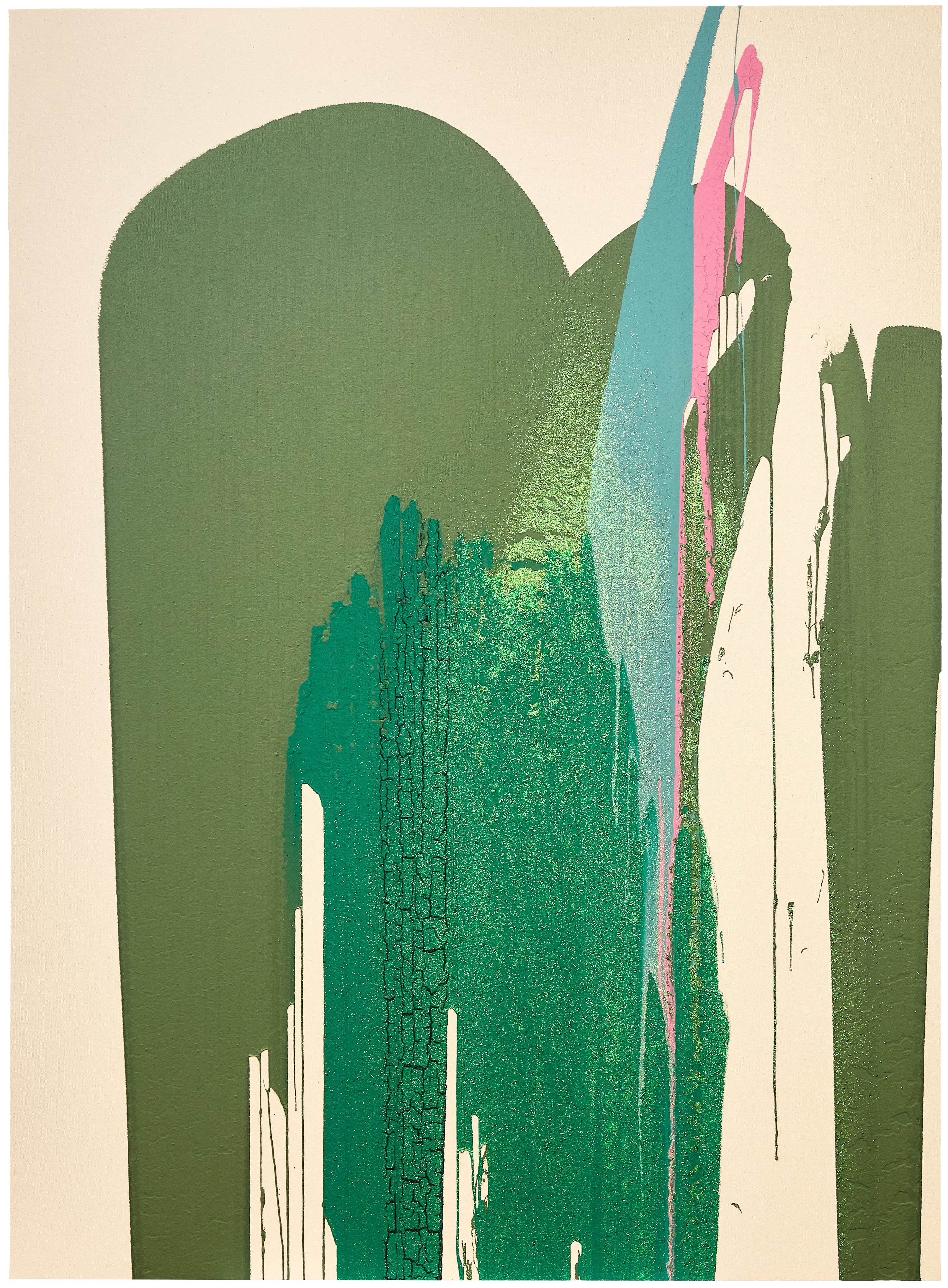
John Armleder
Radiolaria I, 2020
He studied at the Ecole des Beaux Arts in Geneva and later at the Byam Shaw School of Art in London, but his real education came through the networks and movements he helped to build rather than the formal institutions he passed through. Geneva in the late 1960s and early 1970s was a genuinely fertile ground for experimental thought, and Armleder found his people there, artists and performers who wanted to collapse the distinction between art making and living. In 1969, Armleder cofounded the Groupe Ecart with Patrick Lucchini and Claude Rychner, a collective that would become one of the most important nodes in the European Fluxus network. Groupe Ecart organized performances, publications, and exhibitions that brought the spirit of Fluxus, with its democratic irreverence and its insistence that anything could be art, into the Swiss context.
Through Ecart, Armleder corresponded with and hosted figures central to the Fluxus movement, including George Brecht and Robert Filliou, building a transatlantic web of ideas that would shape his sensibility permanently. This formation in collectivity, in the blurring of authorship and intention, left a deep mark on everything he would go on to make. By the 1980s, Armleder had begun to develop the body of work that would bring him international attention: the Furniture Sculptures, or FS series, which paired abstract paintings, often executed in the gestural or geometric modes borrowed from canonical modernism, with functional objects drawn from domestic interiors. A sofa placed before a dripping canvas, a lamp positioned beside a hard edge abstraction, a coat hanger attached directly to the painted surface: these combinations were not merely provocative but genuinely thought provoking.

John Armleder
Liberty Dome Sliced, 1996
They asked the viewer to consider what we look at when we look at art, what role the surrounding environment plays in our reception of a painted surface, and whether the authority we grant to abstract painting is earned or simply inherited. Works like Painting with Coat Hanger, in which acrylic and graphite on canvas share space with a wooden coat hanger, distill this inquiry into something almost comically direct and yet philosophically dense. Armleder's paintings have evolved continuously while maintaining a recognizable sensibility. His Pour Paintings, large canvases onto which paint is poured and allowed to pool and spread without the guidance of a brush, embrace accident and materiality with an openness that recalls both the Abstract Expressionists and the process art of the 1970s, while remaining entirely his own.
Works like Levanzo from 2008, which layers acrylic, oil, enamel paint, and glitter on canvas, demonstrate his love of surface as spectacle and his refusal to treat beauty as a suspect quality. Astrochelys Radiata from 2006, with its combination of acrylic, resin, glitter, and mixed media, is similarly generous in its visual pleasure, a canvas that catches light and rewards sustained looking. His more recent Disobedient I and II, a diptych from 2021 made with acrylic and strass, continues this trajectory, suggesting that at more than seventy years of age, Armleder remains as creatively restless as ever. The mirror works deserve particular attention as an example of Armleder's ability to make sculpture that is simultaneously formal and funny.

John Armleder
Lampe (Lamp)
Each Diameter 36 In., a 1998 work comprising fifteen convex acrylic mirrors, turns the viewer into the subject, scattering and distorting reflection across its circular forms. The work references the long history of the mirror in art, from the vanitas tradition through to the reflective canvases of Gerhard Richter, while arriving somewhere entirely its own. There is genuine wit here, but also a genuine argument about perception, about the impossibility of a neutral viewing position, and about the way an artwork changes with every body that stands before it.
For collectors, Armleder's work offers something relatively rare: a practice that is intellectually serious without being austere, and visually pleasurable without being decorative in any reductive sense. His editions, including collaborative publications produced with World House Editions and Edition Copenhagen, such as the signed and numbered prints Lampe and Lanterne Chinoise, make his ideas accessible at a range of price points while maintaining the integrity of his thinking. Original works on canvas, particularly from the Pour Paintings and the mixed media series, have attracted consistent attention at auction houses and in the secondary market, with European collectors especially drawn to the combination of art historical depth and surface exuberance that defines his output. Armleder's work sits naturally alongside that of artists who share his interest in appropriation and abstraction, including Sigmar Polke, Martin Kippenberger, and Sherrie Levine, and collectors who have engaged with any of those practices will find his work a richly rewarding addition.
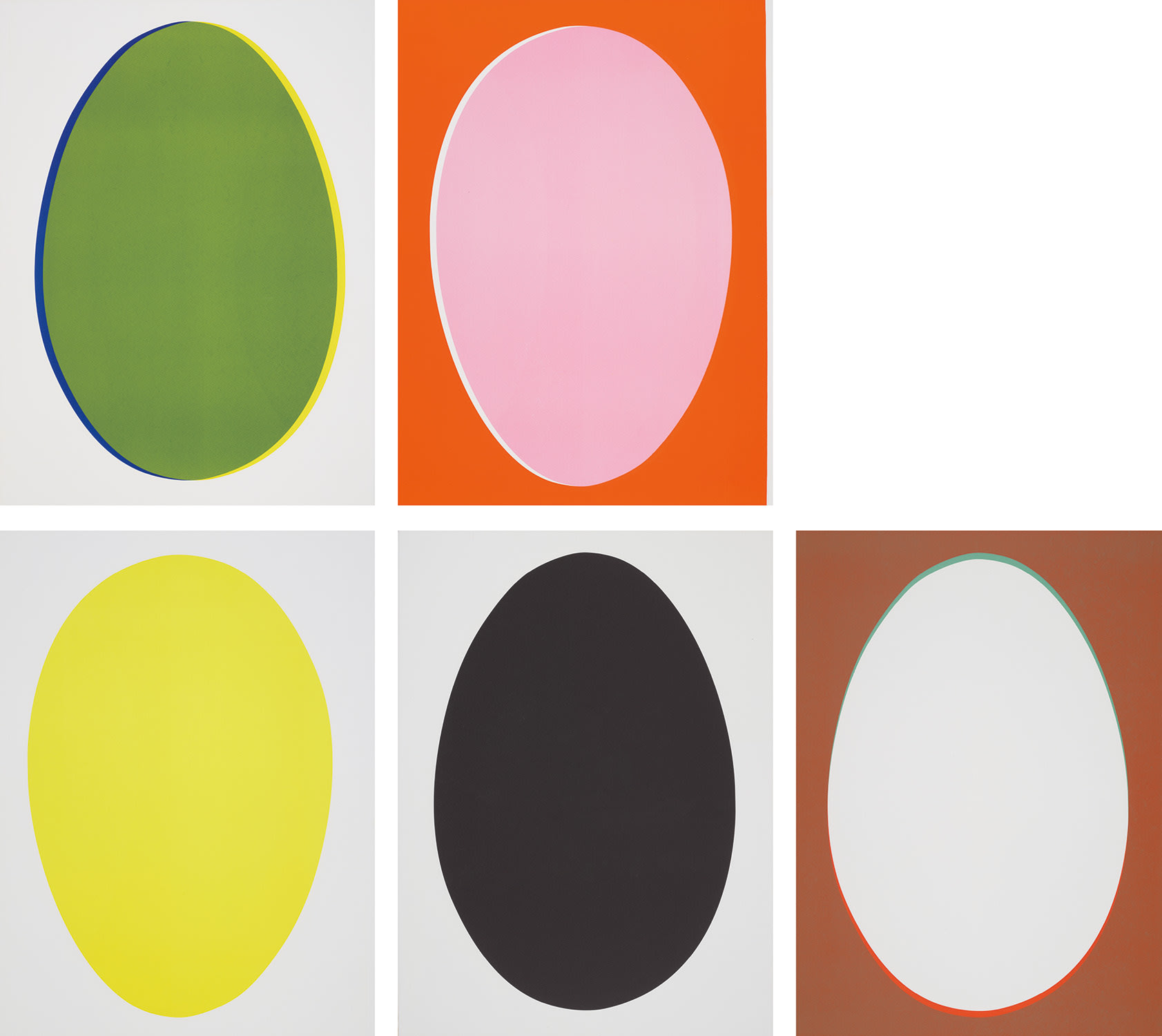
John Armleder
Lanterne Chinoise (Chinese Lantern)
Armleder's legacy is that of an artist who proved that seriousness and pleasure are not opposites, and that the most rigorous thinking about art can be done with a light touch and an open hand. He arrives at questions that occupied Duchamp, Warhol, and the Fluxus generation and carries them forward without nostalgia, finding in glitter and mirrors and coat hangers a language that is entirely contemporary. Institutions from the Centre Pompidou to the Museum of Modern Art hold his work in their permanent collections, a recognition that his contribution to the conversation about what art can be and do is lasting and irreplaceable. To collect Armleder is to participate in one of the most generous and intelligent ongoing arguments in postwar art, an argument that has never once stopped being fun.
Explore books about John Armleder
John Armleder: Paintings and Drawings 1976-1988
Various

John Armleder
Yves Aupetitallot
John Armleder: Retrospective 1978-1998
Various
John Armleder: Works 1976-2000
Various

Armleder: Abstraction and Figuration
Jean-Christophe Ammann