Johan Deckmann
Johan Deckmann Finds Beauty in Everything
Artist Spotlight · The Collection Editorial
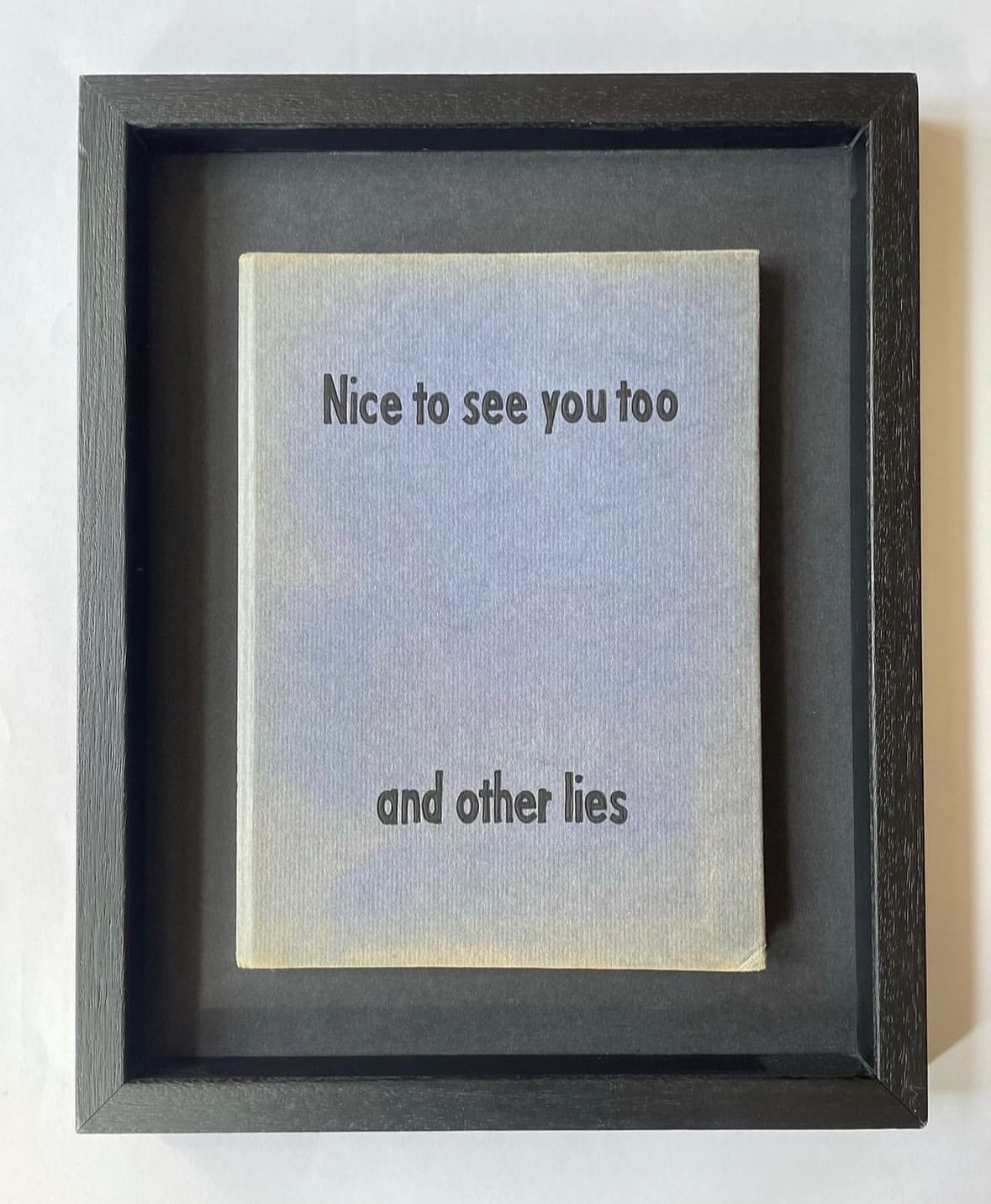
Something quiet and profound is happening in contemporary Danish art, and Johan Deckmann is at the center of it. His 2024 work "Nice To See You Too" arrived with the understated confidence of an artist operating at full creative maturity, a piece that layers acrylic paint across the surface of a book and transforms an everyday object into something genuinely arresting. It is the kind of work that stops you mid step, that makes you reconsider what a surface can hold and what meaning accumulates in objects we overlook. That a single gesture, paint meeting page, can carry this much emotional weight says everything about where Deckmann is right now as a practitioner.
Johan Deckmann
Nice To See You Too, 2024
Born in Denmark in 1968, Deckmann came of age during a period when Scandinavian art was quietly redefining itself against the backdrop of a broader European conceptual tradition. Denmark in the late 1970s and through the 1980s offered a particular cultural texture, a society deeply attentive to design, craft, and the relationship between the handmade and the industrial. These values, absorbed early, would become the invisible architecture beneath everything Deckmann would later make. His formation was shaped by a culture that took material seriousness as a given, where the quality of an object and the intention behind its making were understood to be inseparable concerns.
Deckmann's artistic development traces a path through sculpture, installation, and assemblage, disciplines that share a fundamental commitment to the physical world. He is an artist who thinks through his hands, who lets materials lead him toward meaning rather than imposing a predetermined concept onto inert matter. This approach places him in a rich lineage of artists who understood that transformation, not fabrication, is the deepest form of artistic labor. His practice evolved to incorporate found objects alongside industrial and organic materials, creating a vocabulary that feels simultaneously ancient and urgently contemporary.
The result is a body of work where rust and wood and paint and paper coexist with the same naturalness you find in a forest floor. The thematic concerns that run through Deckmann's work, transformation, decay, and the passage of time, are not chosen for their dramatic potential but because they are honest. He is drawn to the moments when materials change their nature, when something manufactured begins to resemble something grown, when the boundary between the natural and the fabricated becomes genuinely porous. His sculptures occupy this threshold with remarkable ease, creating what might be called hybrid forms, objects that carry traces of multiple lives and multiple origins.
This is conceptual art in the truest sense, where the idea and the material are inseparable, where you cannot think about one without touching the other. "Nice To See You Too" is an exemplary entry point into understanding Deckmann's sensibility. The choice of a book as substrate is never arbitrary in his practice. Books are already objects saturated with time, with human intention, with the residue of countless readings and handlings.
To paint across that surface is to enter into a conversation with all of that accumulated meaning, to add another layer of attention to something that has already been cared for. The acrylic does not erase the book; it collaborates with it. The work belongs to a broader tendency in Deckmann's practice of honoring the found object rather than simply repurposing it, a distinction that separates his work from more superficial engagements with assemblage. For collectors, Deckmann represents a genuinely compelling opportunity within the mid career European contemporary market.
His work sits at a productive intersection of several collecting conversations happening right now: the renewed interest in materiality and craft within conceptual practice, the growing collector appetite for Scandinavian contemporary art, and the broader cultural shift toward sustainability and an ethics of the found and reused. These are not trends Deckmann has chased; they are values his practice has embodied for years, which is precisely why his work feels so timely without being fashionable. Collectors who come to Deckmann now are arriving at the right moment, early enough to be genuine discoverers, late enough to be certain of the work's seriousness. Within the wider landscape of contemporary art, Deckmann's practice resonates with a tradition that includes artists such as Richard Wentworth, whose own found object works transformed British conceptual art, and the assemblage lineage running from Robert Rauschenberg through to more recent practitioners engaged with material culture.
The Scandinavian context also places him in dialogue with artists such as Olafur Eliasson, whose engagement with natural phenomena and perceptual experience shares a sensibility if not a methodology. What distinguishes Deckmann is the intimacy of his scale and the specificity of his material choices, a quality that makes each work feel genuinely considered rather than systematically produced. Deckmann's importance today lies not only in what his work looks like but in what it asks of us. In an art world increasingly dominated by spectacle and scale, his practice makes a quiet argument for attentiveness, for slowing down, for looking at the objects that surround us with something approaching tenderness.
He is an artist who takes the discarded seriously, who finds in the overlooked a kind of dignity that more celebrated materials rarely achieve. This is not a minor position to hold; it is a deeply ethical one, and it is increasingly rare. As the conversation around sustainability and material culture moves from the margins to the center of contemporary life, Deckmann's practice reads not as ahead of its time but as exactly of this time, thoughtful, generous, and made with care.