Jim Nutt
Jim Nutt, Chicago's Most Bewitching Figurative Visionary
Artist Spotlight · The Collection Editorial
In the galleries of the Art Institute of Chicago, a small portrait head commands silence. The face is rendered with almost obsessive precision, each contour of the nose and lip studied and restudied until the surface hums with a strange inner life. It belongs to Jim Nutt, a painter who has spent more than five decades conjuring figures that seem to arrive from some parallel world just adjacent to our own. His 2010 retrospective at the same institution, organized in collaboration with the Moderna Museet in Stockholm and the Zentrum Paul Klee in Bern, confirmed what devoted collectors had known for years: Nutt is among the most singular and rewarding painters working in America today.
Jim Nutt
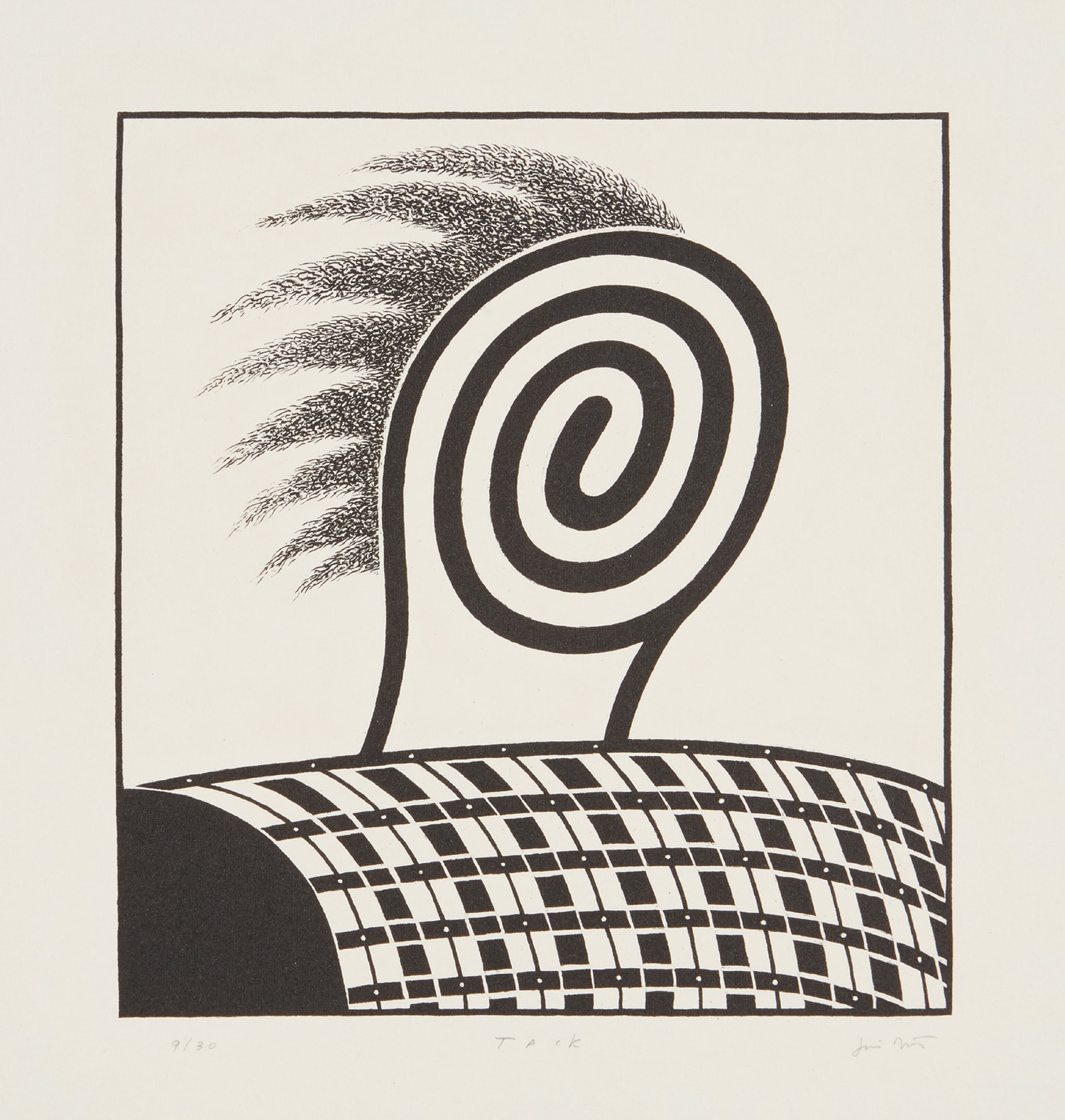
Tack
Nutt was born in Pittsfield, Massachusetts, in 1938, and his path to becoming one of the most original voices in postwar American art wound through Washington D.C. and eventually to Chicago, where he enrolled at the School of the Art Institute in the early 1960s. It was there that the city's particular atmosphere, its blues culture, its vernacular signage, its sense of humor rooted in something darker and stranger than coastal sophistication, began to seep into his sensibility.
Chicago was not New York, and that distance proved enormously generative. Far from the gravitational pull of Abstract Expressionism and the emerging conceptual movements dominating the coasts, Nutt and his peers were free to pursue something wilder and more personal. The decisive turning point came through the Hyde Park Art Center, where curator Don Baum brought together a loose constellation of young Chicago artists in a series of exhibitions beginning in 1966. This group, which would come to be known as the Chicago Imagists, included Roger Brown, Gladys Nilsson (who became Nutt's lifelong partner and collaborator), Ed Paschke, Karl Wirsum, and others.
Jim Nutt
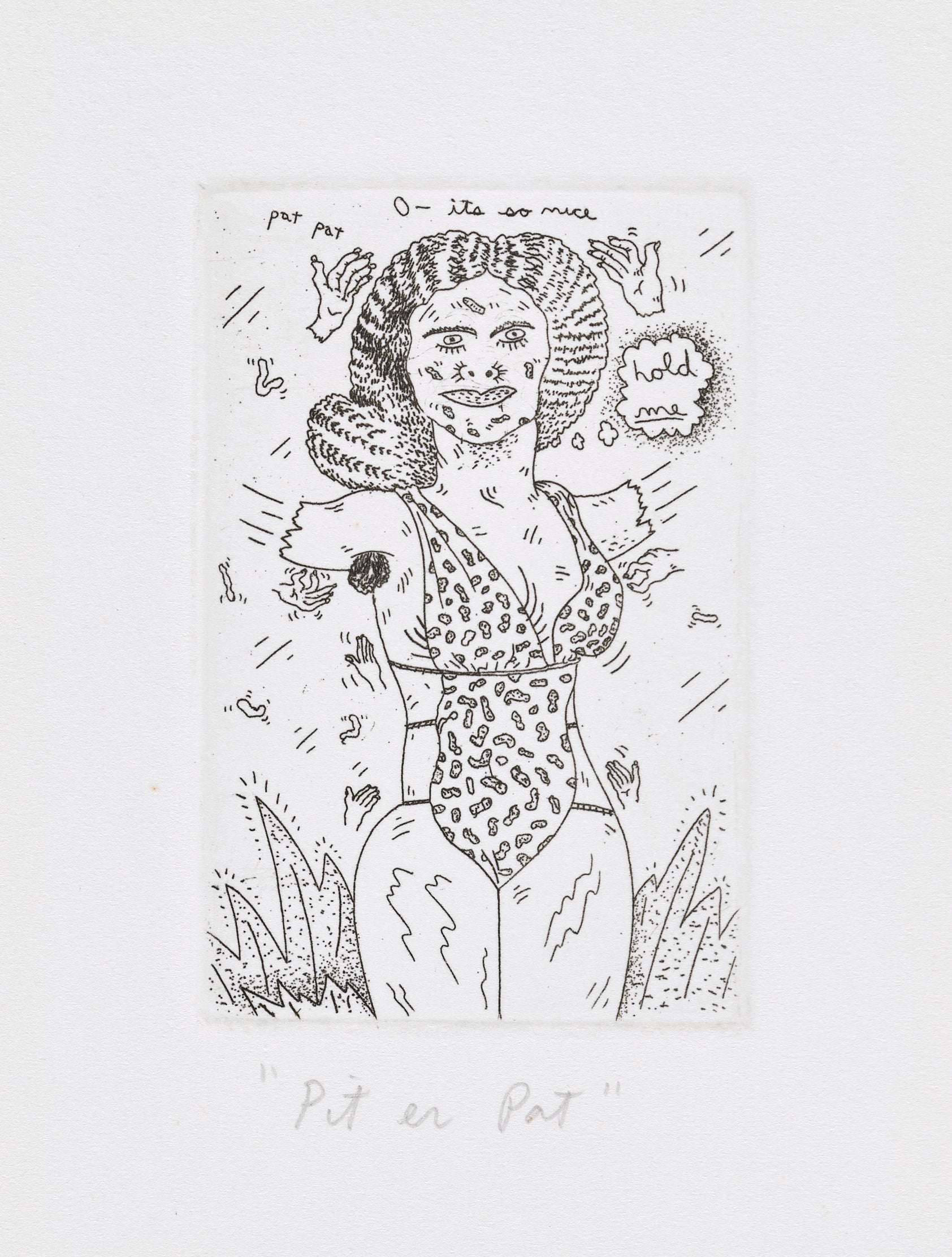
Pit er Pat
The Imagists drew on sources that the mainstream art world had largely dismissed: carnival art, comic books, outsider art, pre Columbian imagery, and the raw graphic energy of shop signs and tattoo parlors. Nutt absorbed all of it and filtered it through a sensibility that was entirely his own, combining meticulous draftsmanship with a mordant, slightly unnerving wit. Nutt's early work from the late 1960s and 1970s is immediately recognizable for its confrontational energy and dense graphic invention. Figures painted on Plexiglas, with text and patterns applied to the reverse side so that image and language seemed to coexist in a single vibrating plane, announced an artist deeply interested in the relationship between looking and reading, between image and word.
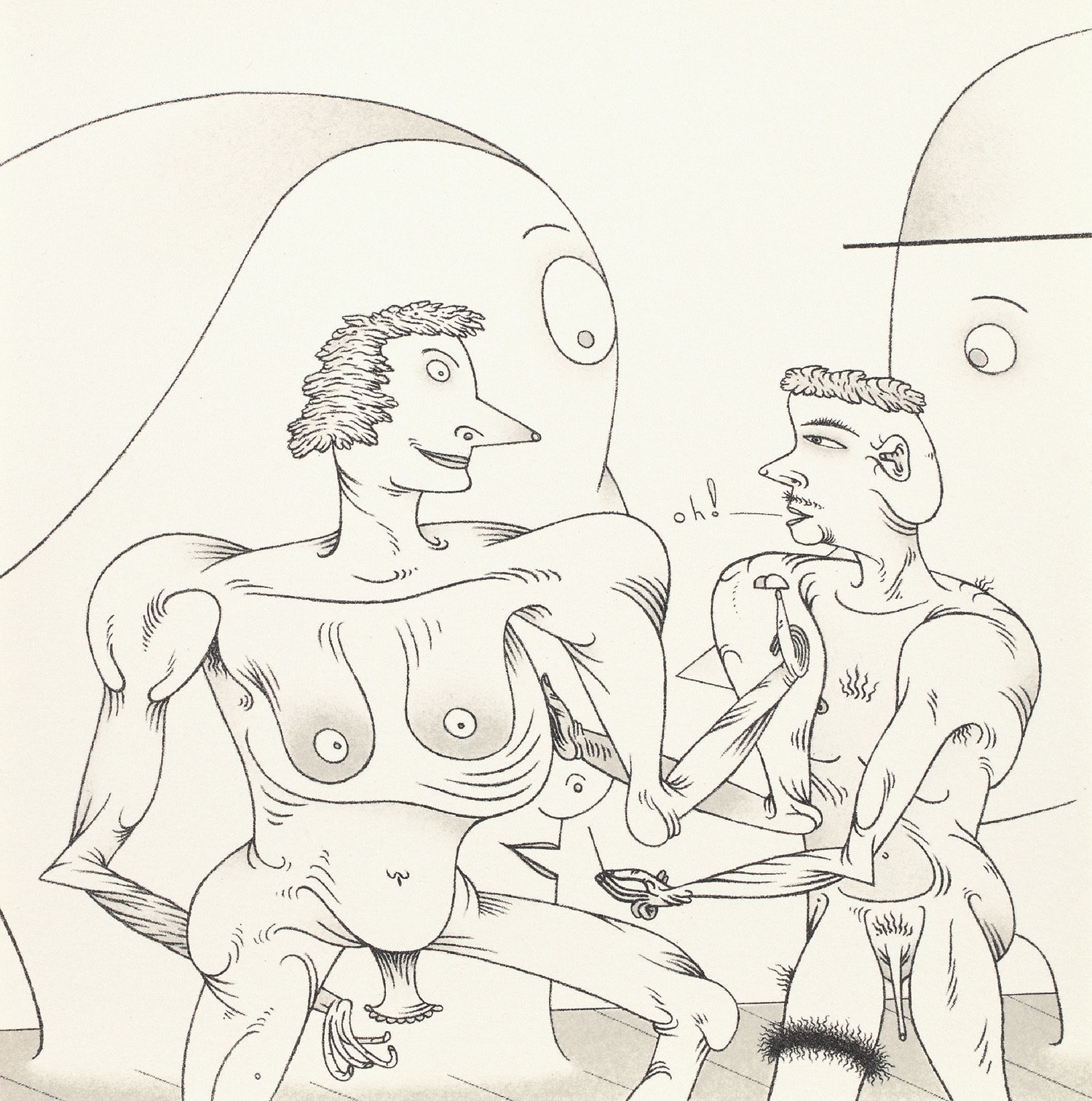
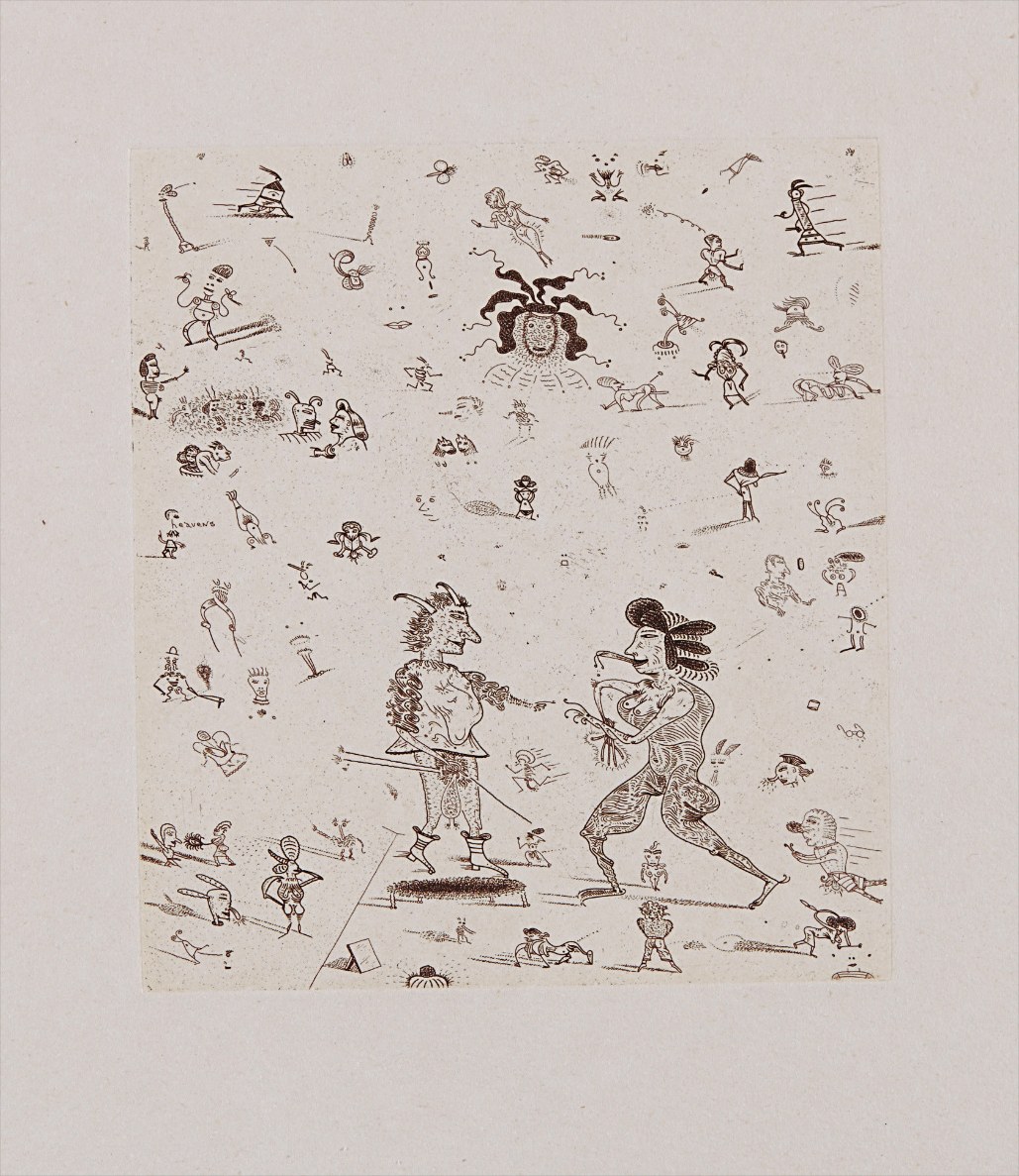
Works such as "your so coarse (tish tish)" and "seams straight!" demonstrate this quality beautifully, their etched lines carrying the same sharp wit and psychological charge as his paintings. The titles, always misspelled or grammatically skewed in ways that feel deliberate and funny, add another layer of playful subversion. Nutt understood that language, like the human face, could be made strange through the slightest manipulation.
Jim Nutt
your so coarse (tish tish)
From the 1990s onward, Nutt's practice underwent a profound and widely admired evolution. He turned his full attention to the portrait head, working in graphite and paint to render singular, imagined faces with a concentration that borders on the devotional. These late works, including the 2006 graphite on paper in The Collection, represent one of the most compelling ongoing series in contemporary figurative art. The faces are neither realistic nor purely invented; they occupy a territory between memory, dream, and close observation that feels genuinely unprecedented.
Nutt has spoken of studying master portraitists from Holbein to Ingres, and that sustained looking is evident in the care with which each form is weighted and placed. Yet the results never feel academic. They feel alive in a way that is difficult to explain and impossible to forget. For collectors, Nutt's works on paper represent a particularly rewarding point of entry into his universe.
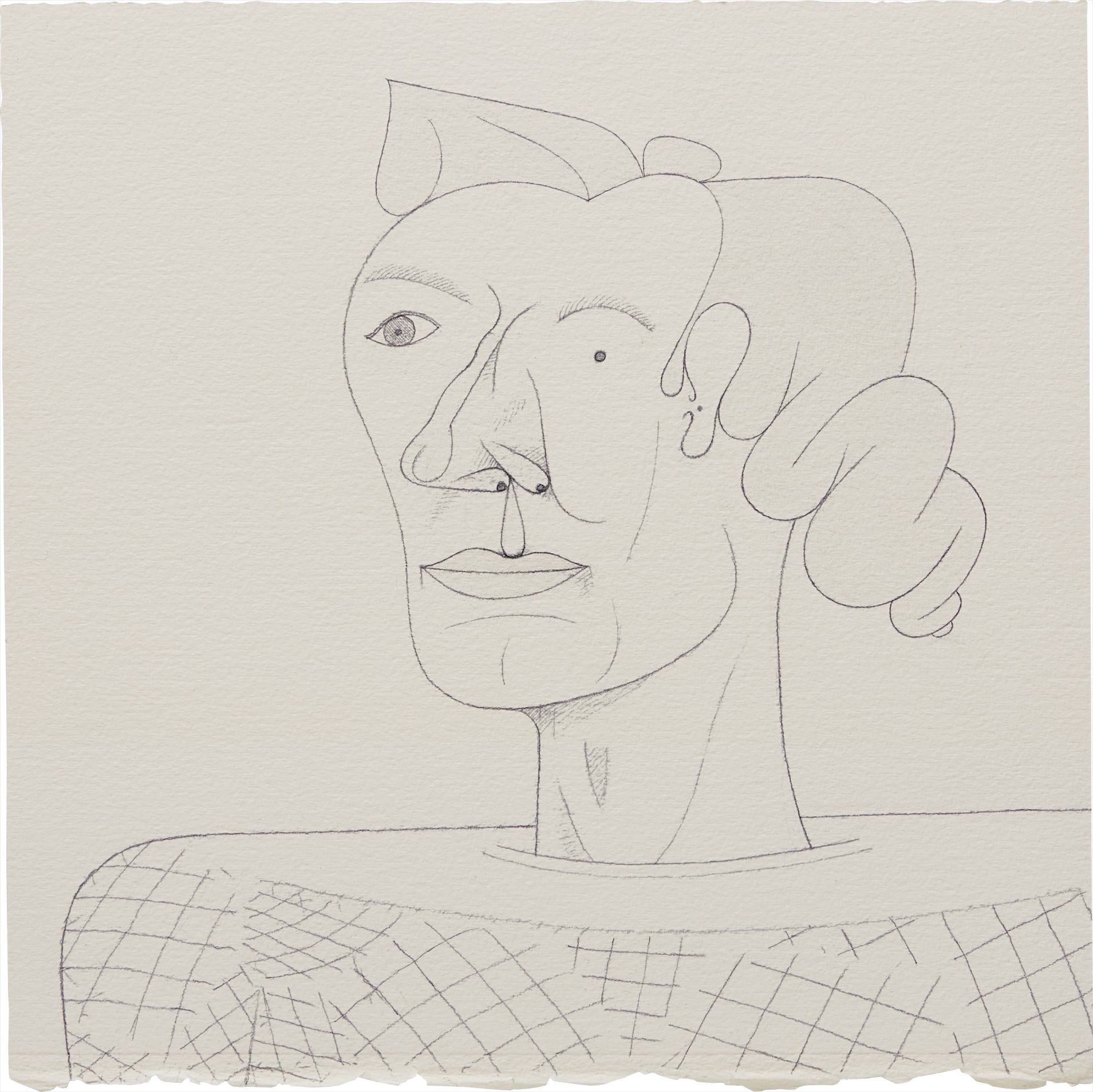
Jim Nutt
graphite on paper, 2006
His prints, including the lithographs "Tack" and "Who Chicago?," alongside his accomplished etchings, carry all the inventive energy of his paintings at a scale and price point that makes them accessible to a broader range of collecting ambitions. These works have appeared consistently at major print sales at Christie's, Sotheby's, and Swann Auction Galleries, where they attract spirited bidding from both seasoned Imagist collectors and newer buyers discovering the Chicago scene for the first time. The market for Nutt has deepened steadily over the past two decades, reflecting growing institutional recognition and the sustained critical reassessment of the Chicago Imagists as a movement of genuine international importance.
To place Nutt within art history is to recognize how many threads he holds together. He shares with his Imagist peers a fundamental debt to the graphic improvisations of Paul Klee and the psychological complexity of late de Kooning, while his interest in vernacular and outsider sources connects him to a tradition running from Jean Dubuffet through Henry Darger. His figurative commitment and his refusal to abandon the human face as a subject align him with painters like Philip Guston, whose late turn back to figuration was similarly met with initial resistance before being recognized as visionary. Nutt belongs in this company, and the continued presence of his prints and drawings in major museum collections, from the Art Institute of Chicago to the Whitney Museum of American Art, confirms his standing.
What makes Nutt matter so urgently today is precisely his resistance to easy categorization. In a moment when art audiences are hungry for work that is psychologically rich, formally inventive, and rooted in a genuine personal vision, Nutt's practice offers all three in abundance. He has never chased fashion or accommodated the market at the expense of his inner logic. The faces he draws emerge from a place of sustained looking and genuine curiosity about what it means to render another consciousness in line and tone.
To own a work by Jim Nutt is to welcome into your home an intelligence that will reward you differently each time you encounter it, which is perhaps the finest thing that can be said of any work of art.
Explore books about Jim Nutt
Jim Nutt
Whitney Chadwick
Jim Nutt: A Retrospective
Museum of Contemporary Art Chicago
Chicago Imagism
Franz Schulze
Jim Nutt: Paintings and Drawings
Phyllis Kind Gallery
The Chicago Imagist Movement
Russell Bowman
Jim Nutt: New Paintings
Edward Gorey