Jean Tinguely
Jean Tinguely: The Joy of Beautiful Chaos
Artist Spotlight · The Collection Editorial
“Everything moves, nothing is fixed. I am not interested in the static. I want the ephemeral, the transitory.”
Jean Tinguely
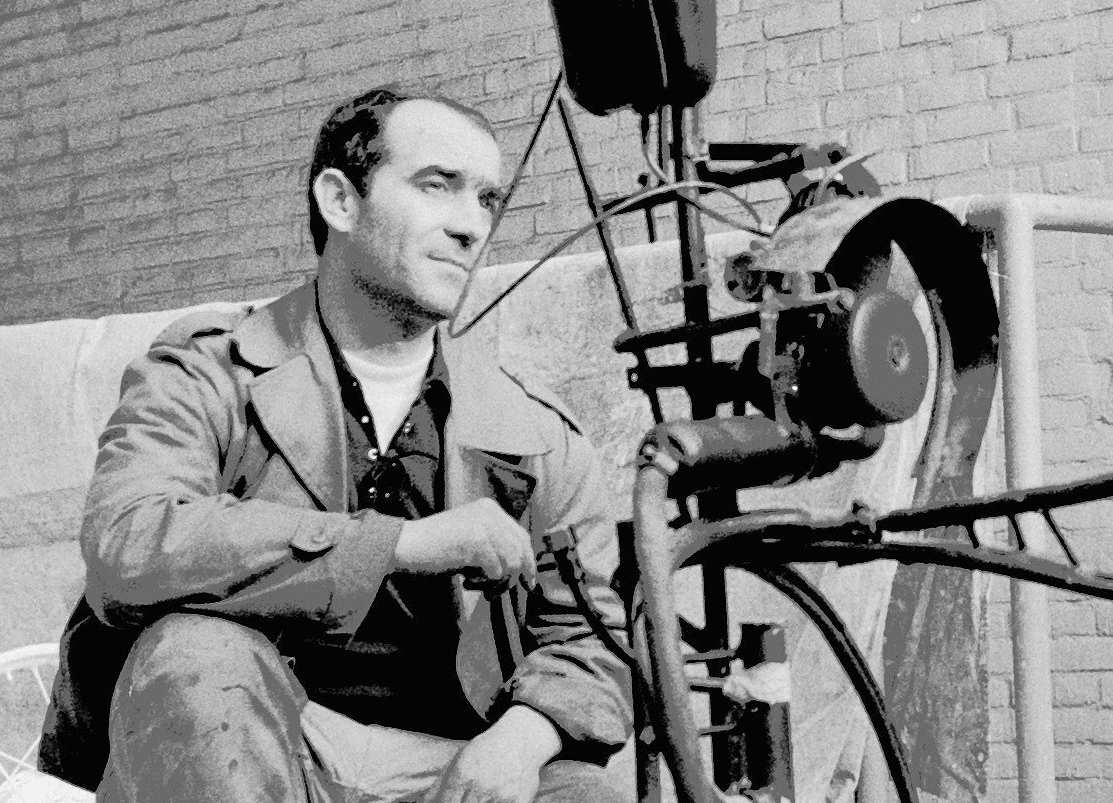
There is a moment in the history of twentieth century art that feels almost mythological: March 17, 1960, in the garden of the Museum of Modern Art in New York, a sprawling, clattering, smoke belching machine called Homage to New York spent roughly twenty seven minutes attempting to destroy itself. Bells rang, motors whirred, a piano caught fire, and an arm painted canvases before flinging them into the crowd. The machine did not fully succeed in its own demolition, and the New York City Fire Department was called. The artist, Jean Tinguely, watched with undisguised delight.
Jean Tinguely
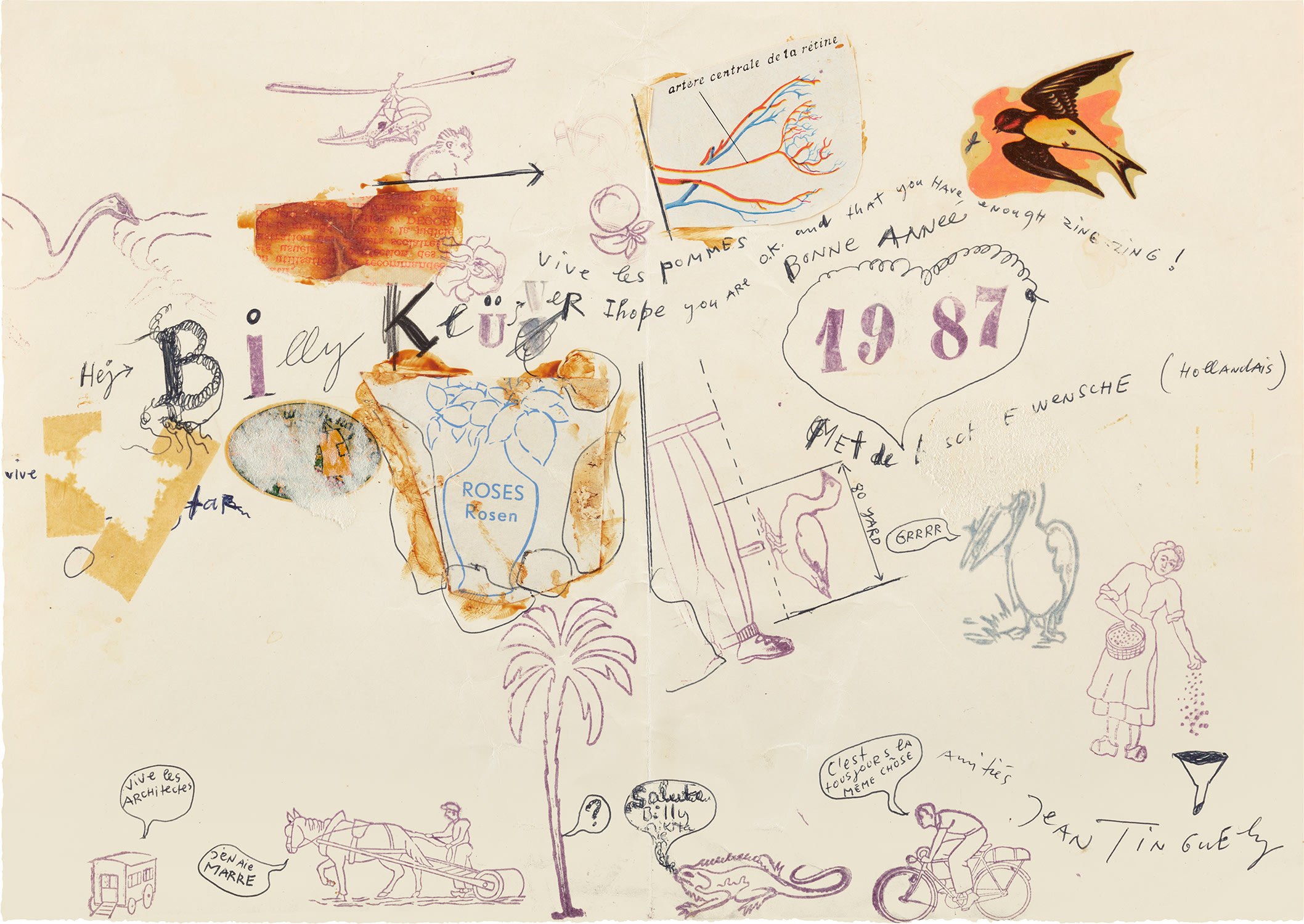
New Years greeting for Billy Klüver
That single evening crystallized everything that made Tinguely one of the most genuinely original sculptors of the postwar era: his love of spectacle, his philosophical wit, his deep belief that art should move, breathe, fail, and surprise. Jean Tinguely was born in Fribourg, Switzerland, in 1925, and grew up in Basel, a city whose sober civic identity and world class museums would prove a productive counterpoint to his own restless temperament. As a child he was drawn obsessively to the sound and rhythm of water mills, spending hours watching wheels turn and water pour in the forests outside the city. That early fascination with mechanical motion, with the poetry of repetition and the beauty lurking inside industrial process, never left him.
He studied at the Basel School of Arts and Crafts in the 1940s, absorbing modernist principles while already chafing against the idea that art should be static, precious, or permanent. His move to Paris in 1953 placed him at the center of a radical and generative scene. He became close to Yves Klein, with whom he collaborated and exhibited, and he was a founding member of the Nouveau Réalisme movement organized by the critic Pierre Restany in 1960. That group, which also included Niki de Saint Phalle (who would become Tinguely's partner and lifelong collaborator), Arman, and Raymond Hains, sought to dissolve the boundary between art and everyday life by incorporating real objects, industrial materials, and lived experience directly into artistic practice.
Jean Tinguely
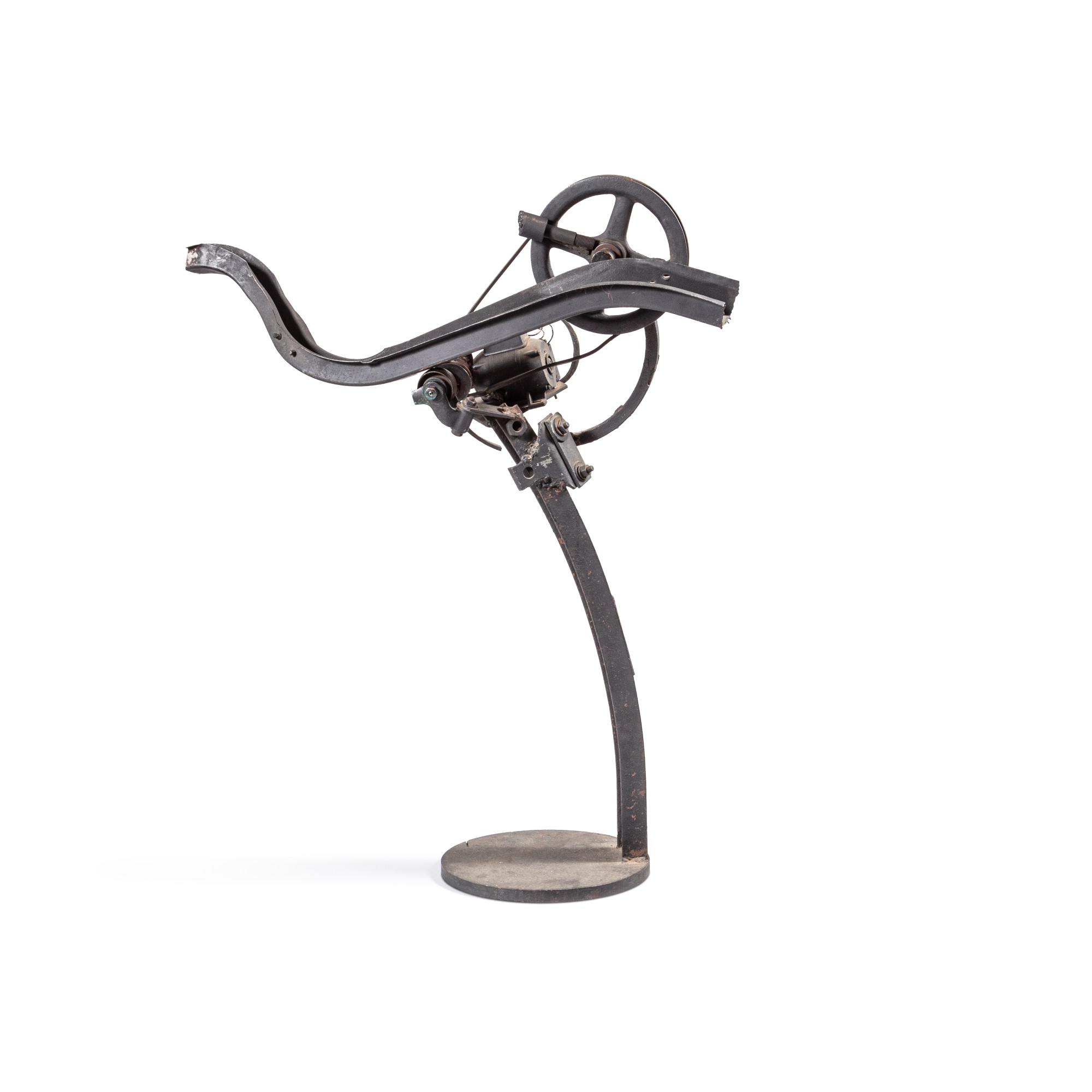
Celebes, 1964
Tinguely's contribution was singular: where others assembled or appropriated, he animated. His machines did not simply represent life; they lived, awkwardly and magnificently. The development of his kinetic sculptures, which he called Méta Matics, marked his first major breakthrough. Beginning in the late 1950s, these were drawing machines: motorized contraptions that held pens or brushes and produced abstract works on paper, inviting visitors to feed in sheets and receive a unique output.
“Let movement be free, alive, and incessant. Long live the immaterial, the transient, and the unstable.”
Für Statik, manifesto, 1959
The gesture was rich with meaning. At a moment when Abstract Expressionism had elevated the gestural mark to near sacred status, Tinguely handed the brush to a motor and laughed. Yet the laugh was never cynical. The Méta Matics produced genuinely beautiful drawings, and Tinguely understood that chance, collaboration between human and machine, and the abdication of authorial control could yield something more alive than pure intention ever could.
Jean Tinguely
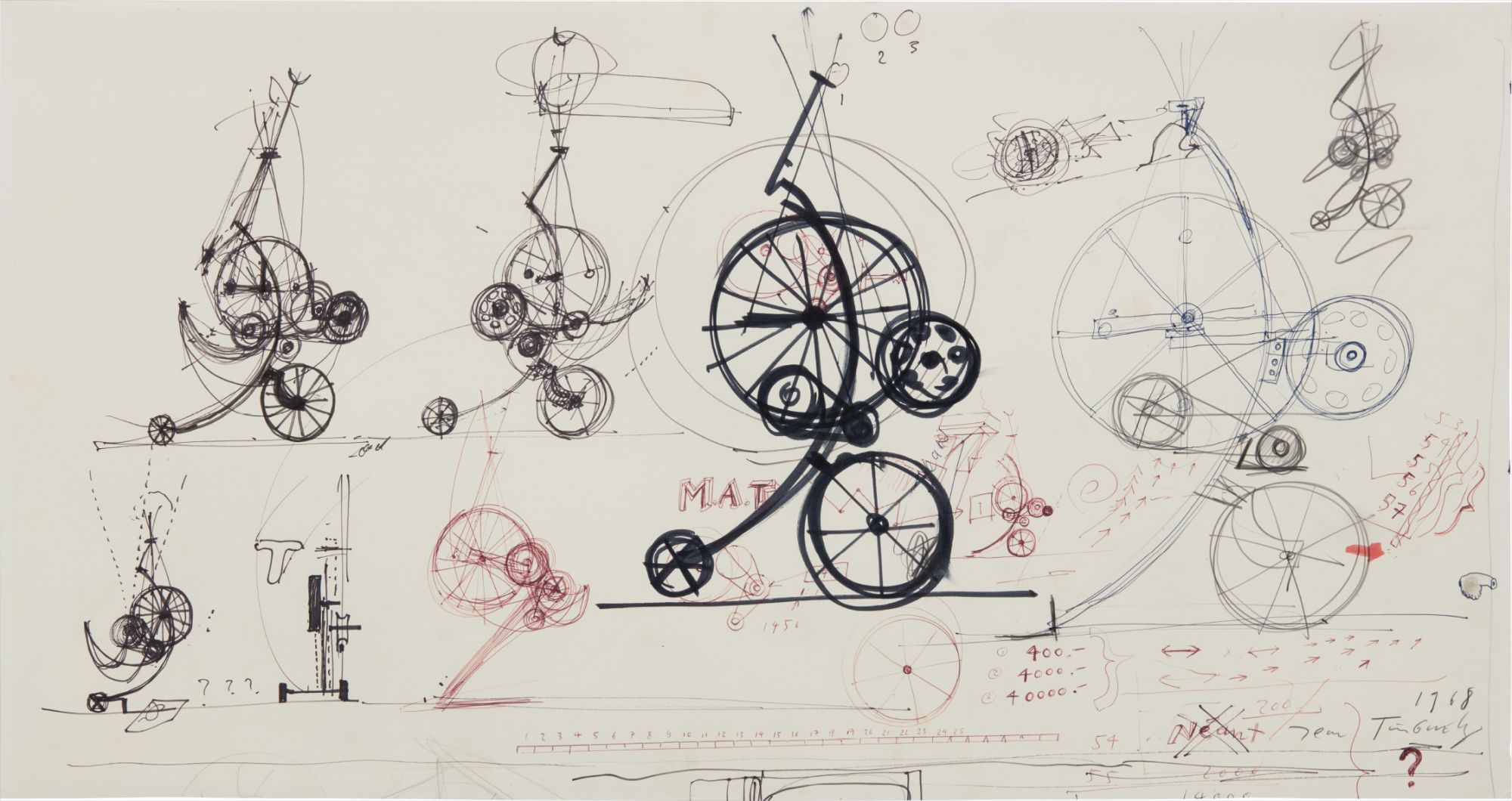
M.a.t., 1968
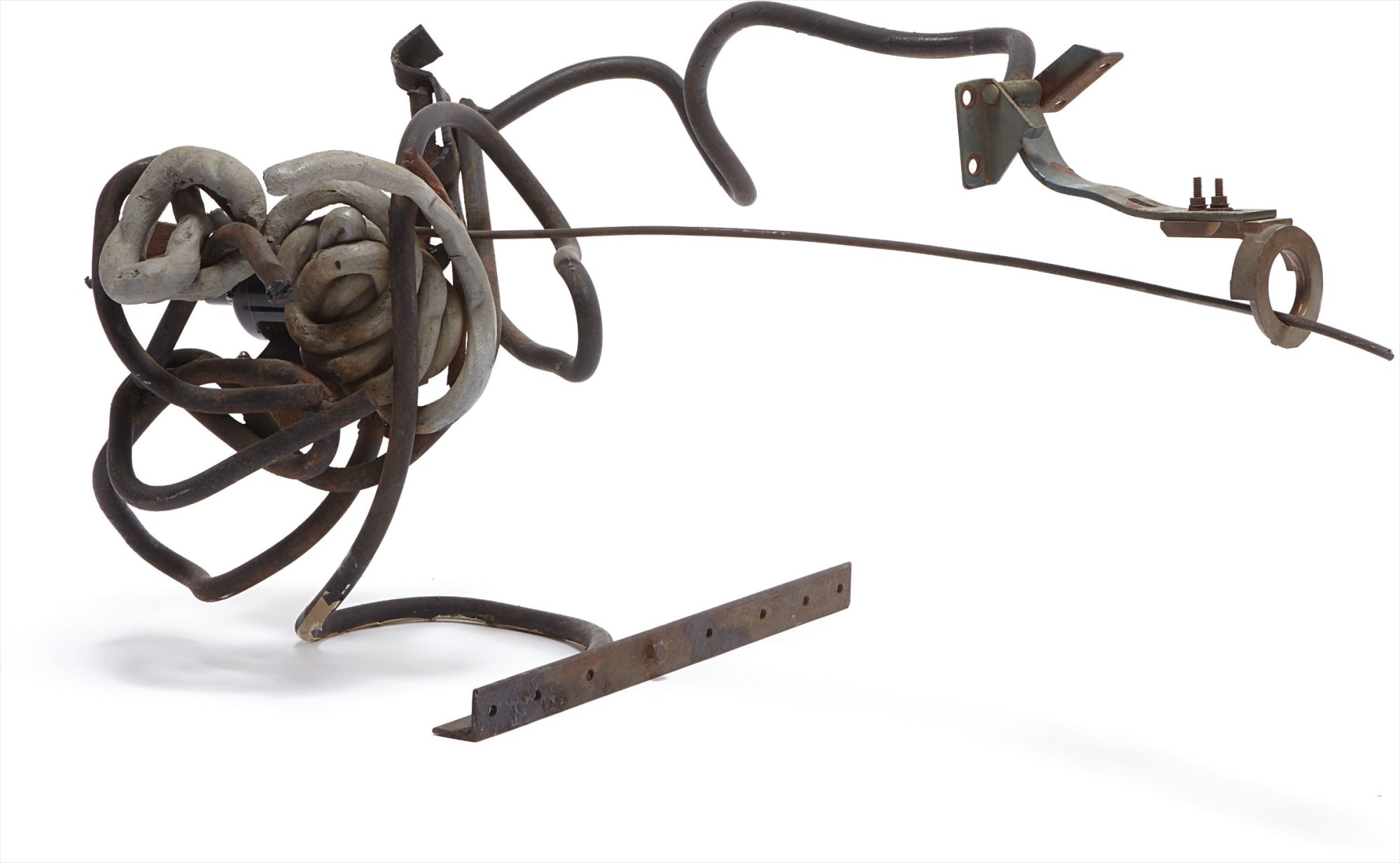
Works on paper from this period, including studies combining felt tip pen, pencil, ballpoint pen, and India ink, reveal a mind that thought in systems and improvised within them with enormous freedom. The works available through The Collection span the full range of Tinguely's restless practice and offer an exceptional window into his working method across multiple decades. Celebes from 1964, constructed from a steel plate foot, bent iron bars, a metal wheel, a rubber belt, and an electric motor, is a prime example of his mature sculptural vocabulary: industrial components elevated to something totemic and slightly absurd. Le Perforateur from 1963, a welded iron construction with painted rubber, nuts, bolts, an electric motor, wire, and transformer, embodies his gift for turning the hardware of modern industry into vehicles of anarchic joy.
Works on paper such as the felt tip, pencil, and ballpoint Char Nr. 8 from 1967 and the layered Klamauk Frankfurt Solothurn from 1978 demonstrate that his draftsmanship was as rigorous and inventive as his three dimensional work. The screen printed Mémoire de la liberté, with its paper and feather collage on black wove paper, and the acrylic and radio parts assemblage WNYR No. 13 from 1962 round out a body of work that rewards sustained looking and rewards it again.
Jean Tinguely
Le Perforateur, 1963
For collectors, Tinguely occupies a position that is both historically secure and genuinely exciting. His major kinetic sculptures have long been held by institutions including the Museum Tinguely in Basel, which opened in 1996 and houses the most comprehensive permanent collection of his work, as well as the Centre Pompidou in Paris and the Kunsthaus Zürich. Works on paper and prints, however, remain accessible points of entry and are increasingly sought after by collectors who understand that Tinguely's ideas lived as fully in his drawings and collages as in his motorized monuments. His works on paper carry the energy of his machines: lines that feel like they are still moving, compositions that seem on the verge of doing something unexpected.
Auction results over the past decade have reflected a sustained and growing recognition of his importance, particularly for works from the key decade of the 1960s. To understand Tinguely properly is to understand a whole web of postwar relationships and conversations. He was in dialogue not only with the Nouveau Réalistes but with figures like Alexander Calder, whose mobiles had pioneered kinetic sculpture in an earlier generation, and with the Fluxus artists who shared his irreverence and his faith in process over product. His collaboration with Billy Klüver, the Bell Labs engineer who became a crucial bridge between art and technology in the 1960s, connected him to a New York circle that included Robert Rauschenberg and Jasper Johns.
The warm, handmade quality of his New Years greeting for Billy Klüver, a rubber stamp, ballpoint pen, and collage drawing on wove paper, speaks to a friendship that was also an intellectual partnership, a reminder that behind the theatrical spectacle was a deeply thoughtful man who corresponded, sketched, and planned with enormous care. Tinguely died in Bern in 1991, but his influence has only deepened with time. In an era saturated with digital interactivity and algorithmic creativity, his insistence on the physical, the fallible, and the frankly ridiculous feels not dated but prophetic. He understood before almost anyone that machines are not neutral, that they carry humor and pathos, that they can be as mortal and as moving as the humans who build them.
Artists working today in kinetic installation, in robotics, in participatory and process based work owe him an enormous debt, whether they know it or not. To collect Tinguely is to own a piece of that founding argument: that art is most alive when it moves, when it risks failure, and when it makes you smile.
Explore books about Jean Tinguely
Jean Tinguely
Pontus Hulten

Tinguely: Catalogue Raisonné
Margit Staber
Jean Tinguely: A Magic Sculptor
K.G. Pontus Hulten
Tinguely
Michel Butor

Jean Tinguely: Catalogue Raisonné
Dieter Koepplin
Tinguely: Sculptures and Reliefs 1954-1968
Kunstmuseum Basel
Jean Tinguely: Metamechanics
Francesco Poli