James Tissot
James Tissot, Life's Most Glittering Observer
Artist Spotlight · The Collection Editorial
Picture the Thames on a bright afternoon in the 1870s, the river alive with pleasure boats and parasols, the air thick with the rustle of silk and the murmur of polite ambition. No painter captured that world with more precision, more warmth, or more quietly devastating intelligence than James Tissot. Today, as major institutions on both sides of the Atlantic continue to revisit the Victorian era through fresh curatorial eyes, Tissot stands at the center of every serious conversation about what narrative painting can achieve, and what fashionable society reveals about itself when it believes it is merely being admired. Born Jacques Joseph Tissot in Nantes, France, in 1836, he grew up in a household shaped by commerce and Catholic devotion, two forces that would quietly animate his art for the rest of his life.
James Tissot
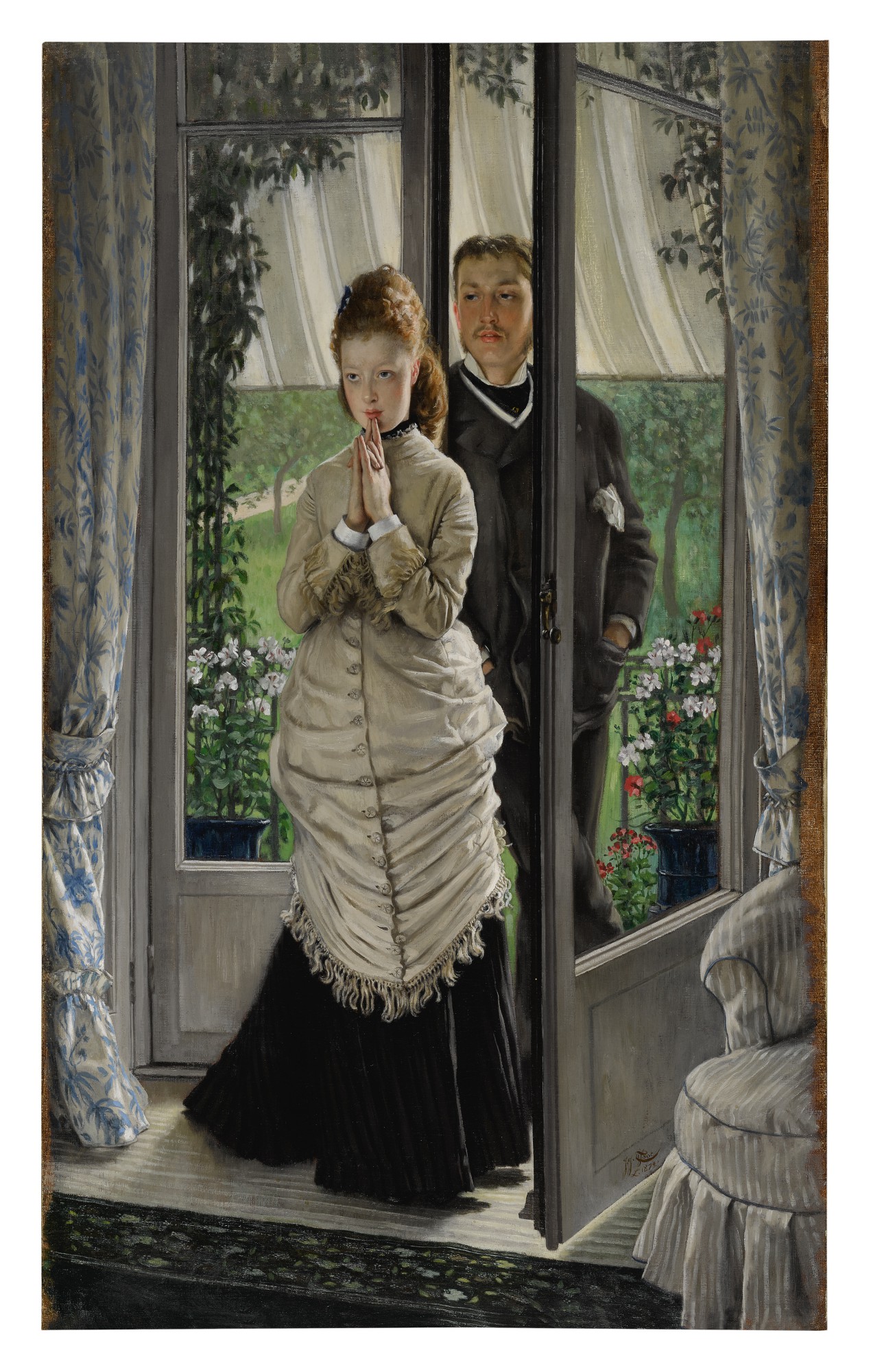
The Proposal
His mother was a milliner, and from her he absorbed an almost forensic sensitivity to fabric, trim, and the social grammar encoded in a woman's dress. He arrived in Paris in 1856 to study at the École des Beaux Arts, where he fell under the influence of Hippolyte Flandrin and later formed close friendships with James McNeill Whistler and Edgar Degas. These relationships pulled him in productive directions simultaneously, toward the exacting draughtsmanship of the academy and toward a new appetite for modern life as worthy subject matter. Tissot's Paris years produced work that moved fluidly between medieval reverie and sharp contemporary observation.
He exhibited regularly at the Salon throughout the 1860s and earned genuine critical respect. But it was his arrival in London in 1871, following the upheaval of the Franco Prussian War and the Paris Commune, that transformed him into the painter we most readily recognize. He settled in a grand house in St. John's Wood, complete with a garden and a lake that would appear again and again as backdrop and metaphor in his paintings.
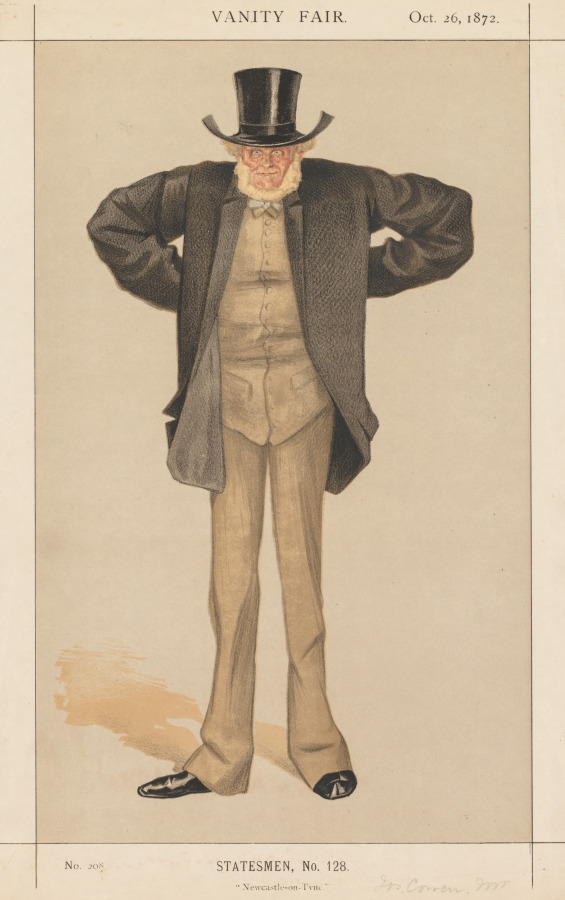
James Tissot
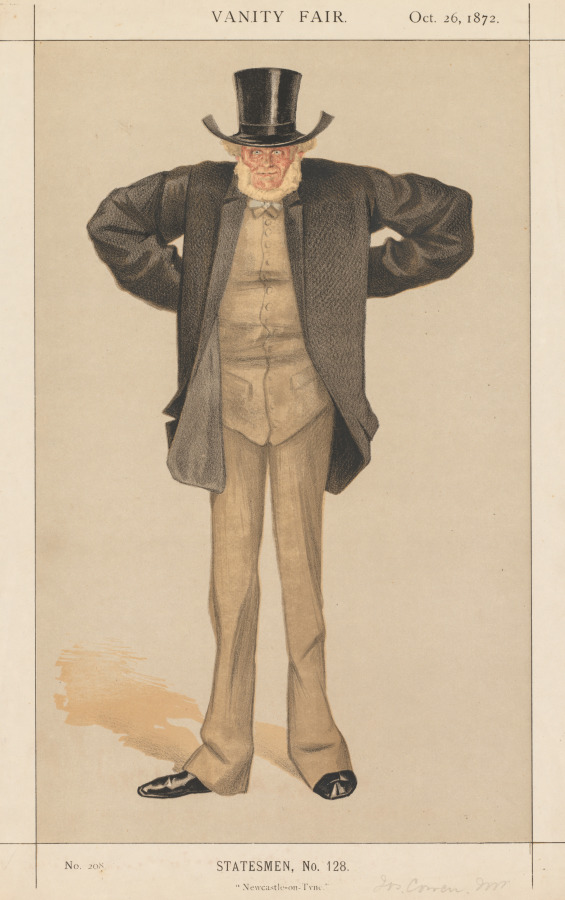
Vanity Fair: Statesman, No. 128 "Newcastle-on-Tyne", 1872
London society welcomed him, and he returned the favor by painting it with a candor disguised as celebration. He became a regular contributor to Vanity Fair, producing the witty color lithograph caricatures of statesmen and sovereigns that demonstrated both his commercial range and his gift for reading power in a face. The eleven years Tissot spent in London were among the most productive of his career, and the works from this period remain his most sought after. Paintings such as The Lovers and Seaside, the 1878 oil on fabric now recognized as a masterpiece of tonal restraint, show a painter operating at the peak of his formal abilities.
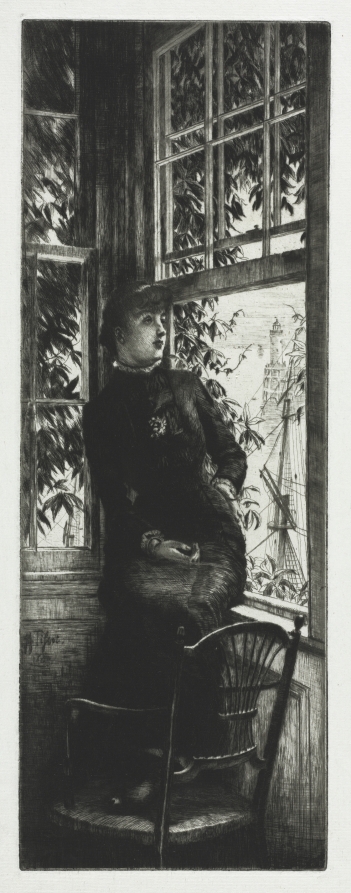
His compositions feel effortless but repay careful study: every accessory, every angle of a hat brim, every arrangement of figures in social space is considered and meaningful. The Garden Bench of 1883, rendered as a luminous mezzotint, demonstrates his exceptional command of printmaking, a discipline he pursued with the same seriousness he brought to oil painting. At the Sea Side from 1880, in etching and drypoint, reveals the influence of his friendship with Degas while remaining wholly its own thing, intimate and slightly melancholy, full of the specific weight of leisure. A woman known as Kathleen Newton entered Tissot's life in the mid 1870s and became his muse, his companion, and the subject of many of his most tender works.
James Tissot
At the Sea Side, 1880
Her presence transformed the emotional register of his painting, introducing a new quality of private feeling into canvases that had previously been admired chiefly for their social acuity. When she died of tuberculosis in 1882 at the age of twenty eight, Tissot left London almost immediately and returned to Paris, carrying a grief that would eventually redirect his entire artistic practice. The works from the London period, including study drawings such as the pencil and watercolor Study for The Proposal, bear the traces of that intimacy, the particular way a specific love makes the world more visible. Back in Paris, Tissot underwent one of the most dramatic transformations in nineteenth century art.
Following what he described as a spiritual vision experienced in the church of Saint Sulpice in 1885, he devoted himself entirely to illustrating the life of Christ and the narratives of the Old and New Testaments. He traveled to Palestine three times to gather visual source material, producing hundreds of watercolors and gouaches of unparalleled archaeological specificity. His illustrated Bible, published between 1896 and 1897, was a publishing phenomenon, greeted with reverence by critics and the public alike. The etching The Prodigal Son: The Fatted Calf from 1881 anticipates this later religious turn, demonstrating that the tension between worldly and spiritual had always run through his work, even at the height of his fashionable London years.
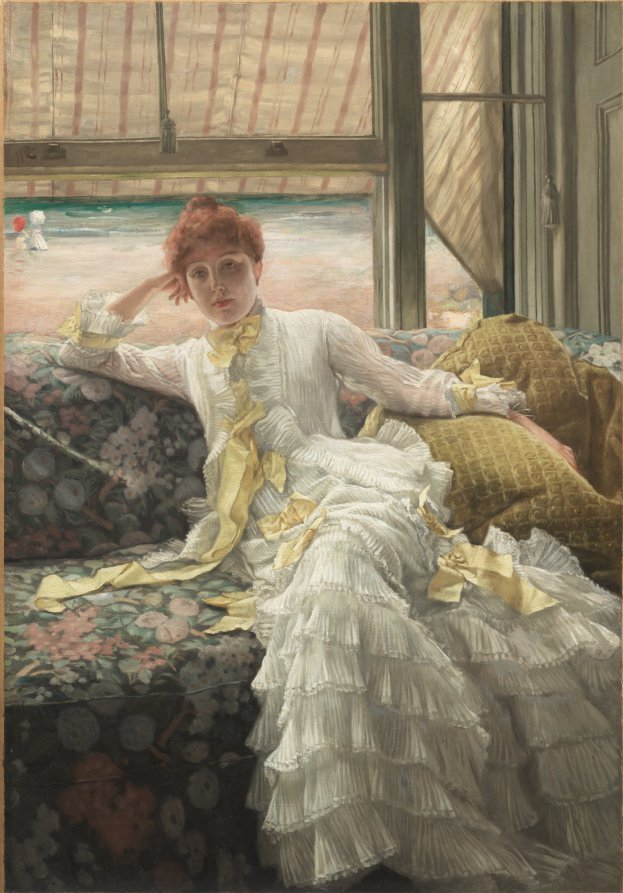
James Tissot
Seaside (July: Specimen of a Portrait), 1878
For collectors, Tissot occupies a position that is both secure and still rich with opportunity. His oils command serious auction attention at Christie's, Sotheby's, and Bonhams, where strong examples regularly achieve prices in the high six and seven figures. His prints, however, including the Vanity Fair lithographs, the etchings, and the mezzotints, remain genuinely accessible entry points into a body of work of the highest quality. These works are not footnotes to the paintings; they are parallel achievements, made by an artist who understood the power of multiples and the intimacy of works on paper.
Collectors drawn to the Victorian era, to French academic painting, to narrative realism, or simply to the pleasure of beautifully made images of beautifully dressed people will find in Tissot an artist whose work rewards living with over time. In art historical terms, Tissot belongs to a cohort of painters who resisted easy categorization and were sometimes penalized for it. Too polished for the Impressionists, too modern for the academicians, too English for France and too French for England, he occupied a position of productive outsiderness that looks, from this distance, like a considerable advantage. His closest peers include Berthe Morisot, whose attention to women's inner lives rhymes with his own, Alfred Stevens, the Belgian painter of Parisian elegance, and Giovanni Boldini, who shared his gift for rendering the shimmer of social surfaces.
Together these painters form a loose constellation of witnesses to a world that was changing faster than it knew. Tissot died in 1902 at his family estate in Buillon, leaving behind a body of work that spans six decades, two countries, two spiritual dispensations, and an astonishing range of media and mood. What endures is not just the technical brilliance or the documentary precision, though both are formidable. What endures is the quality of attention, the sense that every canvas and every print was made by someone who genuinely wanted to understand the people in front of him, their desires, their performances, their small dignities and larger vanities.
In a moment when figurative painting and social observation are once again at the center of contemporary practice, Tissot feels less like a historical figure to be recovered than a permanent presence, someone who already knew what we are still learning to see.
Explore books about James Tissot
James Tissot: A Life
Michael Wentworth
James Tissot
Krystyna Matyjaszkiewicz
Tissot: Illustrator of the Bible
Michael Wentworth
James Tissot and the Pre-Raphaelites
Christopher Wood
James Tissot: Victorian Life and Love
Juliet Steyn
Tissot
Jane Abdy and Charlotte Gere
James Tissot: Striving for Perfection
Janet Whitmore