James Brown
James Brown: Raw Material, Pure Vision
Artist Spotlight · The Collection Editorial
There are artists who work with paint, and then there are artists who seem to wrestle with it, to drag meaning from the physical world through sheer force of will and material honesty. James Brown was emphatically the latter. Born in Los Angeles in 1951, Brown spent his career building a body of work that stands as one of the more genuinely singular contributions to American Neo Expressionism, a practice rooted in bone and rawhide and visceral mark making that placed him in conversation with the great painters of anxiety and transformation. His death in 2020 closed a chapter, but the market and the critical conversation around his work have continued to gain momentum, with collectors and curators returning to his paintings and sculptures with fresh eyes and renewed appreciation.
James Brown
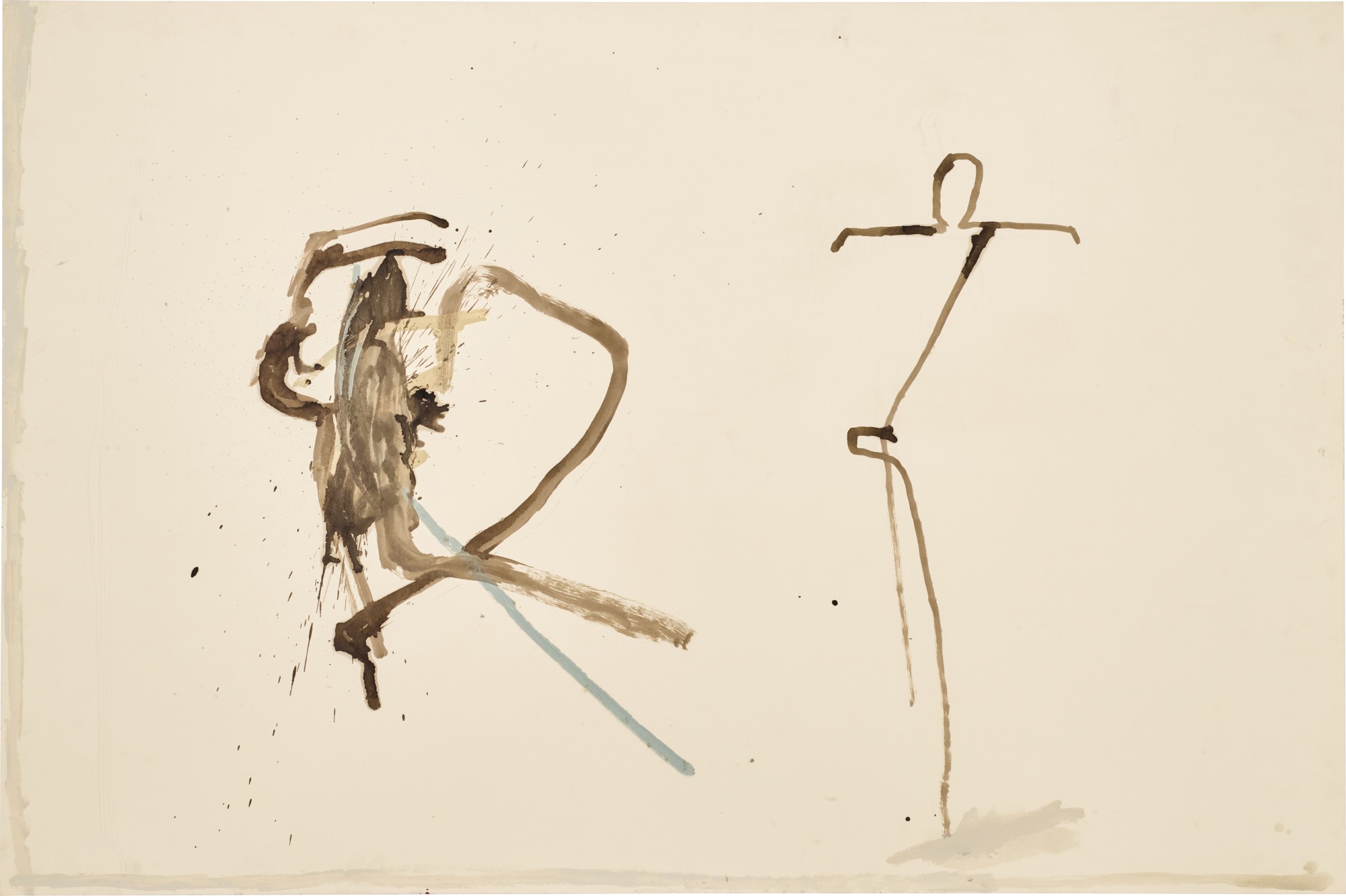
Untitled
Brown grew up in Los Angeles at a moment when the city was finding its own cultural voice, distinct from the institutional gravity of New York. He later spent formative years in Europe, particularly in Paris, where exposure to the long traditions of French modernism and the raw energy of Art Informel left visible marks on his developing sensibility. This transatlantic formation gave Brown something relatively rare among his American peers: a command of historical weight alongside a genuinely restless, anti academic instinct. He did not simply absorb influences but metabolized them, pushing toward something more primal and less resolved than the polish of mainstream gallery painting.
By the early 1980s, Brown had emerged as a distinctive voice within the broader Neo Expressionist movement that was reshaping painting on both sides of the Atlantic. Where artists like Julian Schnabel leaned into operatic scale and art historical pastiche, and Jean Michel Basquiat channeled street energy and social critique, Brown occupied a quieter but no less intense register. His paintings from this period, including works like Masks from 1983, rendered in oil and graphite on paper and often presented in frames the artist constructed himself, show a fascination with the archaic and the ritualistic. The artist's frame is not an afterthought here but a statement, an insistence that the object be received whole, as a totemic thing rather than merely a picture.
James Brown
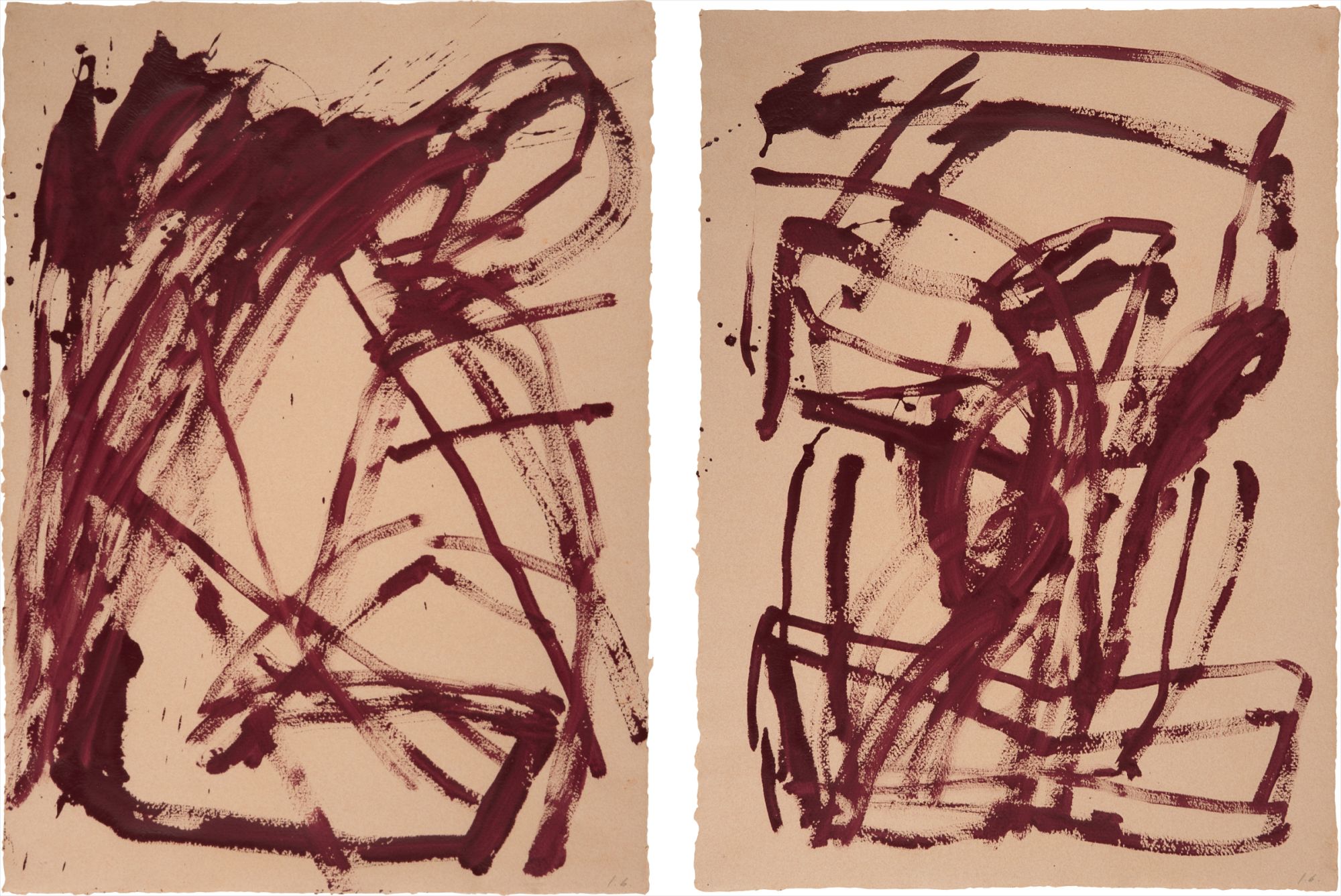
Two works: Interior Study (2); Interior Study (3)
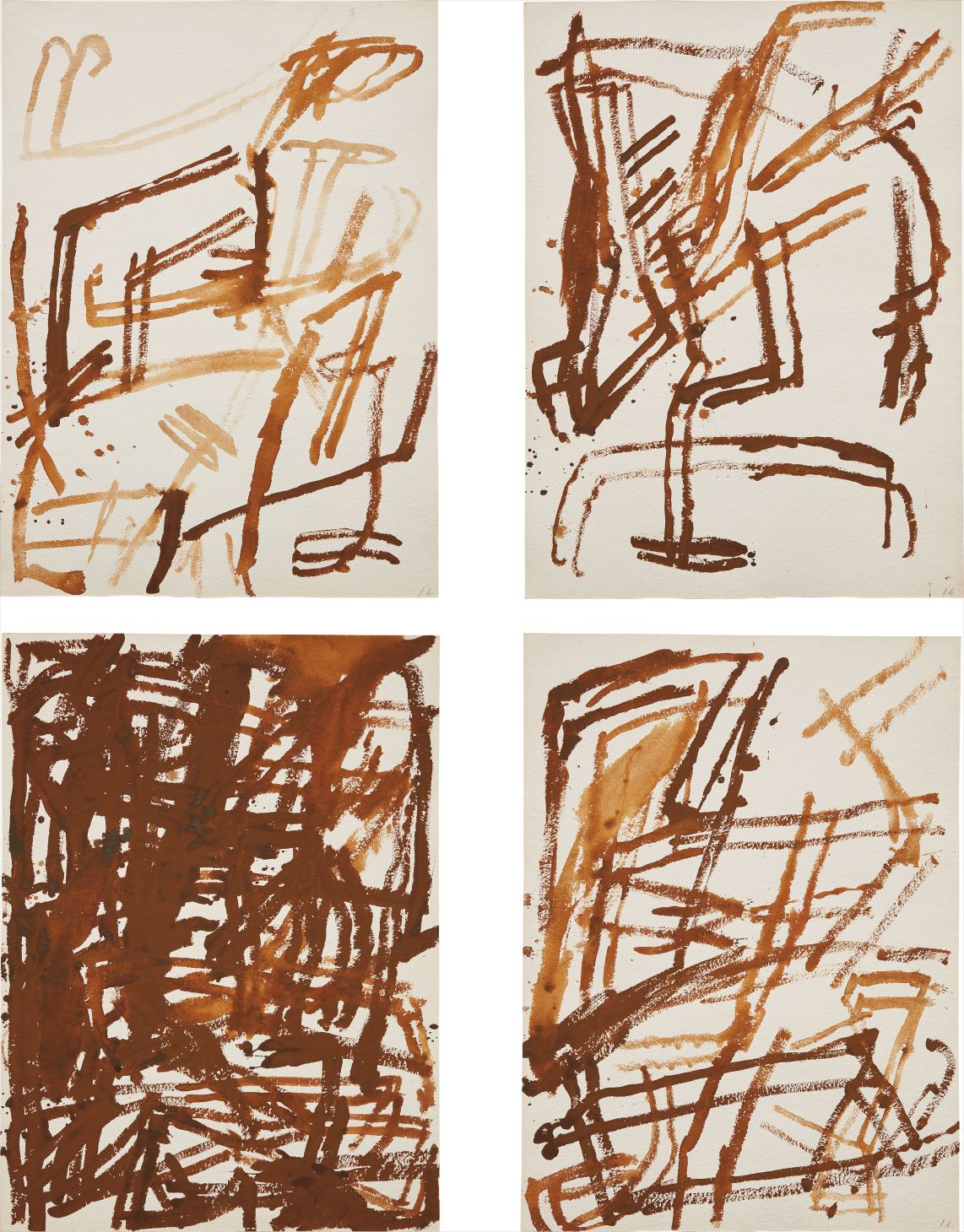
The mid 1980s represent perhaps the most concentrated flowering of Brown's vision. Scene From the Life of Achilles, painted in oil on canvas in 1985, demonstrates his ability to draw on mythological and classical sources without ever becoming illustrative or academic. The painting does not retell the story so much as it inhabits its emotional atmosphere: grief, heroism, and the irreversibility of violence rendered in gestural strokes that feel simultaneously ancient and urgently contemporary. The following year he was producing works in gold paint on paper, a material choice that speaks to both his interest in sacred and ceremonial art traditions and his willingness to destabilize the hierarchy between fine and decorative.
These are paintings that reward close attention, that reveal their construction slowly and generously. Brown's engagement with materials extended well beyond conventional painting supports. His use of burlap, most vividly seen in Black and Blue from 1991, a work executed in oil on burlap mounted on panel, reflects a sustained curiosity about the expressive potential of humble and resistant surfaces. Burlap carries its own history: of labor, of sacking, of things carried and stored.
James Brown
gold paint on paper, 1986
To paint on it is to accept a kind of friction, a negotiation between the image and the ground that keeps both parties honest. Stabat Mater Blood Red from 1988 pushes further still into the territory of devotional imagery and bodily experience, its title drawn from the medieval Catholic hymn contemplating grief and suffering. Brown was not a painter who shied from large emotional territory, but he approached it through material intelligence rather than sentiment. His practice in works on paper deserves particular attention from collectors.
The watercolors, including the Hotel Interior Kyoto series and the Interior Studies, reveal a more intimate and exploratory dimension of his intelligence. These are works in which observation and abstraction blur productively, in which the specific atmosphere of a place, a room in Kyoto, a sequence of interior spaces, becomes the occasion for something more openly lyrical than his larger paintings. Gouache and acrylic on paper works show similar range, a willingness to move between opacity and transparency, between the controlled and the accidental. For collectors new to Brown's practice, works on paper offer an ideal entry point: they are among his most immediate and personal statements, and they demonstrate the full breadth of his formal curiosity.
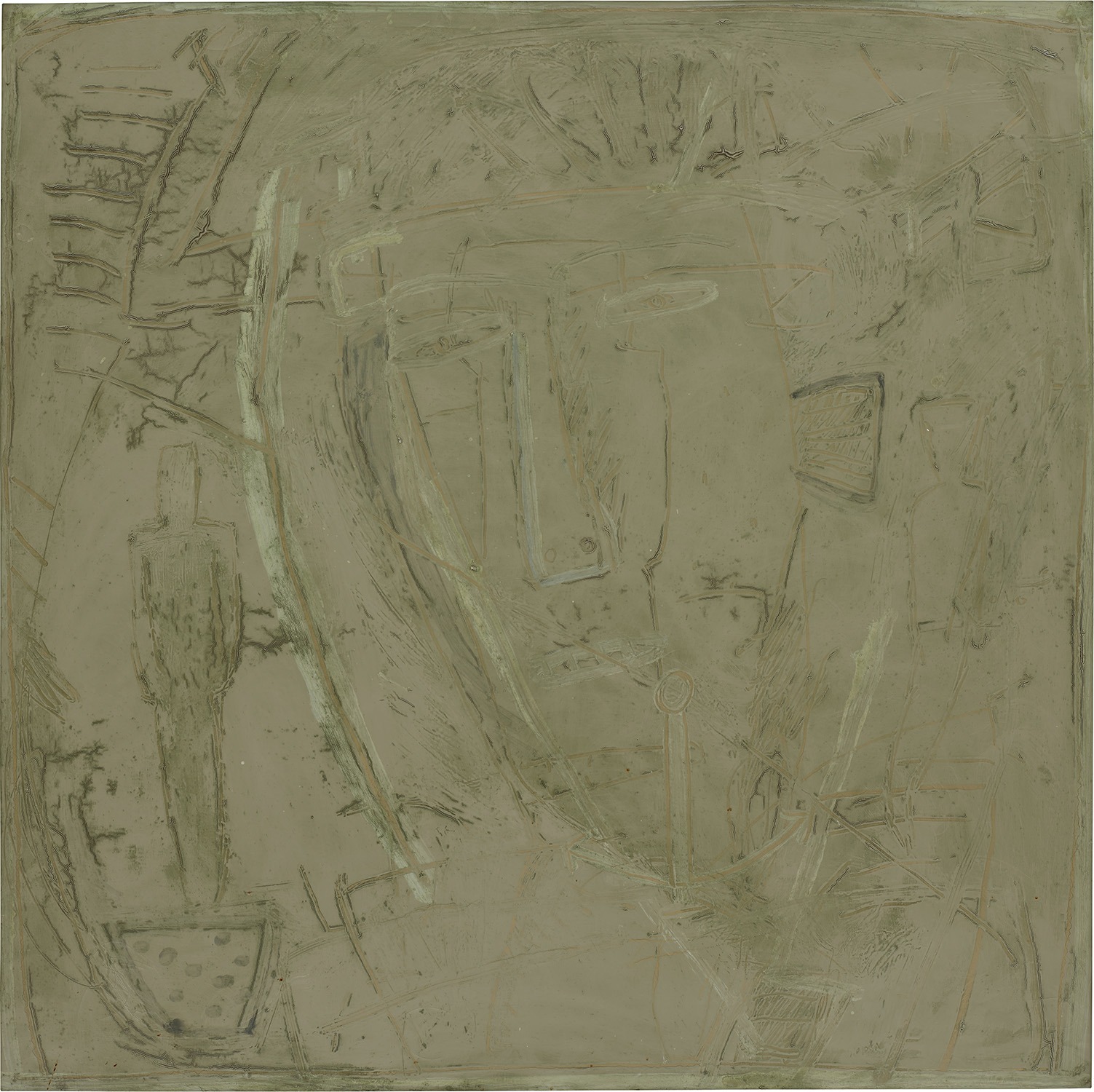
James Brown
Scene From the Life of Achilles, 1985
Within the broader landscape of American art from the 1980s, Brown sits in productive relationship with artists including Georg Baselitz, A.R. Penck, and Sigmar Polke among the Europeans who shaped the Neo Expressionist moment, and with American painters like Terry Winters and Bill Jensen who similarly pursued abstraction through organic and bodily metaphor. His sculpture, incorporating rawhide and bone, places him in conversation with artists working across the boundary between painting and object making, a lineage that includes Joseph Beuys in its willingness to treat the artwork as a site of transformation rather than mere representation.
Brown's institutional recognition was commensurate with this ambition: exhibitions at the Whitney Museum of American Art and the Los Angeles County Museum of Art confirmed his place within the serious critical conversation of his time. For collectors considering Brown's work today, several factors merit attention. His prices have historically offered genuine value relative to peers of comparable institutional standing, and the range of available media, from oil on canvas to intimate watercolor to etching, means there are meaningful entry points at various price levels. The etchings with watercolor on Somerset paper are especially worth seeking out: they combine printmaking's structural discipline with the warmth and immediacy of hand applied color in ways that feel wholly characteristic of Brown's best instincts.
As the critical reassessment of 1980s painting continues to deepen, driven by major museum surveys and growing scholarly attention, artists like Brown who operated at the movement's more genuinely experimental edges stand to benefit considerably. His work asks something of the viewer, asks for patience and for a willingness to sit with difficulty and beauty in equal measure. That quality does not diminish with time. It only becomes more rare and more valuable.
Explore books about James Brown
James Brown: The Godfather of Soul
James Brown with Bruce Tucker
The One: The Life and Music of James Brown
David Shelf
James Brown: A Fire That Shines So Bright
Daphne A. Brooks
Soul Brother: The Life and Music of James Brown
R.J. Smith
James Brown and the Rise of the B-side
Matthew F. Jordan
The Rhythm of Business
James Brown with Marc Shi Zuckerman