Jake Chapman: Art's Most Gloriously Unrepentant Voice
Artist Spotlight · The Collection Editorial
“Art that doesn't have the potential to offend isn't really doing its job.”
Jake Chapman, interview with The Guardian
When the Royal Academy of Arts staged its landmark survey of Young British Artists in the late 1990s and early 2000s, few names generated more electric conversation than the Chapman Brothers. Yet as Jake Chapman has increasingly stepped into his own light, whether through solo exhibitions, published writings, or the continued vitality of works appearing at major auction houses and in distinguished private collections, it becomes clear that his contribution to contemporary art is singular, irreducible, and worthy of sustained attention. In 2024, interest in Chapman's multiples and works on paper has remained remarkably buoyant among serious collectors, with institutions and private buyers alike recognising that his practice touches something essential about the contradictions of modern life. Jake Chapman was born in 1966 in Cheltenham, England, and went on to study at the North East London Polytechnic before completing his MA at the Royal College of Art in London.
Jake
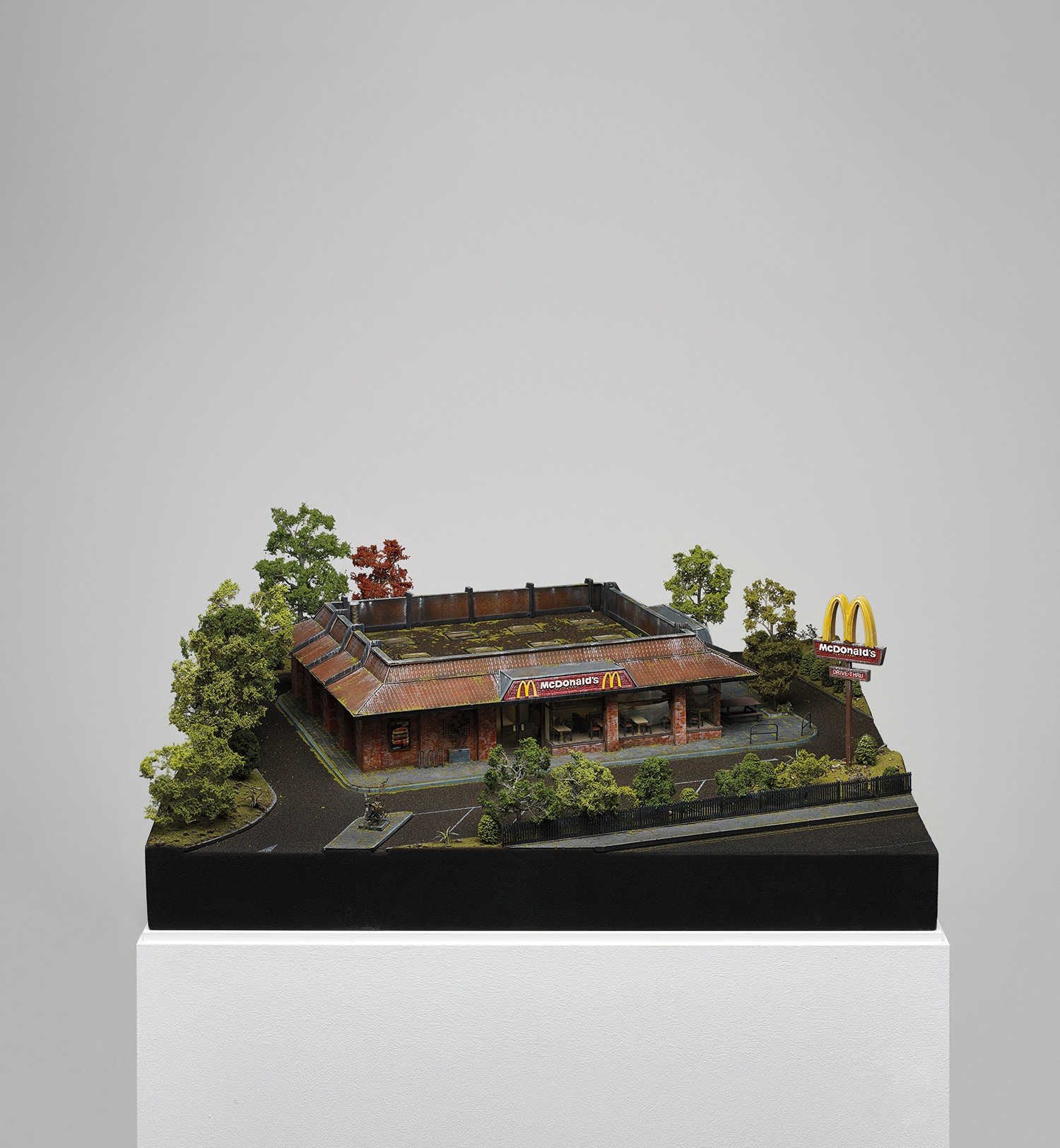
Rhizome, 2000
It was there that he met his brother Dinos, and the two formed one of the most formidable artistic partnerships in recent British art history. Jake's formation was shaped by a deep and restless engagement with philosophy, literature, and the history of Western art, particularly the tradition of moral satire running from Hogarth through Goya to the twentieth century. That intellectual seriousness, combined with a disarming willingness to court controversy, has always distinguished his sensibility from mere provocation for its own sake. The Chapman Brothers rose to prominence as central figures in the Young British Artists movement, exhibiting with White Cube gallery in London and becoming synonymous with a generation that refused polite boundaries.
Yet what set Jake and Dinos apart was the rigour beneath the spectacle. Their interventions into the history of art, most notably their acquisition and reworking of Francisco Goya's Disasters of War etchings, were not acts of vandalism but of deeply considered dialogue with the violence and moral failure encoded in Western civilisation. The resulting works, shown to considerable international attention in the early 2000s, established the Chapmans as artists who took art history seriously enough to wrestle with it directly. Among the works available through The Collection, several illuminate the full range of Jake's practice with particular clarity.
Jake
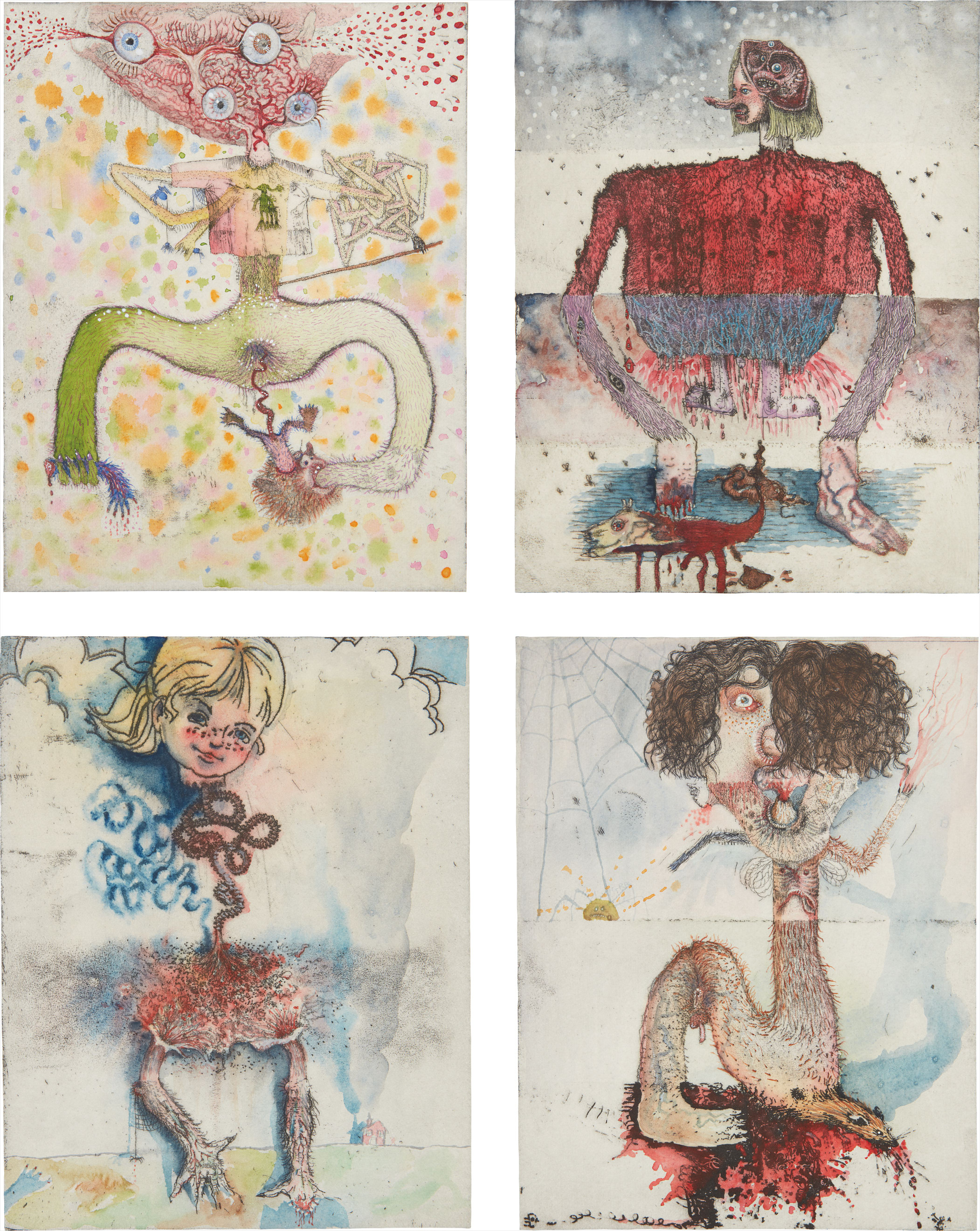
Four works: (i) Fop haired monopod I; (ii) Monster T-shirt I; (iii) Young girl with the spinal column I; (iv) Fuck face I, 2000
Great Deeds Against the Dead, created in 1994, remains one of the defining sculptures of the YBA era, its cast resin figures arranged in a tableau that reworks Goya's imagery into three dimensional form with acrylic and artificial grass. The work is simultaneously horrifying and formally exquisite, demonstrating Jake's ability to make beauty and moral discomfort inseparable. Rhizome, from 2000, realised in glass fibre, plastic and mixed media, shows a different register of the same intelligence, the title evoking Deleuze and Guattari's philosophical concept of non hierarchical growth, and the object embodying a kind of mutant vitality that feels as urgent now as it did at the turn of the millennium. The works on paper in The Collection speak to yet another dimension of Jake's practice.
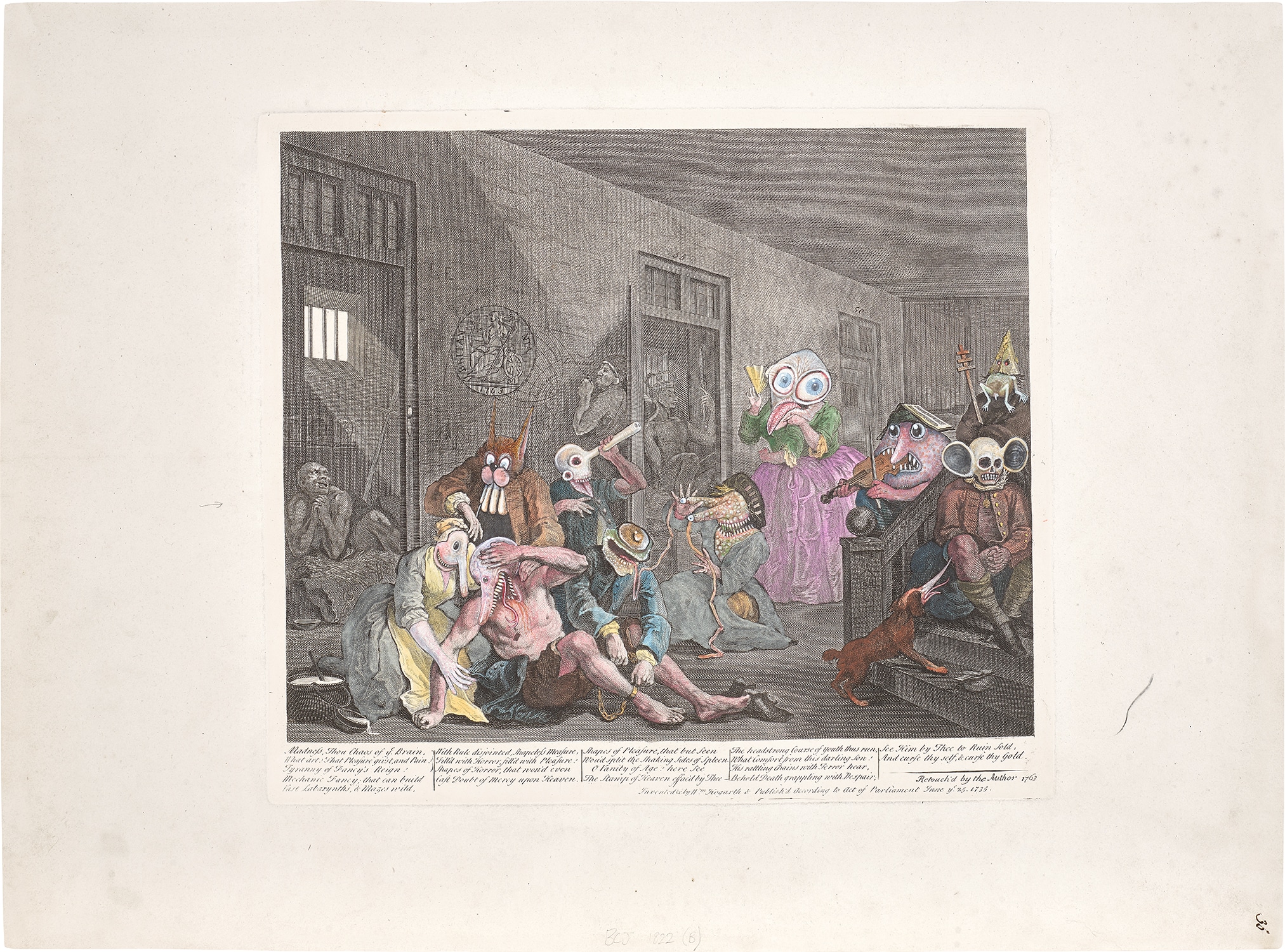
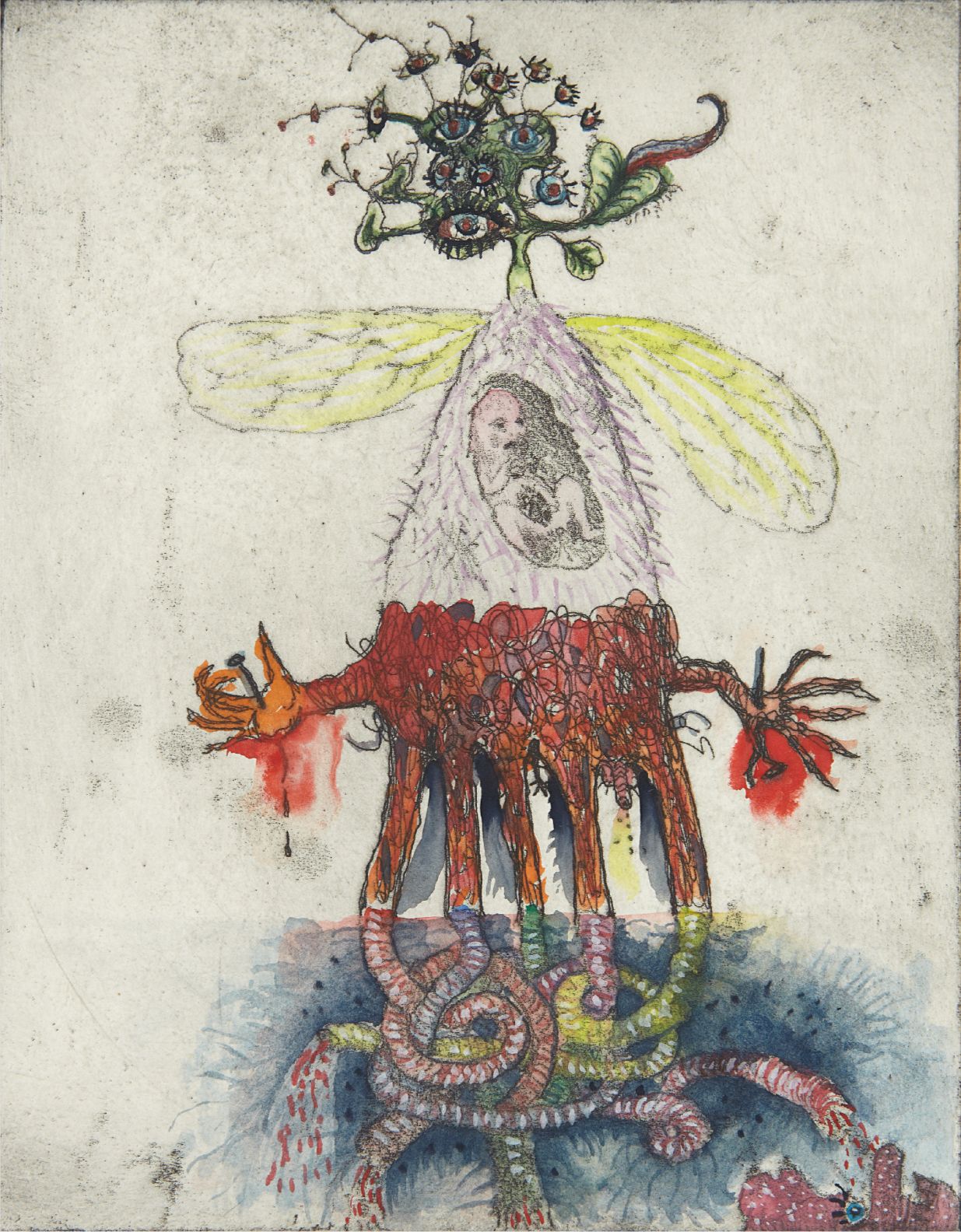
The Exquisite Corpse series, published by The Paragon Press in London and including contributions to a collaborative body of work combining etching and watercolour, demonstrates his mastery of traditional printmaking techniques wielded in the service of deeply contemporary imagery. Dinos and Jake's Progress Plate 8, which places their imagery onto an original Hogarth etching and engraving, is a remarkable object: a work that exists in conversation with eighteenth century moral satire while being unmistakably of the present moment. Tinkerbellend, a hand painted polypropylene doll housed within a glass dome on an oak base, brings the same sensibility into the territory of the multiple, a form the Chapmans have always approached with particular wit and care. Drawing I from The Chapman Family Collection, an etching on wove paper published by Paragon Press, rounds out a picture of an artist whose command of the printed and drawn image is as sophisticated as his engagement with sculpture and installation.
Jake
Pregnant Eye Head I from The Exquisite Corpse
For collectors, Chapman's work occupies a particularly compelling position in the market. His prints and multiples, especially those produced with Paragon Press and in limited editions, have maintained consistent demand at auction houses including Christie's, Sotheby's and Phillips, with strong results across London and New York sale rooms. The appeal is not merely speculative. These are works of genuine art historical importance, created at a moment when British art was reshaping the international conversation, by an artist whose intellectual ambitions have only deepened with time.
Works from the early 2000s in particular, when the Chapman Brothers' profile was at its most intense, now carry the weight of historical significance alongside their intrinsic quality. Collectors drawn to artists working in the tradition of Goya, George Grosz, or Otto Dix will find in Jake Chapman a contemporary heir to that lineage of mordant, morally engaged image making. The context in which Chapman's work sits is rich with resonance. Within British art, his nearest peers include Damien Hirst, Sarah Lucas, and Tracey Emin, all of whom share that YBA generation's willingness to confront uncomfortable truths through formal invention.
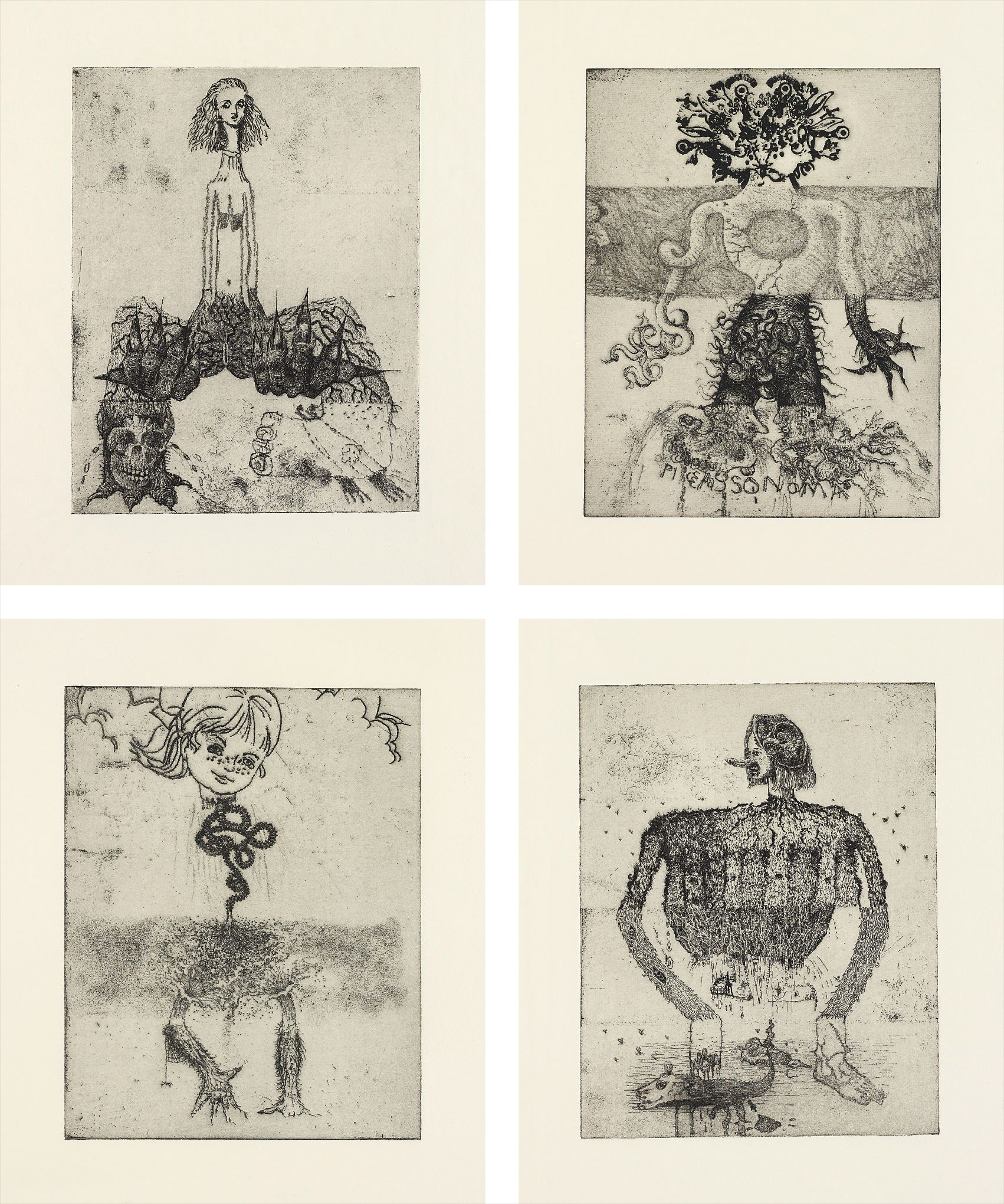
Jake
Exquisite Corpse
In a broader European context, Chapman belongs to a tradition that includes the German Neo Expressionists of the 1980s and the Viennese Actionists, artists who understood that form and content cannot be separated when the subject matter is violence, desire, and the failures of civilisation. His practice also invites comparison with American artists such as Paul McCarthy and Mike Kelley, who similarly deploy the language of popular culture and abjection in the service of serious philosophical inquiry. What endures about Jake Chapman's work, and what makes it so rewarding for collectors who live with it, is the sense that it refuses to settle. A Chapman print or sculpture on the wall does not recede into decoration.
It continues to ask questions, to generate unease and laughter and thought in equal measure, to insist on its own presence. That quality is rare in contemporary art, and it is what ensures that Chapman's place in the history of this period is secure. To collect his work is to own a piece of one of the most genuinely consequential practices in British art since Francis Bacon, a practice that takes seriously both the pleasures and the terrors of being alive in the world as it actually is.