Jacob Lawrence
Jacob Lawrence, Painter of Living American History
Artist Spotlight · The Collection Editorial
“My belief is that it is most important for an artist to develop an approach and philosophy about life.”
Jacob Lawrence
In the permanent collection galleries of the Museum of Modern Art in New York, visitors still stop cold in front of them. Sixty panels, each one a compressed world of flat color and angular form, each one a chapter in one of the most ambitious storytelling projects in the history of American painting. Jacob Lawrence completed his Migration Series in 1941, when he was just twenty four years old, and it immediately entered the canon. Today, split between MoMA and the Phillips Collection in Washington D.
Jacob Lawrence
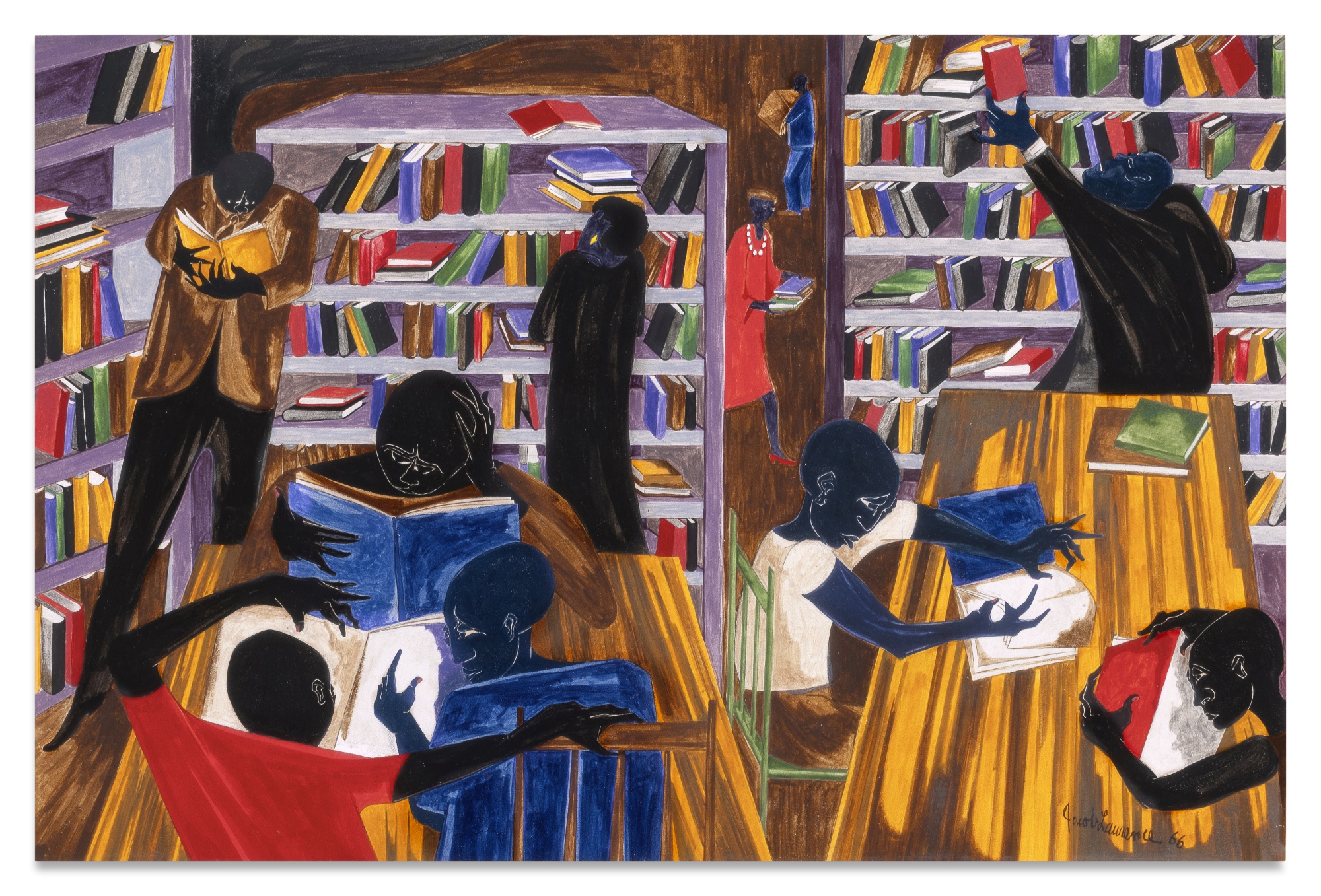
Students and Books, 1966
C., the work feels not like a relic but like a living document, as urgently relevant to conversations about movement, belonging, and perseverance as it was the year it was made. Lawrence was born in Atlantic City, New Jersey, in 1917, and his early years traced the very arc his art would later illuminate. His family was part of the Great Migration itself, moving northward through Pennsylvania before settling in Harlem when Jacob was a teenager.
It was Harlem in the 1930s, still electric with the creative energy of the Renaissance that had transformed it in the previous decade, that formed the young artist. He studied at the American Artists School and found early mentorship through the Harlem Art Workshop, where painter Charles Alston recognized something exceptional in him. The neighborhood gave Lawrence his subjects, his sense of community, and his belief that art could carry the full weight of history. His formation was shaped by a remarkable constellation of influences.
Jacob Lawrence
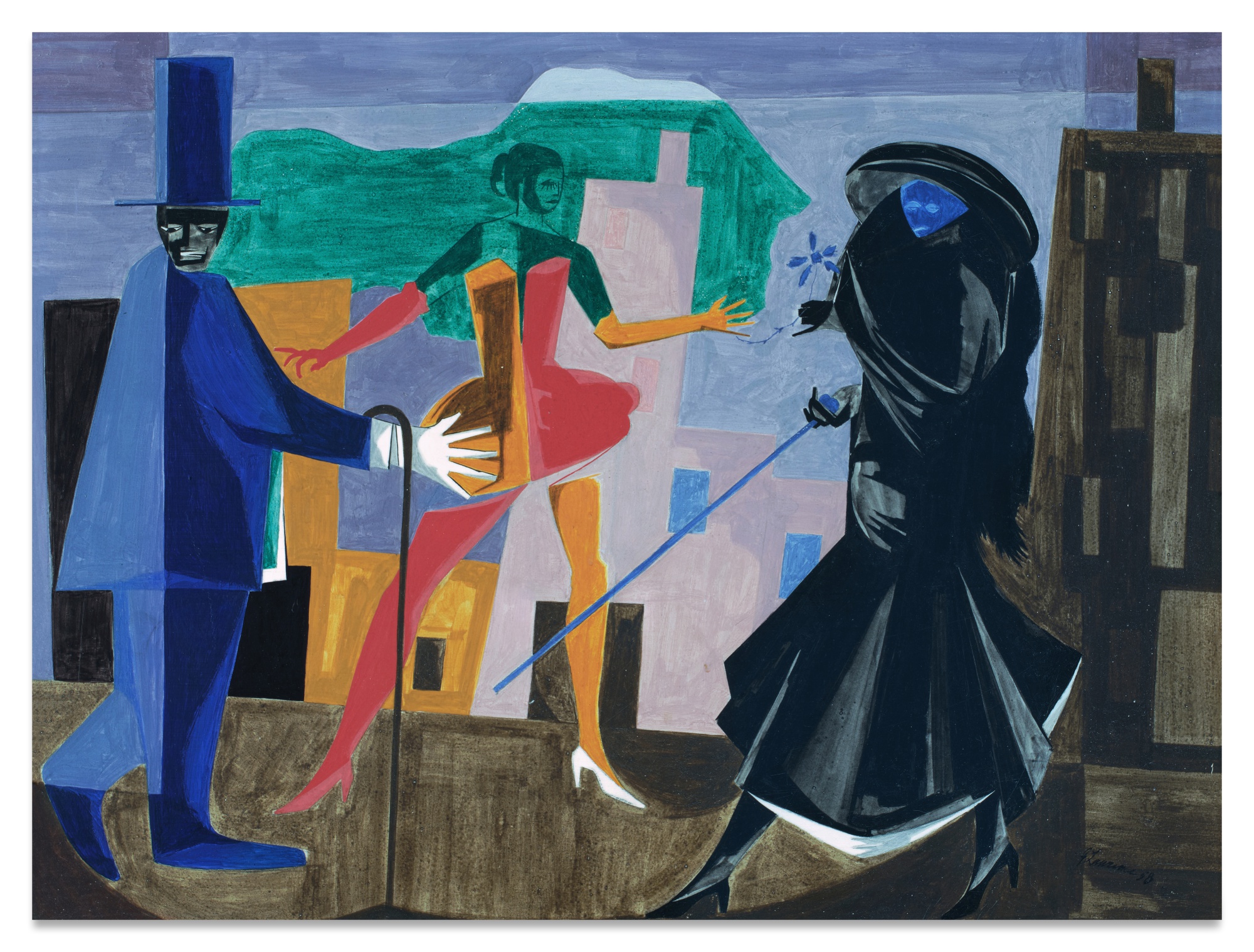
Two Comedians and a Dancer, 1958
The sculptor Augusta Savage championed his early development, and through her he gained access to the Federal Art Project, which provided crucial support during the Depression years. He absorbed the lessons of the Harlem Renaissance masters around him while also looking hard at the work of Francisco Goya and Honoré Daumier, artists who understood how to render social conditions with clarity and force. He also studied African art closely, finding in its formal economy a model for his own emerging visual language. What Lawrence built from these sources was entirely his own: a style of bold, simplified shapes and unmodulated color fields that owed something to modernist abstraction but remained rooted in the specificity of Black American life.
“I work from a community of people, a triangle of the artist, the audience, and the subject.”
Jacob Lawrence
The Migration Series announced his arrival and established the terms of everything that followed. But Lawrence's career encompassed far more than that single masterwork. Through the 1940s and 1950s he produced series devoted to the lives of Toussaint Louverture, Frederick Douglass, and Harriet Tubman, works that amounted to a visual biography of Black heroism across centuries. His Builders series, developed across several decades beginning in the 1970s, shifted toward a more universal language of community and collective effort, with carpenters and laborers working together as a symbol of shared human purpose.
Jacob Lawrence
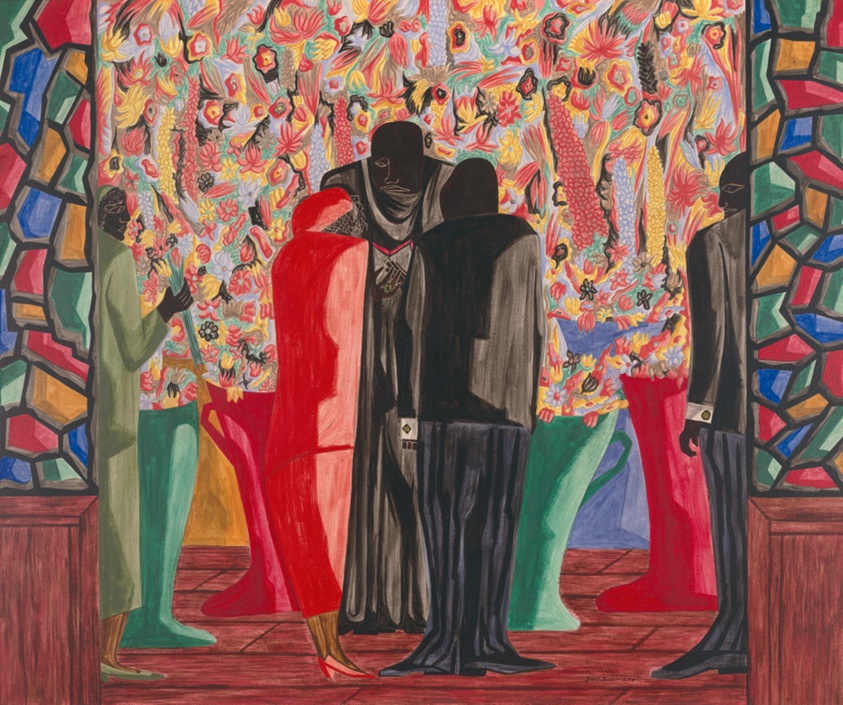
The Wedding, 1948
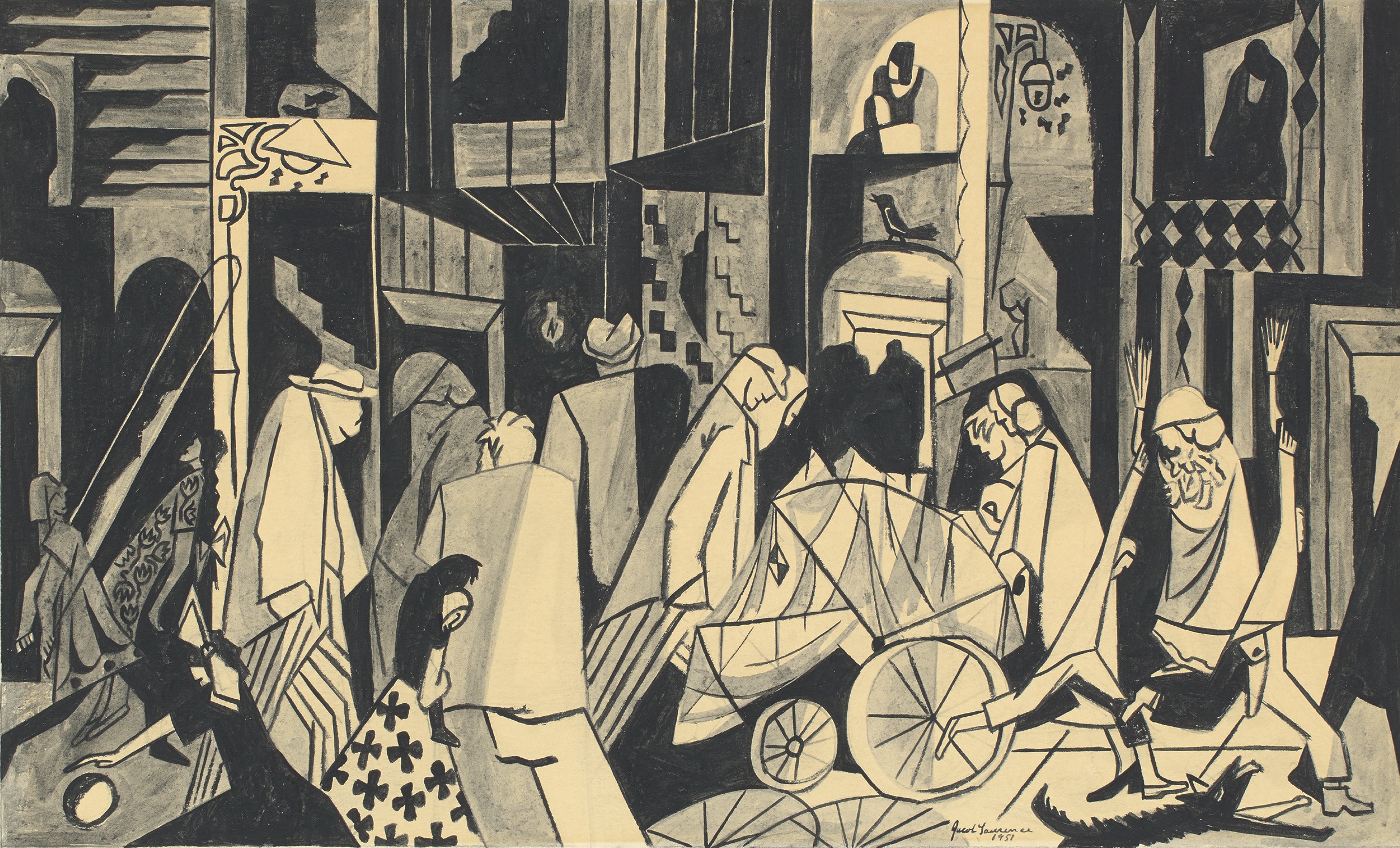
Throughout it all his compositional intelligence remained constant: the flattened perspective, the strong diagonal, the way a single image could condense a vast social moment into something immediately and emotionally legible. The works available through The Collection offer a revealing cross section of his range and his sustained power across different decades and media. The Wedding from 1948, rendered in egg tempera on hardboard, captures his gift for ceremony and human warmth, the figures reduced to their essential emotional postures without losing any of their particularity. Street Scene from 1951, worked in gouache, ink, and graphite, shows his urban eye at its most alert, the sidewalk world of Harlem compressed into a composition of almost musical rhythm.
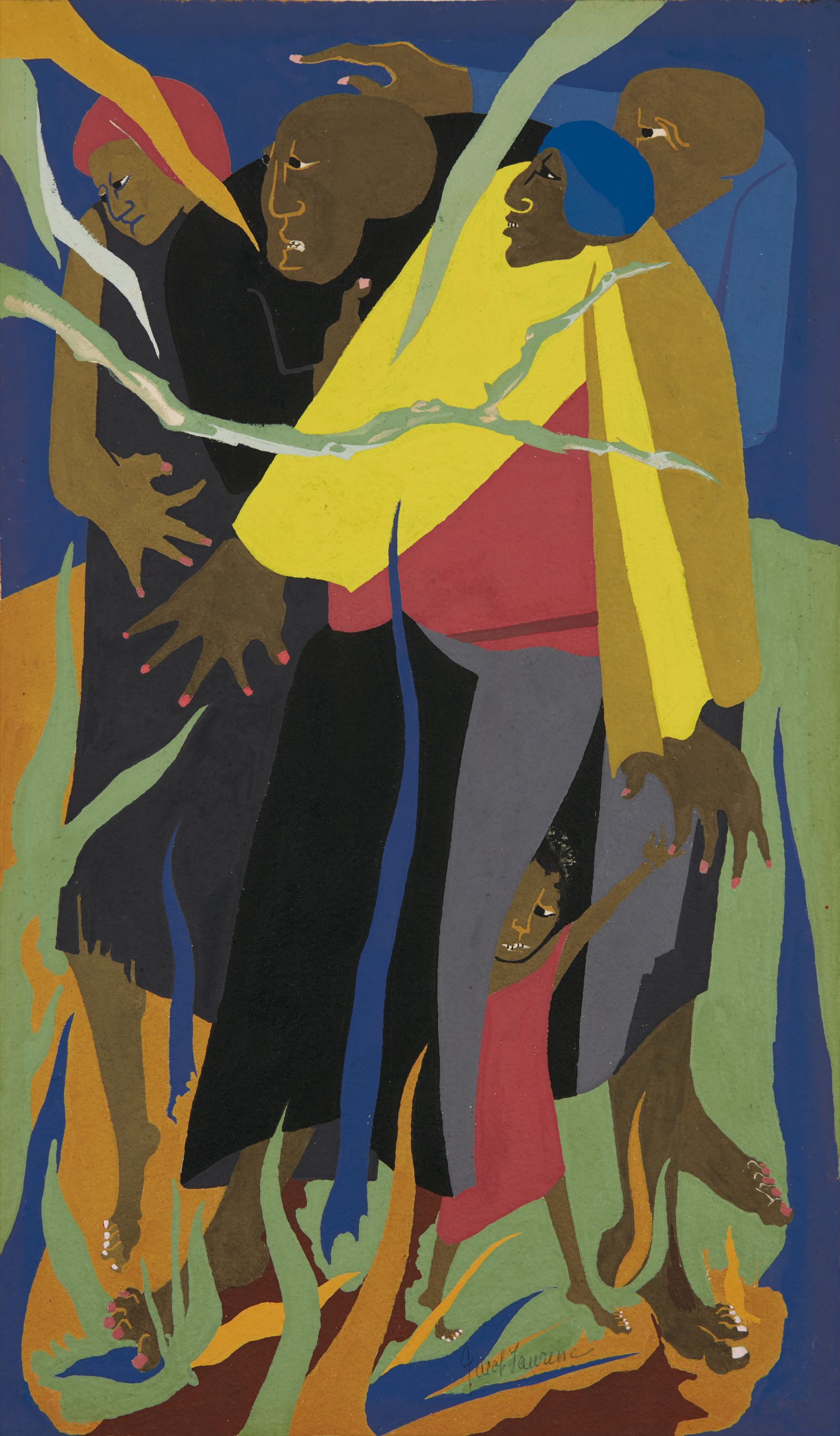
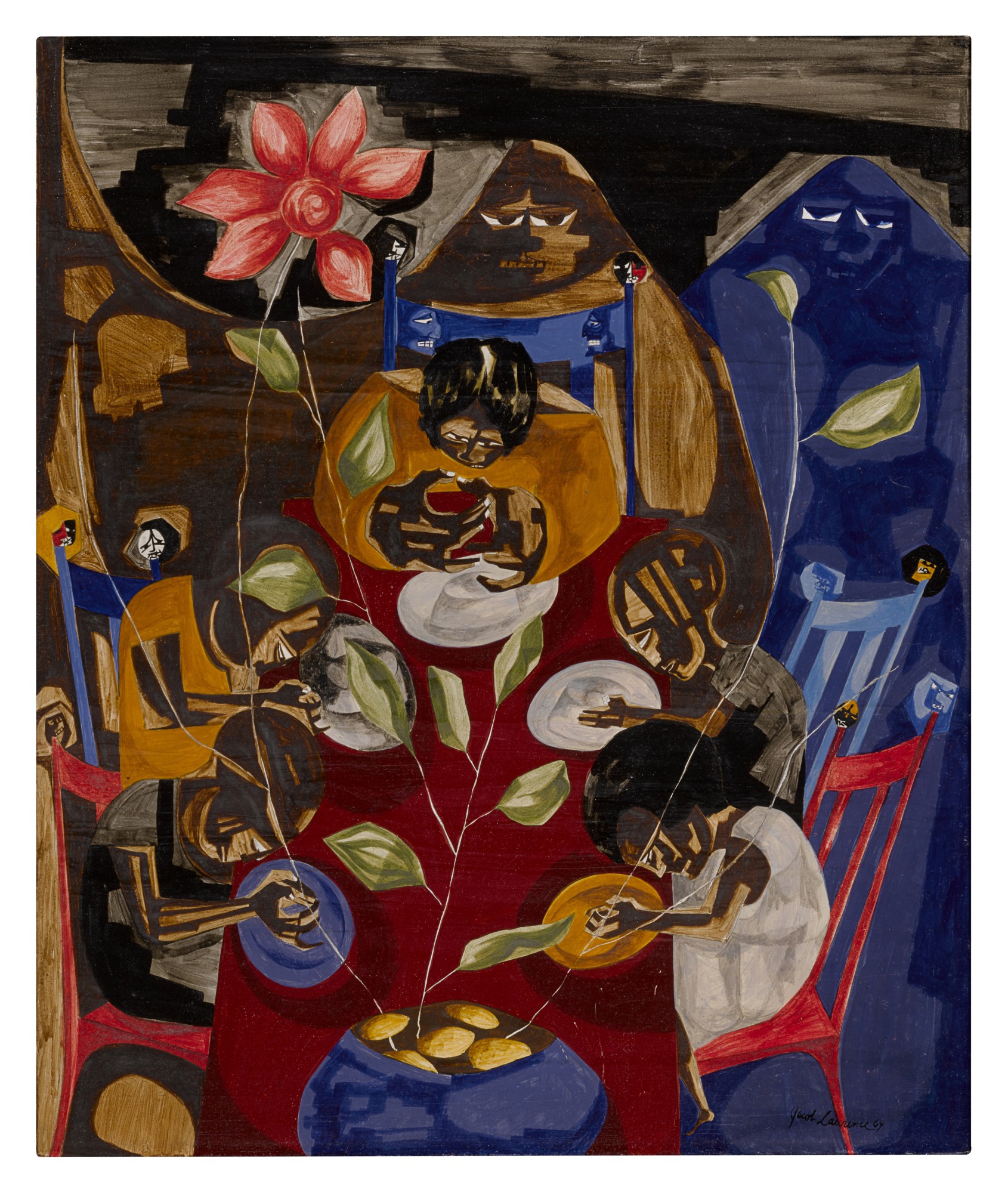
Escape from 1967 and Students and Books from 1966 demonstrate how fully his concerns remained engaged with freedom and education, two themes that recur throughout his work like a steady bass note. Two Comedians and a Dancer from 1958 reveals a less often discussed quality in Lawrence: his delight, his sense of play, his understanding that joy is as much a part of Black life as struggle. Together these works remind us that Lawrence was not a painter of a single idea but of an entire world. For collectors, Lawrence occupies a position of unusual security and significance within the American modern market.
Jacob Lawrence
Escape, 1967
His work has been sought by major institutions and private collectors for decades, and the combination of historical importance, visual accessibility, and the emotional force of his subjects creates a rare alignment of scholarly prestige and genuine popular appeal. Works on paper and smaller panel paintings, particularly those from the 1950s and 1960s, have drawn sustained attention at auction, with institutions and private collectors often competing for the same pieces. What to look for: works that demonstrate his characteristic formal clarity, the full commitment to his palette, and above all his narrative economy, the sense that everything unnecessary has been removed and what remains is essential. Within the broader landscape of twentieth century American art, Lawrence stands in illuminating relationship to several of his contemporaries.
His social realism connects him to artists like Ben Shahn, though Lawrence's formal vocabulary was always more rigorously abstract. His use of serial narrative anticipates strategies that would become central to conceptual art decades later. His influence on later generations of African American artists, from Romare Bearden to Kerry James Marshall, is profound and acknowledged. Bearden in particular admired Lawrence's ability to hold together formal sophistication and political commitment without sacrificing either, a balance that remains one of the defining challenges of socially engaged art.
What makes Lawrence matter now, in this particular cultural moment, is the totality of his achievement. He made work that was beautiful and legible and morally serious, work that trusted its audience to hold all of those things at once. He spent his career insisting that the history of African Americans was not a marginal story but the central story of the American experience, told through color and shape with a precision that no amount of rhetoric could match. He taught for many years at the University of Washington in Seattle, mentoring generations of artists, and he received the National Medal of Arts in 1990.
He died in 2000, leaving behind a body of work that continues to grow in stature with each passing year. To collect Lawrence is to hold something that belongs both to the history of American art and to its future.
Featured Works
Explore books about Jacob Lawrence
Jacob Lawrence: American Painter
Ellen Harkins Wheat

Jacob Lawrence: The Frederick Douglass and Harriet Tubman Series
Avis Berman
Over and Above
Peter T. Nesbett and Michelle DuBois

Jacob Lawrence: Paintings, Drawings, and Prints
Graham W. J. Beal
The Migration Series
Jacob Lawrence and Isabel Wilkerson
Jacob Lawrence: 1916-2000
Peter T. Nesbett

Jacob Lawrence: The American Struggle
Carroll Greene and Michele Greet