Invader
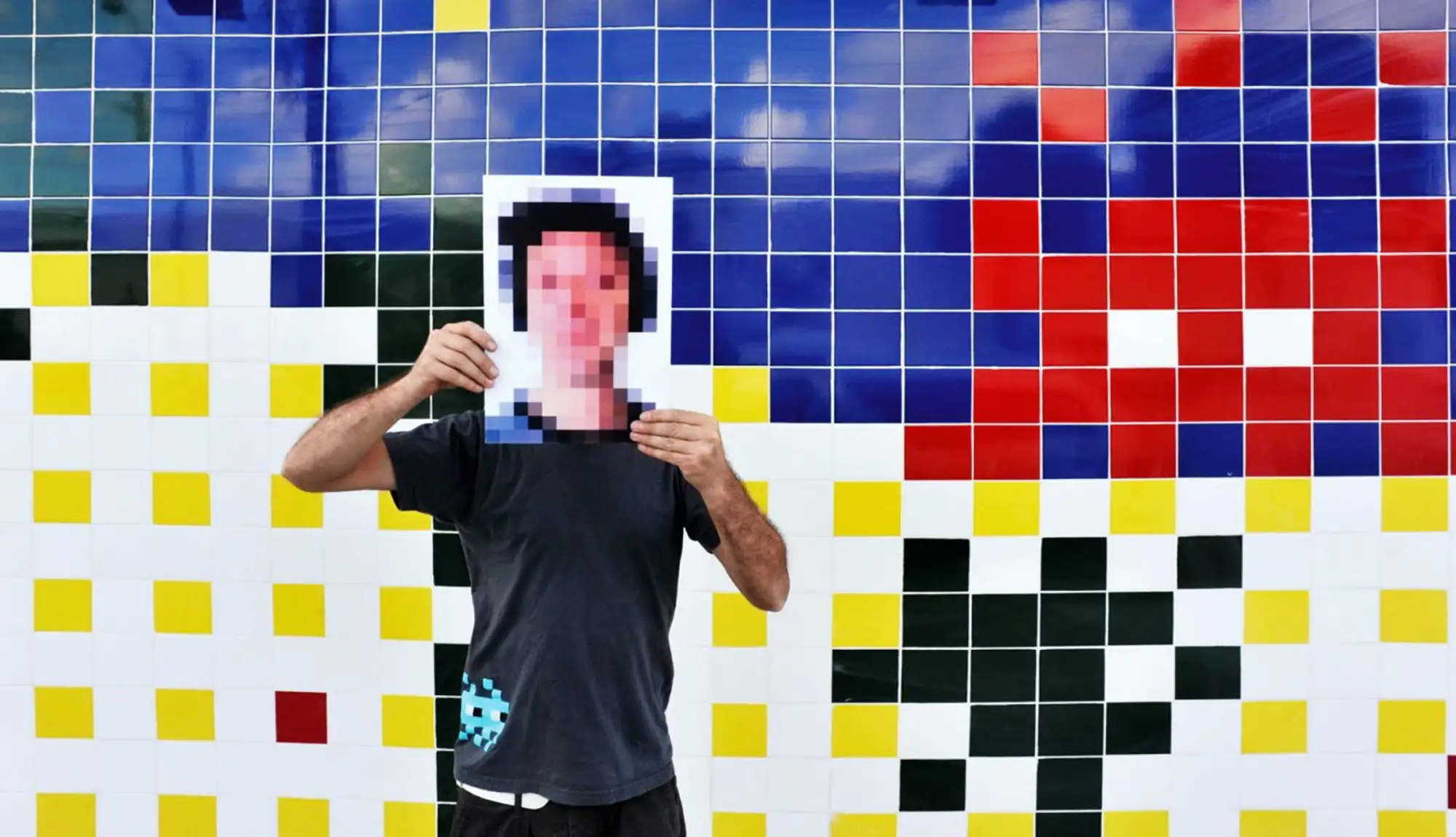
Invader Turns Every City Into Art
Artist Spotlight · The Collection Editorial
“I invade cities and I do it in a way that is the most accessible for everyone.”
Invader, artist statement
Sometime in the past year, a handful of devoted art world insiders gathered their phones, activated the Flash Invaders app, and set off through the streets of Paris, Tokyo, Los Angeles, and beyond on a mission that felt equal parts treasure hunt and pilgrimage. They were tracking the ceramic tile mosaics of the artist known simply as Invader, scanning works to earn points in a real world game that has quietly become one of the most beloved participatory art projects of our era. With major institutional attention continuing to grow, a string of significant new works appearing in 2024 and 2025, and a collector base that spans seasoned contemporary art veterans and a passionate younger generation, Invader stands at a genuinely remarkable moment in his career. Born in France in 1969 and fiercely protective of his anonymity, Invader has never revealed his face or his given name, a choice that feels less like affectation and more like a deeply principled commitment to the primacy of the work itself.
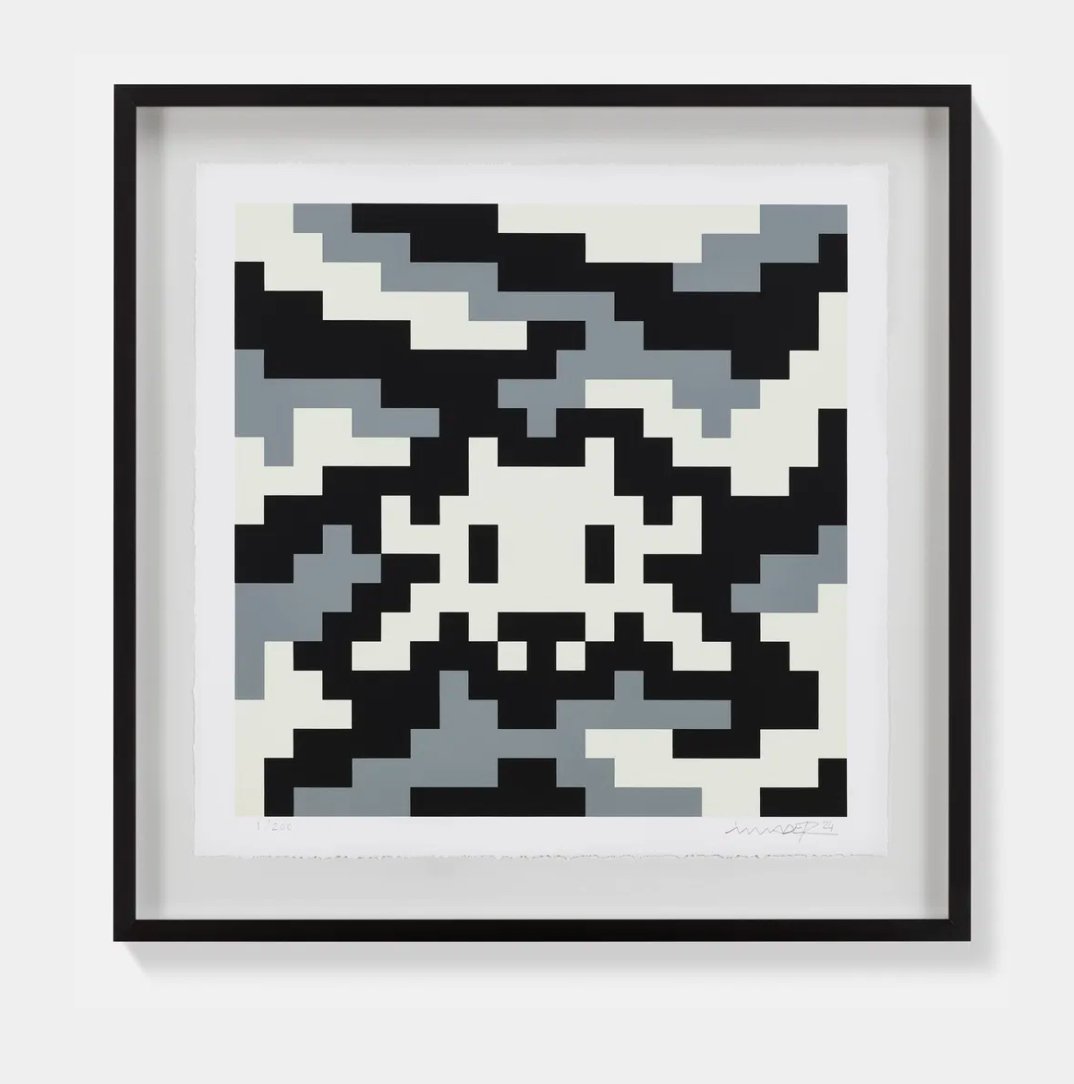
Invader
Camouflage (Small), 2024
Growing up in the era of the first great wave of arcade culture, he was among the generation that experienced the pixelated worlds of Space Invaders and Pac Man not as nostalgia but as a formative visual language, as immediate and emotionally resonant as any painted canvas. That experience planted a seed. When the broader art world was still wrestling with the legacies of Neo Expressionism and the Pictures Generation, the young French artist was quietly developing a practice that would take the pixel from the screen and press it, tile by tile, into the stone and plaster of the city itself. Invader launched his invasion formally in 1998, beginning in Paris and radiating outward with extraordinary ambition.
The logic was elegant and almost military in its precision: each city constituted a separate invasion, each mosaic installation a new point on a map that grew more extraordinary with every passing year. By the early 2000s, he had moved beyond Europe into the Americas, Asia, and beyond, eventually documenting invasions across more than 80 cities in over 40 countries. He published artist books for each invaded city, numbered and editioned, which became sought after objects in their own right. The project had the discipline of Conceptual Art and the energy of a street movement, and it drew admiring attention from curators, collectors, and fellow artists who recognized something genuinely new was happening on walls that most people walked past without looking up.
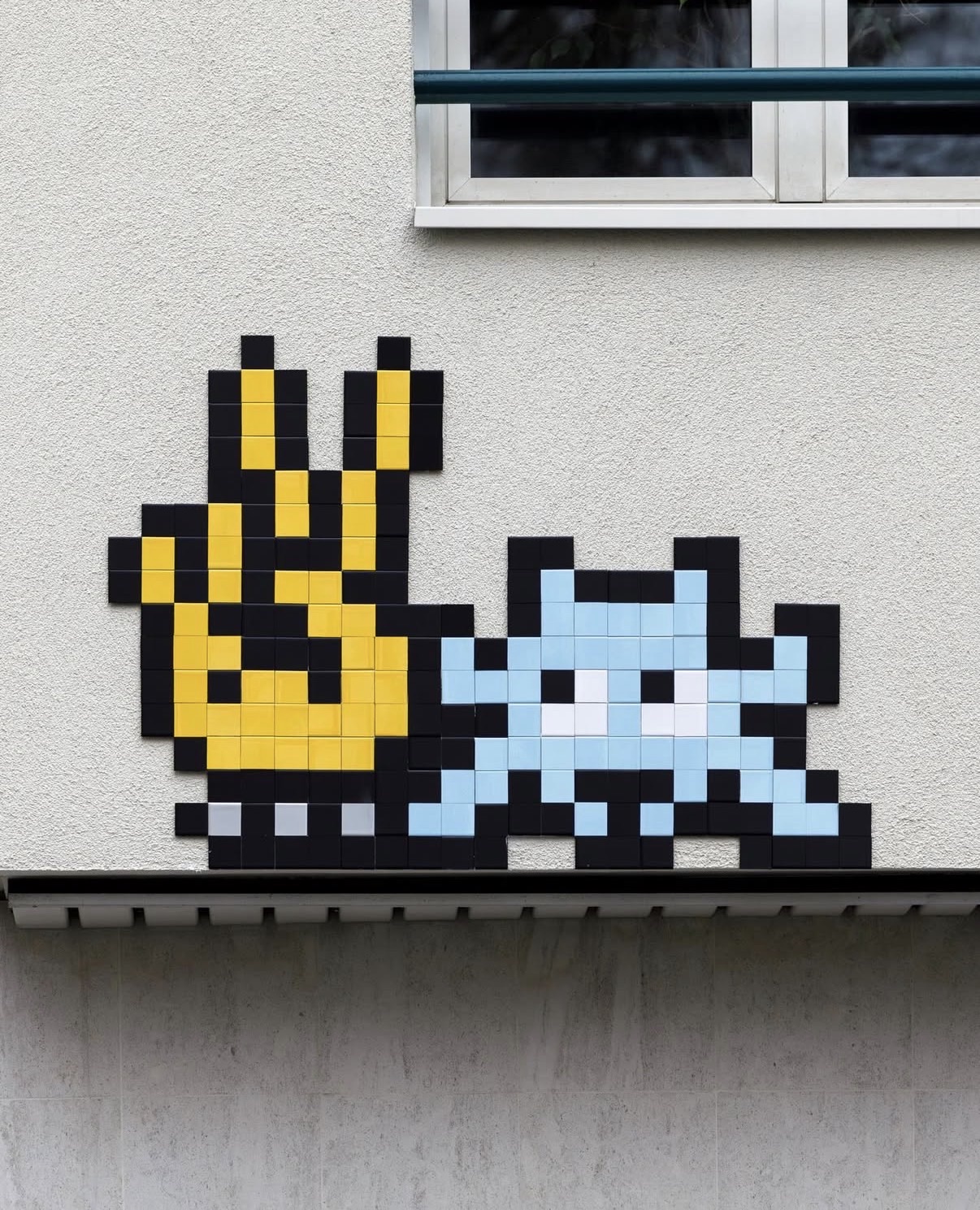
Invader
Untitled
What makes the practice so enduring is the way it operates simultaneously on multiple registers. At street level, the mosaics are small, often placed high on building corners or tucked beside doorways, rewards for the observant and the curious. In ceramic tile, a medium associated with ancient traditions of decoration and durability, Invader renders characters and images in the blocky, irreducible logic of early digital graphics, and the collision of those two traditions produces something that is neither purely nostalgic nor purely contemporary but suspended between worlds in a way that feels genuinely poetic. The use of ceramic also carries a quiet subversive wit: unlike spray paint, which authorities sand away, tiles bond to surfaces with a near permanence that has allowed many works to survive for decades.
“The street is the biggest gallery in the world.”
Invader
Among the most celebrated recent works are pieces that push the practice into new territory entirely. "InvadHirst" and "Trouble Mae West," both realized in 2025 in ceramic tiles on aluminium, demonstrate the artist's ongoing appetite for dialogue with art history and popular culture. The extraordinary "Secret from the Deep" from 2025, executed in glass, painted stainless steel, silicone, resin, and formaldehyde solution, announces an artist willing to expand his material vocabulary in ways that will reward close looking from serious collectors. The Rubik's cube works deserve particular attention as a strand of the practice that has achieved remarkable critical and commercial traction.
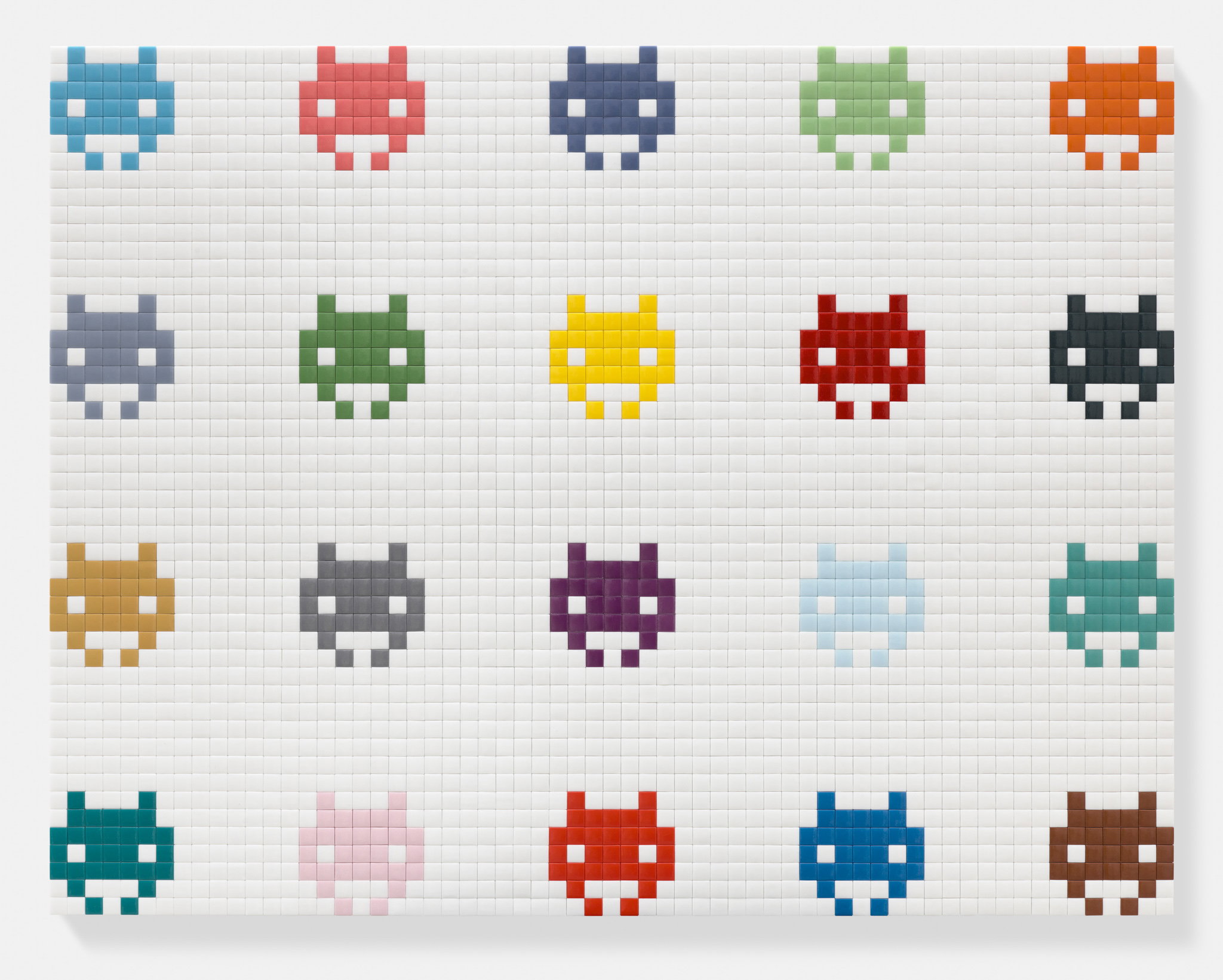
Invader
InvadHirst, 2025
By substituting the individual ceramic tile for the face of a Rubik's cube, Invader extends his pixelated language into three dimensions while also engaging with another beloved object from the same era of his childhood. Works such as "Rubik Kubrick Clockwork Orange (Alex)" and pieces from 2022 and 2025 in this series have generated significant collector enthusiasm. They sit at the intersection of sculpture, painting, and conceptual proposition, and they photograph with a vitality that has given them considerable presence in the digital sphere, which feels entirely appropriate for an artist whose subject is the translation of digital imagery into physical form. On the prints market, editions such as the screenprint "Rubik Kubrick Clockwork Orange (Alex)" and the technically inventive "Camouflage (Small)" from 2024, produced with glow in the dark ink, demonstrate a sophisticated understanding of the multiples market and a generosity toward collectors at various levels of engagement.
Within the broader context of contemporary art, Invader occupies a singular position that resists easy categorization but invites rich comparative thinking. His roots in street art place him in conversation with the tradition that runs from Keith Haring and Jean Michel Basquiat through to Shepard Fairey and Os Gemeos, artists who insisted that the city was a legitimate canvas and that art belonged to everyone who encountered it. His Conceptual rigour and systematic approach to his project recalls the durational ambition of artists like On Kawara. His engagement with popular culture and the visual languages of mass media aligns him with the Pop Art lineage, though filtered through a distinctly European and generational sensibility.
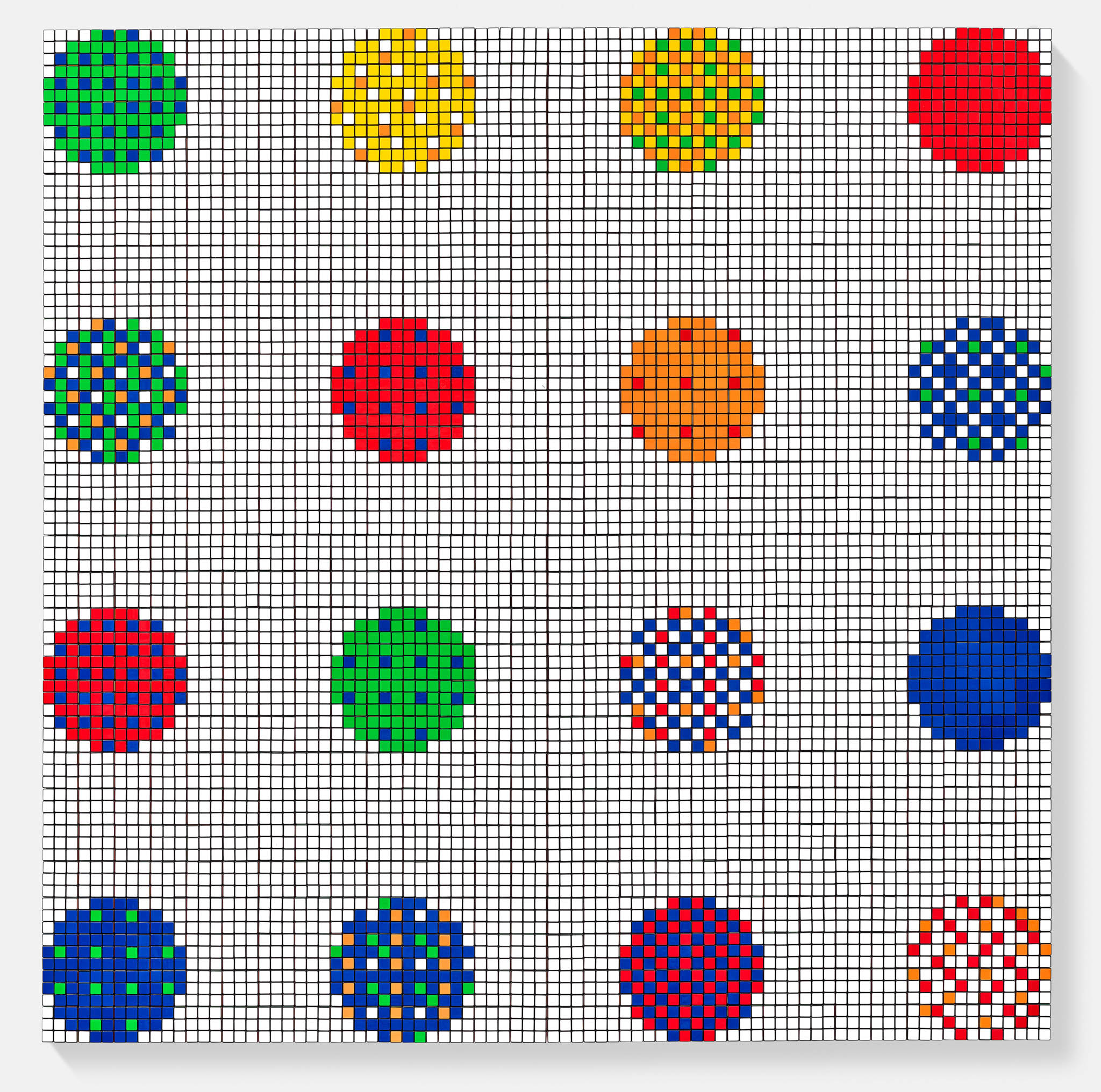
Invader
Rubik Isonicotinoyl Chloride, 2022
And his interest in gamification and participatory art places him in productive dialogue with artists working at the intersection of technology, experience, and community. For collectors, what distinguishes Invader is the coherence and richness of a practice that rewards both breadth and depth of engagement. A collector who begins with a print edition quickly finds themselves drawn to the ceramic works, the Rubik's cube pieces, the artist books, and the broader ecosystem of the invasion project. Works span a wide range of price points, making entry genuinely accessible, while the top tier ceramic and mixed media pieces command serious attention at auction and in the secondary market.
The artist's anonymity, far from being a barrier, has become a form of mythology that adds a compelling dimension to ownership. When you acquire an Invader work, you join a global community of enthusiasts who understand that the real game has always been bigger than any single piece. Invader's legacy is already secure in a way that few living artists of his generation can claim. He took an idea of genuine simplicity, placing pixelated tile mosaics on city walls, and through decades of disciplined, joyful, intellectually serious work, transformed it into one of the defining art projects of the early twenty first century.
Cities across the world carry his mark. Museums have collected his works. Collectors in every major market have recognised the quality and originality of what he does. And on any given morning, somewhere in the world, someone looks up at a wall, recognises a small ceramic mosaic, and smiles.
That capacity to generate delight, in strangers, in unexpected places, without explanation or apology, is among the rarest gifts an artist can possess.
Explore books about Invader
