Ilya Kabakov
Ilya Kabakov: Master of Worlds Within Worlds
Artist Spotlight · The Collection Editorial
“The viewer who comes into the installation is inside my picture. He is a participant in the event I have described.”
Ilya Kabakov, interview with Boris Groys
In the spring of 1988, visitors to the Ronald Feldman Gallery in New York encountered something that defied easy categorization. They stepped through a doorway into a cramped, wallpapered room littered with Soviet era detritus, where a hole had been blasted through the ceiling and a makeshift launching apparatus suggested that someone, at some point, had rocketed out through the roof and into the sky above. The work was called The Man Who Flew into Space from his Apartment, and it announced to the Western art world what those inside Soviet cultural circles had long understood: Ilya Kabakov was one of the most visionary artists of his generation, a poet of the mundane who could transform the residue of everyday life into something transcendent. Kabakov was born in 1933 in Dnepropetrovsk, in what is now Ukraine, and came of age in a world defined by the vast Soviet bureaucratic machinery.
Ilya Kabakov
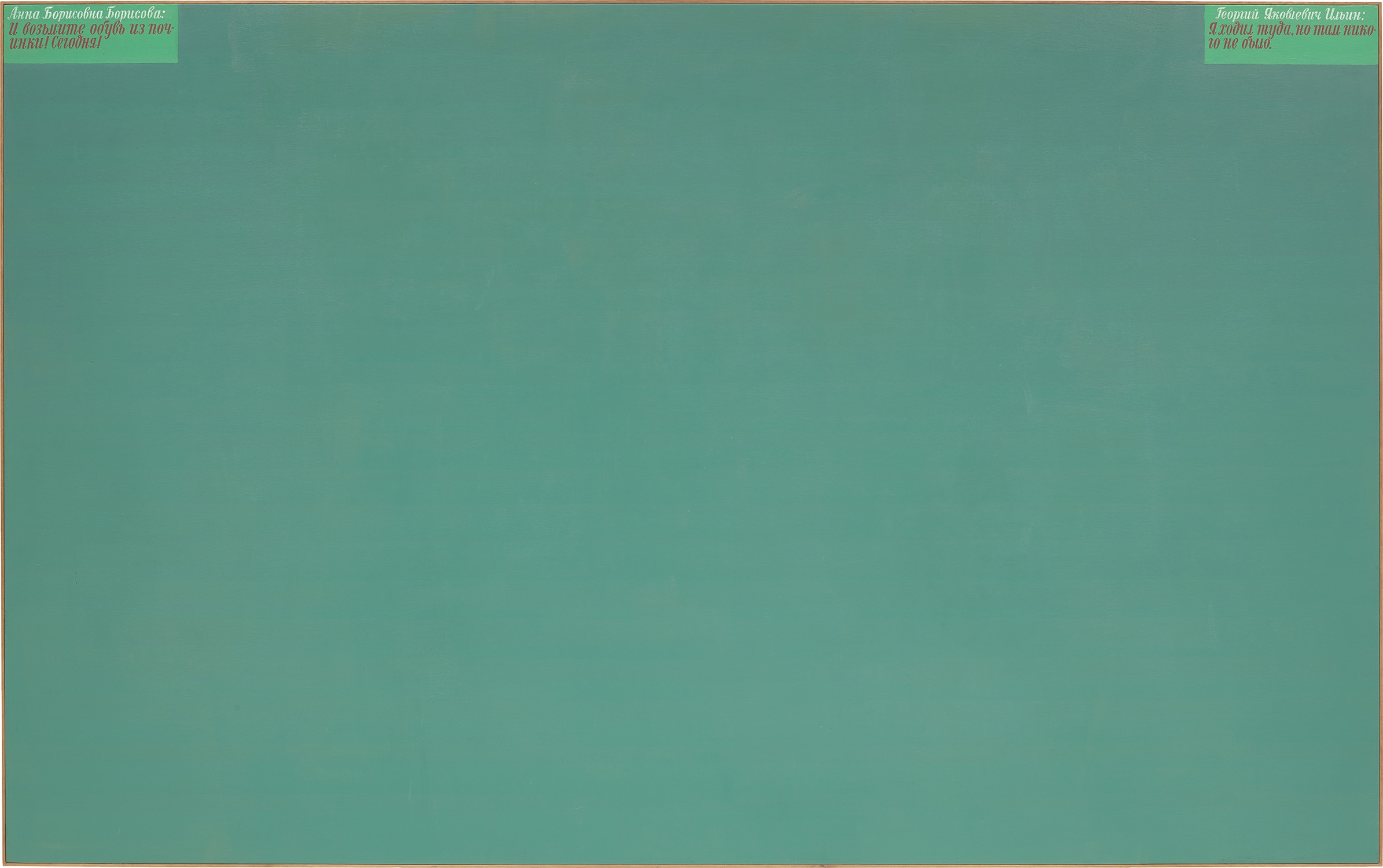
A. B. Borisova: And Pick the Shoes from the Repair Shop Today!, 2006
He trained at the Surikov State Art Institute in Moscow, graduating in 1957, and spent the following decades working as a children's book illustrator, a profession that gave him both financial cover and a deep fluency in the art of visual storytelling. During this period he was also a central figure in the Moscow Conceptualist movement, gathering alongside artists such as Erik Bulatov, Vladimir Yankilevsky, and Eduard Steinberg in unofficial studios and apartments where a genuinely independent intellectual life flourished beyond the reach of official Soviet culture. The Moscow Conceptualist circle was a remarkable phenomenon: a group of artists who, working in near total isolation from Western contemporary art, developed a rigorous, philosophically sophisticated practice that engaged with language, ideology, and the nature of representation. Kabakov absorbed and exceeded this context.
Where many of his contemporaries worked in relatively portable formats, he was increasingly drawn to something larger and more enveloping. Through the 1970s and into the 1980s he developed the concept he would eventually call the total installation, an environment that placed the viewer inside a complete fictional or psychological world rather than asking them to stand before individual objects. The result was a form of art that owed as much to theater and literature as it did to painting or sculpture. His breakthrough in the West coincided with glasnost and the gradual opening of Soviet cultural life in the late 1980s.
Ilya Kabakov
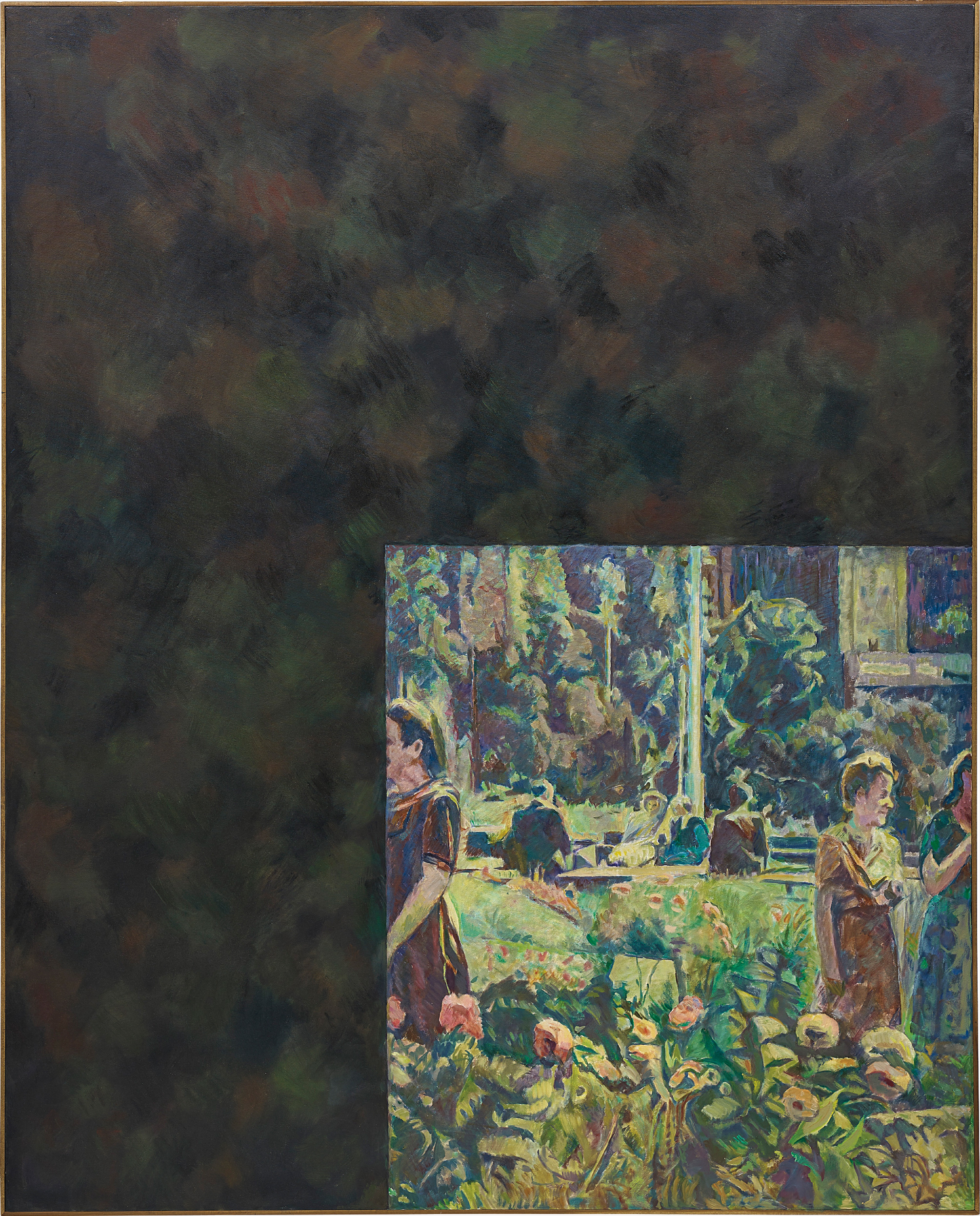
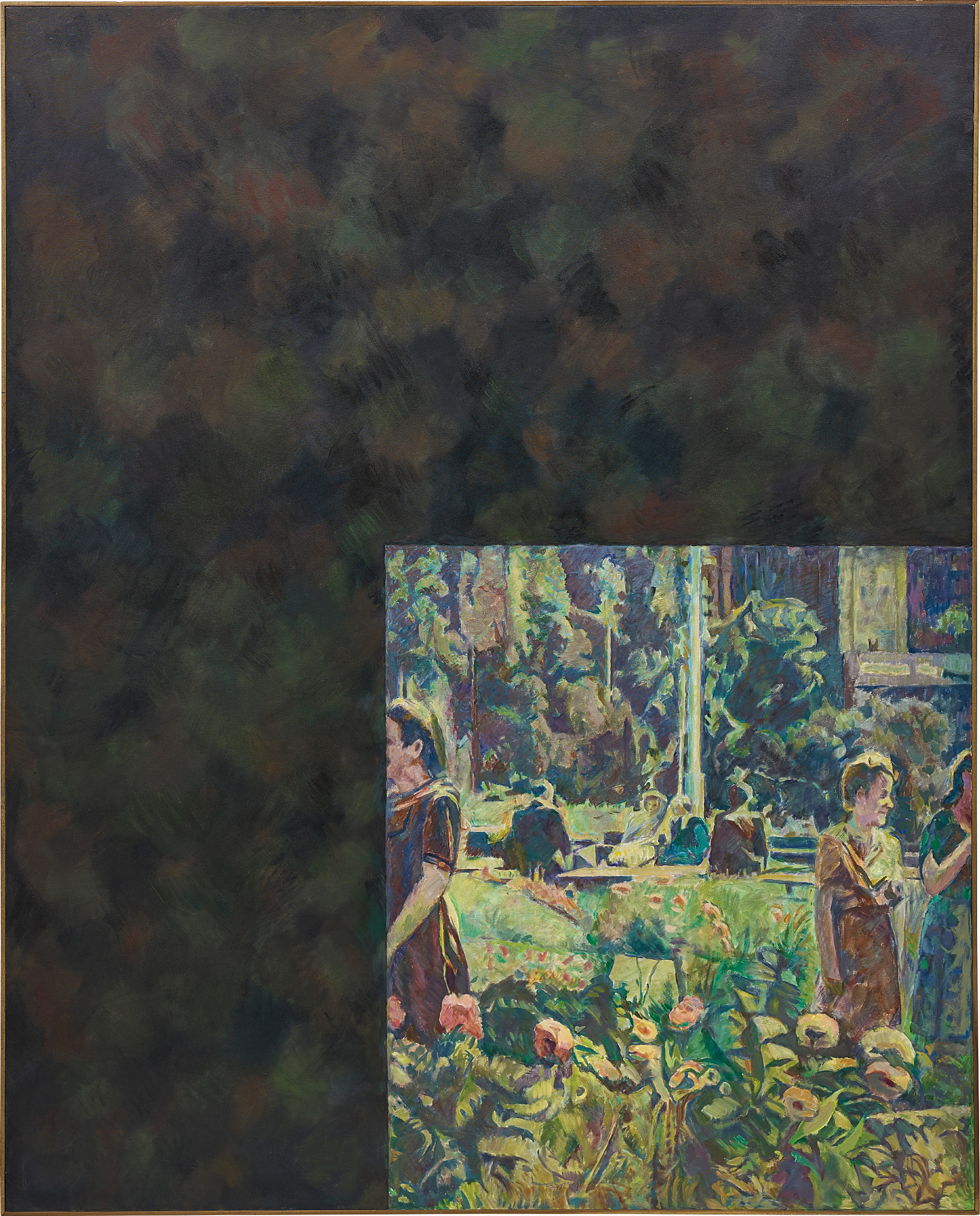
In the Park 1972, 2002
Kabakov emigrated to the West in 1988, eventually settling in New York, and the international art world received him with a recognition that felt both belated and urgent. At the 1993 Venice Biennale he represented Russia with The Red Pavilion, an installation that brought his complete imaginative universe to one of art's most prestigious stages. Museums and institutions across Europe and North America mounted major exhibitions throughout the 1990s and 2000s, and his reputation as one of the defining artists of the twentieth century solidified rapidly. Much of this later work was developed in close collaboration with his wife Emilia, who became his partner in both life and artistic practice.
“I was always interested in the person who is not a hero, who is marginal, who lives in the corner.”
Ilya Kabakov
What makes Kabakov's work so enduringly compelling is the particular texture of its emotional intelligence. His total installations do not simply critique the Soviet system from a distance; they inhabit it from the inside, rendering visible the interior lives of ordinary people crushed or sustained or quietly deluded by ideology. Works like The Ten Characters, a series exploring the imaginary inhabitants of a communal apartment, give voice to figures whose dreams are both absurd and deeply moving. The recurring presence of text, handwritten notes, bureaucratic forms, and marginal annotations creates a layered documentary quality that feels simultaneously specific to Soviet experience and universally human.
Ilya Kabakov
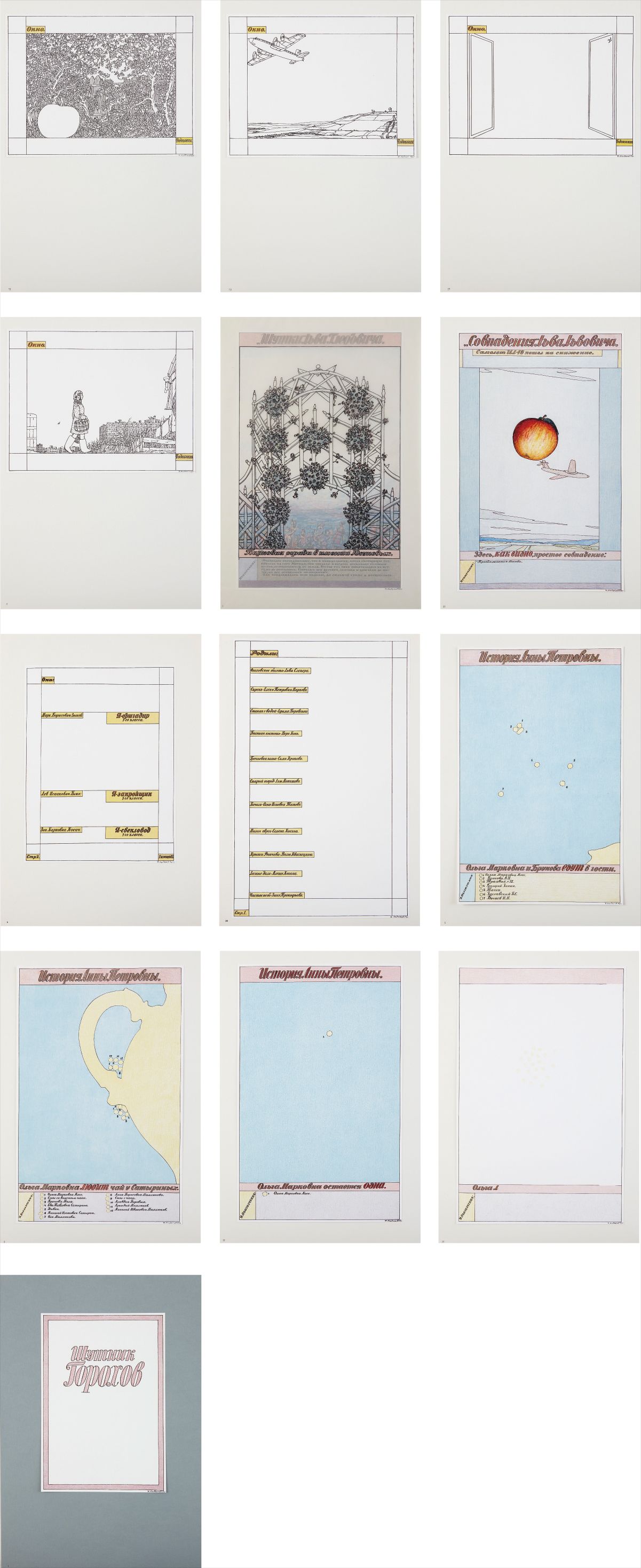
10 Characters, Complete Set of Portfolios: (i) The Flying Komarov; (ii) The Joker Gorokhov; (iii) Generous Barmin; (iv) Agonizing Surikov (v) Anna Petrova Has A Dream; (vi) Sitting-in-the-Closet Primakov; (vii) Mathematical Gorsky; (viii) The Decorator Maligin; (ix) The Released Gavrilov; (x) The Looking-Out-The-Window Arkhipov
His paintings, too, carry this quality: canvases such as In the Park 1972 and the formally inventive Painting No. 11 (Under the Snow) combine observed reality with a kind of melancholy lyricism that is entirely his own. For collectors, Kabakov's work offers an extraordinary range of entry points. His paintings on canvas, including works such as Flying 12 and In The Store, demonstrate the full breadth of his painterly skill, while works on paper including In the Forest reveal an intimacy and directness that larger installations cannot always provide.
The artist's characteristic framing device, presenting works within hand constructed frames as though they were recovered artifacts, lends even modest works a profound conceptual weight. The complete portfolio set of 10 Characters is particularly significant: it encapsulates the entire imaginative universe of the communal apartment project in a format that brings the collector directly into the heart of Kabakov's most celebrated body of thought. Institutional works such as The Composer, with its assembly of music stands, drawings, and found objects, demonstrate how powerfully his ideas translate across media. Kabakov belongs to a lineage of artists who transformed the experience of living under authoritarian systems into universal art historical statements.
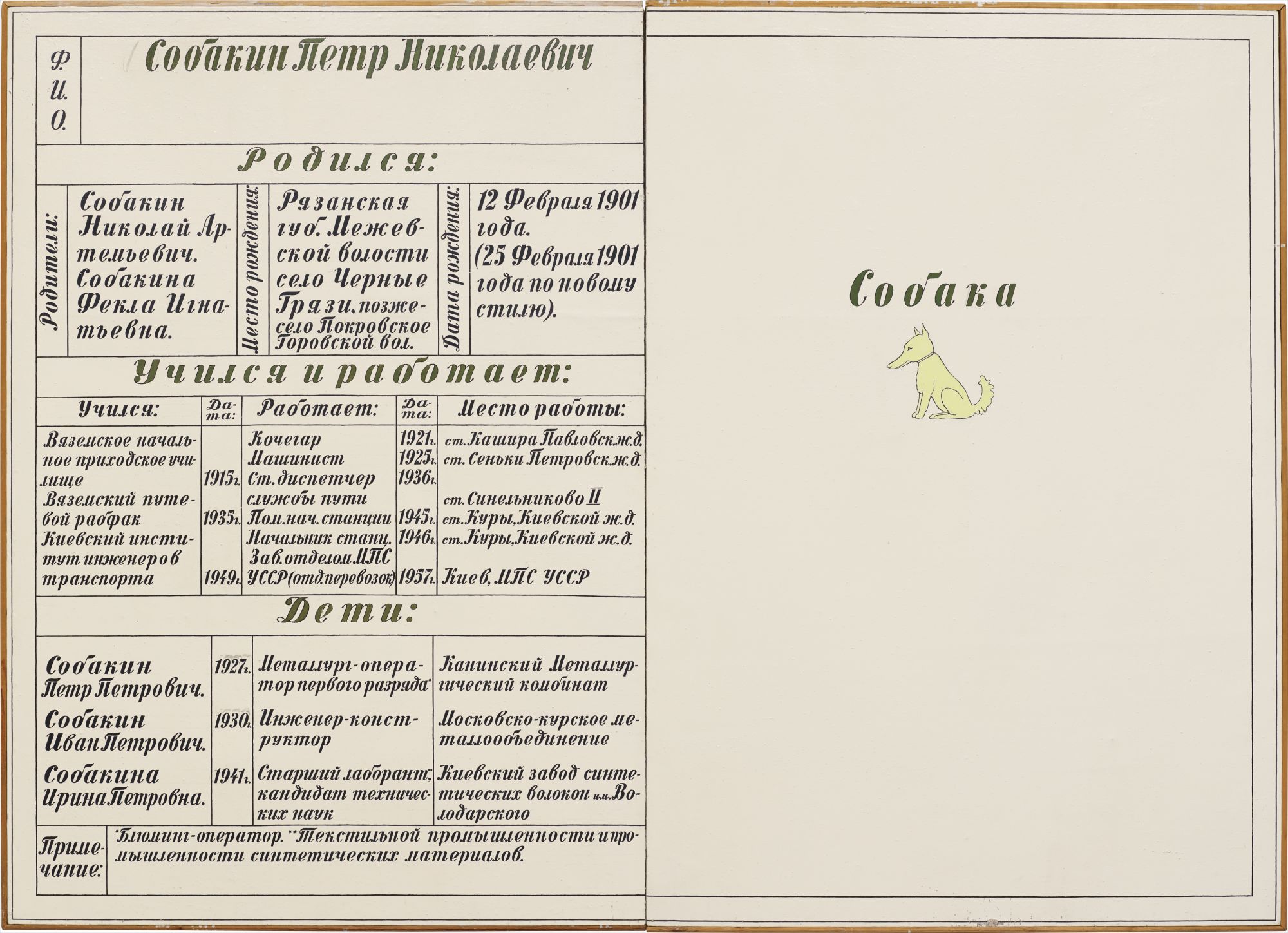
Ilya Kabakov
Sobakin
His closest points of comparison within the Western canon might be found in the conceptual environments of Christian Boltanski or the text based institutional critiques of Hans Haacke, but his sensibility is entirely distinct. Unlike artists who approach ideology from an analytical remove, Kabakov writes from inside the dream, and the dream is always specific, always inhabited by particular people with particular names and particular griefs. This specificity is what separates great conceptual art from mere illustration, and it is what ensures his work remains alive and necessary. Kabakov passed away in May 2023 at the age of 89, leaving behind a body of work that will take decades to fully absorb.
His legacy is already secure in the collections of the Museum of Modern Art, the Tate Modern, the Stedelijk Museum, and institutions across the globe. But his work also belongs in private hands, where it can be lived with, returned to, and allowed to unfold slowly over time. The quality of attention he brought to the forgotten corners of human experience is exactly the quality of attention that the best collecting rewards. To own a work by Ilya Kabakov is to keep faith with a vision of art as a form of radical empathy, an insistence that the interior lives of ordinary people are worthy of the most serious artistic ambition.
Explore books about Ilya Kabakov

Ilya Kabakov: The Ten Characters
Boris Groys
Ilya Kabakov
Jean-Hubert Martin

Ilya Kabakov: A Retrospective
Susan Cross
Ilya Kabakov: Projects 1981-1990
Ilya Kabakov

The Communal Kitchen: On Ilya Kabakov
Boris Groys
Ilya Kabakov: In the Bathroom of the Titanic
Rudolf Springer

Ilya Kabakov: Installations and Drawings
Iwona Blazwick