Hilo Chen
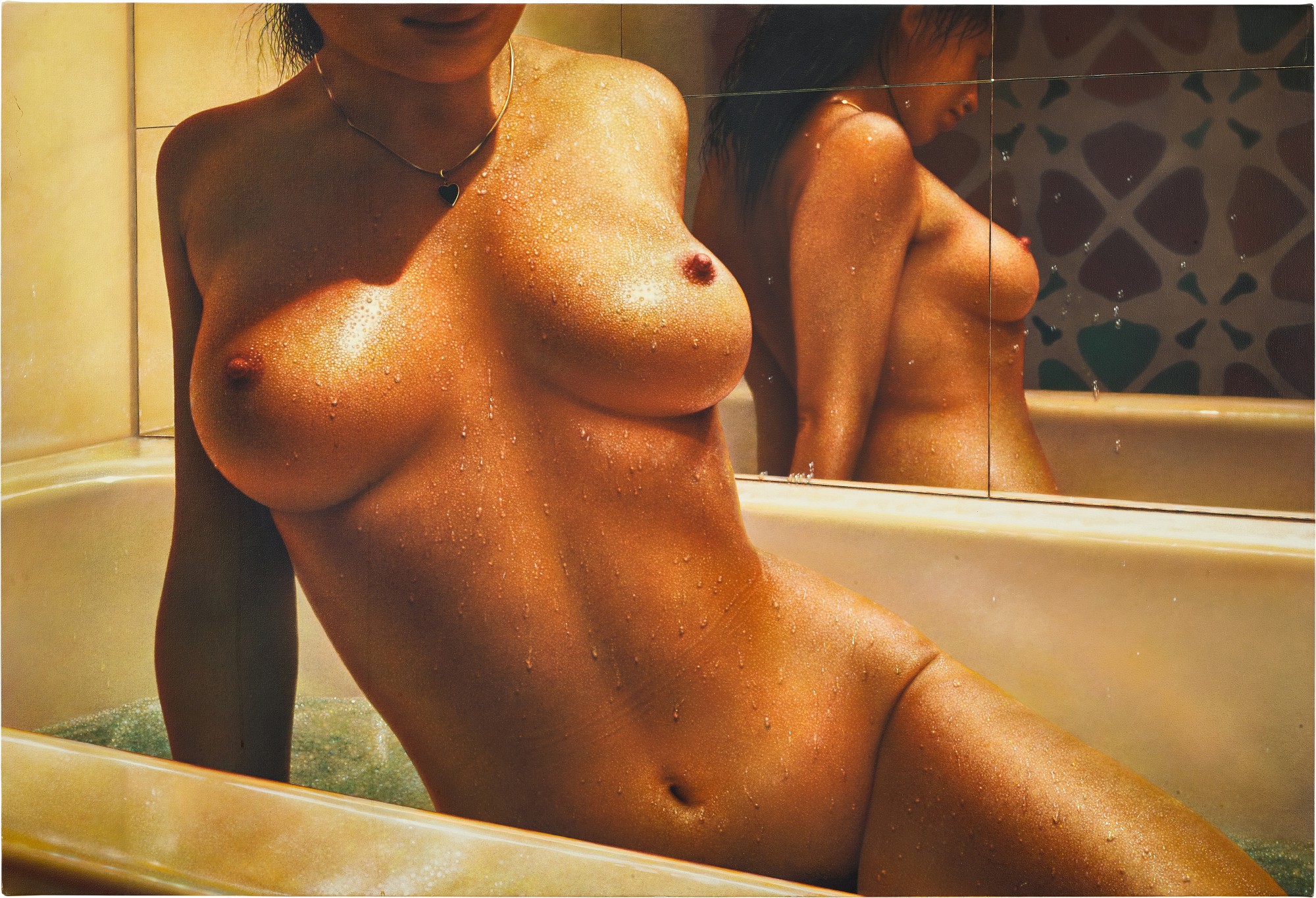
Hilo Chen's Sun Drenched World Glows
Artist Spotlight · The Collection Editorial
There is a particular quality of light that belongs almost exclusively to Hilo Chen. It is the light of a summer afternoon held perfectly still, pooled across wet skin, rippling through shallow turquoise water, catching the edge of a swimsuit strap. When the photorealist movement roared into American galleries in the early 1970s, Chen arrived with it, and yet he stood slightly apart from his peers, painting not the chrome of automobiles or the glass facades of city storefronts, but the intimate, sun warmed world of the beach and the pool. Decades later, that world feels not dated but timeless, and collectors and institutions are increasingly recognizing the singular achievement it represents.
Hilo Chen
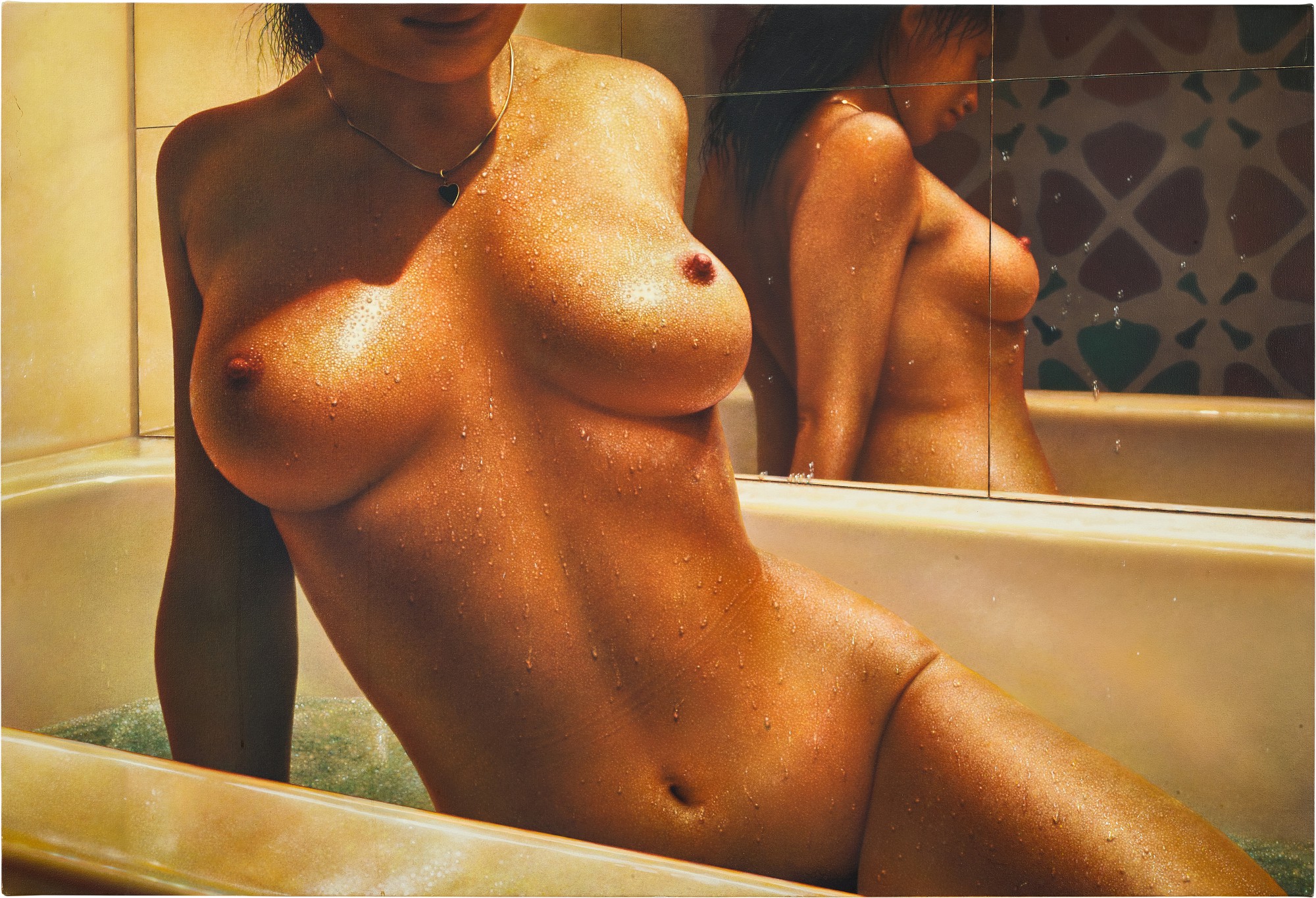
Bathroom - 15 浴室 - 15
Hilo Chen was born in Taiwan in 1942, and his journey to becoming one of the defining voices of American Photorealism is itself a story of remarkable transformation. He immigrated to the United States and eventually settled into the New York art world at a moment of extraordinary creative ferment. The late 1960s and early 1970s were years when a generation of painters was pushing back against the dominance of abstraction, reaching instead for a kind of painterly hyper fidelity to the visual world. Chen absorbed these energies and found in them a language that felt authentically his own.
His formation as an artist bridged two cultures, two sensibilities, and that dual inheritance gave his work a quality of calm, almost meditative observation that distinguishes it from the sometimes aggressive precision of his American contemporaries. Chen came to prominence alongside a cohort of painters who were collectively redefining what realism could mean in a post photographic age. Artists such as Chuck Close, Richard Estes, Ralph Goings, and Audrey Flack were all working through similar questions about representation, photography as a painterly tool, and the nature of visual truth. Chen shared their commitment to the photograph as a compositional starting point and their extraordinary discipline in rendering surface and texture.
Hilo Chen
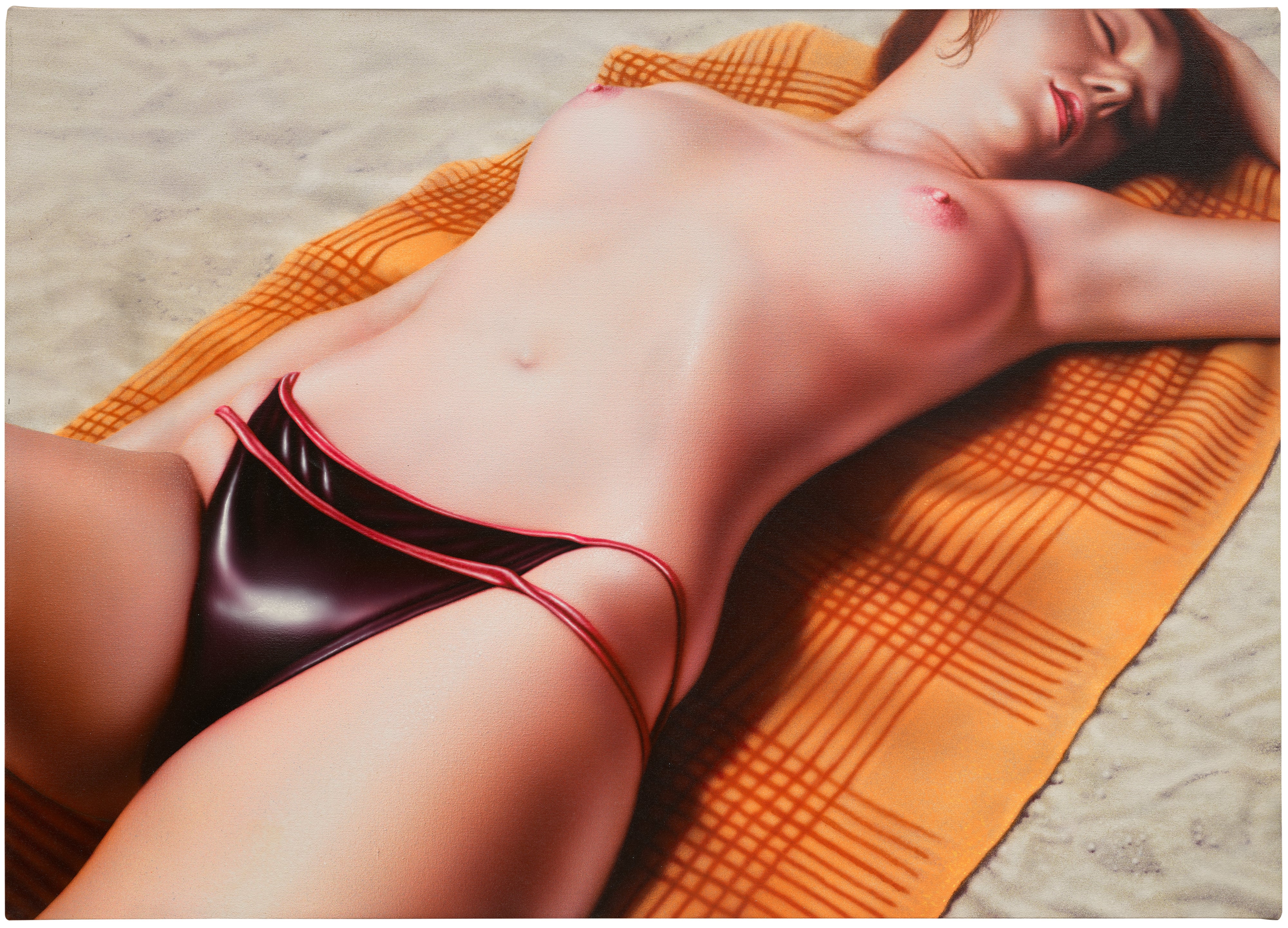
Beach - 110, 1986
But where Estes turned to the reflective surfaces of urban New York and Goings to the diner and the pickup truck, Chen planted himself firmly in the realm of leisure, warmth, and the female figure. Louis K. Meisel Gallery in New York, which became the essential home for Photorealism during this period and which Meisel himself championed with evangelical conviction, represented Chen and gave his work a prominent platform within this defining movement. The paintings that emerged from Chen's studio across the 1970s and 1980s are among the most technically demanding and visually arresting works of the entire Photorealist canon.
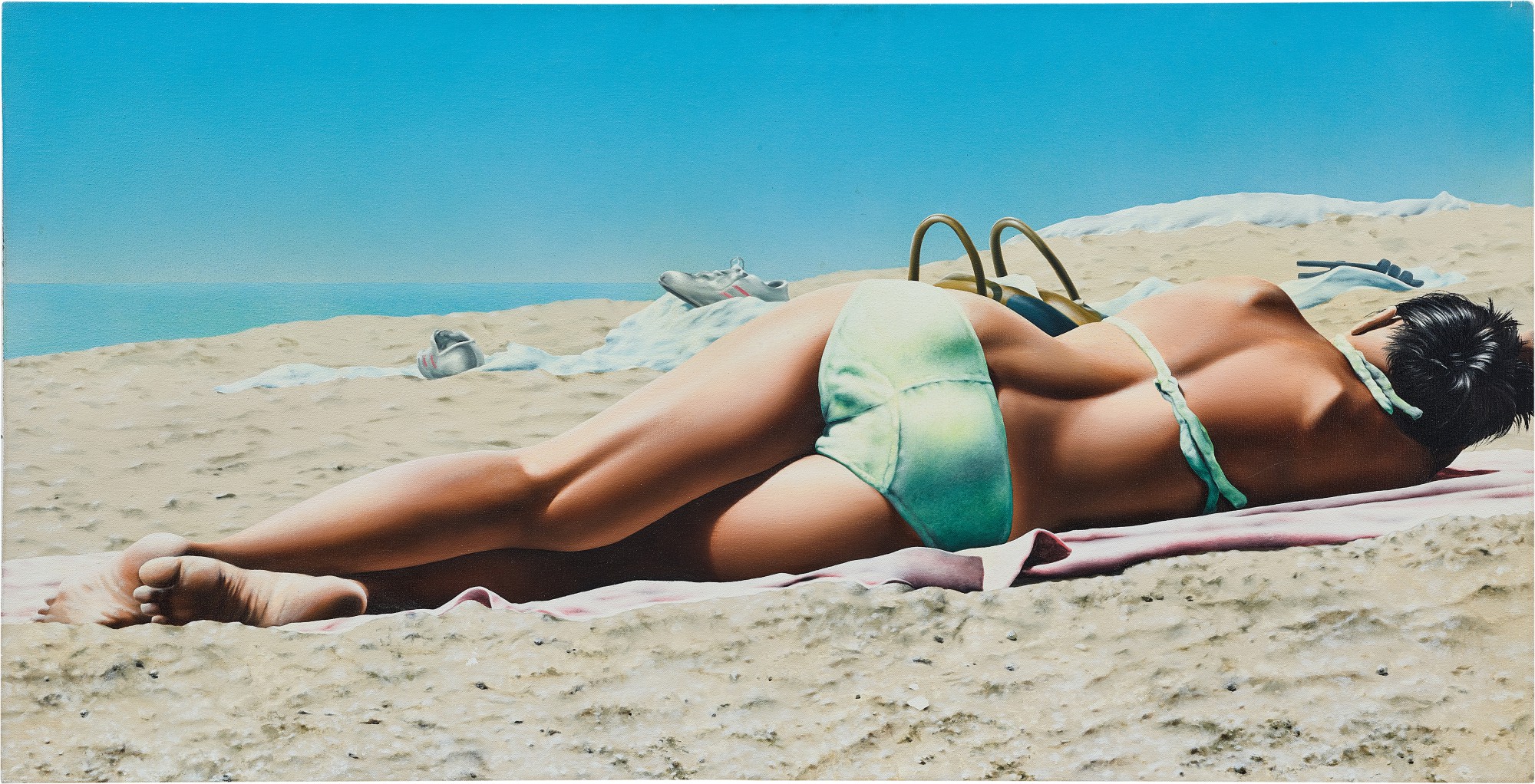
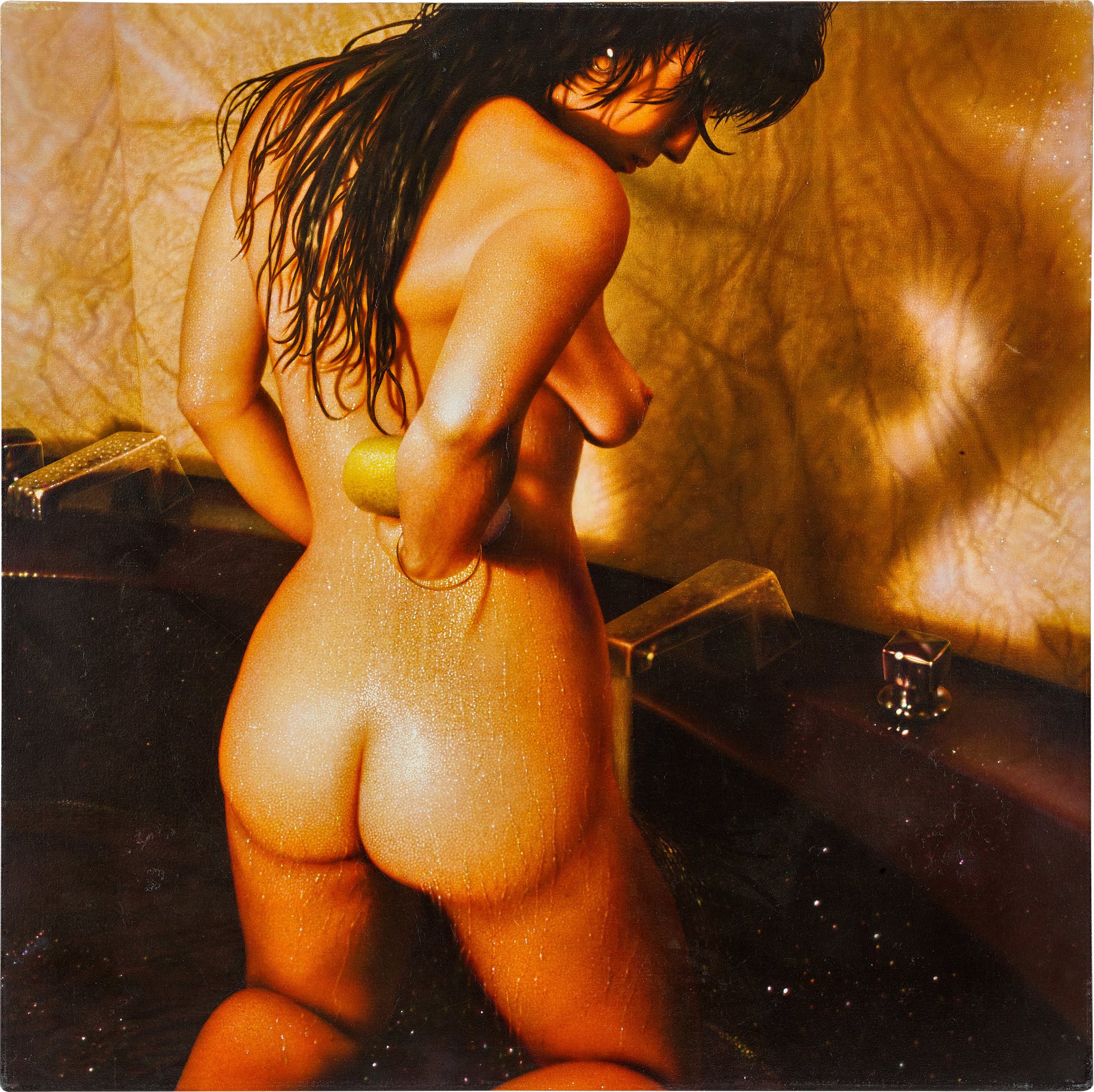
Consider Beach 沙灘 from 1974, rendered in oil on canvas, one of his earliest major statements. Here Chen establishes the grammar that will define his career: a reclining or standing female figure occupying the foreground, the geometry of sand and water organized behind her, and light doing the primary narrative work of the composition. By 1977, with Bath Room 13 浴室 13, he had moved the drama indoors, into the private world of the bathroom, where steam, tile, and reflected light created an entirely different register of intimacy. Beach 110 from 1986 shows the full maturity of his acrylic technique, the surfaces smoother, the color relationships even more finely calibrated.
Hilo Chen
Beach 沙灘, 1974
The bilingual titling of many of his works, with Chinese characters alongside English, is a quiet but profound assertion of his dual identity, a reminder that this vision of American leisure is seen through a particular set of eyes. What draws serious collectors to Chen is precisely the combination of technical mastery and a certain emotional ambiguity that his paintings sustain. On the surface, his subject matter could seem straightforward, even celebratory. But there is something more complex at work.
His figures are often turned away from the viewer, absorbed in private reverie, their faces unavailable. The paintings offer proximity without invasion, presence without exposure. This careful negotiation between visibility and privacy is part of what makes the work feel sophisticated rather than merely decorative, and it is a quality that rewards sustained looking. Collectors who live with a Chen painting often report that it shifts character with the seasons and the quality of natural light in a room, which is a testament to how precisely he has encoded light itself into these canvases.
Hilo Chen
Bath Room 13 浴室 13, 1977
From a market perspective, Chen occupies an interesting position. As Photorealism has undergone a significant critical and commercial rehabilitation over the past two decades, with major museum exhibitions and auction results reflecting renewed institutional enthusiasm for the movement, Chen's work has attracted growing attention. His paintings appear in important private collections and have passed through major auction houses, with strong results reflecting both the quality of individual works and the steadily rising profile of Photorealism as a whole. For collectors entering the market now, Chen represents a compelling opportunity: a painter of undeniable technical achievement whose work remains somewhat underrecognized relative to the very front rank of his movement, and who is therefore still acquirable at prices that future markets may regard as having been remarkably accessible.
The context of art history places Chen in distinguished company. The Photorealist movement of which he was a part was itself a response to the conceptual and abstract currents that had dominated the 1950s and 1960s, a reaffirmation that painting could engage with the visible world on its own demanding terms. Within that movement, Chen's particular focus on the female figure, leisure, and the specific quality of outdoor light has earned comparison with the broader tradition of painters who have treated the body in sunlight as a worthy and serious subject, from the Impressionists through to the great figurative painters of the twentieth century. His work sits comfortably in dialogue with Philip Pearlstein's rigorous figure paintings and with the cooler, more detached figuration that ran alongside the hot abstractions of the postwar years.
The legacy of Hilo Chen is still being written, and that is part of what makes this a particularly rewarding moment to engage with his work. He gave Photorealism a warmth it did not always possess, a human temperature that balanced the movement's celebrated clinical precision. He brought a Taiwanese American perspective to quintessentially American scenes of leisure and abundance, quietly complicating the mythology of the beach and the poolside as sites of uncomplicated pleasure. And he did all of this with a painter's commitment to the act of looking, to the belief that close attention to the surface of the world is itself a form of meaning making.
For collectors, for curators, and for anyone who has ever stood at the edge of a pool on a summer afternoon and felt time slow to a standstill, the paintings of Hilo Chen offer something genuinely rare.