Hermann Corrodi
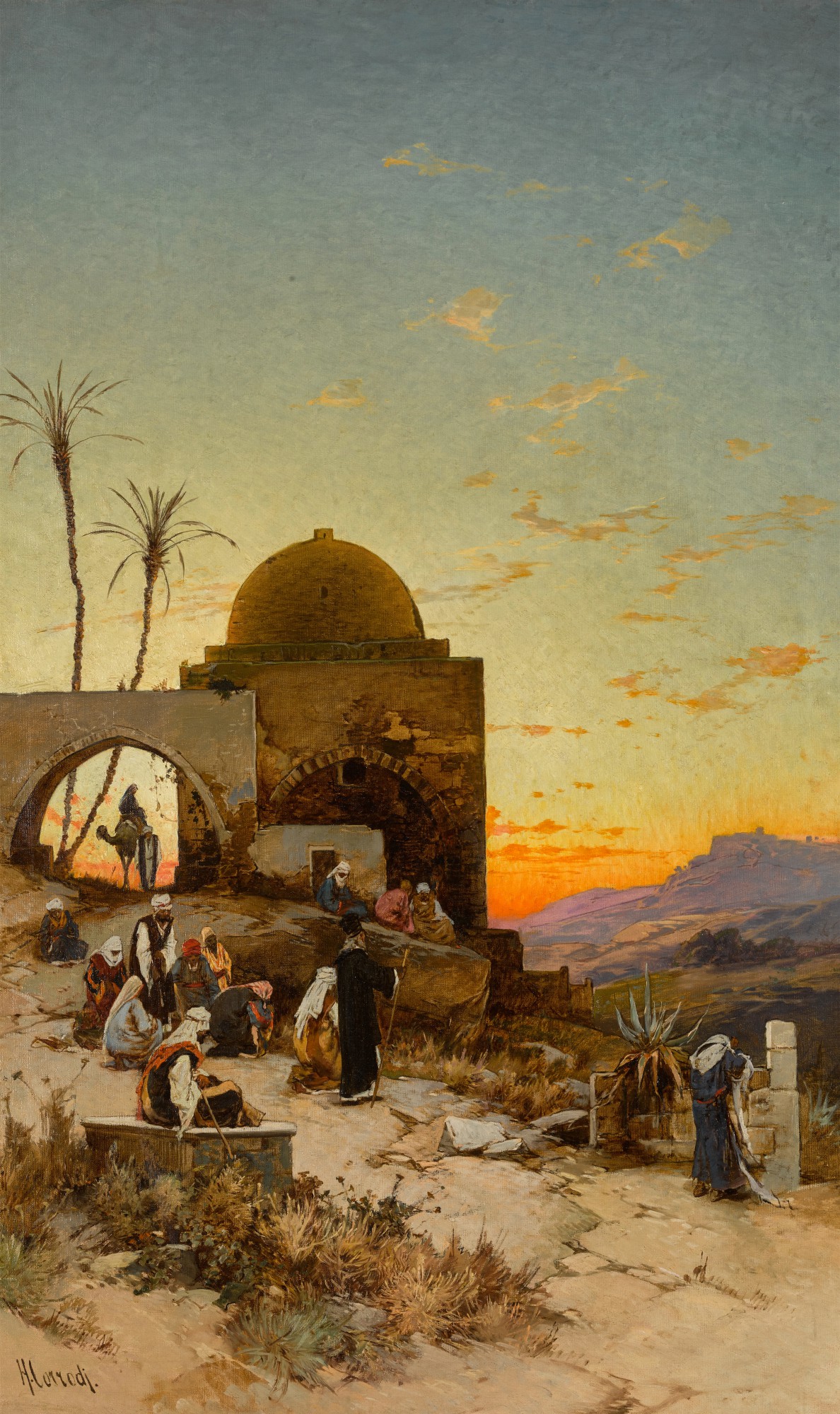
Hermann Corrodi's Light Never Stops Glowing
Artist Spotlight · The Collection Editorial
Stand before a painting by Hermann Corrodi and you understand immediately why European royalty once competed for his canvases. The light in his work does something almost impossible: it feels both scientifically observed and spiritually transfigured, as though the artist had found a way to bottle the particular gold of a Nile sunset or the cool blue shadow falling across ancient limestone. In recent seasons, the art market has rediscovered Orientalist painting with serious critical and commercial energy, and Corrodi sits at the very heart of that reappraisal, a painter whose technical gifts and genuine feeling for his subjects place him well above the merely decorative. Hermann Corrodi was born in 1844 in Frascati, the Italian hill town near Rome that had drawn generations of northern European artists into its warm, painterly embrace.
Hermann Corrodi
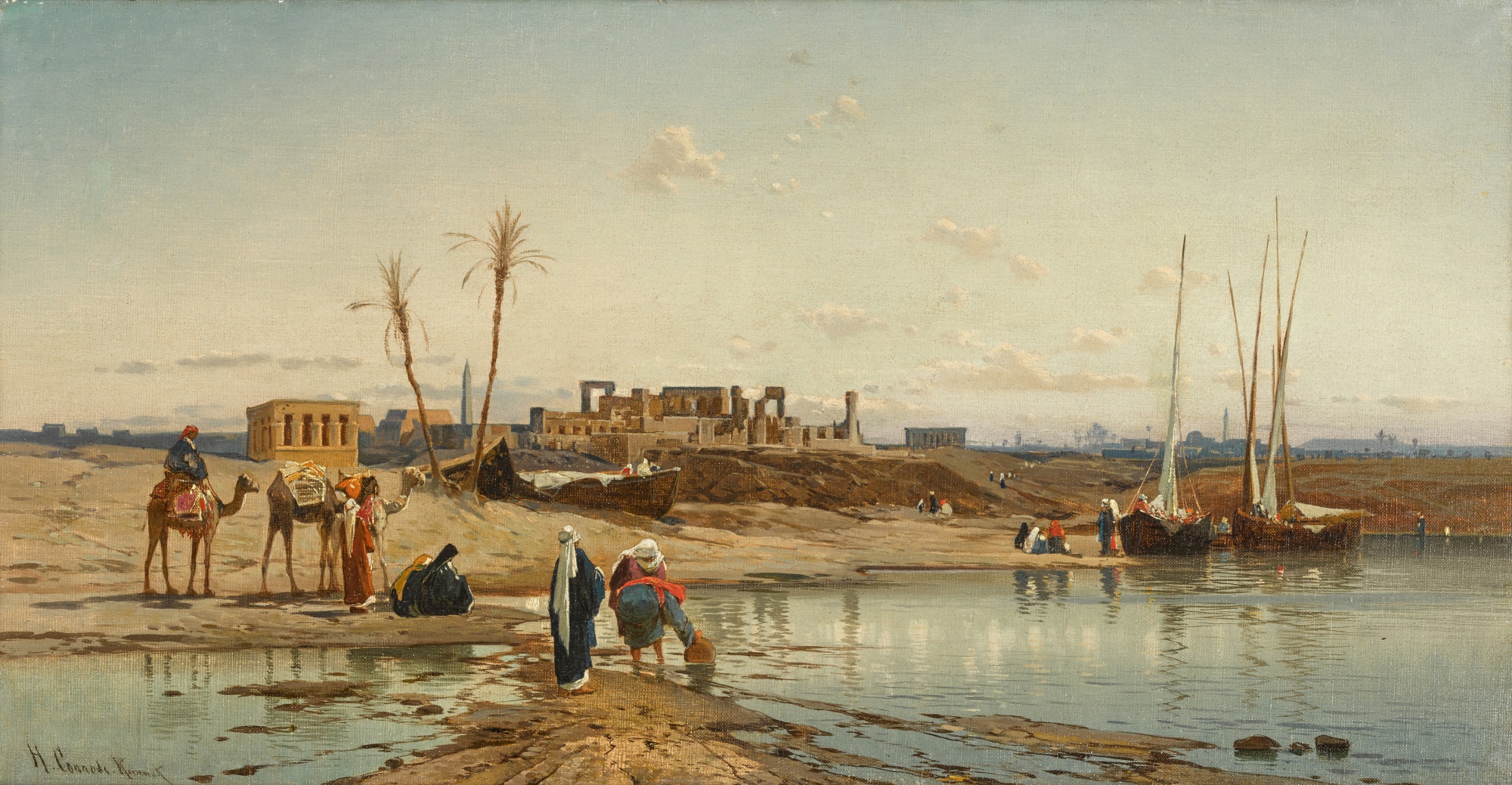
Resting before the Temple of Karnak
His father, Salomon Corrodi, was himself a respected Swiss landscape painter who had settled in Italy, and the young Hermann grew up inside a working studio culture, absorbing the discipline of careful observation and the romance of the Italian campagna from an early age. This dual inheritance, Swiss precision grafted onto Italian sensuousness, would define everything he made. He trained formally in Rome, then one of the most cosmopolitan artistic cities in the world, where the traditions of academic painting met the influence of the Barbizon school and the growing appetite among European collectors for scenes of exotic, sun drenched lands. Corrodi's decisive breakthrough came when he turned his attention eastward.
By the 1870s and into the 1880s, he had made multiple extended journeys to Egypt, Palestine, and the broader Middle East, and these trips transformed his practice entirely. Where many of his contemporaries relied on studio props and imagination to conjure the Orient, Corrodi immersed himself in the actual light, dust, and architectural grandeur of the region. He sketched obsessively on location, studying the way afternoon sun dissolved the hard edges of ancient temple columns, the way feluccas caught the wind on the Nile, the particular silence of desert encampments at dusk. This commitment to firsthand experience gave his finished canvases an authority that collectors and critics recognized immediately.
Hermann Corrodi
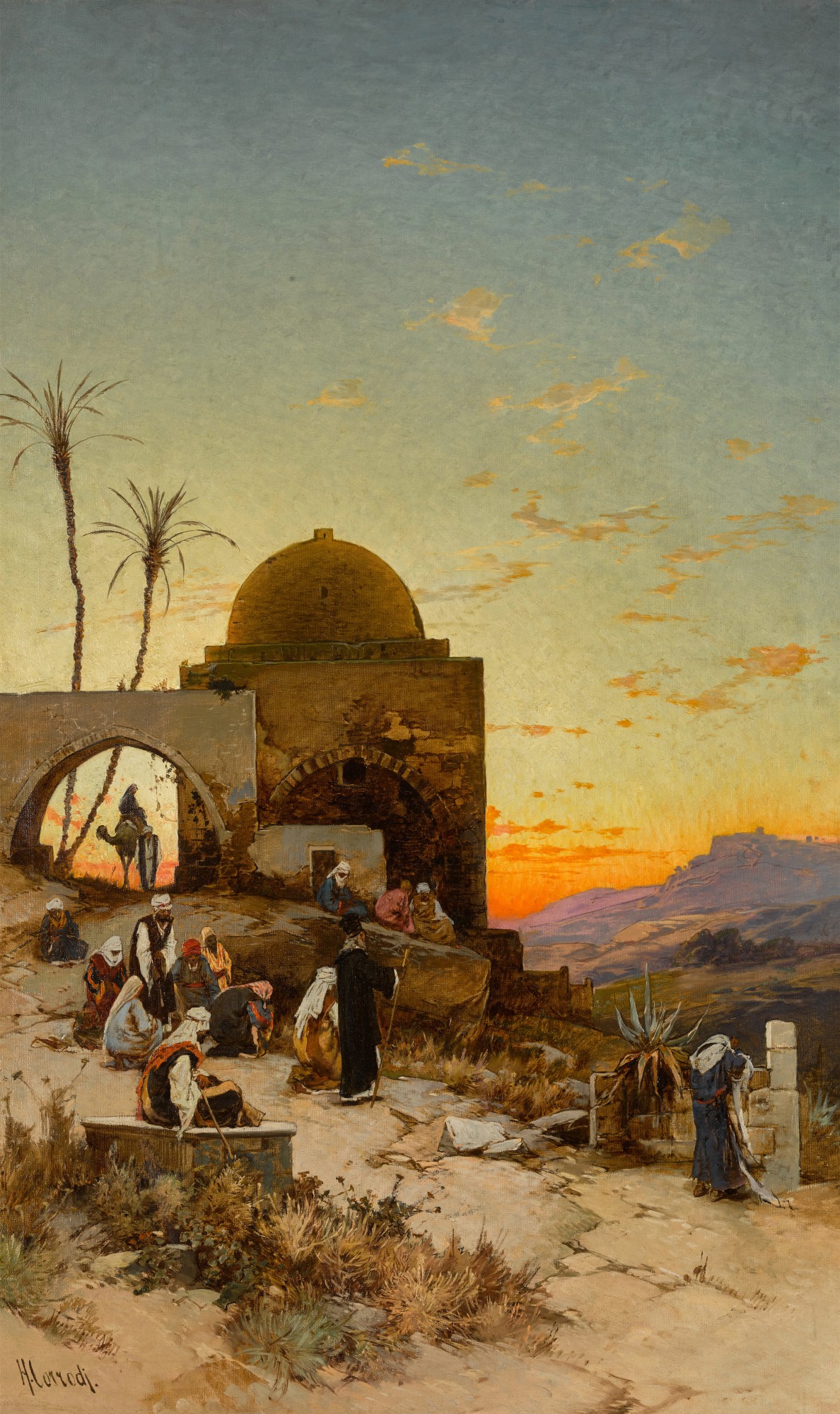
Evening Prayers Outside Jerusalem
The paintings that made his name are extraordinary achievements of atmospheric naturalism. "Resting before the Temple of Karnak" demonstrates his mastery at its most assured: the ancient columns rise with genuine monumentality while human figures rest in the foreground, dwarfed but not diminished, their presence giving scale and poetry to the scene. The light here is Corrodi at his most characteristic, warm and enveloping, describing stone texture and dust haze with equal care. "Evening Prayers Outside Jerusalem" works a different register entirely, quieter and more devotional, the fading sky lending the scene a gravity that transcends mere topography.
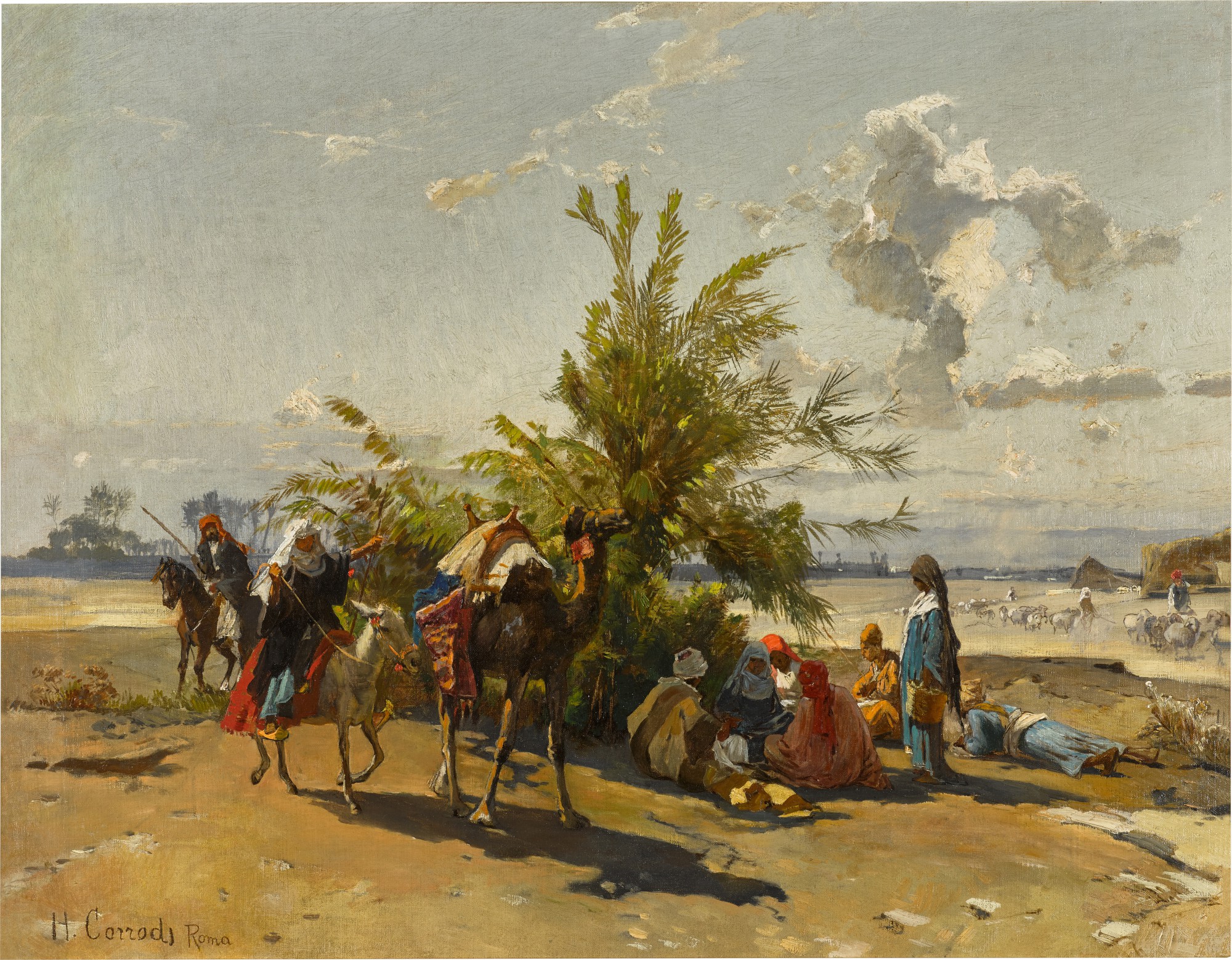
"Feluccas on the Nile" and "Sunset over the Nile" show his command of water and reflected light, a subject he returned to repeatedly because it allowed him to explore the full chromatic range of the Egyptian palette. "Encampment" brings his gift for human narrative into focus, figures settled into their environment with an ease that speaks to his long familiarity with the region and its people. The patronage Corrodi attracted tells its own story. European royalty, including members of ruling houses who traveled to Egypt and the Levant during the great age of grand tourism, sought out his work as both souvenir and serious art.
Hermann Corrodi
Encampment
His paintings were not merely decorative acquisitions but statements of cultural engagement, proof that the collector had access to the finest contemporary interpretation of the most fashionable subjects of the age. That royal and aristocratic endorsement shaped his reputation for the remainder of his life, and it speaks directly to the quality that serious collectors value today: Corrodi painted for people who knew the difference. Within the broader history of Orientalist painting, Corrodi occupies a distinctive position. He belongs to the generation that followed the pioneering expeditions of artists like David Roberts and preceded the more theatrical productions of later academic painters.
His sensibility has something in common with the luminous stillness of Jean Léon Gérôme, whose command of Near Eastern light he shares, and with the architectural precision of Ludwig Deutsch, though Corrodi's palette tends toward the warmer and more atmospheric. His Italian formation also connects him to the Vedutisti tradition, the great painters of Roman and Venetian scenes, so that his Egyptian and Palestinian subjects carry a classical composure that sets them apart from the more sensational end of the Orientalist market. For collectors approaching Corrodi today, a few qualities are worth keeping in mind. His finest works balance architectural grandeur with intimate human incident, the best canvases holding both in productive tension.
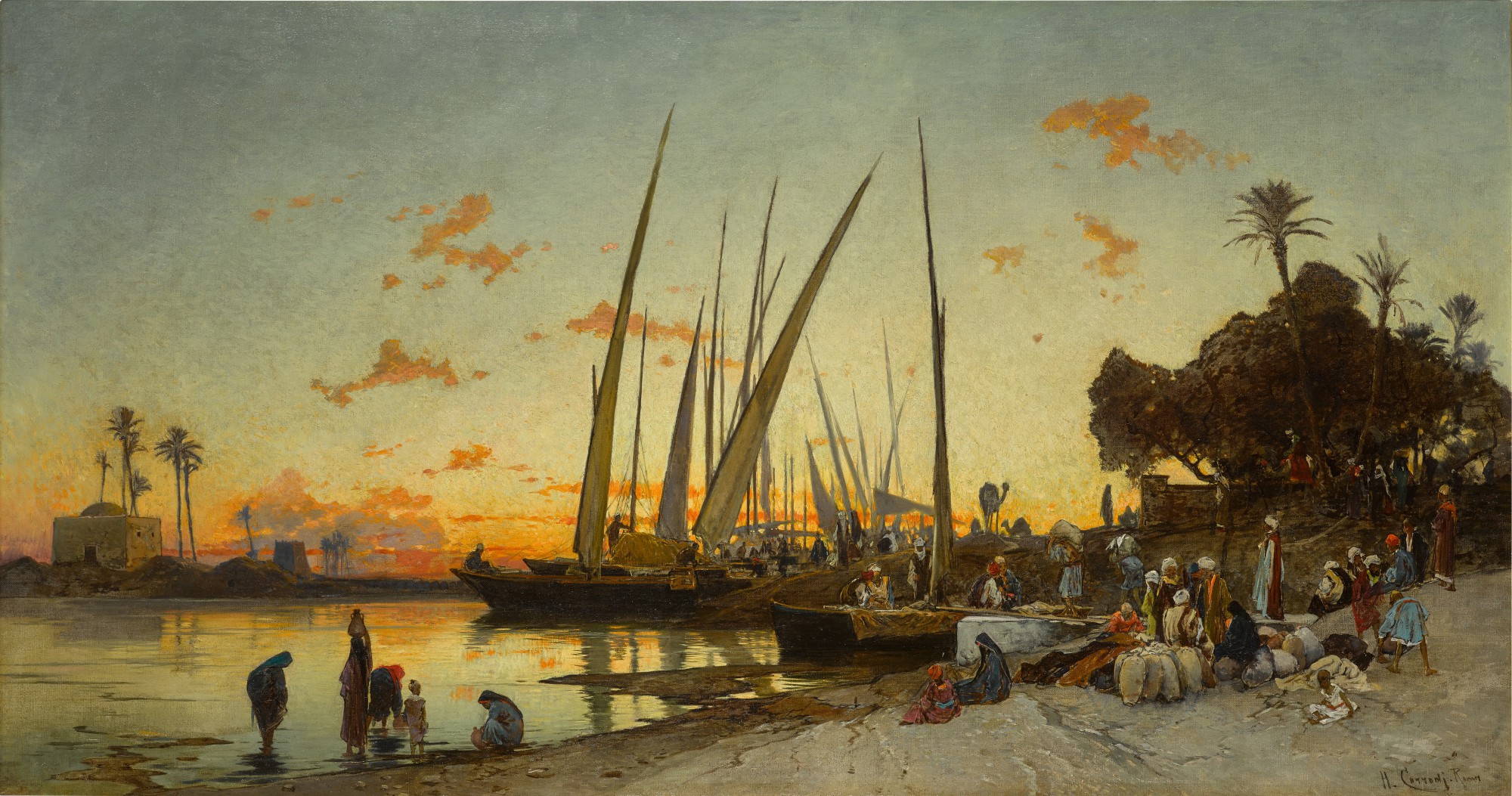
Hermann Corrodi
Feluccas on the Nile
The quality of his light is the surest indicator of his hand at its most engaged: when the luminosity feels genuinely ambient rather than applied, when shadows read as colored rather than merely dark, you are looking at Corrodi performing at the level that earned him his reputation. Oil on canvas is his primary medium for major statements, and scale matters, the larger compositions allowing him to develop the full spatial poetry of his Egyptian and Palestinian scenes. Provenance connecting works to his period of greatest activity, roughly the 1870s through the 1890s, is a strong indicator of quality. Corrodi died in Rome in 1905, at the height of a career that had spanned four decades of extraordinary productivity.
He left behind a body of work that did something genuinely difficult: it made distant places feel emotionally accessible without diminishing their strangeness, it found the human scale within monumental landscapes, and it captured qualities of light that remain vivid more than a century after he mixed his pigments. As contemporary collectors and institutions rethink the Orientalist tradition with more nuanced critical frameworks, recognizing both its cultural complexities and its remarkable artistic achievements, Corrodi emerges as one of the movement's most honest and gifted practitioners. His canvases earned their place on the walls of palaces. They earn their place on any serious collection today.
Explore books about Hermann Corrodi
Hermann Corrodi: Ein Schweizer Maler des 19. Jahrhunderts
Oskar Bätschmann
Hermann Corrodi 1844-1905: Catalogue Raisonné
Peter Märker
Corrodi und die italienische Landschaft
Christian Klemm