Henri Cartier-Bresson
The Man Who Captured Time Standing Still
Artist Spotlight · The Collection Editorial
“Your eye must see a composition or an expression that life itself offers you, and you must know with intuition when to click the camera.”
Henri Cartier-Bresson
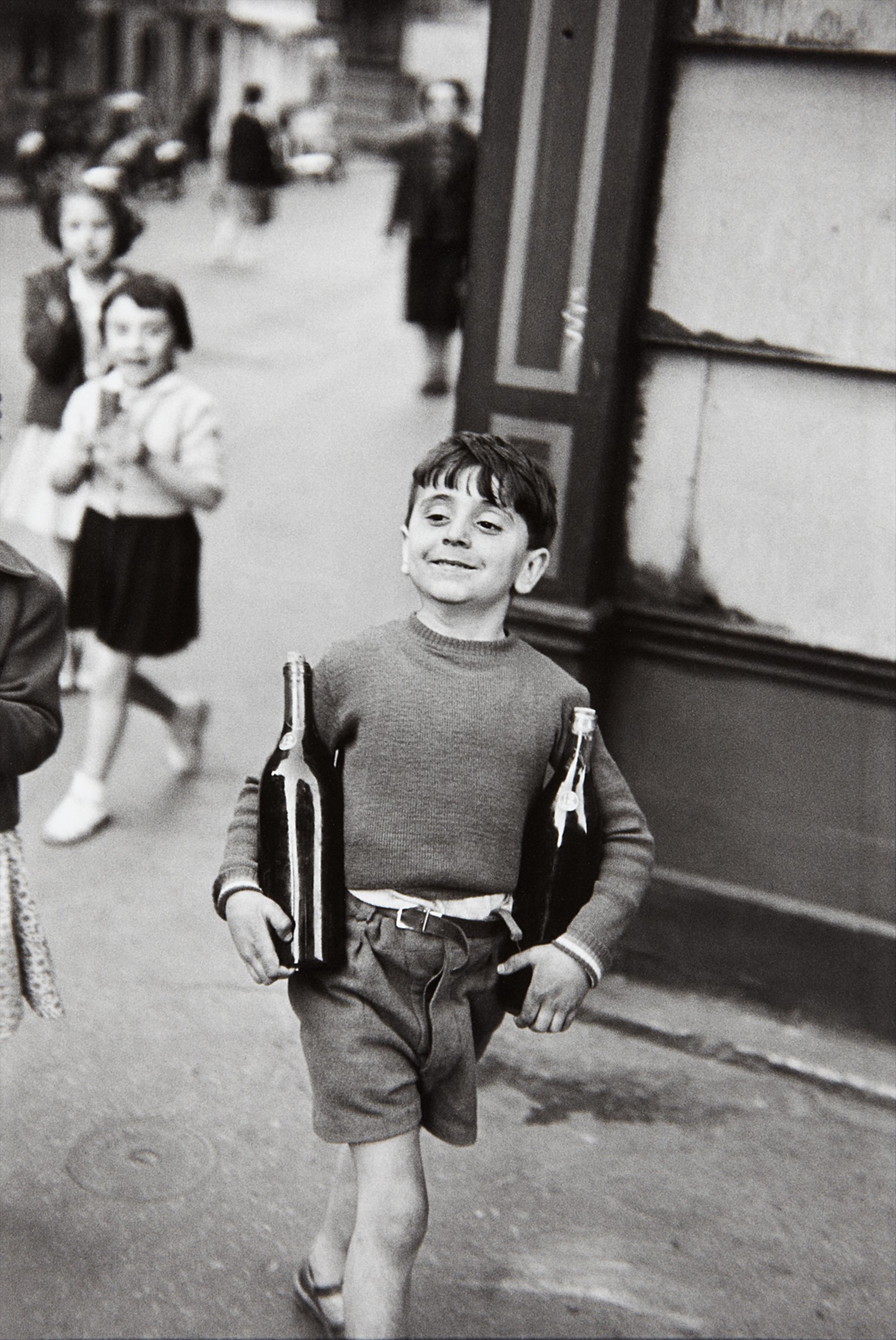
There is a photograph of a boy walking down a Paris street, a wine bottle tucked under each arm, his face creased into a smile of absolute self possession. He is perhaps seven years old. He is going somewhere. He has no idea he is being watched, and that is precisely the point.
Henri Cartier-Bresson
Rue Mouffetard
Henri Cartier Bresson made this image sometime in the 1950s on the Rue Mouffetard, one of the oldest market streets in Paris, and it has since become one of the most reproduced photographs in the history of the medium. It is not famous because it is dramatic. It is famous because it is true. Cartier Bresson was born in 1908 in Chanteloup en Brie, a small town east of Paris, into a prosperous bourgeois family whose textile business gave him both financial comfort and a lifelong restlessness against convention.
As a young man he studied painting under the Cubist André Lhote, an education that instilled in him a rigorous attention to geometry, composition, and the organization of a visual field. He encountered Surrealism in the late 1920s and early 1930s and absorbed its conviction that the irrational and the poetic were lurking just beneath the surface of ordinary life, waiting to be released by the right kind of attention. These twin inheritances, the painter's eye and the Surrealist's faith in the unrehearsed moment, would define everything he ever made. He purchased his first Leica camera around 1932, and the small, quiet instrument became an extension of his body.
Henri Cartier-Bresson
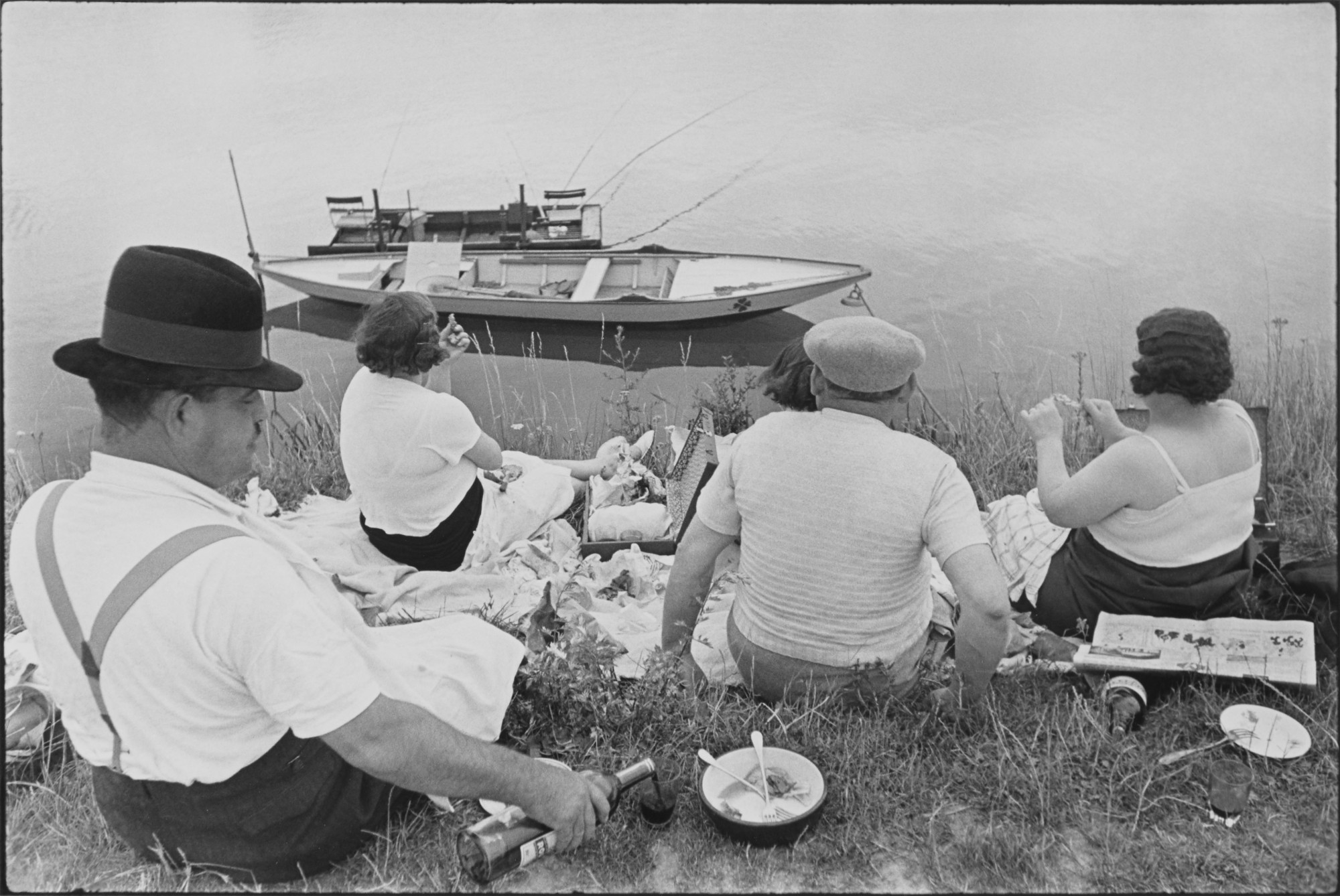
Sunday on the Banks of the Seine, Near Juvisy-sur-Orge, France
The Leica allowed him to move through the world without announcing himself, to photograph from the hip or from a low angle, to be present without dominating. He traveled to Mexico, Spain, the United States, and across Europe in those early years, and by the time he was thirty his photographs were already the subject of serious critical attention. A 1947 exhibition at the Museum of Modern Art in New York, mounted partly under the assumption that he had died during the Second World War, introduced his work to an American audience and helped cement his reputation as something altogether new in photography. That same year, Cartier Bresson co founded the Magnum Photos agency alongside Robert Capa, David Seymour, and George Rodger, a cooperative that gave photographers ownership of their negatives and control over how their images were used.
“To me, photography is the simultaneous recognition, in a fraction of a second, of the significance of an event.”
The Decisive Moment, 1952
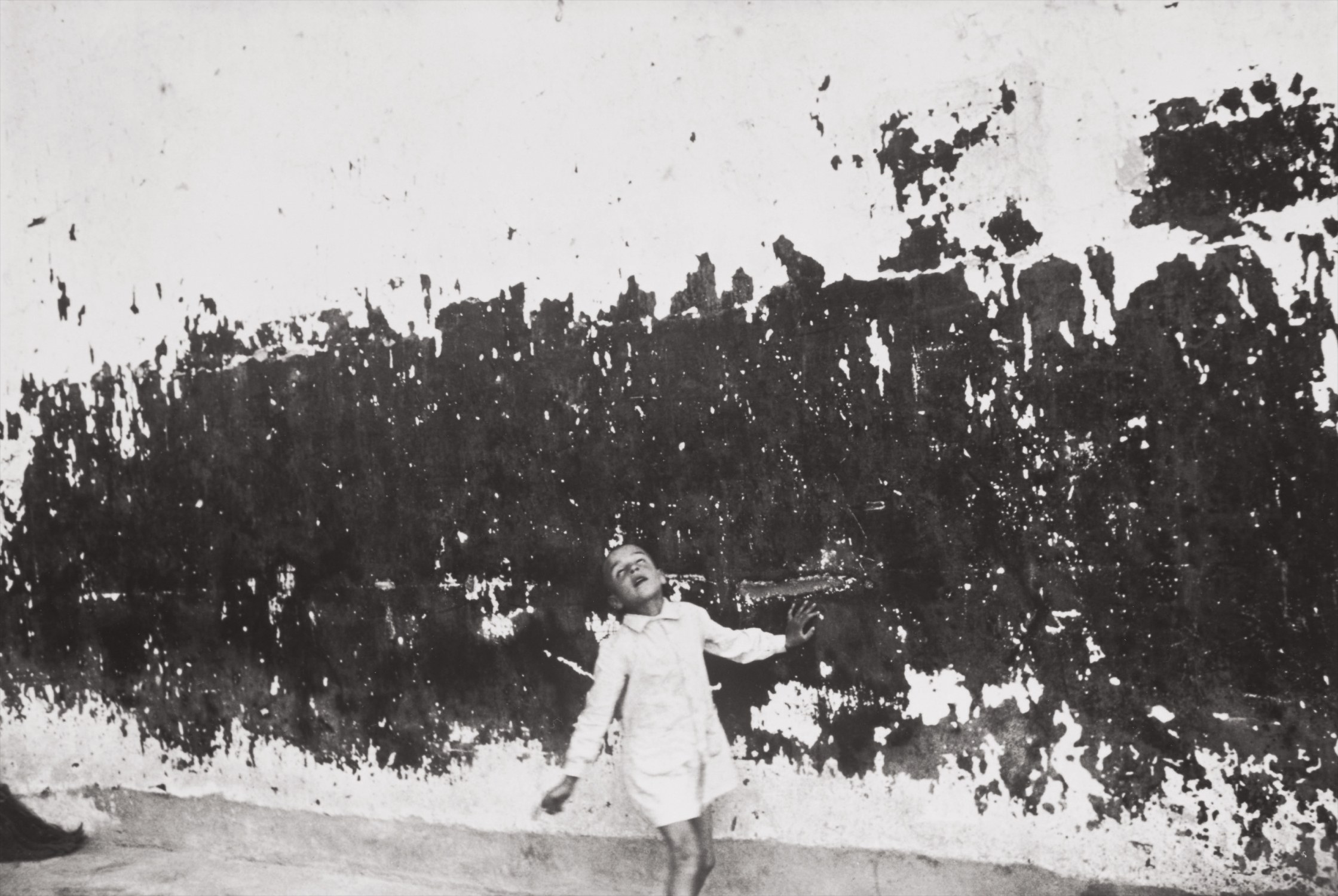
The founding of Magnum was not merely a business arrangement; it was a philosophical statement about the dignity of photographic authorship at a time when images were routinely cropped, captioned inaccurately, and stripped of context by magazine editors. The agency transformed the economics and ethics of photojournalism and remains active today. Looking closely at the four works reproduced here, one is immediately struck by the consistency of Cartier Bresson's formal intelligence across wildly different subjects. In the Rue Mouffetard image, the boy's diagonal movement creates a kinetic energy that the surrounding architecture gently contains.
Henri Cartier-Bresson
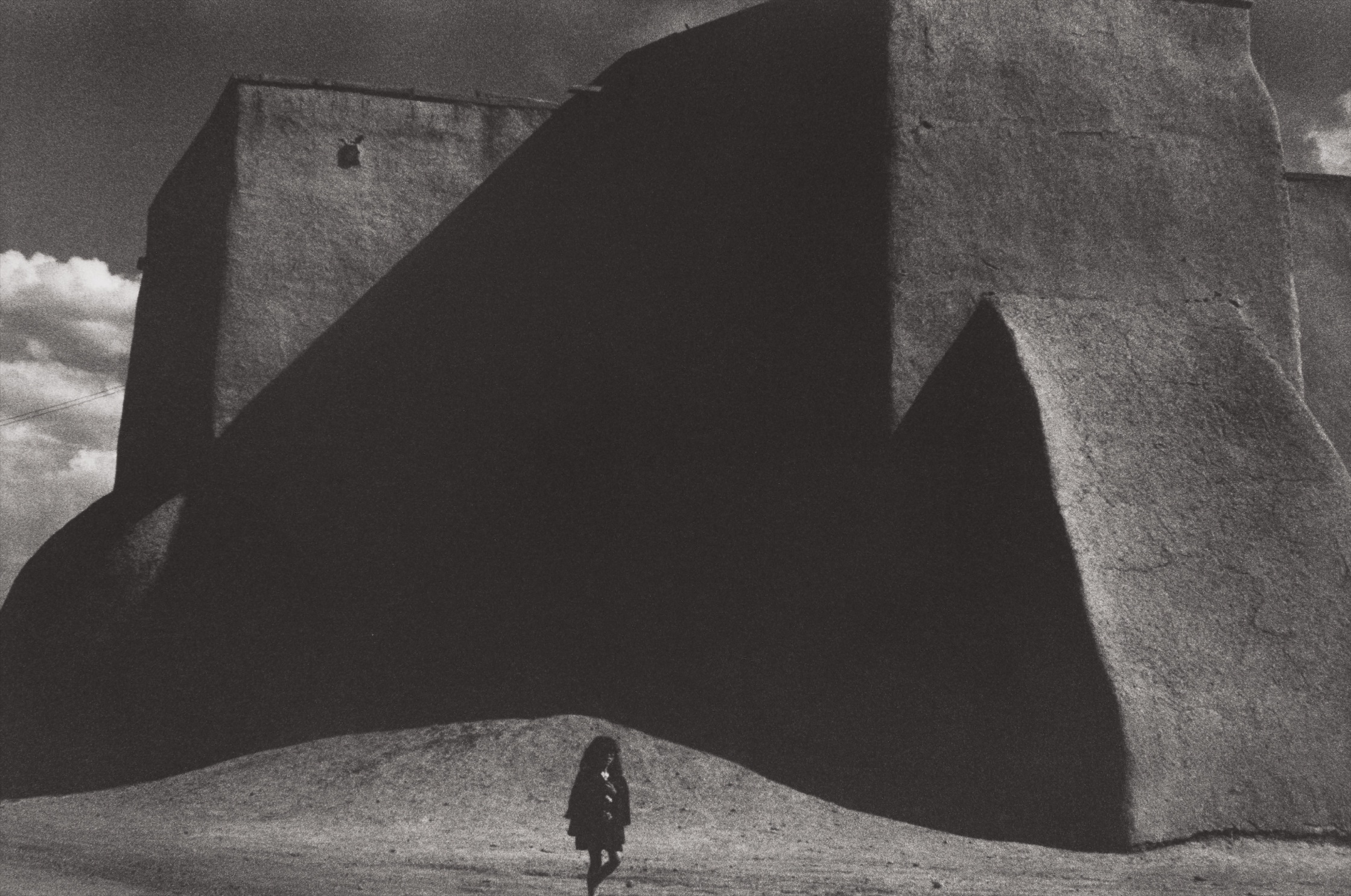
Taos, New Mexico
The photograph taken from the top of a staircase, looking down onto a cyclist crossing a cobblestone courtyard, is a near abstract study in spiraling form: the iron railing curves in one direction, the bicycle passes in another, and the whole composition resolves itself with the completeness of a musical phrase. These are not accidental arrangements. They are the product of an artist who understood that photography was as much about what happens in the corners of a frame as at its center. The portrait of Albert Camus is equally revelatory.
“Thinking should be done beforehand and afterwards, never while actually taking a photograph.”
Henri Cartier-Bresson
Camus stands in three quarter view, a cigarette at his lip, his coat collar turned up against the Paris cold, his expression carrying the particular gravity of someone who has thought carefully about suffering and chosen, nonetheless, to remain present in the world. Cartier Bresson made this image without theatrical lighting, without a studio backdrop, without any apparatus of formal portraiture. He simply stood near a man he admired and waited. The result is one of the great literary portraits of the twentieth century.
Henri Cartier-Bresson
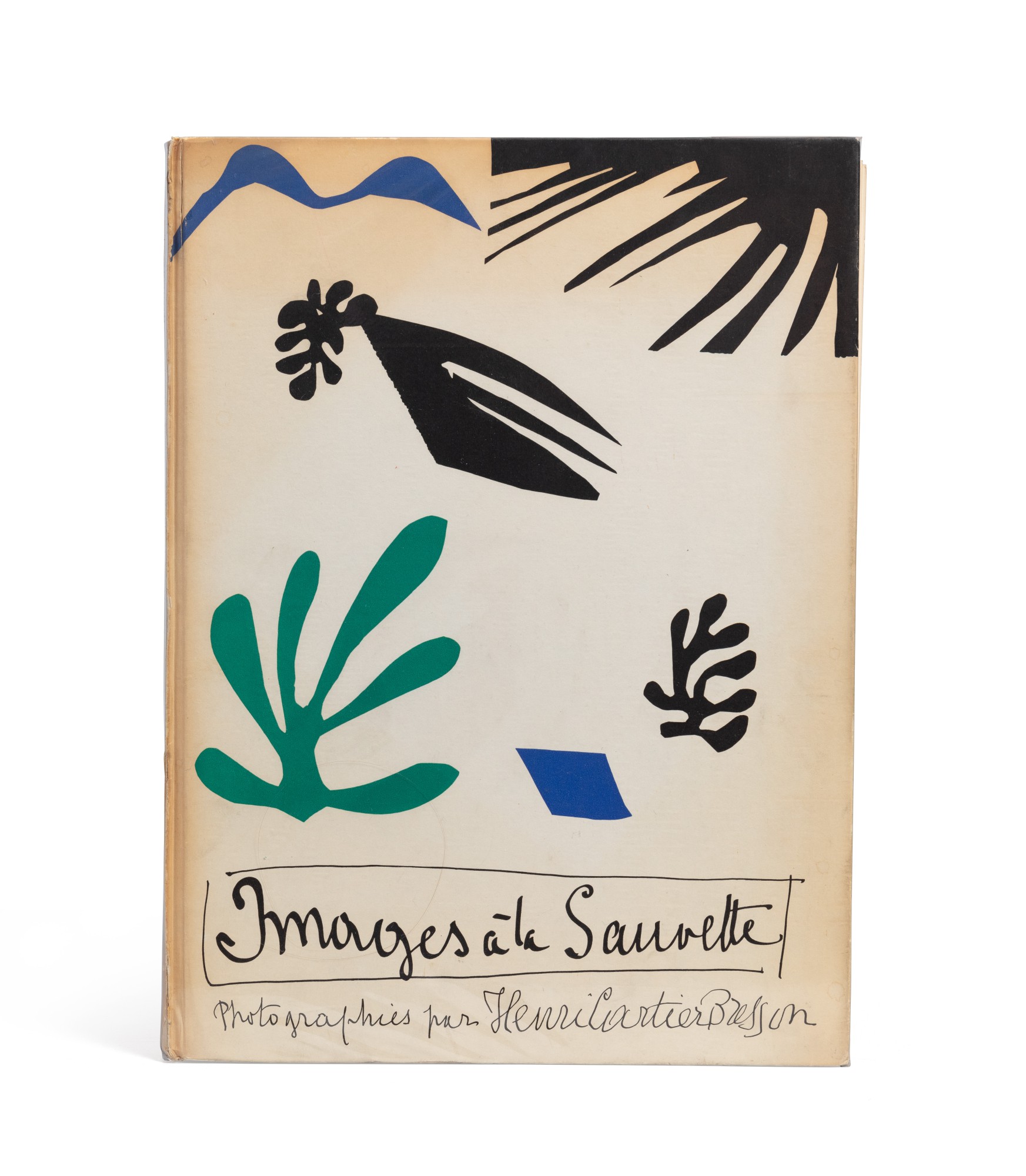
(book) Images à la Sauvette, 1952
And then there is the academician in ceremonial dress, his bicorne hat and sweeping black cape incongruous against the modern street, younger men in overcoats watching him with an expression that is somewhere between amusement and awe. The image is quietly comic, humanly generous, and compositionally immaculate. All four works share the same material qualities that define Cartier Bresson's output: gelatin silver prints, rendered in a tonal range that moves from deep, velvety shadows to luminous highlights, with a middle gray that gives the images their characteristic warmth. There is no color to distract from form.
There is no manipulation of the negative, no cropping after the fact, no darkroom theatrics. What you see is what he saw, organized at the moment of exposure with a speed and precision that remains astonishing. For collectors, Cartier Bresson's market occupies a position of rare stability. His prints have been held by major institutions including the Museum of Modern Art in New York, the Bibliothèque nationale de France, and the Henri Cartier Bresson Foundation in Paris, which was established in 2003 and continues to manage his legacy with care.
Vintage prints, made close to the time of exposure, command the highest prices at auction, though later authorized prints retain significant value and remain far more accessible. Works from the Paris street photography series, including Rue Mouffetard and related images, are among the most sought after, as are his portraits of twentieth century cultural figures. Collectors drawn to documentary photography, to the humanist tradition in European art, and to the intersection of painting and photography will find in Cartier Bresson a figure who speaks to all of those interests simultaneously. His closest contemporaries and spiritual neighbors include Robert Doisneau, whose affectionate images of Parisian street life share Cartier Bresson's warmth if not his formal severity; Brassaï, whose nocturnal Paris established another register of the city's mystery; and Dorothea Lange, whose American documentary work shares the ethical commitment to finding dignity in the unposed moment.
Later photographers including Garry Winogrand, Lee Friedlander, and Joel Meyerowitz acknowledged his influence directly. The street photography tradition he helped define remains one of the most vital in contemporary practice. Cartier Bresson stopped photographing professionally in the 1970s and returned to drawing and painting, a choice that surprised many but was entirely consistent with who he had always been: a visual artist who happened to use a camera. He died in 2004 at the age of ninety five.
What he left behind is a body of work that asks nothing of the viewer except attention, and rewards that attention with the recognition that the world, properly seen, is endlessly strange and endlessly beautiful. To own a Cartier Bresson print is to own a small, precise argument that looking carefully at the world is among the most important things a person can do.
Featured Works
Explore books about Henri Cartier-Bresson
The Decisive Moment
Henri Cartier-Bresson
Henri Cartier-Bresson: A Biography
Pierre Assouline
The Mind's Eye: Writings on Photography and Photographers
Henri Cartier-Bresson
Henri Cartier-Bresson: The Modern Century
Peter Galassi
Cartier-Bresson: The Uncertain Masterpiece
Clément Chéroux
Henri Cartier-Bresson: Europeans
Henri Cartier-Bresson
Cartier-Bresson: The Eye of the Century
Jean Clair
Henri Cartier-Bresson: A Free Spirit
Martine Franck and Agnès Sire