Harland Miller
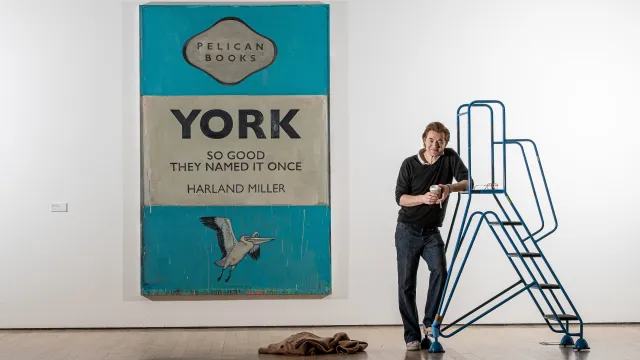
Harland Miller, Where Words Become Pure Poetry
Artist Spotlight · The Collection Editorial
“I wanted to make work that was immediately accessible but had a kind of emotional depth that revealed itself over time.”
Harland Miller, White Cube interview
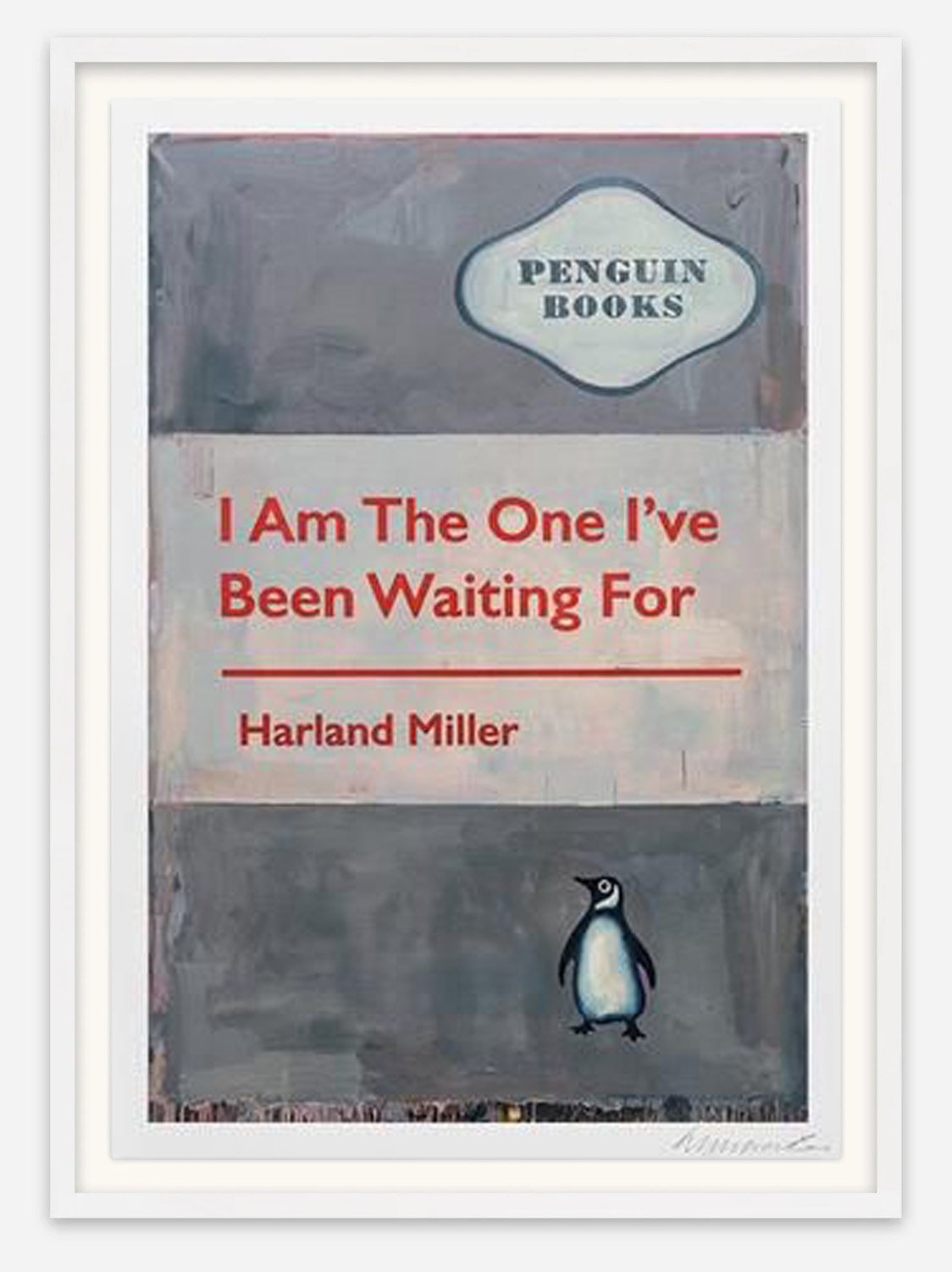
There is a moment, standing before a Harland Miller canvas, when something unexpected happens. The familiarity of the form pulls you in, that unmistakable Penguin paperback silhouette, the banded colour fields, the serif lettering, and then the title lands like a perfectly timed punchline at the end of a long, earnest joke. In 2025, Miller released a luminous new silkscreen, 'I Am The One I've Been Waiting For,' a work that captures everything that has made him one of the most beloved and genuinely original voices in British contemporary art. Rendered across 24 colours on Somerset Tub Sized Radiant White paper, the piece is both declaration and deflection, absurdist and tender in equal measure.
Harland Miller
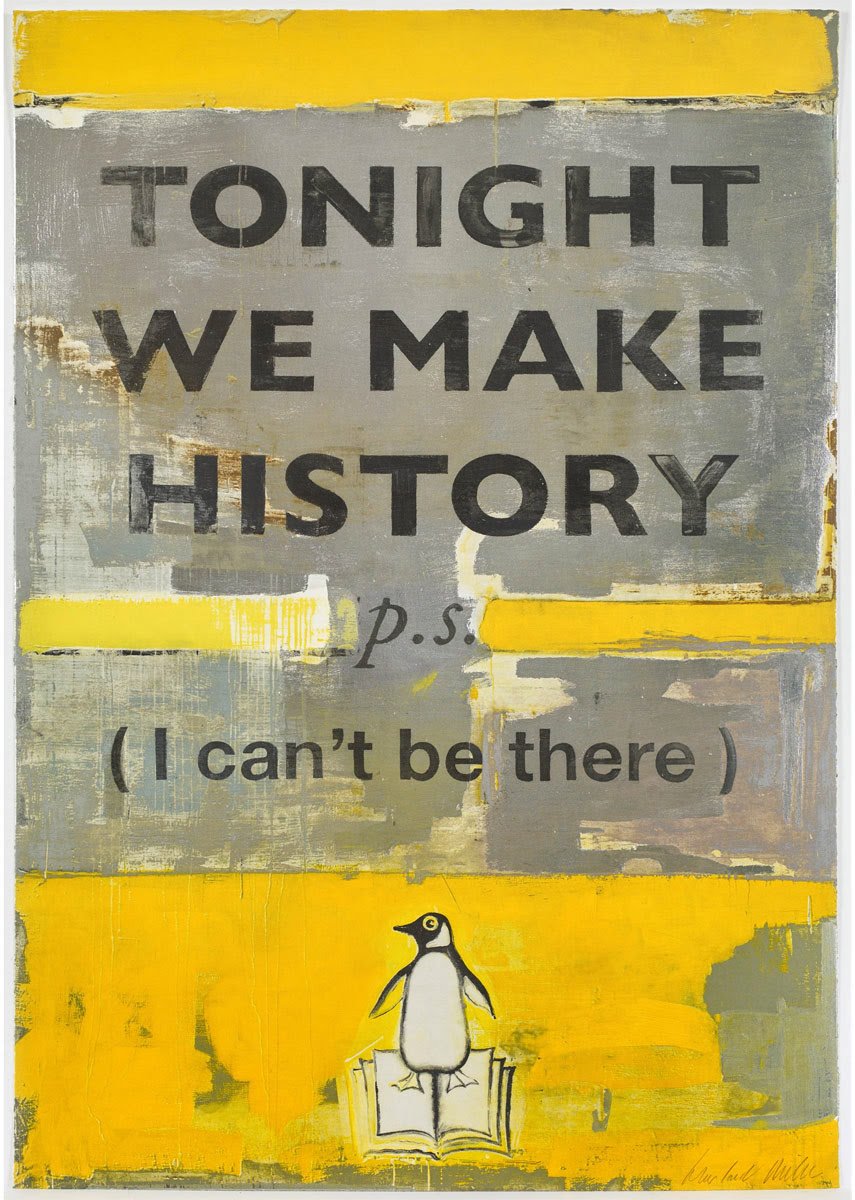
Tonight We Make History, P.s. I Can't Be There (Small), 2018
It is proof, if any were still needed, that Miller's project is not just holding up but deepening with time. Harland Miller was born in Yorkshire in 1964, and the north of England has never really left him. There is something in the flat wit, the refusal of pretension, and the genuine warmth beneath the sardonic surface that feels deeply rooted in that landscape. He went on to study at the Chelsea School of Art and later the Royal College of Art in London, two institutions that in the 1980s were crackling with debate about the relationship between image and language, commerce and culture, sincerity and irony.
Miller absorbed all of it without being consumed by it, which is perhaps his most impressive early achievement. He also pursued a serious literary life, publishing his novel 'Slow Down Arthur, Stick to Thirty' in 2000 to genuine critical notice, and that commitment to words as lived objects, not decorations, runs through everything he has made since. The breakthrough into his signature practice came through an act of what might be called loving appropriation. The Penguin paperback, particularly the editions designed between the 1950s and 1970s by Hans Schmoller and others, represents one of the great democratic design achievements of twentieth century Britain.
Harland Miller
I Am The One I've Been Waiting For, 2025
Those covers promised transformation at a modest price point. They sat in pockets and on bedside tables. Miller took that form and turned it into a vehicle for his own private lexicon of loss, hope, bravado, and absurdity. The shift was both conceptually rigorous and immediately, viscerally communicative.
“The titles come from a place that is half joking and half completely serious. Which is probably how I live my life.”
Harland Miller, The Guardian
You did not need an art history degree to feel the collision between the trustworthy container and the destabilising content. That accessibility, never dumbed down but always open, became his calling card. His practice expanded across painting, printmaking, and works on paper, each medium handled with genuine craft. Works like 'Whitby: The Self Catering Years' from 2002, rendered in watercolour, gouache, and graphite, show a more intimate, autobiographical register, the Yorkshire coast refracted through nostalgia and gentle self mockery.
Harland Miller
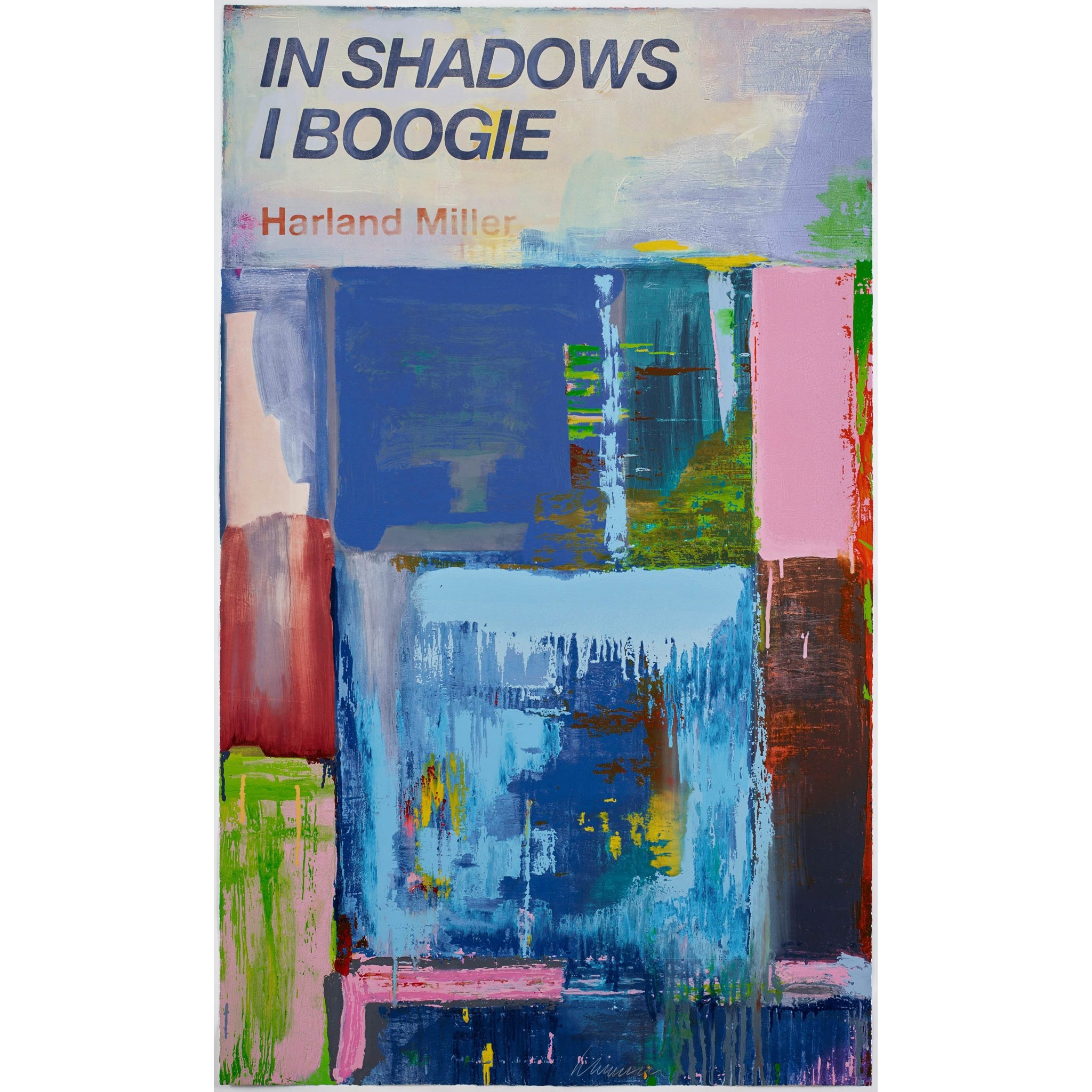
In Shadows I Boogie, 2019
His printmaking, which has become increasingly central to his output, includes etchings, woodcuts, and silkscreens of remarkable technical ambition. 'Tonight We Make History' pairs grandiose proclamation with the modest, democratic form of the print edition, which is precisely the tension Miller has always found most generative. Works such as 'In Shadows I Boogie,' 'Hell... It's Only Forever,' and 'Blonde But Not Forgotten' each carry that same double charge: phrases that could belong to a self help book, a country song, a eulogy, or a toast at a very good party.
Within the broader landscape of British contemporary art, Miller occupies a position that is both singular and in rich conversation with his peers. His use of text as image invites comparison with Ed Ruscha, whose deadpan American vernacular preceded Miller's own explorations, and with the conceptual rigour of artists such as Lawrence Weiner and Jenny Holzer, who similarly understood that language in visual space carries a different charge than language on a page. Closer to home, there are resonances with the Pop sensibility of Richard Hamilton and Peter Blake, both of whom mined popular culture for its emotional and formal possibilities. Yet Miller's work is not derivative of any of these.
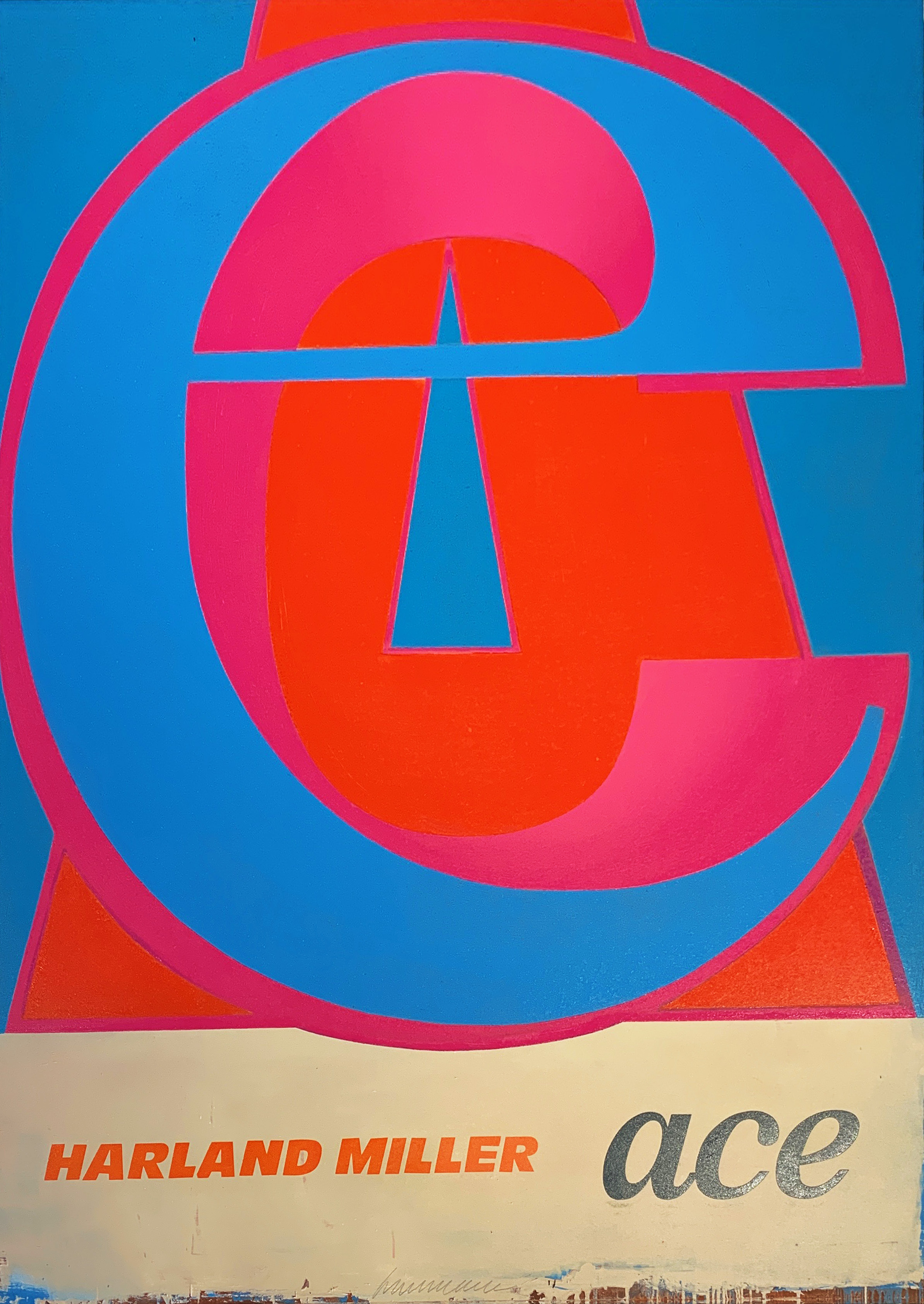
Harland Miller
Ace, 2019
His particular combination of literary intelligence, formal restraint, and emotional generosity is his own. From a collecting perspective, Miller's market has shown consistent strength and growing institutional recognition. His relationship with White Cube gallery has brought sustained visibility and serious critical attention. His prints have proven especially compelling for collectors approaching his work for the first time, offering genuine access to his practice at multiple price points, while his unique paintings and works on paper represent some of the most sought after examples of British contemporary art in circulation.
The diptych 'Fuck Art Let's Dance and Fuck Dancing Let's Fuck' from 2011 is emblematic of the energy that early collectors responded to with such enthusiasm, a work that is simultaneously confrontational and completely disarming. For those building collections with long term vision, Miller's works on paper offer particular depth, as they reveal the full range of his technical and conceptual investigation in ways that reward sustained attention. What Miller has achieved over three decades is something rarer than it might initially appear. He has made an art that is funny without being frivolous, literary without being obscure, and emotionally direct without being sentimental.
He has taken one of the most recognisable design languages of the twentieth century and made it entirely his own, filling it with a new mythology that feels both universal and deeply personal. In 2025, with new work still arriving with the confidence and wit of someone at the height of their powers, the conversation around Miller feels not like a retrospective assessment but an ongoing excitement. He remains an artist whose next title you genuinely cannot wait to read, and whose canvases, once seen, have a way of staying with you long after you have left the room.
Explore books about Harland Miller
Harland Miller: Works on Paper
Harland Miller, Various Contributors
Harland Miller
Hans Werner Holzwarth

Harland Miller: New Paintings
Various
Harland Miller: Recent Works
Gagosian Gallery
Harland Miller: The Book Paintings
Various Contributors