Gustave Cariot
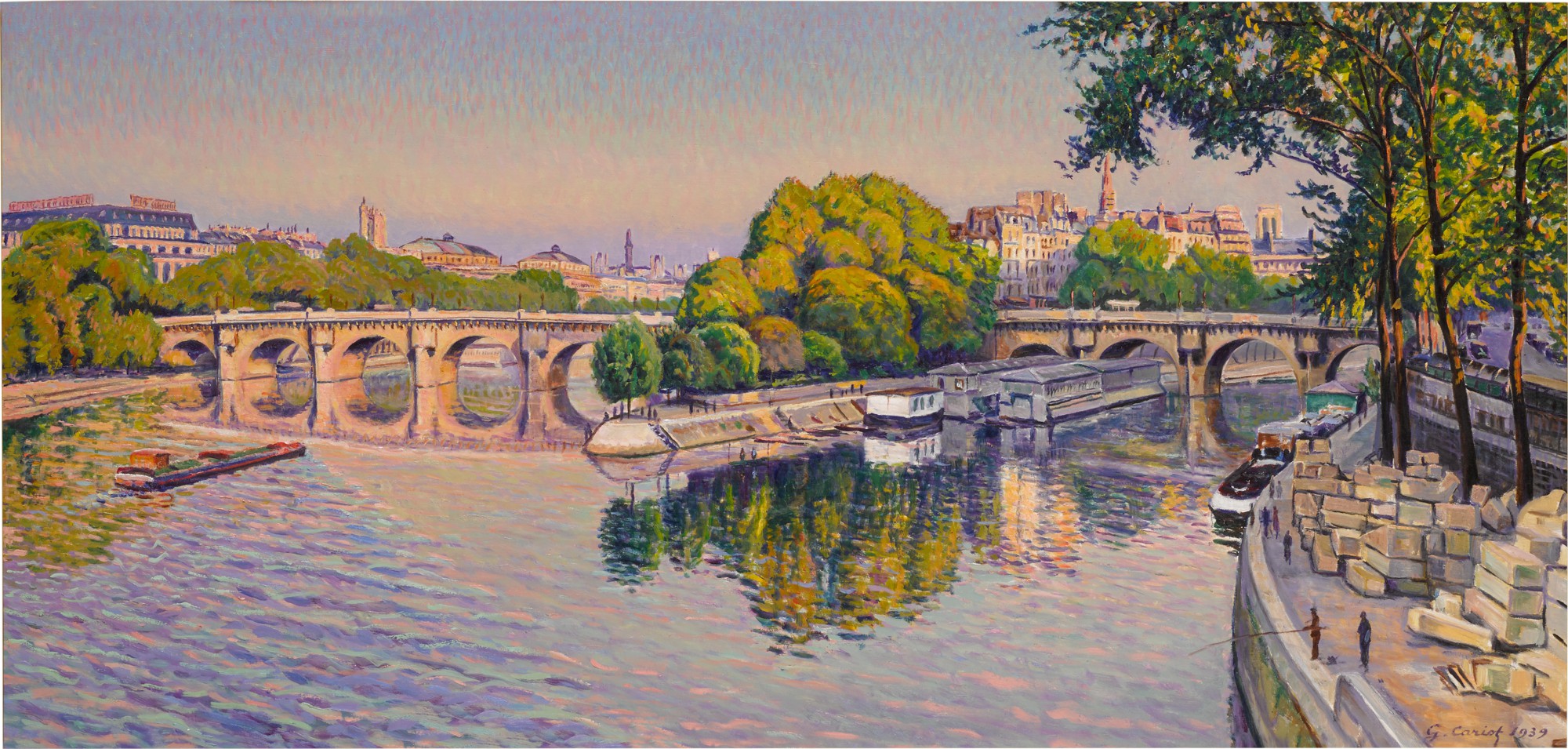
Gustave Cariot, Painter of Luminous French Life
Artist Spotlight · The Collection Editorial
There is a particular quality of light that belongs to the Seine valley in the late afternoon, when the sun softens and the river exhales a silvery haze across the banks and bridges. It is precisely this light that Gustave Cariot spent a lifetime chasing, capturing, and distilling onto canvas with a patience and sensitivity that feels, in retrospect, like a form of devotion. As interest in Post Impressionist painting continues to strengthen across European and American auction markets, Cariot's quietly radiant work has drawn renewed attention from a new generation of collectors who recognize in his canvases something rare: an unaffected sincerity about the beauty of everyday French life. Cariot was born in 1872, entering the world at a moment when French painting was in extraordinary flux.
Gustave Cariot
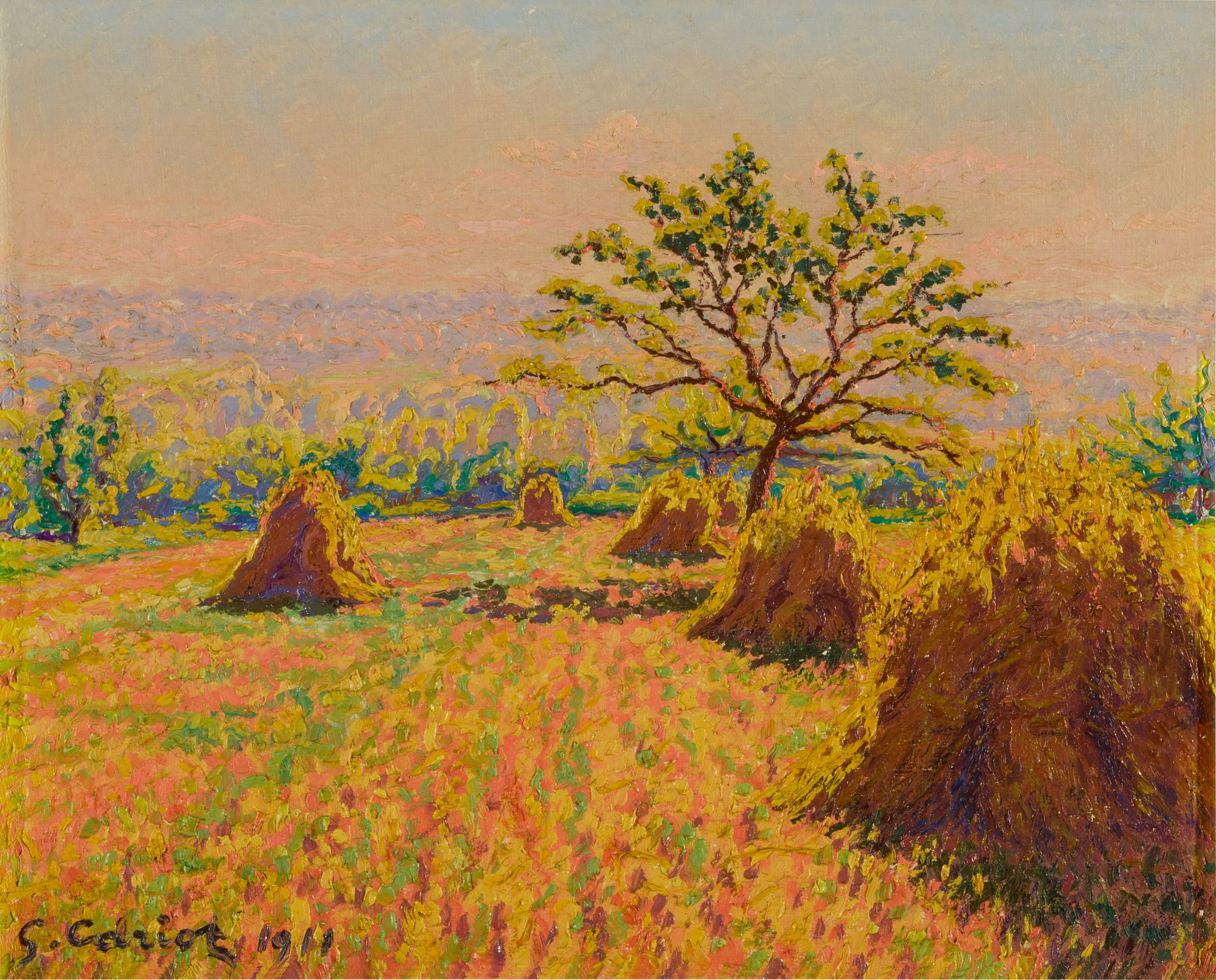
Meules, 1911
The Impressionists had already begun their great experiment with light and sensation, and the generation that followed would inherit their discoveries and push them in a dozen different directions. Cariot came of age in this atmosphere of possibility, and his formation was shaped by one of the most consequential teachers of the era. He studied under Gustave Moreau at the prestigious École des Beaux Arts in Paris, joining a studio that at various moments included Henri Matisse, Georges Rouault, and Albert Marquet among its students. Moreau was a singular mentor, one who encouraged his pupils to look deeply at the old masters while trusting their own instincts about color and feeling.
The influence of that studio would prove lasting for Cariot, even as his mature work moved far from Moreau's own Symbolist extravagance. What Cariot took from Moreau was not iconography or mythology but rather an understanding of how color could carry emotional weight. As he developed his own practice through the late 1890s and into the early twentieth century, he turned resolutely toward the world outside his window: the streets of Montmartre, the stone bridges spanning the Seine, the harvested fields of the Île de France, and the quiet suburban villages that ringed Paris along the Yerres and Marne rivers. His early work, exemplified by the 1897 oil study "Etude à Charenton," shows a painter already confident in his observation of place and atmosphere, working on cardboard with a directness that suggests both humility and conviction.
Gustave Cariot
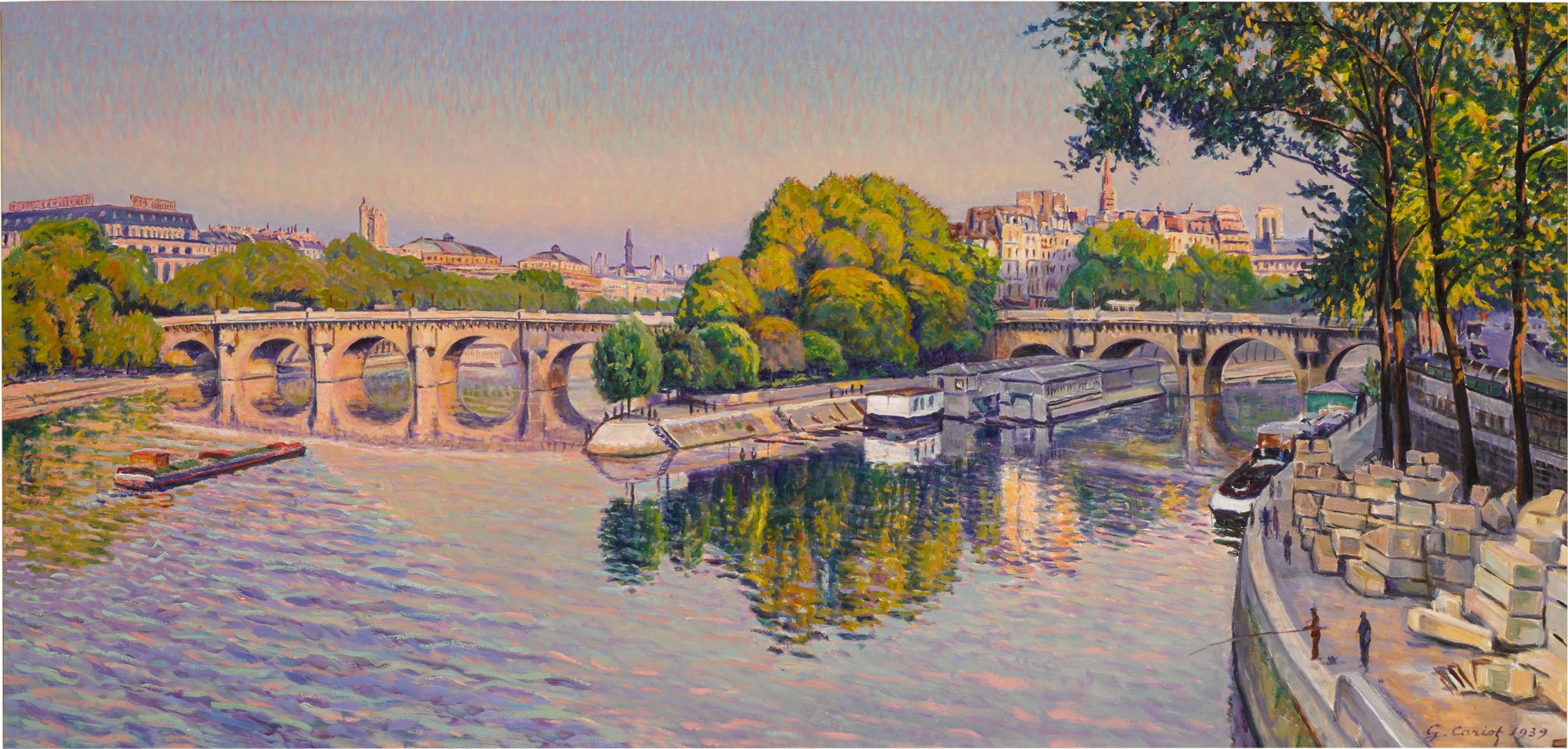
Le Pont-Neuf, eté, 20 heures, 1939
Charenton, a commune at the confluence of the Marne and the Seine, was a subject that suited his sensibility perfectly: not a grand monument or a celebrated landmark, but a lived in corner of France where water and light conspired beautifully. Through the first decades of the twentieth century, Cariot's practice deepened and his palette grew richer. Works from this period reveal a painter at full command of his gifts. "Périgny, automne, matinée sur l'Yerres," painted in 1910, and "Meules" from 1911 demonstrate his abiding interest in the rhythms of the agricultural and riverine landscape, subjects that place him in a clear line of descent from Camille Pissarro and Alfred Sisley while asserting something distinctly his own.
His handling of light is softer than Monet's and less analytical than Signac's; he is interested not in the science of perception but in its poetry. The haystacks of "Meules" and the later "Les moissons (Paysage aux meules)" of 1928 invite inevitable comparison with Monet's celebrated series, yet Cariot's approach is warmer and more intimate, less concerned with serial investigation than with the singular mood of a specific morning or afternoon. The paintings feel chosen rather than constructed. Cariot's long career encompassed some of the most turbulent decades in European history, and yet his work maintains a remarkable consistency of spirit.
Gustave Cariot
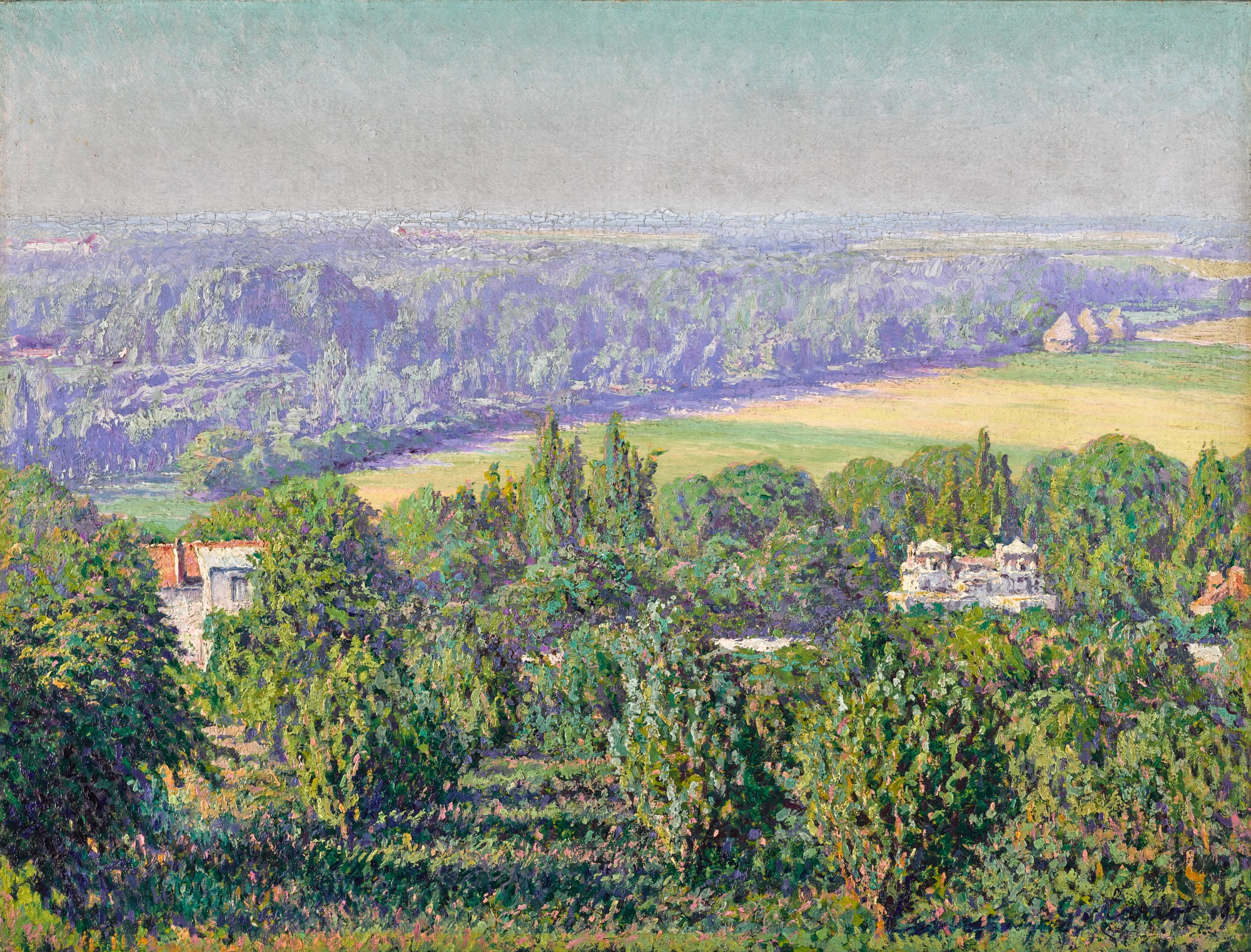
Paysage, 1905
Even the paintings made during and after the Second World War, including "Juin, temps couvert no. 28" from 1942 and "Le village de Georgenborn" from 1946, carry the same attentive calm that characterizes his earliest canvases. This is not evasion but rather a kind of artistic commitment: Cariot believed in the restorative power of observing the natural and human world with care. His 1939 canvas "Le Pont Neuf, eté, 20 heures" is among his most celebrated works, depicting Paris's oldest surviving bridge in the long golden light of a summer evening.
The specificity of the hour in the title is characteristic of Cariot's practice; he was a painter of precise, cherished moments, not generalized impressions. For collectors, Cariot's work occupies a particularly rewarding position in the market. His paintings have appeared regularly at Christie's, Sotheby's, and the Hôtel Drouot in Paris, where they attract both seasoned French collectors and international buyers drawn to the quality and accessibility of his vision. His works are not trophy acquisitions in the contemporary sense, but they reward sustained attention in ways that more fashionable names sometimes do not.
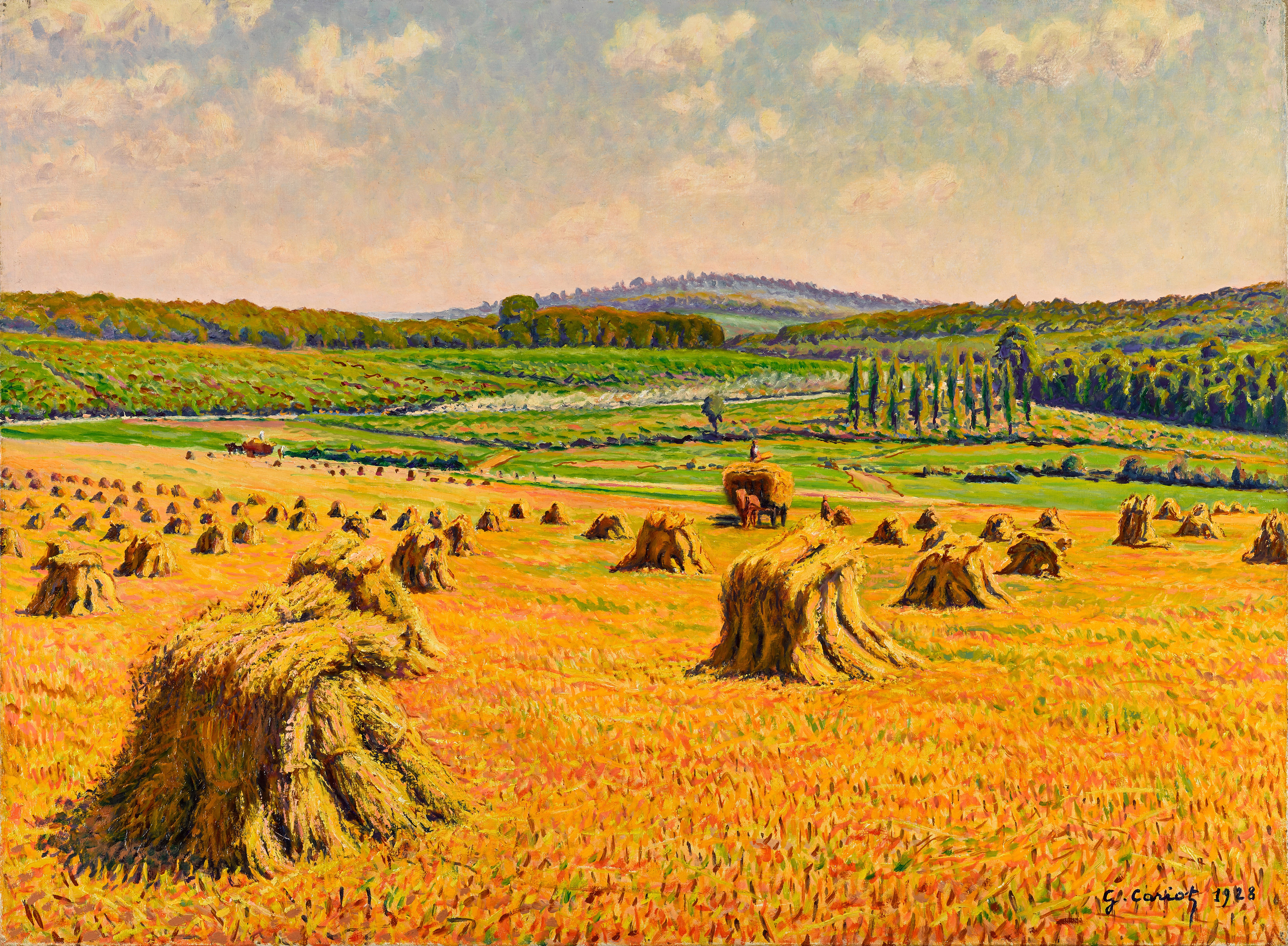
Gustave Cariot
Les moissons (Paysage aux meules), 1928
The range of his subjects means that a collection might include a luminous Parisian street scene, a tranquil river landscape, and a sun warmed harvest field, each one a complete world. Collectors who admire Pissarro's later Pointillist work, Sisley's English and French river scenes, or the quiet suburban poetry of painters like Eugène Boudin and Henri Le Sidaner will find in Cariot a natural companion. Within the broader arc of French Post Impressionism, Cariot represents something valuable and sometimes underappreciated: the tradition of the dedicated regional and periurban landscape painter, working outside the polemics of movements and manifestos, attentive to the actual texture of French life. His contemporaries in spirit, if not always in strict style, include Marquet, whose flat, luminous harbor scenes share Cariot's affection for water and urban geometry, and Maximilien Luce, who brought a similar tenderness to the working landscapes of northern France.
Cariot is not a painter of grand ambitions or radical gestures; he is a painter of conviction, patience, and genuine feeling, and these qualities have proven more durable than many noisier reputations. Gustave Cariot died in 1950, having spent nearly eight decades in attentive, grateful observation of the world around him. His legacy is the legacy of all painters who trust that the ordinary contains the extraordinary: that a haystack in summer light, a bridge at eight in the evening, or an autumn morning on a quiet river is worth recording with full seriousness and full love. For collectors who value that tradition, and who understand that a painting's depth reveals itself slowly and over time, Cariot's canvases offer a lifetime of companionship.