Gertrude Abercrombie
Gertrude Abercrombie, Queen of Chicago Surrealism
Artist Spotlight · The Collection Editorial
There is a painting by Gertrude Abercrombie that stops you cold. A bare room, a door slightly ajar, a cat poised at the threshold, a shell resting on the floor as if placed there by some invisible hand. Nothing is explained. Everything is felt.
Gertrude Abercrombie
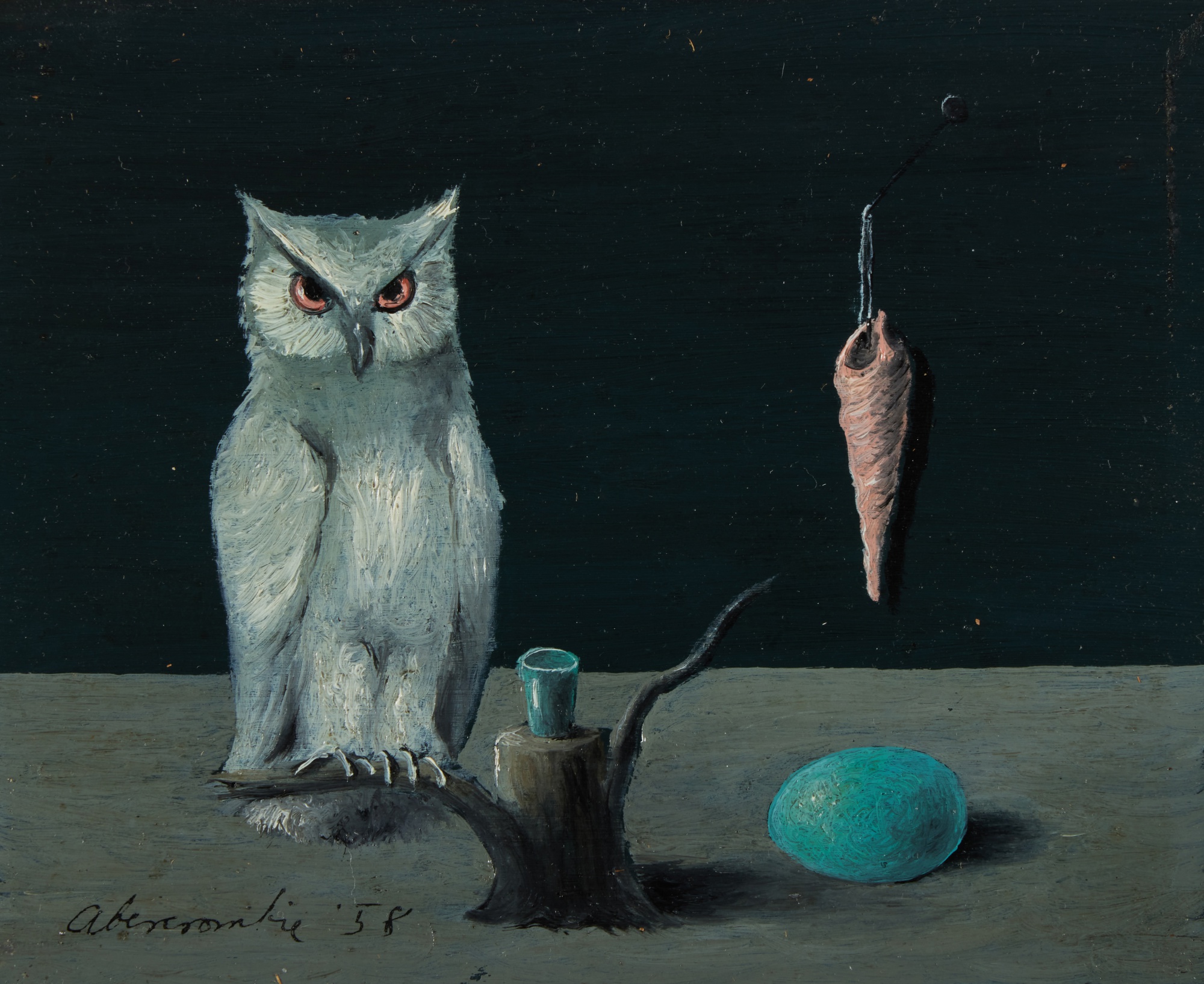
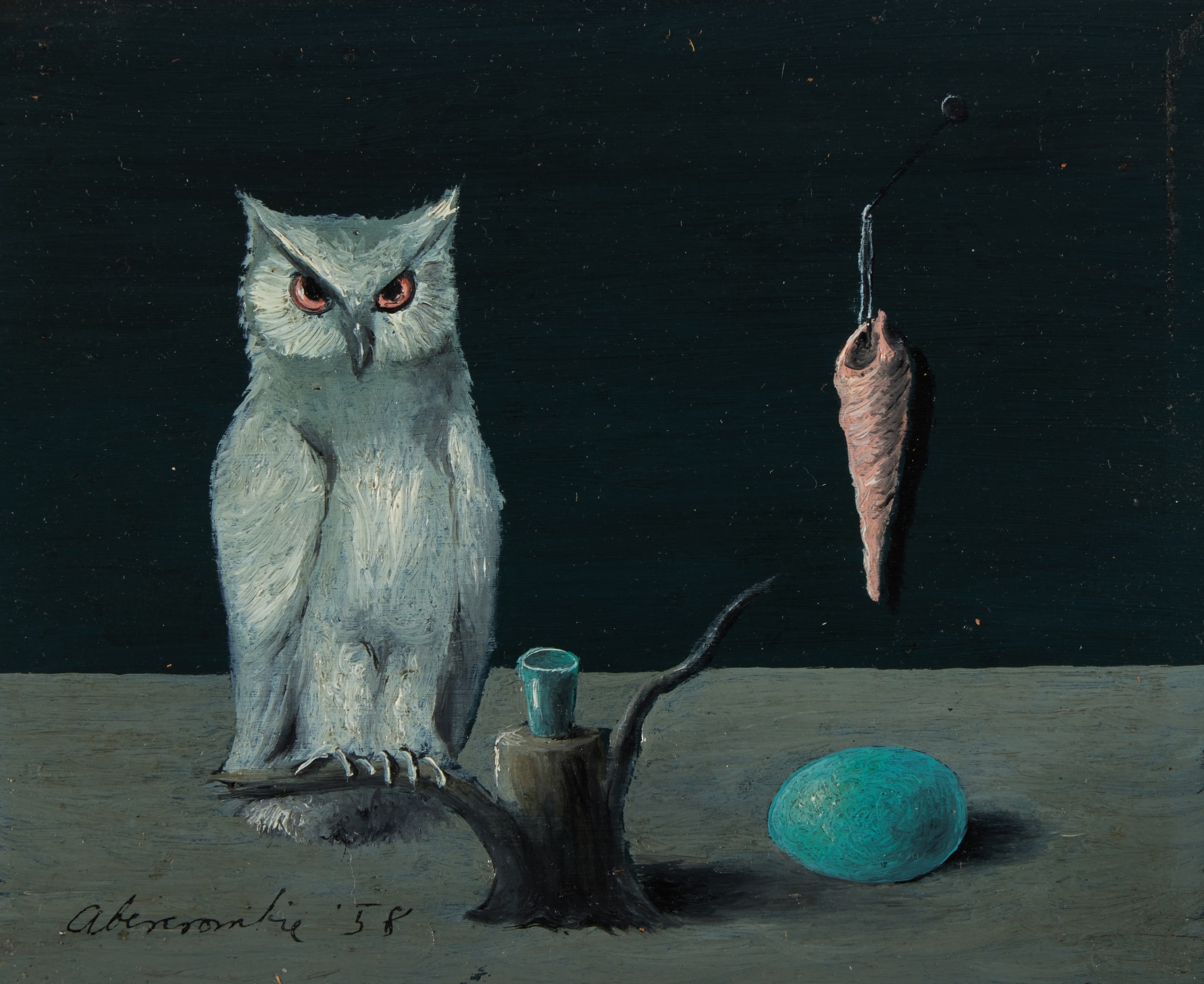
Owl, Shell and Egg, 1958
Abercrombie spent five decades conjuring exactly this kind of scene, and the world is catching up to just how singular her achievement was. In recent years, major retrospectives and renewed critical attention have repositioned her not as a regional curiosity but as one of the most distinctive voices in American Surrealism, an artist whose quiet, enigmatic canvases reward patience and surrender in equal measure. Gertrude Abercrombie was born in Austin, Texas, in 1909, and raised primarily in Chicago, the city that would define her life and her legend. Her father was an opera singer, her mother a performer as well, and the household she grew up in was steeped in performance, aesthetics, and a certain theatrical bohemianism that she would carry into adulthood.
She studied at the University of Illinois and later took classes at the Art Institute of Chicago, where she absorbed the formal traditions of European painting while quietly developing her own interior vocabulary. Chicago gave her community and freedom in equal measure, and she gave the city back something it had never quite seen before. By the late 1930s, Abercrombie had arrived at the visual language she would refine for the rest of her life. Her early works already show the spare, dreamlike quality that would become her signature: flat horizons, isolated figures, objects arranged with the deliberateness of a still life but charged with the anxiety of a dream.
Gertrude Abercrombie
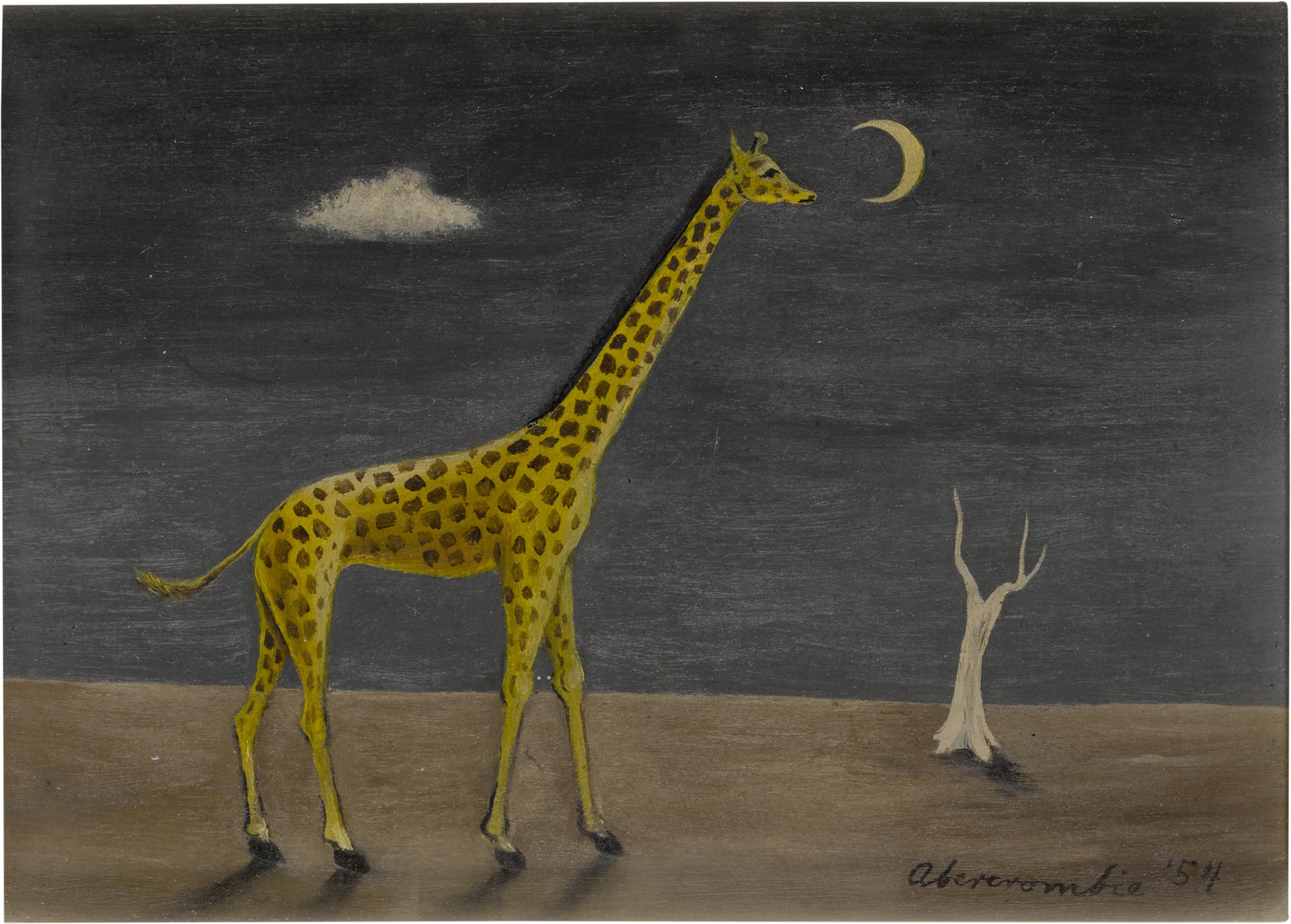
Giraffe
Works from this period, including the quietly mesmerizing Untitled (Key on Table) from 1937, reveal an artist already in full command of her intentions. She favored oil on Masonite, a support that allowed for the smooth, almost lacquered surface she preferred, and her palette settled into a range of muted grays, dusty purples, deep blacks, and chalky whites that felt unlike anything else being made in America at the time. Her home in Chicago became a salon of extraordinary vitality. Jazz musicians, poets, writers, and artists gathered there regularly, and among her close friends were Dizzy Gillespie, Charlie Parker, and Sarah Vaughan.
This immersion in jazz culture was not incidental to her work. Like the best bebop, her paintings operate through economy and implication, saying the most through what is withheld, building tension through absence rather than accumulation. She was also a beloved figure in the Chicago Imagist scene before that movement had a name, and her influence on younger artists in the city was considerable and largely unheralded for too long. The Imagists themselves, artists like Roger Brown and Ed Paschke, owe a quiet debt to the psychological directness she pioneered.
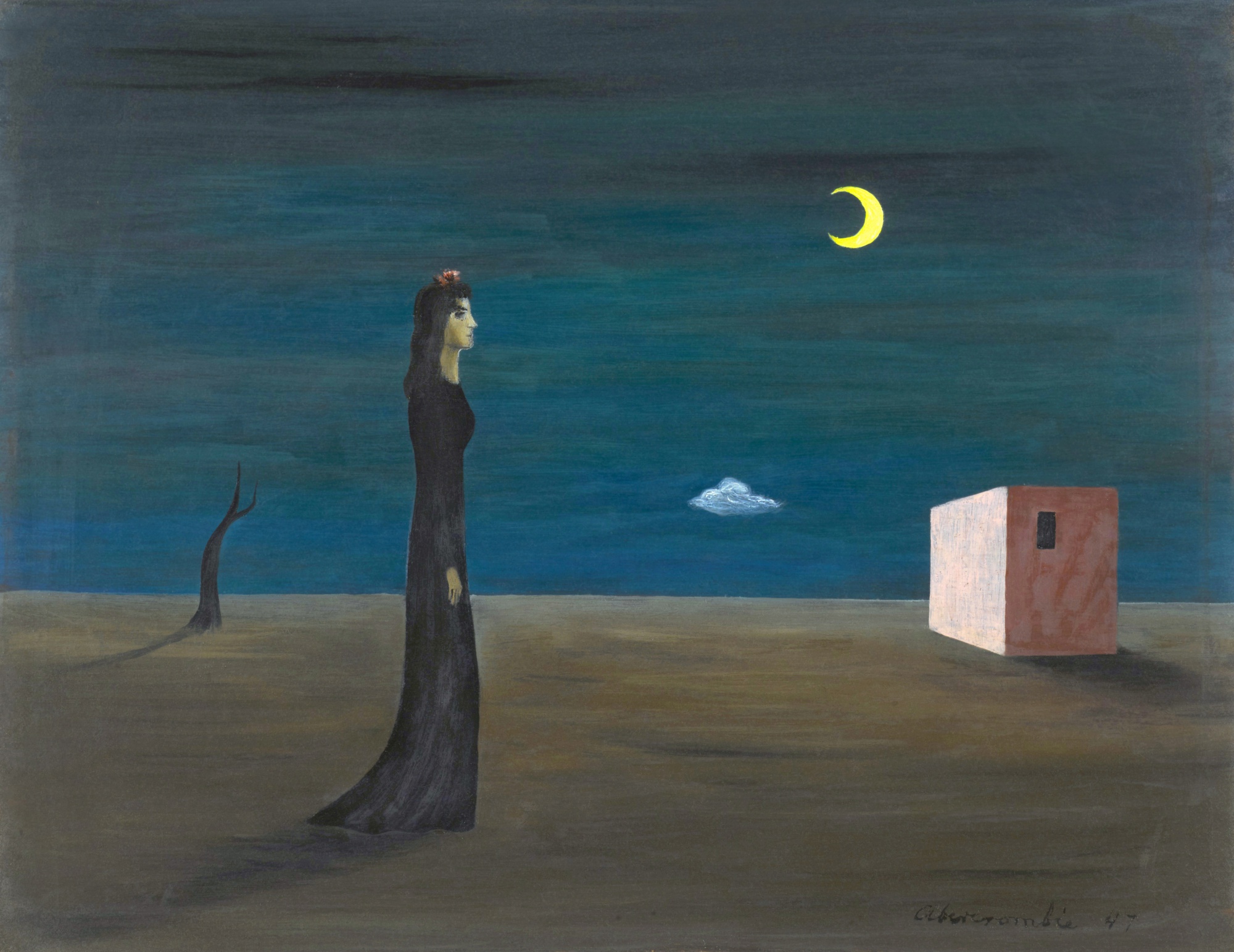
Gertrude Abercrombie
Figure Facing East, 1947
The paintings themselves are the argument. Self Portrait of My Sister from 1941 is one of her most celebrated canvases, a work that layers identity, doubling, and self examination with a coolness that feels entirely modern. The figure stands before a flat, ambiguous space, her gaze turned inward, the title itself a riddle that Abercrombie never felt compelled to fully explain. Countess Nerona No.
3 from 1951 shows her at her most theatrically mysterious, a figure of regal stillness surrounded by the symbolic objects that populate her world: shells, keys, doors, animals, and skies that exist just outside the logic of waking life. Doors with Cat and Shell from 1957 and Owl, Shell and Egg from 1958 demonstrate how she returned to the same talismanic objects again and again, not out of habit but out of conviction, building a personal mythology with the patience of a poet working in a single form. For collectors, Abercrombie represents a compelling convergence of art historical importance and genuine rarity. Her output was not enormous, and her works rarely appear on the open market without generating serious interest.
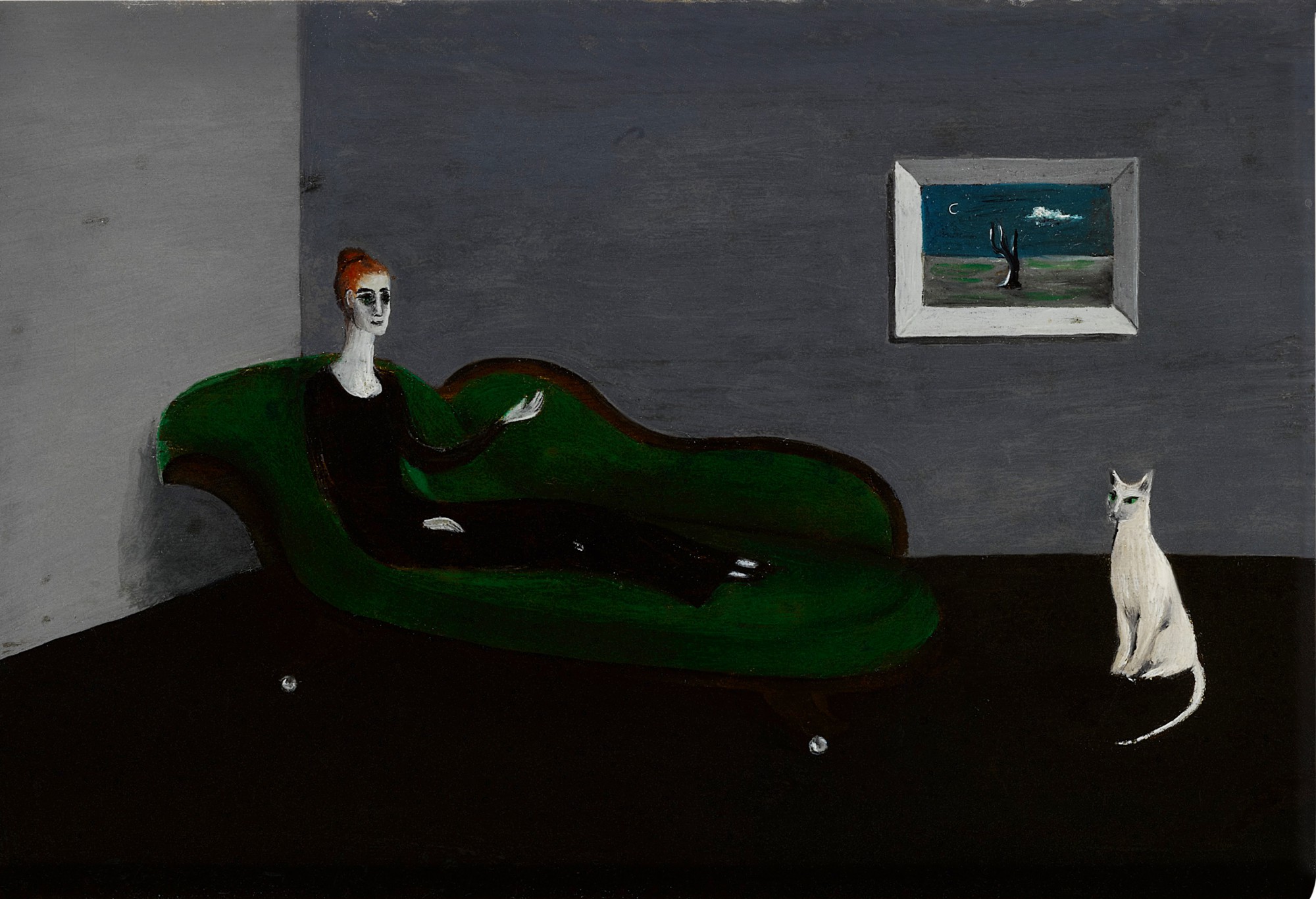
Gertrude Abercrombie
Countess Nerona #3, 1951
When they do surface at auction, her paintings draw attention from institutions as well as private collectors, a sign of how firmly she has entered the canon of American art. The intimacy of her scale is part of the appeal: these are paintings made for close looking, for living with, for returning to across years. Collectors drawn to American Surrealism, to the Chicago tradition, and to artists whose work holds genuine psychological depth tend to find her utterly irreplaceable. Her work belongs in the same conversation as Dorothea Tanning, Kay Sage, and Loren MacIver, women artists whose contributions to Surrealist practice in America have been substantially reassessed over the past two decades.
The renewed enthusiasm for Abercrombie is not simply a matter of market correction or revisionist art history, though both are at work. It reflects a broader recognition that American modernism was far stranger, richer, and more plural than the canonical narratives once allowed. Abercrombie painted on her own terms, outside the New York art world's gravitational pull, supported by a community of musicians and writers and intellectuals who recognized her genius even when the institutions were slow to follow. She exhibited at the Art Institute of Chicago and received recognition during her lifetime, but the full scale of her achievement is something the present moment is still measuring.
She died in Chicago in 1977, leaving behind a body of work that has only grown more luminous with time. To encounter Abercrombie now is to understand that some visions simply need the distance of decades to come fully into focus. Her paintings do not age. They wait, as all good dreams do, for the right moment to reveal themselves.
The cat at the door, the shell on the table, the figure facing east toward something the rest of us cannot quite see: these are images that lodge in the imagination and refuse to leave, which is the oldest and most reliable definition of art that matters.
Explore books about Gertrude Abercrombie