Georges Mathieu
Georges Mathieu: Speed, Fire, and Freedom
Artist Spotlight · The Collection Editorial
“I paint faster than anyone in the world. Speed is my way of catching the unconscious before the conscious can interfere.”
Georges Mathieu
Picture Paris, 1956. A crowd has gathered not in a gallery but around a canvas, watching a man in a ceremonial costume move across an enormous field of white with the concentrated urgency of a conductor mid symphony. Paint flies from tubes held at arms length. Marks accumulate in seconds, calligraphic and electric, forming a composition that could not have been planned because it was not planned at all.
Georges Mathieu
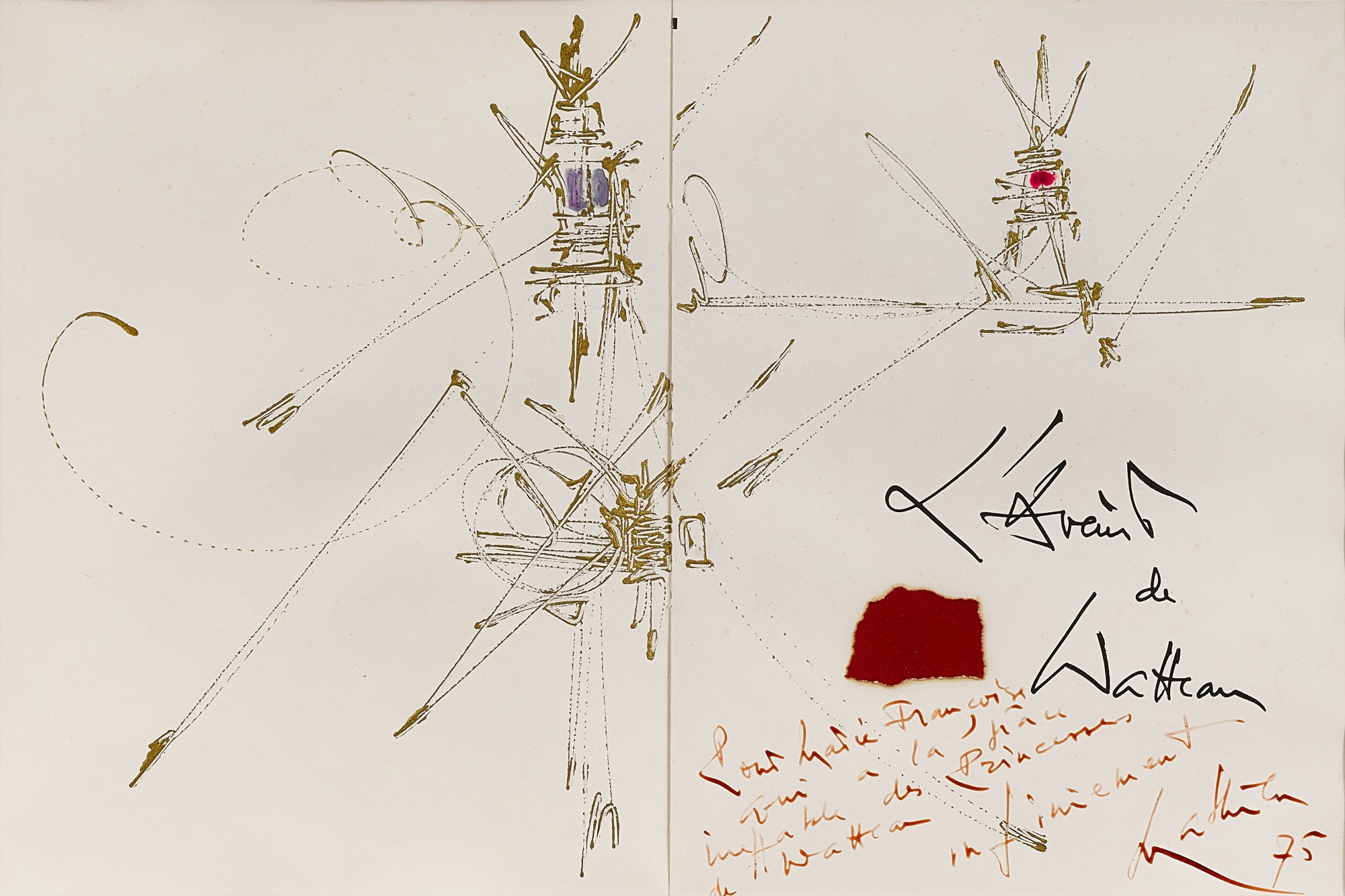
Composition 構成, 1975
This was Georges Mathieu at the height of his powers, and it was like nothing European art had seen before. Georges Mathieu was born in 1921 in Boulogne sur Mer, a port city in northern France, and came of age in a country still absorbing the trauma of occupation and war. He studied law and philosophy before turning fully to painting, and that intellectual foundation never left him. He was a voracious reader of history, particularly medieval and heraldic traditions, and his interest in the signs and symbols of power would eventually permeate his entire pictorial language.
By the late 1940s he had moved to Paris and was immersing himself in the city's postwar ferment, arguing passionately for a new kind of painting that could match the speed and emotional intensity of the moment. It was in those years that Mathieu began forging what would become one of the most distinctive practices in postwar European art. He was among the first to advocate publicly for what he called Lyrical Abstraction, a movement later grouped under the broader French term Tachisme, and he saw himself in explicit dialogue with the American Abstract Expressionists, though he was equally insistent on a European lineage rooted in gestural freedom and spiritual depth. In 1948 he helped organize one of the earliest exhibitions of abstract painting in Paris, bringing together artists whose work signaled a definitive break with figuration.
Georges Mathieu
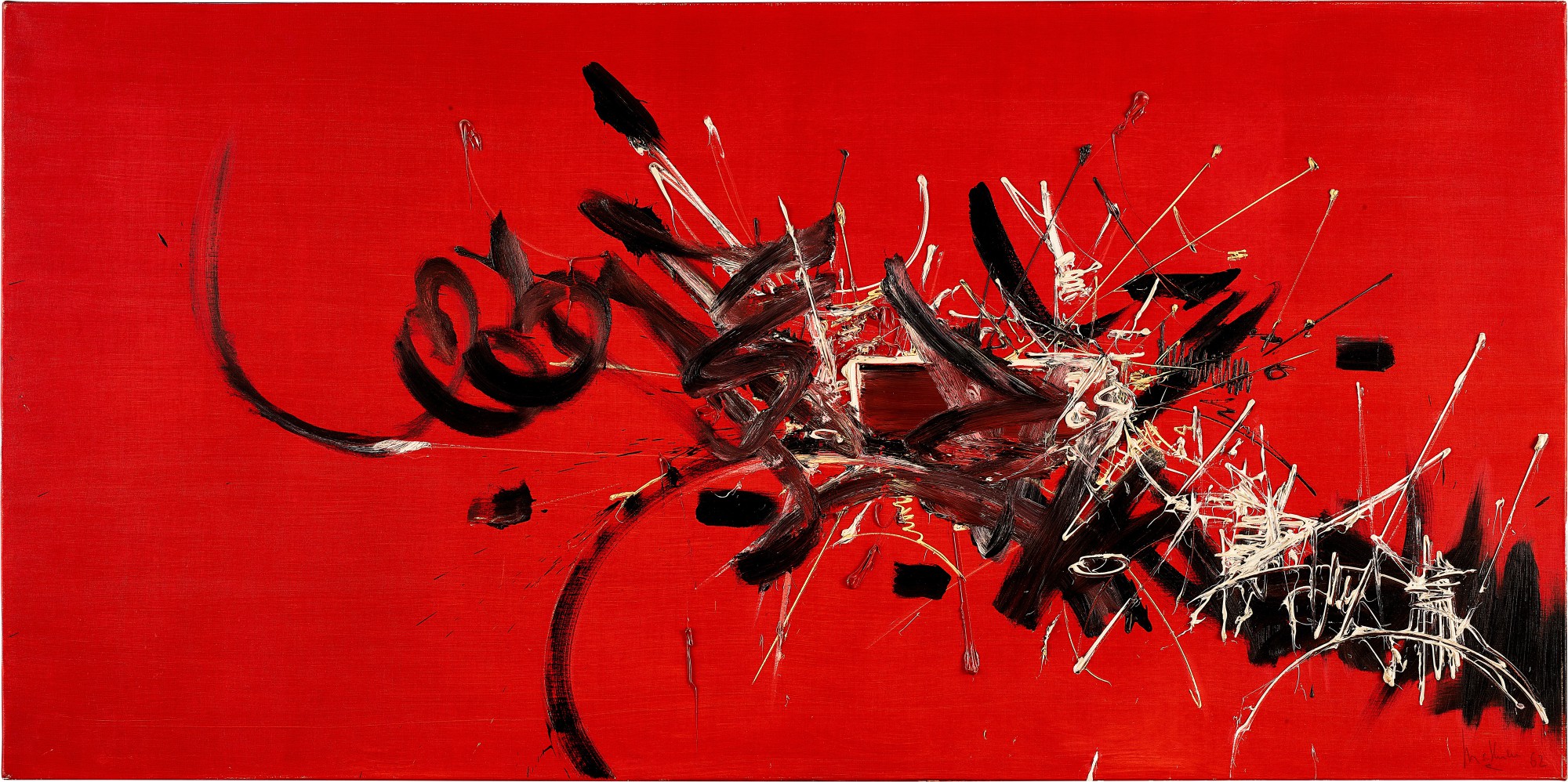
Petit embrasement du Palais d'Alcine 阿爾奇娜宮的花火, 1962
His ambitions were never merely aesthetic. He believed painting could carry the weight of history, of emotion, of metaphysical inquiry, and he worked with the ferocity of someone who meant it. The breakthrough works of the 1950s established the vocabulary that would define his career. Moving with extraordinary speed, sometimes completing large canvases in under thirty minutes, Mathieu applied paint directly from the tube, using the gesture of the whole arm and body rather than the measured movement of the wrist.
The results were astonishing: looping, slashing, erupting lines of pigment that suggested both the automatic energy of Surrealism and the heroic scale of action painting. Works like "Électricité" from 1956, executed in gouache on card, show how even in modest formats he could concentrate an almost violent energy. His titles, drawn frequently from medieval battles and historical events, gave his abstract forms a narrative resonance without ever illustrating anything literally. "Camp de Carthage" from 1951 is a compelling early example of this approach, its loaded surface carrying the feeling of conflict and upheaval without resorting to imagery.
Georges Mathieu
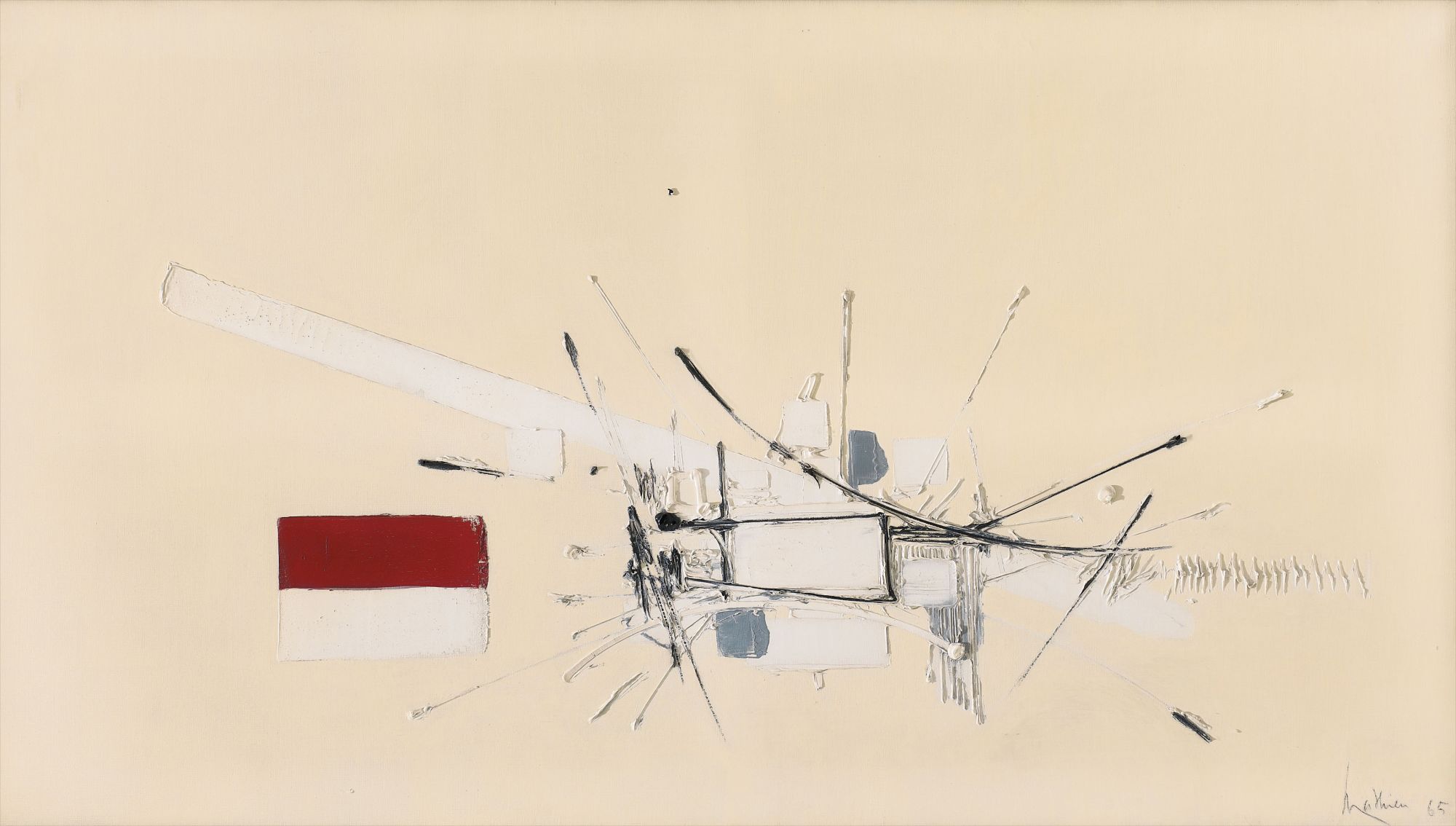
Redorte
By the 1960s Mathieu was one of the most recognizable names in European art, and the decade produced some of his most celebrated canvases. "Petit embrasement du Palais d'Alcine" from 1962 is among the works that best represent him at full command, its oil surface alive with layered incident and chromatic intensity. "Jadis et Maintenant" from 1961 demonstrates how he could hold a canvas in tension between explosive gesture and a kind of stately compositional intelligence. The theatrical public performances, staged in venues across Europe and Japan, brought him enormous popular attention, and his travels through Japan in particular deepened his understanding of calligraphy as a sacred, time based practice.
He found in Japanese brushwork a philosophical kinship with his own instincts about speed, spontaneity, and the trace of the body in paint. Works from his middle period frequently carry dual French and Japanese titles, a gesture of genuine cultural respect and identification. For collectors, Mathieu presents a rich and layered proposition. His output spans several decades and a wide range of media, from large scale oil paintings to works on paper and gouache, offering entry points at various scales and price levels.
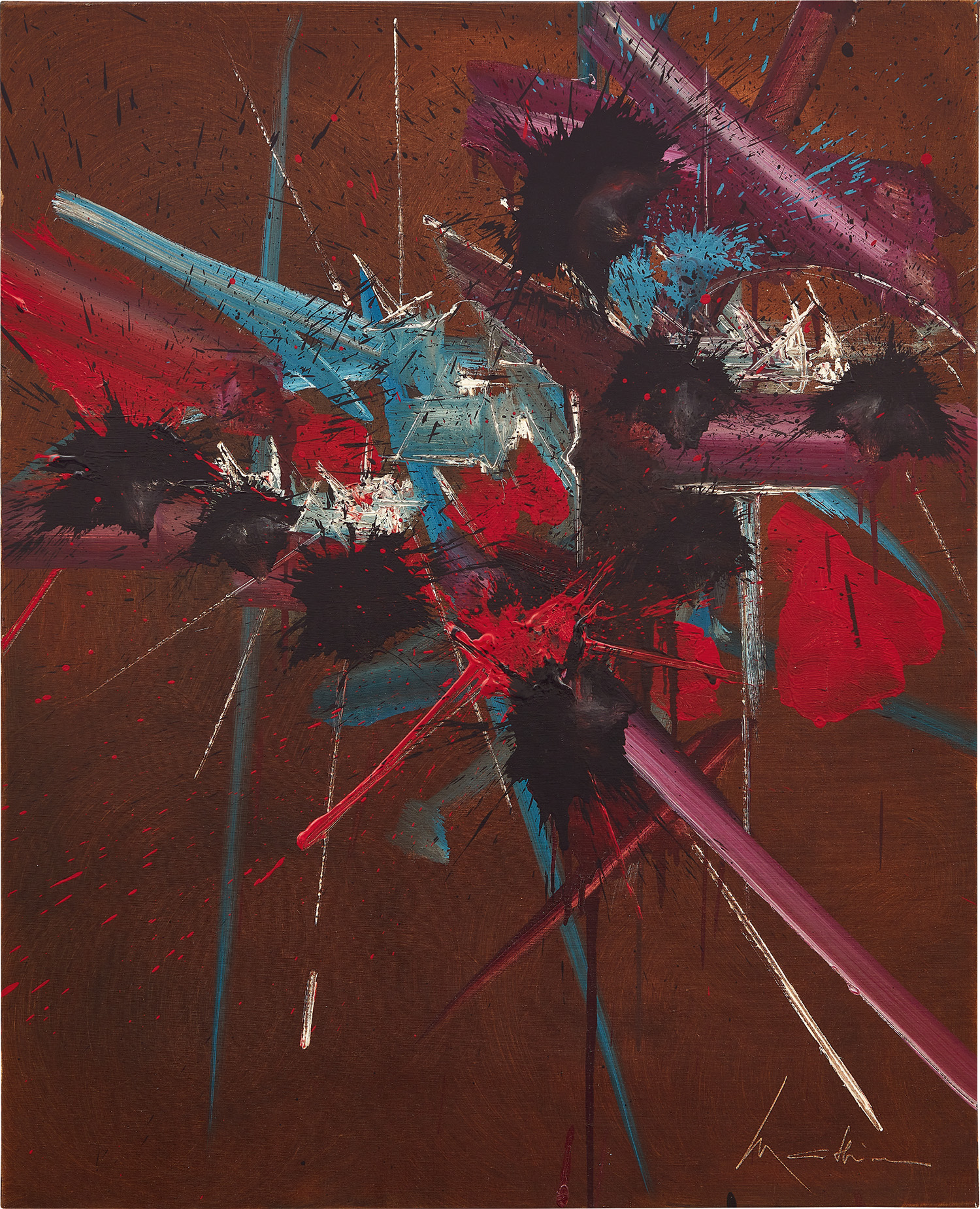
Georges Mathieu
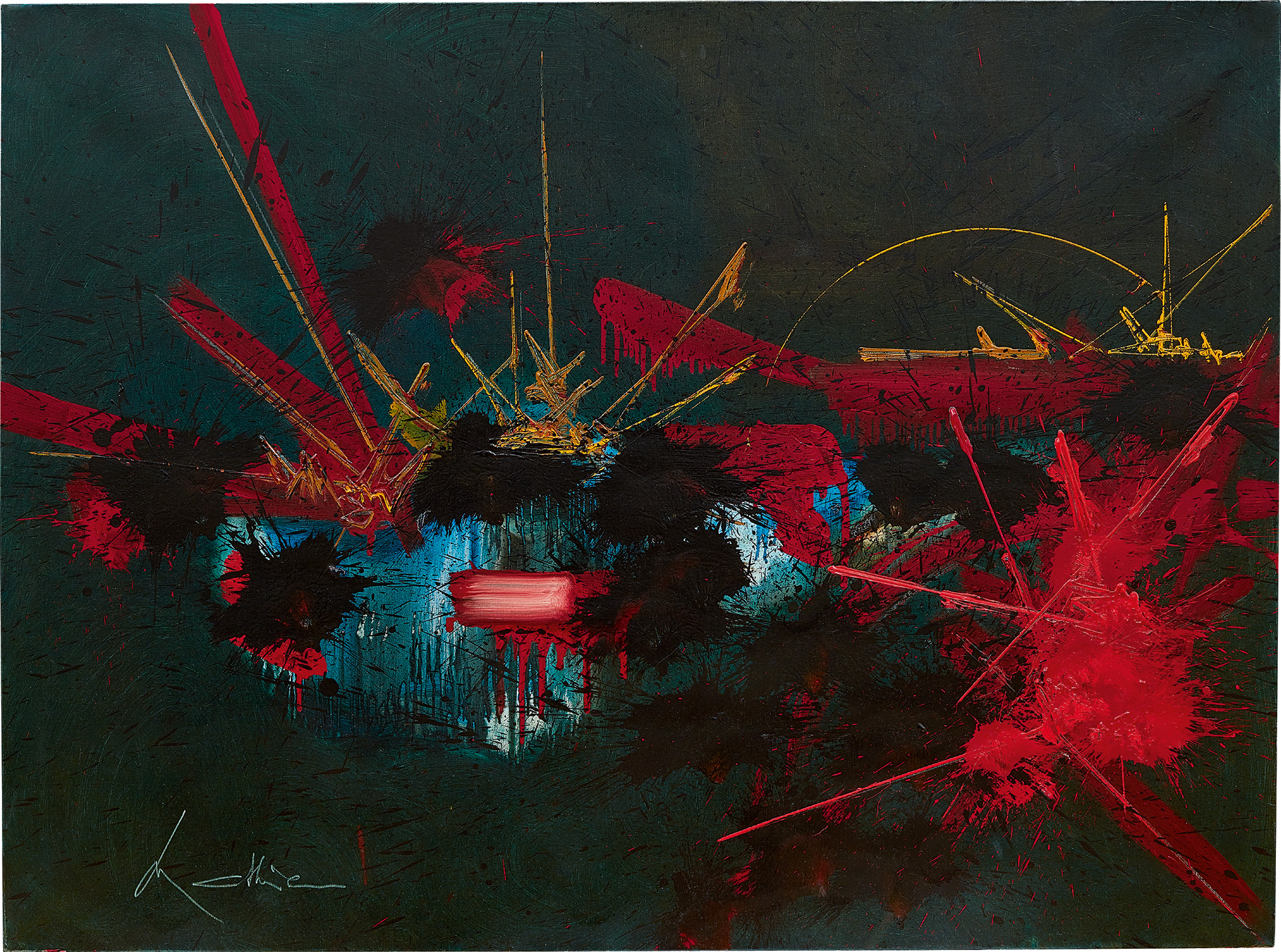
Calvaire Vain, 1987
His works on paper, including compositions like the 1975 mixed media piece "Composition," allow intimate access to his line and color thinking without the commanding spatial presence required by his monumental canvases. The oils demand space but reward it generously. When considering a Mathieu, collectors are advised to attend closely to the quality and complexity of the mark making, to the depth of color layering, and to the internal coherence of the composition. His finest works feel inexhaustible in the way they reveal new incident and structure across repeated looking.
His market has shown sustained strength among European and Asian collectors in particular, reflecting both his historical importance and his ongoing influence. Auction appearances of major canvases from the 1950s through the 1970s consistently attract serious attention, and museum quality works from those decades represent the peak of his collecting desirability. To understand Mathieu fully is to understand a particular constellation of postwar European ambition. His closest contemporaries include Hans Hartung, whose own gestural language grew from a similarly intense engagement with automatic mark making, and Pierre Soulages, whose investigation of black paint and light evolved in parallel dialogue with the Tachiste generation.
Internationally, his work stands in productive comparison with Franz Kline and Willem de Kooning, artists working through similarly charged questions about gesture and scale on the other side of the Atlantic. Mathieu was always clear that the European tradition, with its long engagement with symbolism, heraldry, and spiritual painting, offered resources that the New York scene had not fully drawn upon, and his work remains the most persuasive case for that argument. Georges Mathieu died in 2012 at the age of ninety, having outlived many of his contemporaries and witnessed the full arc of the movements he had helped create. His legacy is both historical and living.
Contemporary painters working in gestural abstraction continue to encounter his example as an irreducible proof of what urgency, intelligence, and physical commitment can produce together on a surface. His insistence that painting could be simultaneously spontaneous and deeply learned, both visceral and historically conscious, remains as generative a challenge as it was when he first set the rooms of Paris alight. For those who encounter his work for the first time, the experience is rarely neutral. There is a charge in a Mathieu that crosses time without any loss of voltage.
Explore books about Georges Mathieu