George Grosz
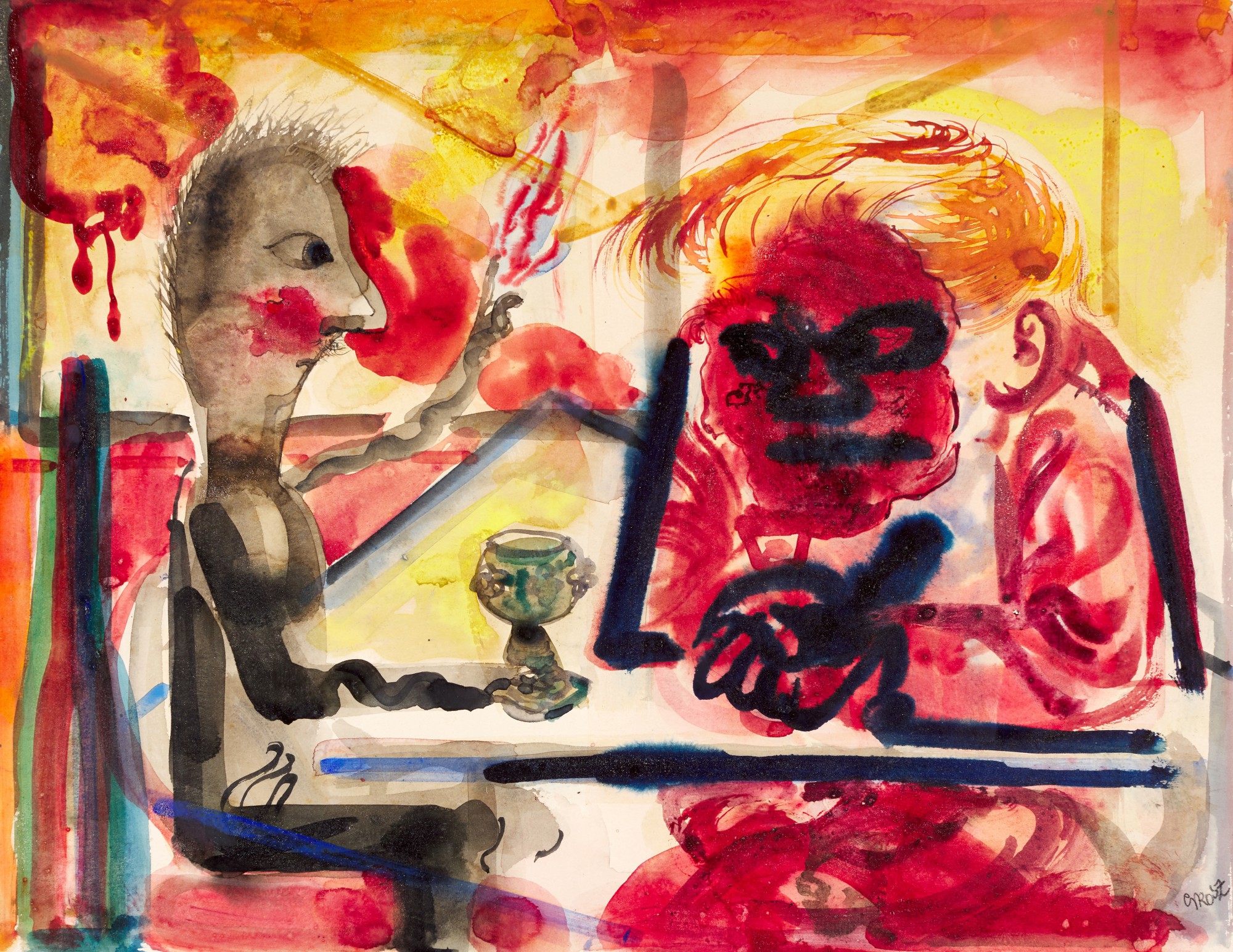
George Grosz: A Master of Fierce Beauty
Artist Spotlight · The Collection Editorial
“I drew and painted from a spirit of contradiction, and tried by means of my work to convince the world that it was ugly, sick, and mendacious.”
A Little Yes and a Big No, autobiography, 1946
Few artists have captured the convulsions of the modern world with the precision, wit, and savage grace of George Grosz. The Neue Galerie in New York, that temple to German and Austrian modernism on Fifth Avenue, has long held Grosz in the highest regard, and his work continues to surface at major auction houses and in museum retrospectives as institutions recognize afresh how urgently his vision speaks to contemporary audiences. When Grosz drawings appear at Christie's or Sotheby's, they reliably attract serious attention from collectors who understand that his work sits at the intersection of art history and cultural prophecy. To encounter a Grosz in person, whether a crackling pen and ink study or a luminous watercolour, is to feel the full voltage of a singular artistic intelligence.
George Grosz
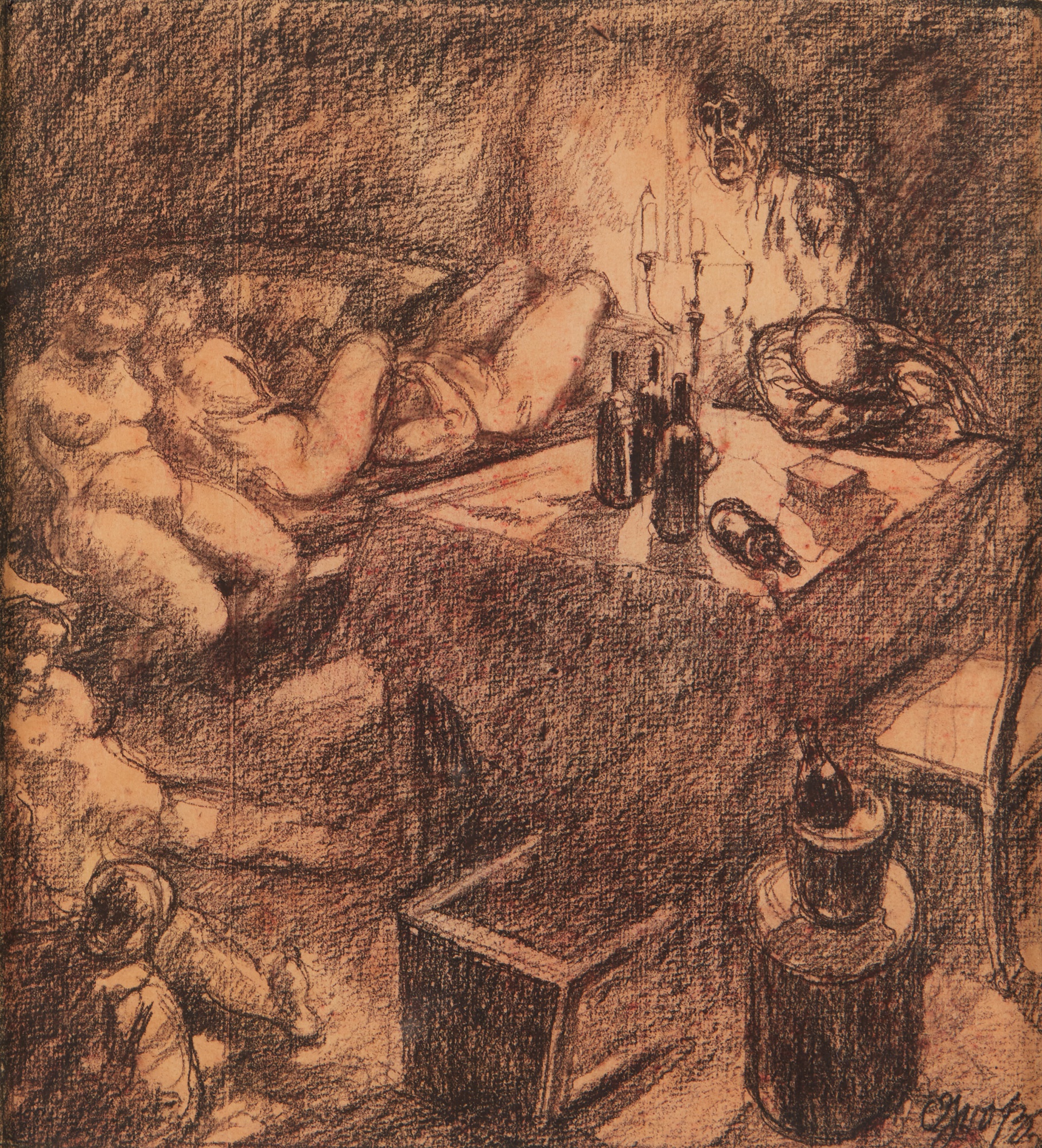
Nach dem Fest, 1912
Georg Ehrenfried Groß was born in Berlin in 1893, the son of a pub owner, and grew up in the small Pomeranian town of Stolp after his father's early death. His mother worked as a seamstress for a local military club, and the young Georg absorbed the textures of provincial German life with a watchful, unsentimental eye. He showed precocious drawing talent and won a place at the Dresden Academy of Fine Arts in 1909, later studying at the Berlin School of Arts and Crafts. The streets of Berlin, teeming with soldiers, prostitutes, war wounded, and profiteers, became his true academy, and he would anglicize his name to George Grosz as a gesture of admiration for what he imagined as the democratic vitality of American culture, long before he ever set foot on American soil.
Groszs artistic development accelerated dramatically during and after the First World War, a conflict he despised and survived partly through feigned illness and institutional luck. His encounters with the Dada movement in Berlin were transformative. Alongside Richard Huelsenbeck, John Heartfield, and Wieland Herzfelde, he helped forge a particularly savage strain of German Dada, one less interested in philosophical provocation than in direct political assault. The portfolio Gott mit uns, published in 1920, resulted in a prosecution for insulting the German military, and the scandal only sharpened his reputation.
George Grosz
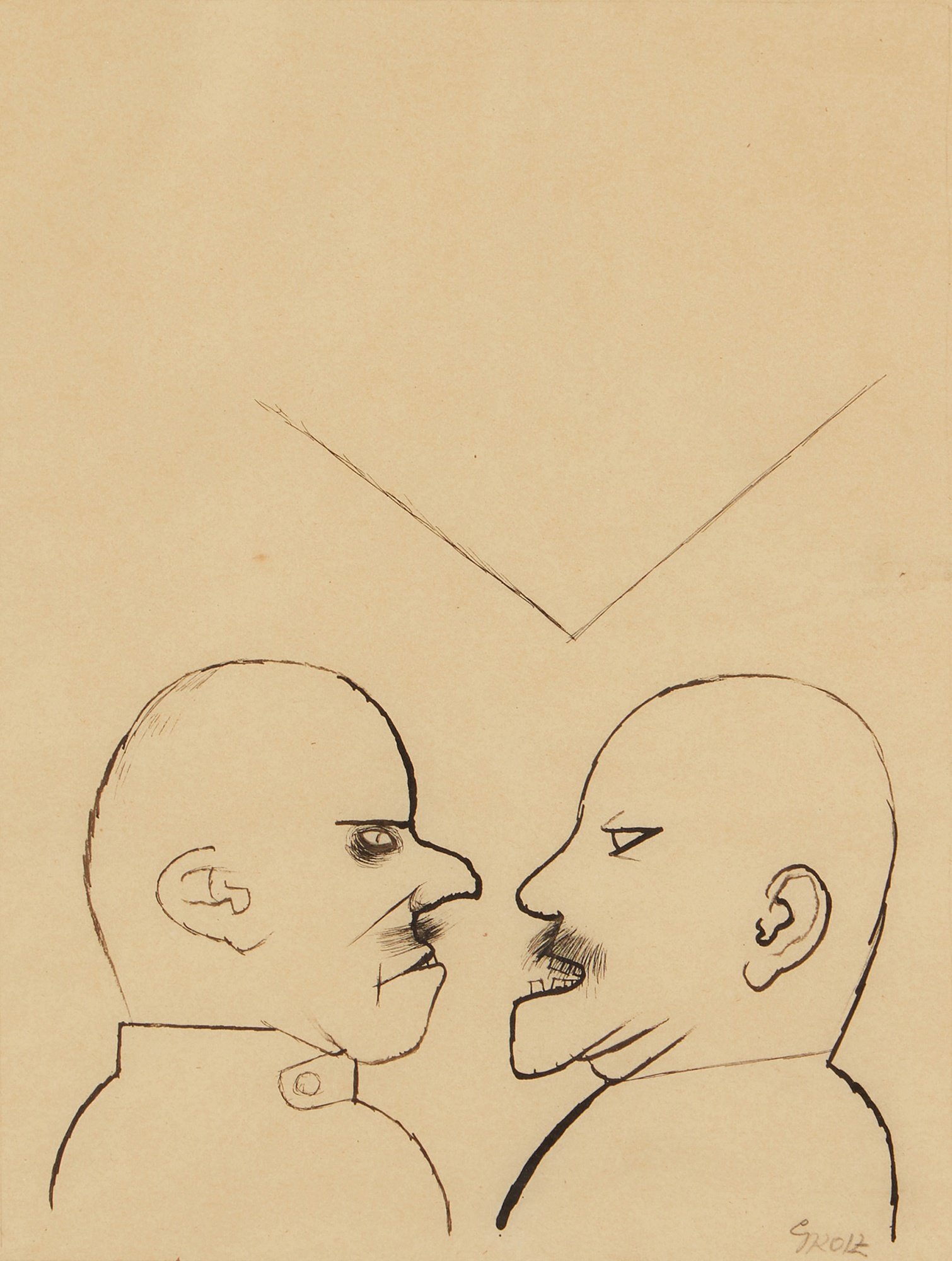
Zwei streitende, 1920
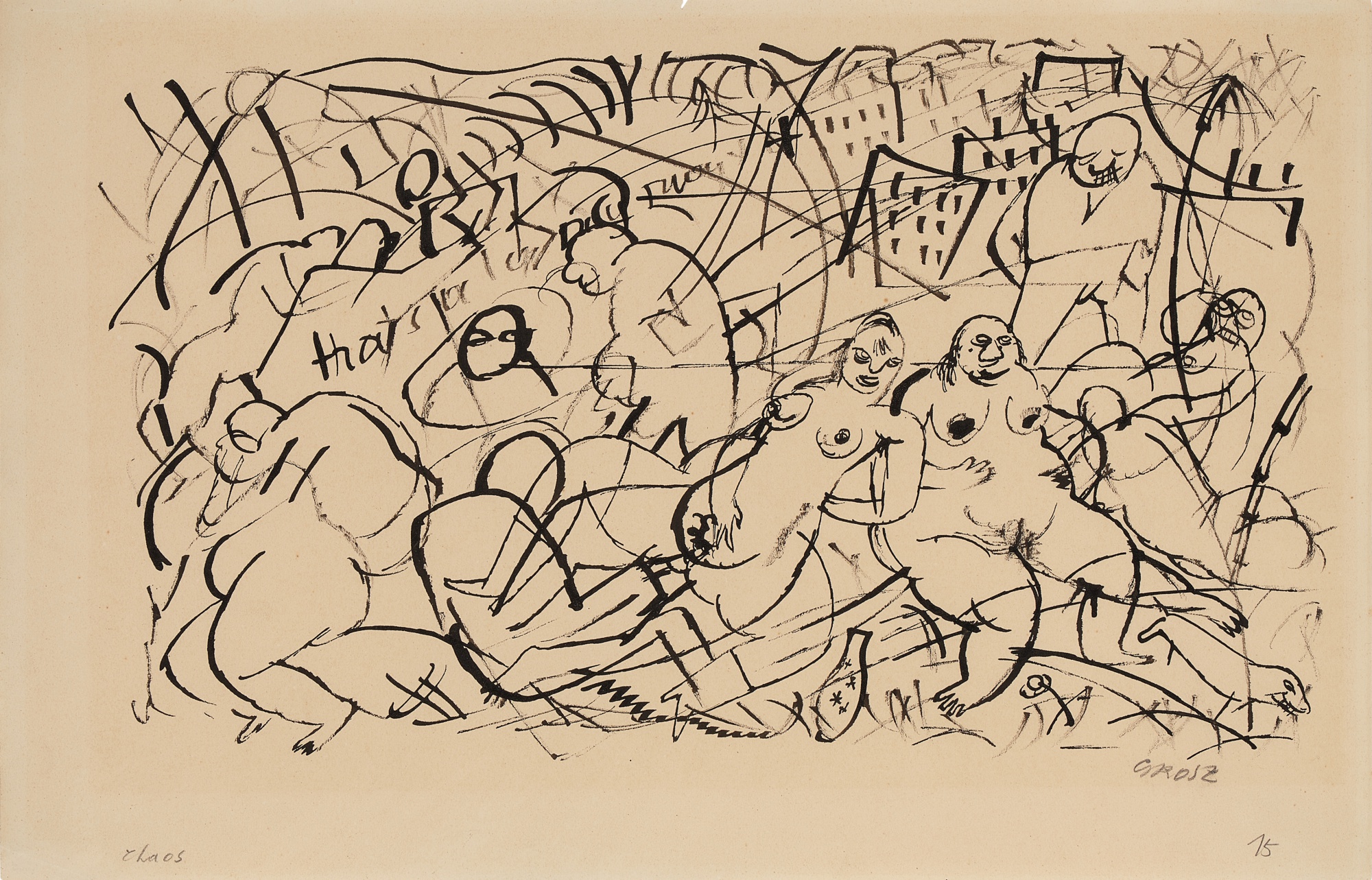
His work from this period, dense thickets of line in which bloated capitalists, corrupt clergy, and brutalized soldiers occupy the same nightmarish space, established him as the most ferocious visual satirist of his generation. The works available through The Collection illuminate the full arc of Grosz's achievement with remarkable richness. Nach dem Fest from 1912 is an early charcoal that already shows his gift for capturing human vulnerability through posture and shadow. Aufruhr from 1915 and Das Ende from 1917, both executed in brush and ink, belong to the incandescent wartime period when his line became a weapon.
“Art is not something that can be taught. Either you see or you don't see.”
George Grosz
Zwei streitende from 1920, combining brush and ink, pen and ink, and pencil, demonstrates his mastery of layered mark making, while the pen and ink Bar Montmartre from 1925 shows the more relaxed, even sensuous register he could command when observing Parisian street life. Fleischerei from 1930 is a superb watercolour, the medium he handled with a transparency and luminosity that surprised those who knew only his inky polemics. The Hemingway Story, a watercolour and pen and ink work from 1954, speaks movingly to his late American period and to a literary friendship that meant a great deal to him. For collectors, Grosz presents one of the most intellectually and aesthetically rewarding opportunities in the field of early twentieth century works on paper.
George Grosz
Aufruhr, 1915
His output was prolific but uneven, and the works that command the greatest attention are those where formal brilliance and thematic urgency reinforce each other. Drawings from the period between 1915 and 1925 are considered by scholars and market specialists alike to represent his peak, though his American watercolours have attracted growing reappraisal as collectors recognize the melancholy beauty of his later practice. Works on paper predominate in his output and in the market, and they reward close looking: the intelligence in a single Grosz line, the way figures compress into each other, the way negative space becomes charged with menace or comedy, repays sustained attention in ways that reproductions can never fully convey. Auction records at major houses confirm that museum quality examples from the Weimar period consistently perform strongly.
Groszs place within art history is best understood in relation to a constellation of contemporaries and near contemporaries whose work shared his commitment to social observation and formal innovation. Otto Dix, his great rival and sometime ally, pursued similar territory through a more painterly, hyperrealist approach, while Max Beckmann brought an expressionist intensity to themes of urban alienation that resonates with Grosz's own concerns. The broader context of Neue Sachlichkeit, the New Objectivity movement of 1920s Germany, positions Grosz alongside artists who turned away from expressionist subjectivity toward a cooler, more documentary gaze, even as Grosz himself resisted easy categorization. Kathe Kollwitz, working in a different register of political art, shared his commitment to depicting the suffering of ordinary people, while in America, artists like Reginald Marsh absorbed Grosz's influence and translated it into a distinctly New World idiom.
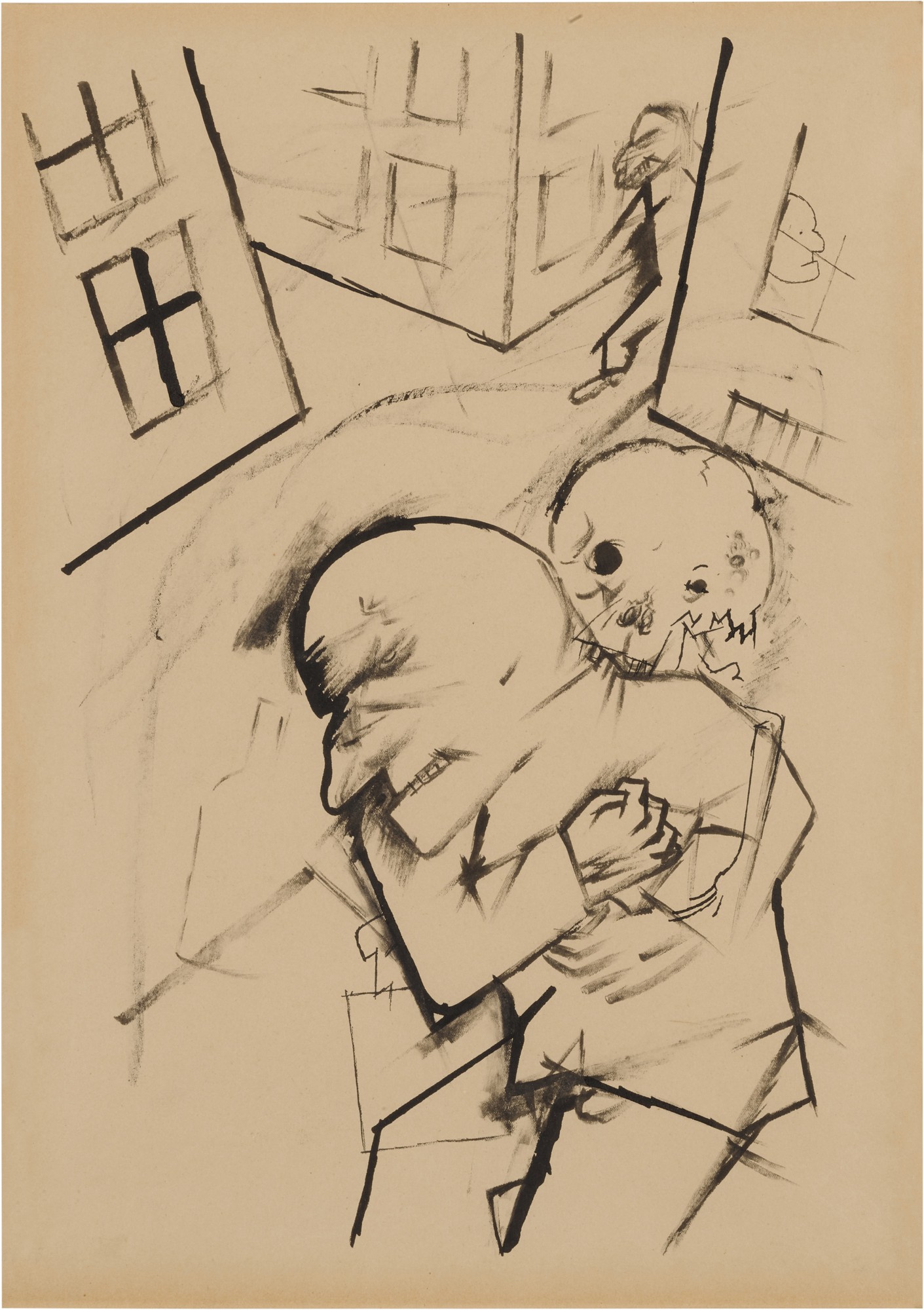
George Grosz
Das Ende (The End), 1917
When the Nazis came to power in 1933, Grosz had the foresight and the good fortune to accept a teaching invitation to New York, and he spent the rest of his life in the United States, becoming a citizen and teaching at the Art Students League. His American decades brought a loosening of his line, warmer palettes, and landscapes of a haunted, elegiac quality. He returned to Berlin in 1959 and died there within weeks of arriving, as if the city he had fled and never stopped mourning had finally claimed him. His legacy is not merely that of a satirist but of an artist who understood that visual form is a moral act, that the way a line is drawn is inseparable from what it means to be alive in history.
In an era when images circulate with unprecedented speed and political life often seems to outpace satire itself, the work of George Grosz feels not dated but eerily, magnificently present.
Explore books about George Grosz

George Grosz: A Life
Peter Selz
George Grosz: Berlin-New York
Uwe M. Schneede
George Grosz: The Abyss and Ecstasy
Beth Irwin Lewis
George Grosz: Drawings and Watercolors
Serge Sabarsky
Grosz
Hans Hess
George Grosz: Art and Politics in the Weimar Period
Richard Cork
George Grosz: 1893-1959
Ralph Jentsch
George Grosz: His Life and Work
Herbert Furst