Françoise Gilot
Françoise Gilot, Luminous Force of Modern Painting
Artist Spotlight · The Collection Editorial
“I didn't want to be anybody's reflection. I wanted to be myself.”
Françoise Gilot, interview
When Françoise Gilot died in June 2023 at the age of 101, the art world paused to reckon with a loss that felt both immense and clarifying. Here was a painter who had worked prolifically across eight decades, who had studied law before devoting herself entirely to color and form, and who had outlived nearly every artist of her generation by simply continuing to paint. The tributes that followed were unanimous in one conviction: that Gilot had always been far more than the biographical footnote that lazy cultural shorthand had sometimes tried to make her. She was, above all, a major painter.
Françoise Gilot
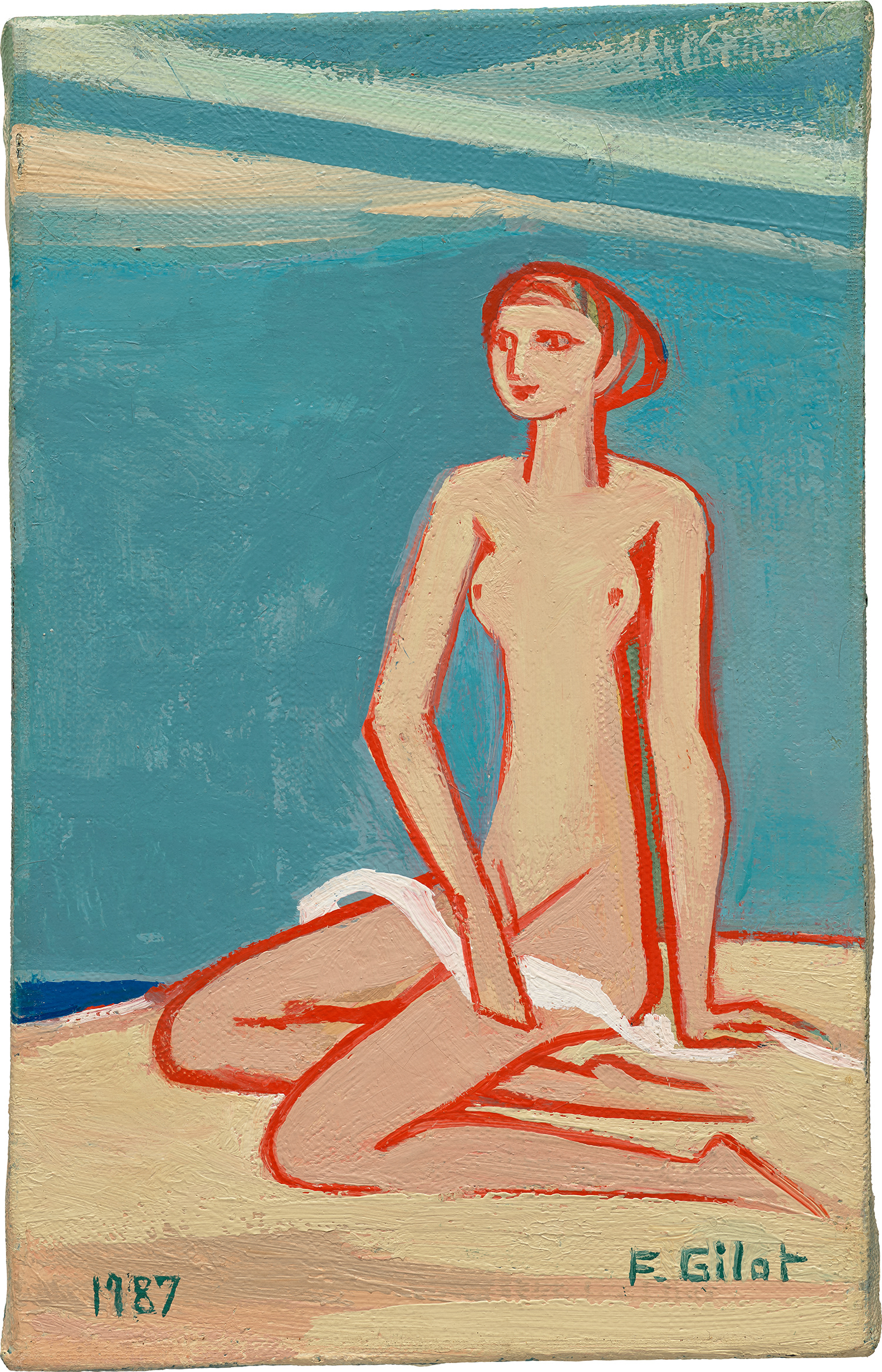
Nude on the Beach by the Sea, 1987
Gilot was born on November 26, 1921, in Neuilly sur Seine, the daughter of a prosperous businessman who initially steered her toward law. She studied at the Sorbonne and earned a degree, but the pull of the canvas proved irresistible. By her early twenties she had committed fully to painting, drawing on the extraordinary intellectual ferment of postwar Paris. She was fluent in philosophy, literature, and the visual arts, and she brought that fluency to the studio in ways that distinguished her from contemporaries who arrived at abstraction or figuration through narrower paths.
Her formation was broad, curious, and deeply European, shaped by the Mediterranean light that would come to define so much of her chromatic sensibility. Her relationship with Pablo Picasso, which began around 1943 and lasted nearly a decade, brought her into close contact with the apex of twentieth century modernism. She lived inside Cubism, watched its originator at work, argued with him and learned from him. But Gilot was not a student waiting for instruction.
Françoise Gilot
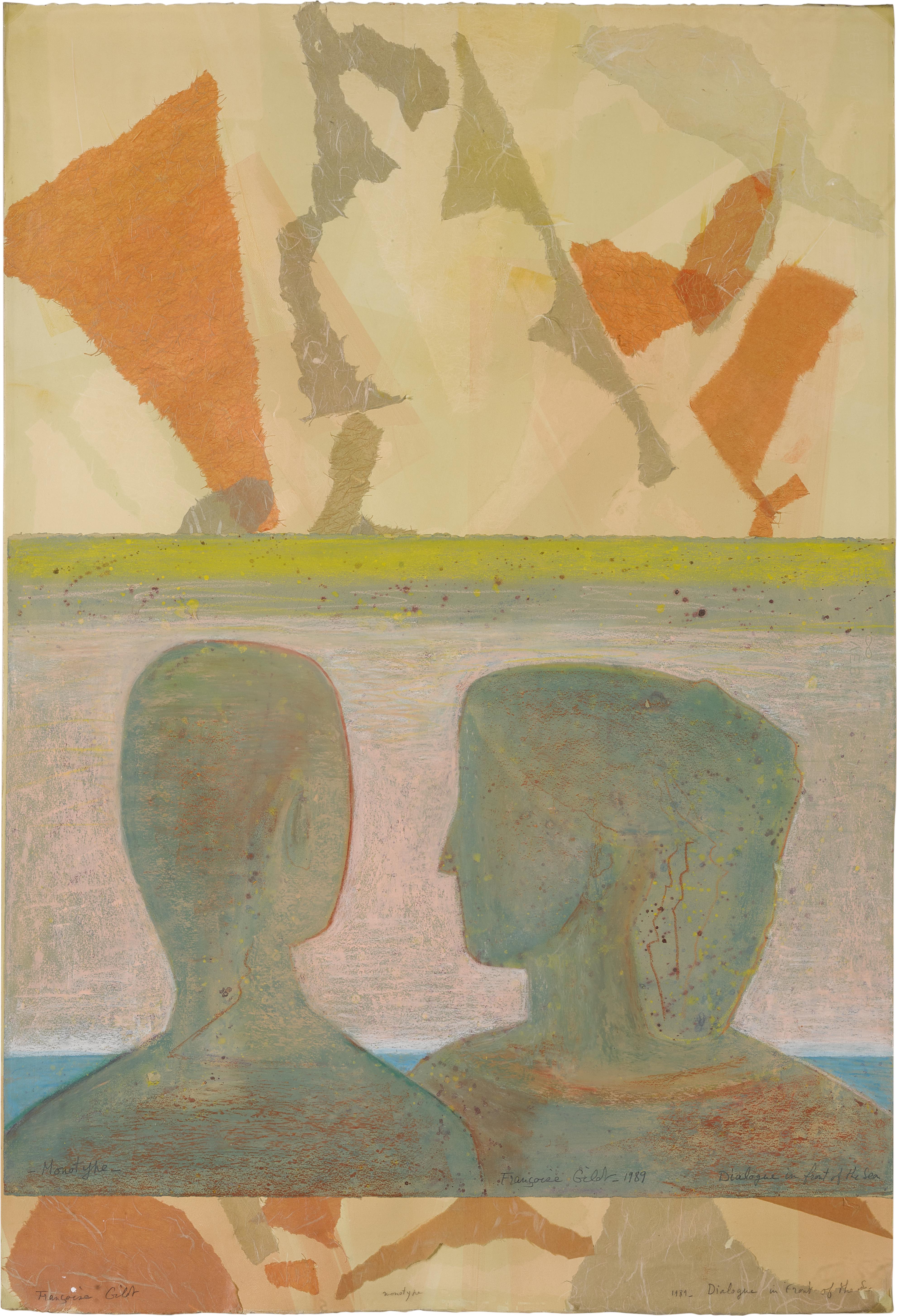
Dialogue in front of the Sea, 1989
She was already developing her own visual language, one that absorbed the lessons of Cubism and Surrealism without being consumed by either. Her palette grew warmer, more Mediterranean, more suffused with the particular blue and gold of the Côte d'Azur. When the relationship ended in 1953, Gilot continued painting with undiminished purpose. She later married the polio researcher Jonas Salk, divided her time between Paris, New York, and La Jolla, and went on producing work of increasing confidence and joy.
“Painting is a way of life. It is not a profession or a career. It is truly a way of being in the world.”
Françoise Gilot
The arc of her artistic development is one of the more fascinating stories in postwar painting. Early works reveal a painter testing the tension between structure and sensation, between the geometric discipline she had absorbed from Cubist thinking and the sensual immediacy of direct observation. By the 1960s and into the 1970s she had arrived at something genuinely her own: compositions that feel both rigorously organized and warmly alive, with color doing structural work that line alone could not accomplish. Her Paysage of 1964, now among the works available on The Collection, captures this quality beautifully.
Françoise Gilot
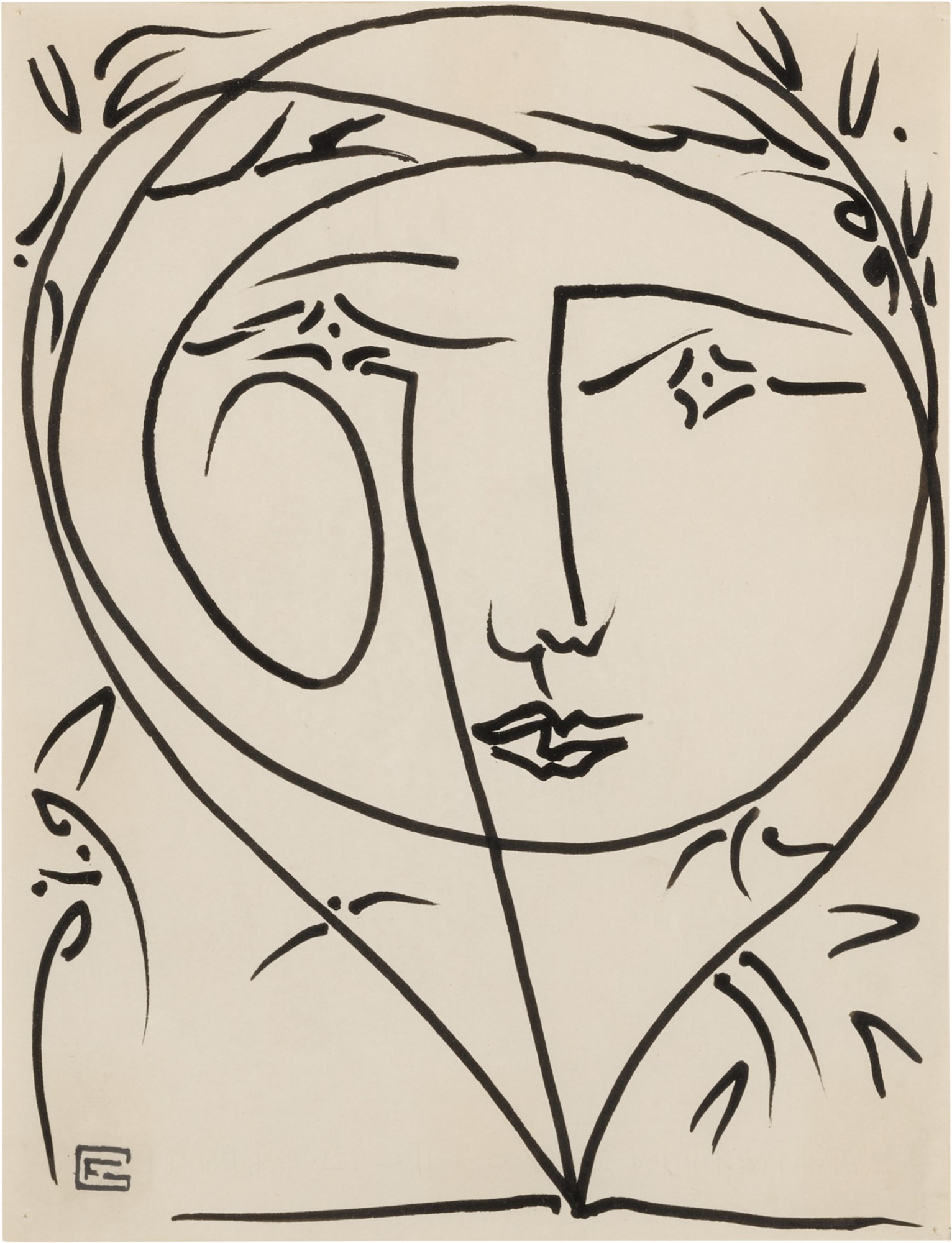
Summer Maiden
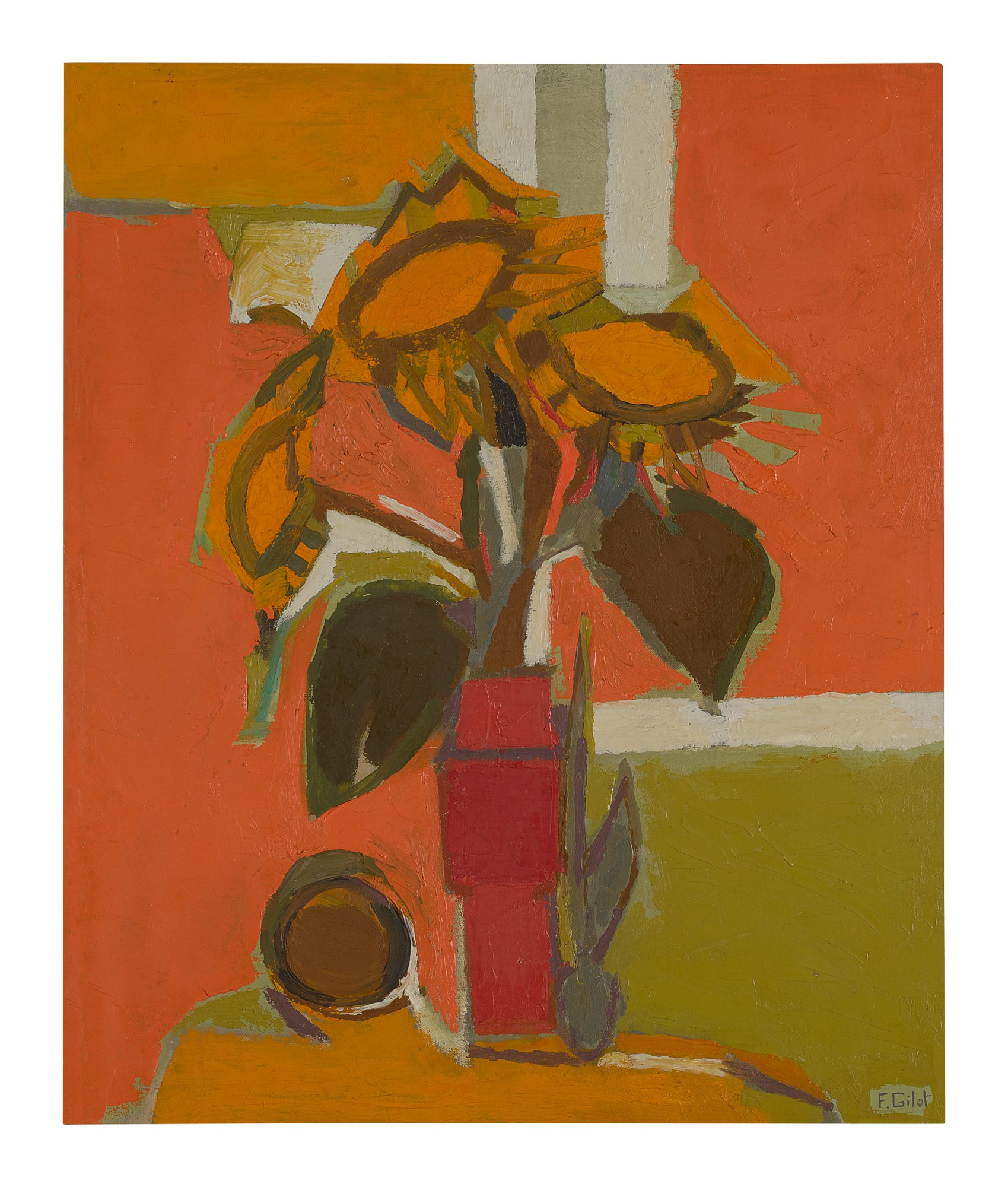
The landscape is at once recognizable and transformed, held together by a logic of color relationships that feels both earned and instinctive. Among her most celebrated bodies of work are the flower paintings, which reward close attention in ways that simpler floral pictures do not. Little Sunflowers from 1960 and White Tulips on Blue from 1990 are not decorative exercises. They are explorations of how a simple subject can become a vehicle for everything a painter knows about light, weight, and the relationship between a form and its ground.
Tulipes Perroquet of 1979 is particularly striking in this regard, its layered oil surface building a presence that is almost architectural. The nudes and beach scenes, including Nude on the Beach by the Sea from 1987 and Dialogue in front of the Sea from 1989, demonstrate her gift for placing the human figure within a landscape in ways that feel neither sentimental nor cold. The sea in these works is not backdrop. It is participant.
Françoise Gilot
Little Sunflowers, 1960
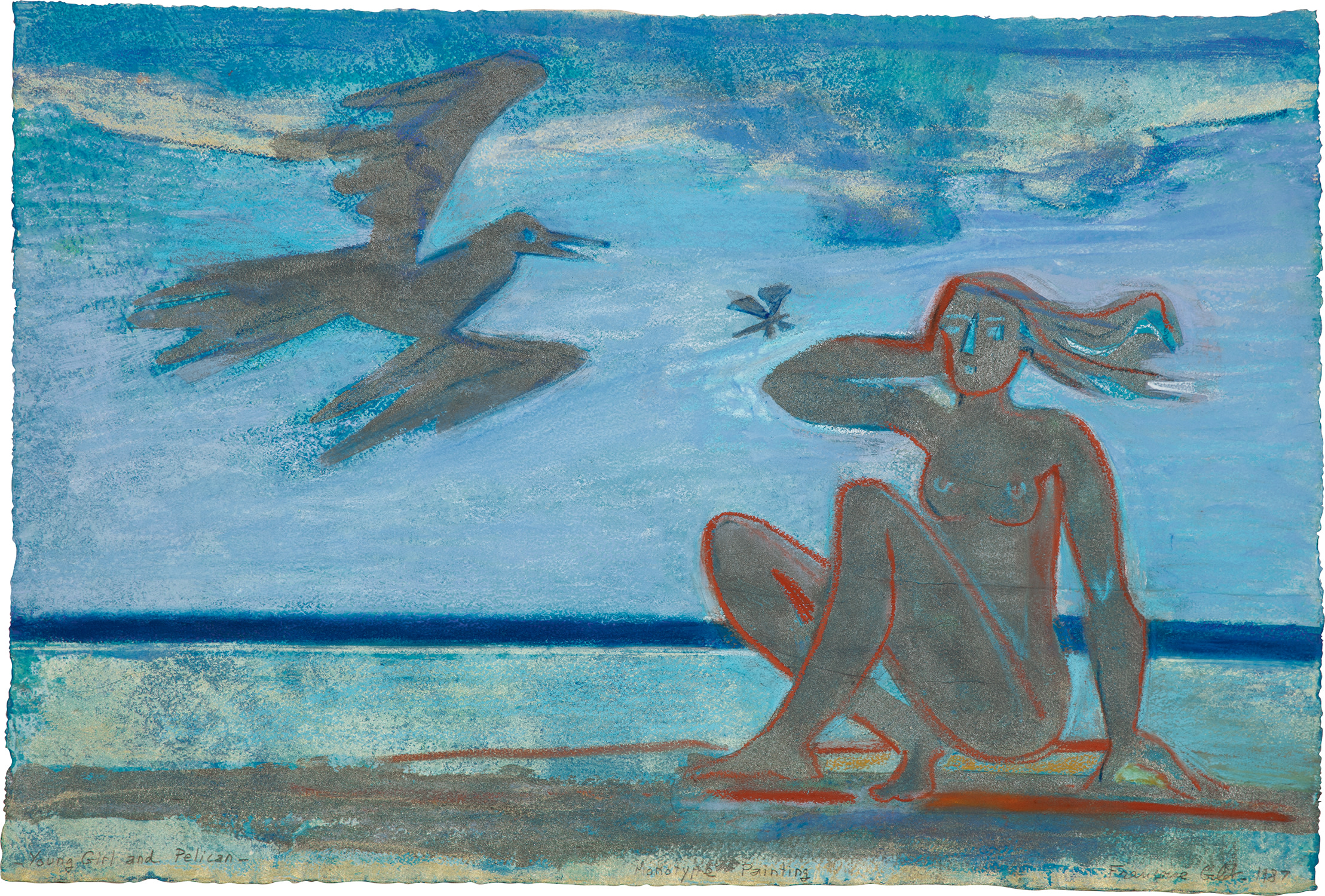
Her printmaking and works on paper reveal yet another dimension of her practice. Young Girl and Pelican and Proud Pélican, both executed as monotypes in colors with collage on handmade paper, show an artist who understood that different materials demanded different thinking. The pelican as a recurring motif in Gilot's work is characteristic of her broader interest in creatures as symbols of dignity and resilience rather than mere decoration. Fire Image from 2011, an oil on canvas made when Gilot was nearly ninety years old, is perhaps the most telling proof of her sustained powers.
The work pulses with energy, demonstrating that her late career was not a diminishment but an intensification. For collectors, Gilot's work presents a compelling and still underrecognized opportunity. Her prices at auction have risen steadily in recent years as the reassessment of women modernists has gained momentum. Works on paper, particularly her monotypes and mixed media pieces, offer points of entry that reward both the eye and the intellect.
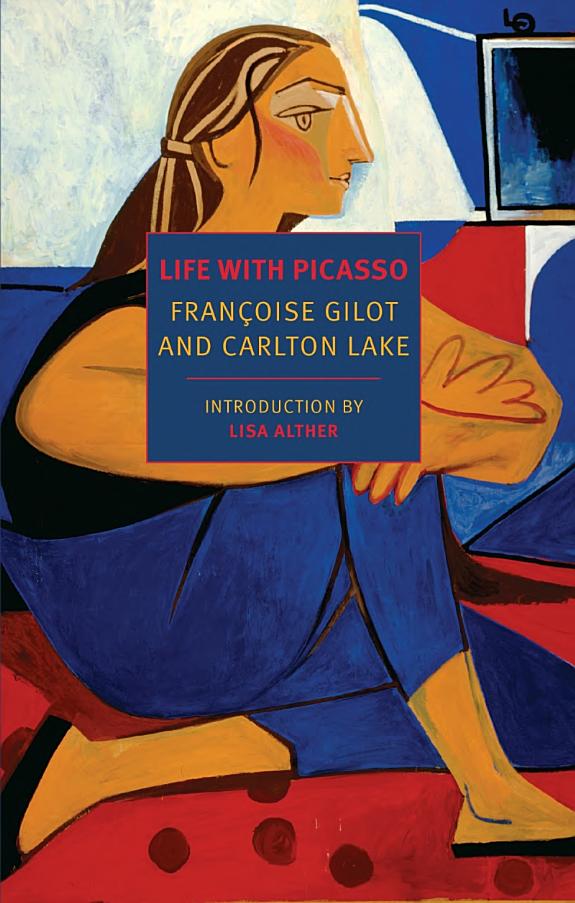
Oil paintings from the 1960s through the 1990s represent the fullest expression of her mature voice and are increasingly sought by collectors who understand the depth of her contribution. Those drawn to the joyful rigor of Henri Matisse, the structural confidence of Fernand Léger, or the chromatic ambition of Nicolas de Staël will find in Gilot a painter who belongs in that company without apology. The publication of her memoir Life with Picasso in 1964 made her famous in ways that she navigated with characteristic composure. The book is a masterpiece of witness literature, sharply observed and beautifully written, but Gilot always insisted that it was a document of a life lived, not a definition of who she was as an artist.
She was right to insist. The critical reappraisal that has gathered force since her death is correcting a long imbalance, placing her painting at the center of the story where it always belonged. Museums, dealers, and collectors are catching up to what her canvases have always been telling anyone willing to look closely: that Françoise Gilot built a world entirely her own, and it is one of the most generous and alive worlds in modern art.
Explore books about Françoise Gilot