Francis Ruyter
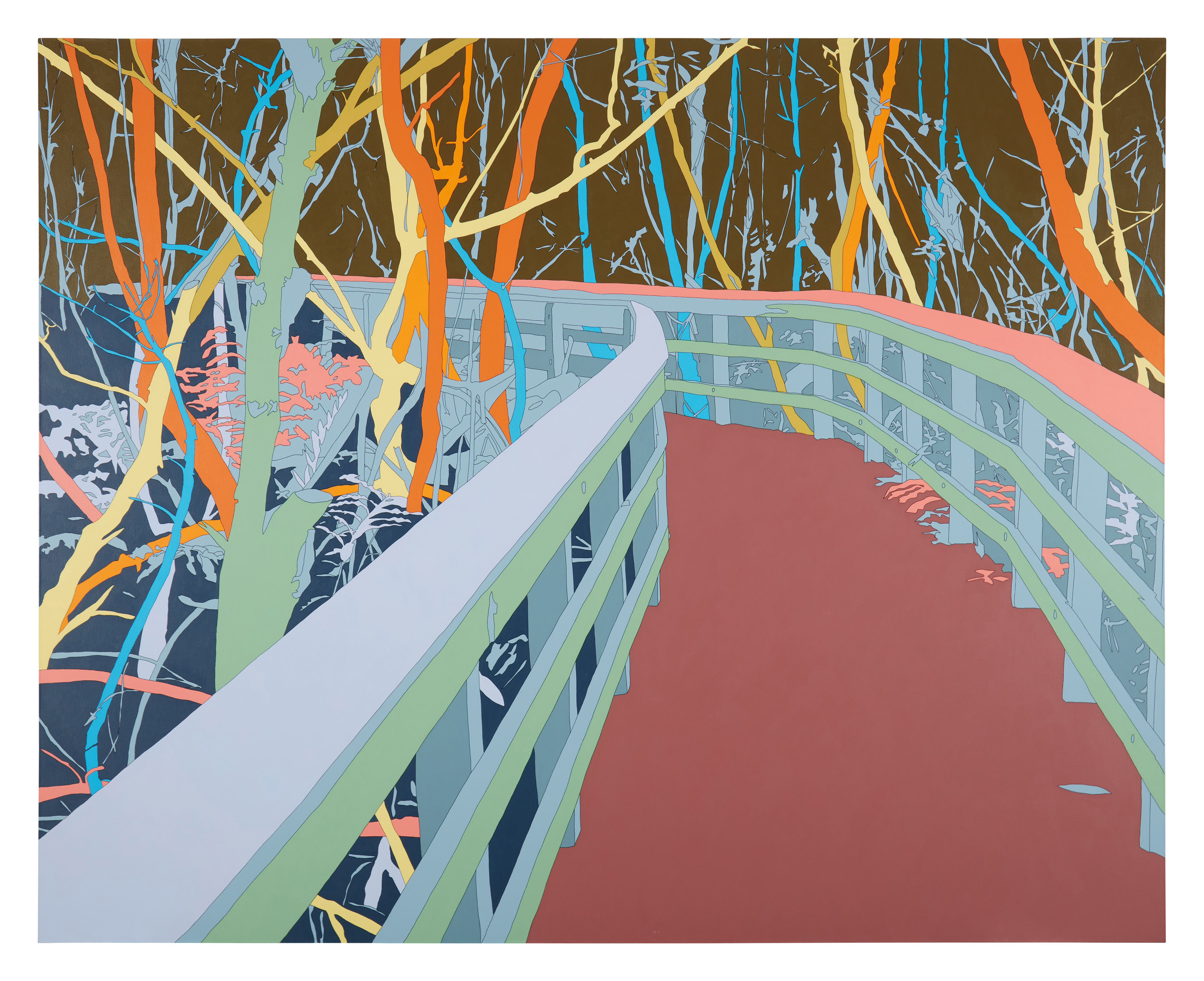
Francis Ruyter Finds Beauty in the Familiar
Artist Spotlight · The Collection Editorial
When the Museum of Modern Art invited Francis Ruyter to participate in MoMA Projects 77 in 2002, the Washington, DC born painter installed a billboard work that stopped pedestrians mid stride on the streets of New York. It was the kind of gesture that announced an artist operating at the precise intersection of the monumental and the intimate, the public and the deeply personal. That project, set against the backdrop of one of the world's most closely watched institutions, confirmed what a devoted circle of collectors and curators had already sensed: Ruyter was building a body of work that deserved serious, sustained attention. Ruyter grew up in Washington, DC, a city whose visual culture is layered with portraiture, civic grandeur, and the strange formal weight of images designed to persuade and commemorate.
Francis Ruyter
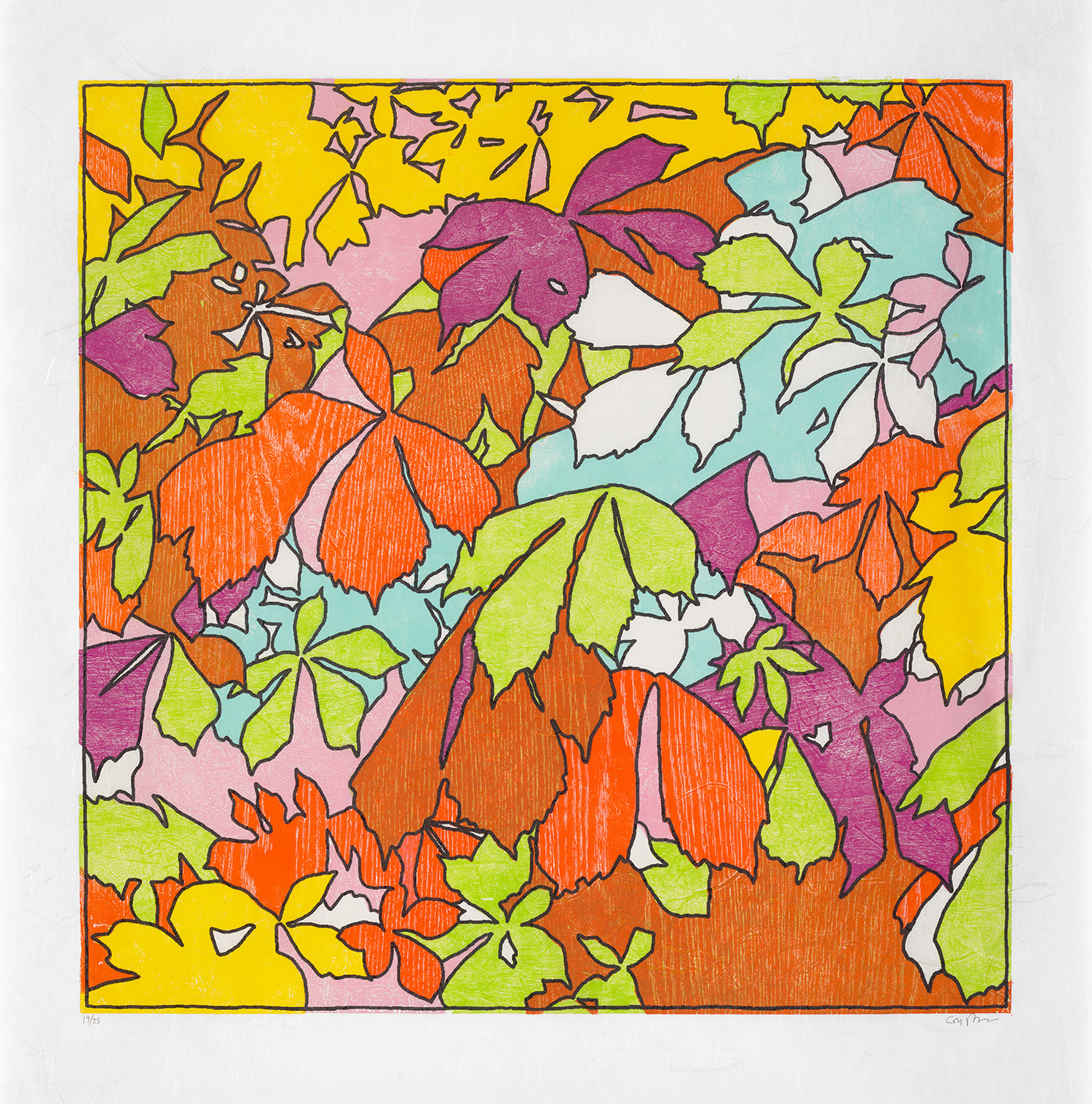
Beyond the Forest
It is perhaps no coincidence that an artist shaped by that environment would become fascinated with the photograph as a source, with the way images accumulate authority through repetition and reproduction. The American capital offered a kind of early education in the power of the picture plane, and Ruyter absorbed those lessons deeply before finding his way to painting as his primary language. His practice centers on photographic source material, a decision that places him in dialogue with one of the most generative conversations in postwar American art. Like the Pop artists who preceded him, Ruyter understands that the photograph is never neutral.
It carries the residue of its original context, its moment of capture, and the cultural apparatus through which it traveled before arriving in his studio. Where Pop art often played that tension for irony or cool detachment, Ruyter's paintings feel warmer, more psychologically invested in what those images hold. His canvases suggest that pictures remember things, and that the act of painting them again is a form of reckoning. The acrylic on canvas works that anchor his output have titles that read almost like film noir chapter headings: "Hotel Terminus," "Home Before Midnight," "The Strange Door," "Landscape After Battle.
Francis Ruyter
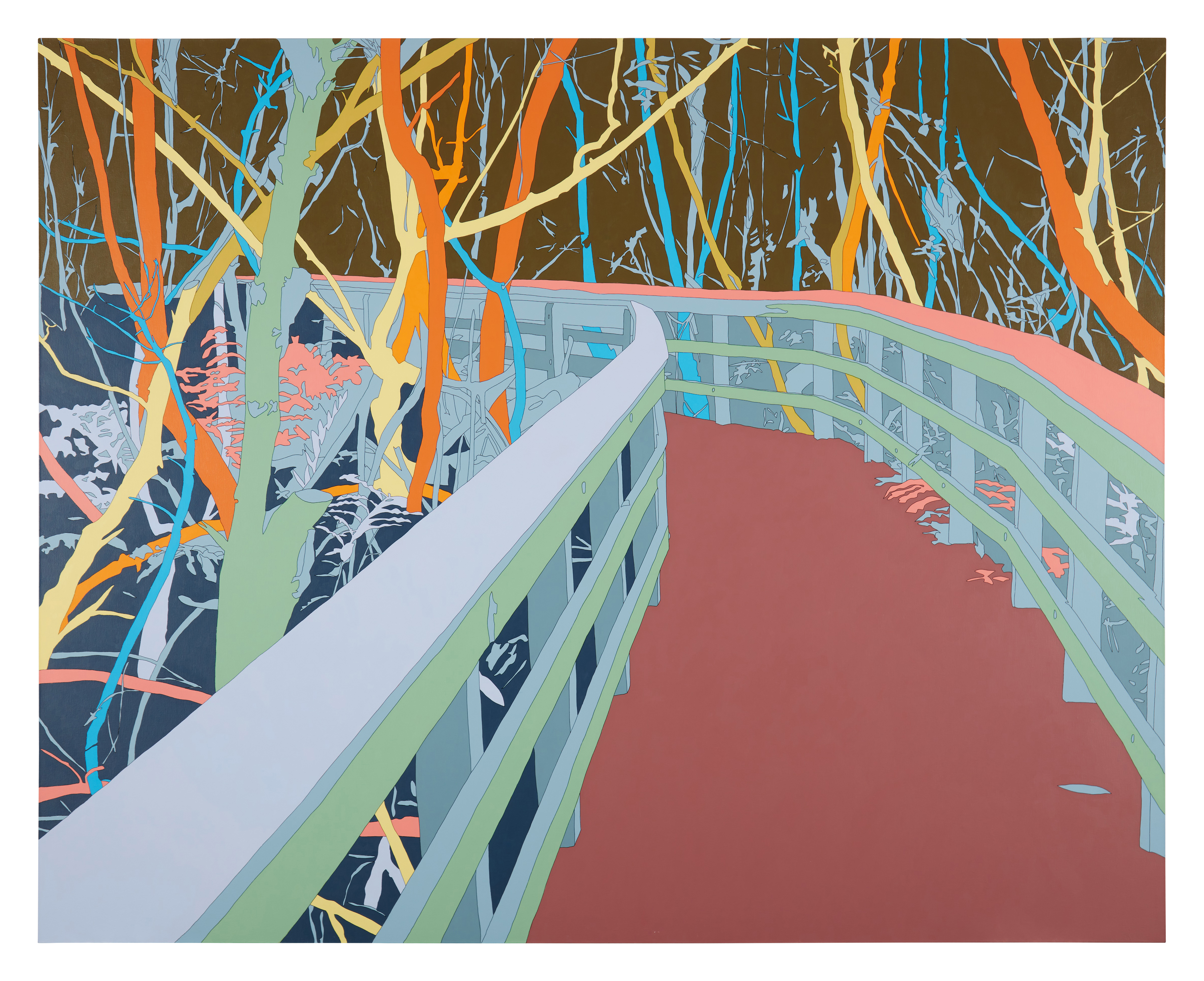
Landscape After Battle, 2003
" Created in the late 1990s and early 2000s, these paintings establish a cinematic grammar that is entirely Ruyter's own. He borrows the atmosphere of mid century photography and American vernacular imagery but refines it through a painterly sensibility that rewards close looking. The surface of a Ruyter canvas is not merely a vehicle for an image; it is where meaning accumulates, where the distance between source photograph and finished work becomes charged with feeling. His printmaking represents a parallel and equally compelling strand of his practice.
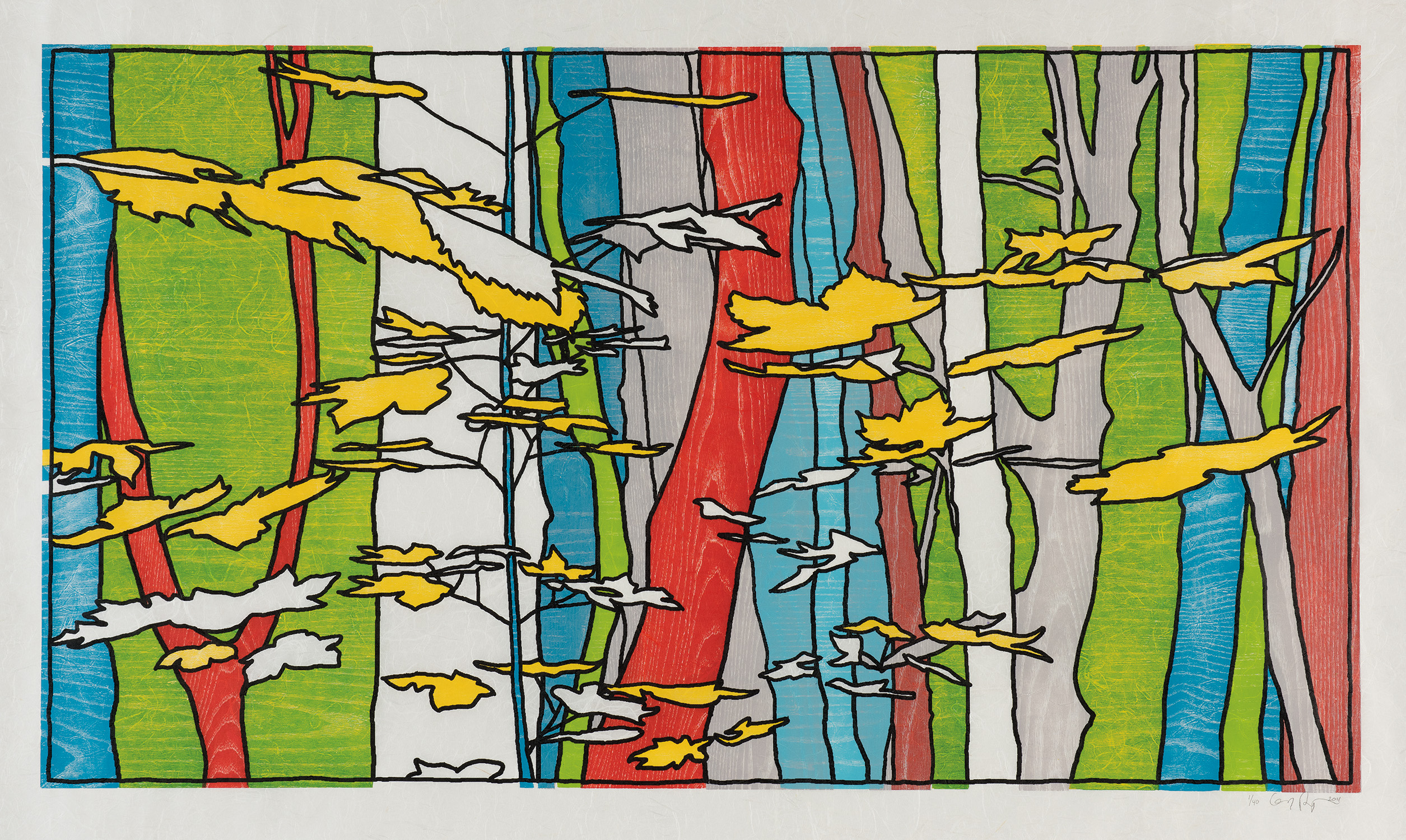
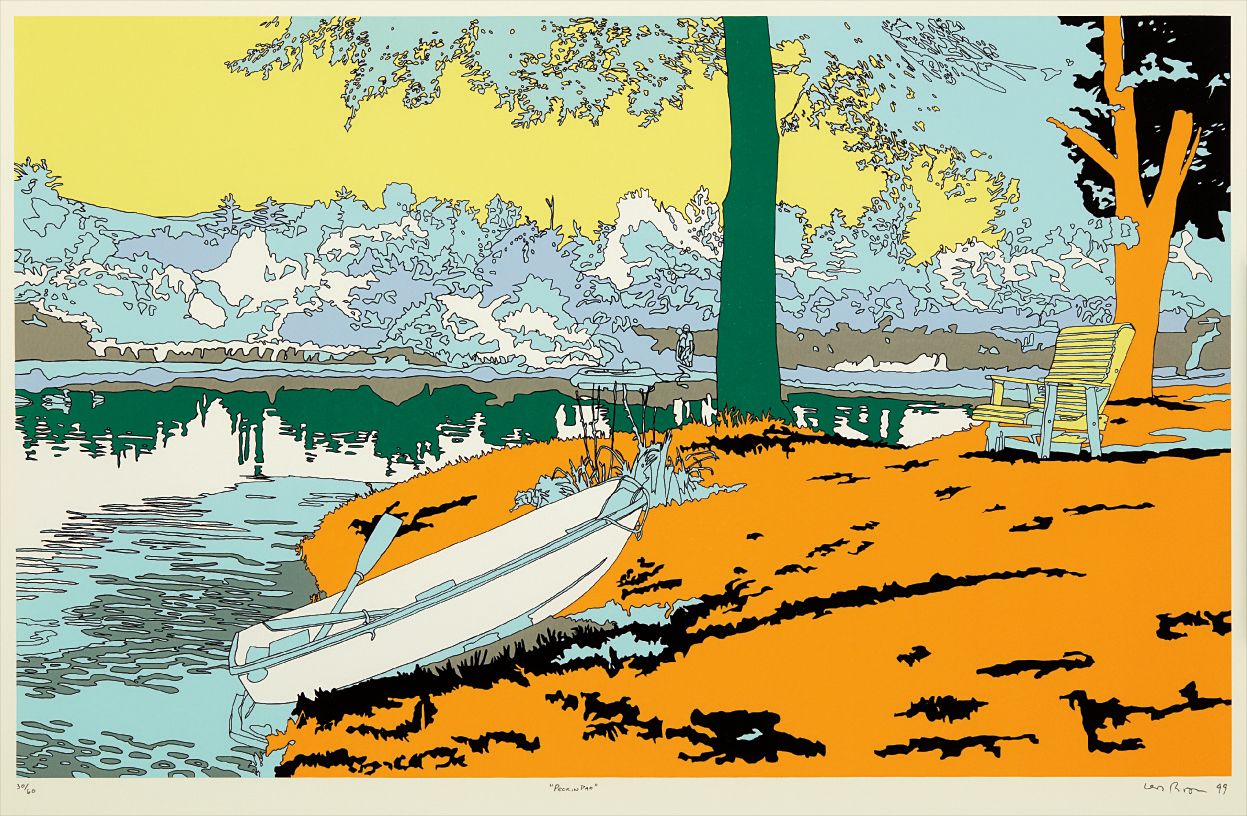
Works such as "Beyond the Forest" and "Where The Sidewalk Ends," rendered as woodcuts in colors on Japanese Unryu shi paper, demonstrate Ruyter's sensitivity to the specific material possibilities of each medium. The texture of Unryu shi paper, with its translucent fiber inclusions, creates an almost luminous ground that inflects the image with a quality quite different from his painted canvases. Similarly, screenprints on Moulin des Berger paper, such as "Peckinpah," show an artist who understands that printmaking is not merely a means of reproduction but a distinct artistic act with its own expressive range. The edition of "The Women," published by the Alan Cristea Gallery in London in a run of 35 signed and numbered impressions with five artist's proofs, is a particularly sought after example, marrying the institutional credibility of a serious print publisher with Ruyter's gift for charged, evocative imagery.
Francis Ruyter
Where The Sidewalk Ends
For collectors, Ruyter's work occupies an enviable position: it is held in the permanent collections of institutions that represent the highest standard of curatorial judgment in the United States. The Museum of Modern Art in New York, SFMOMA, the Pérez Art Museum Miami, and the Denver Art Museum have each made the considered decision to bring his work into their holdings, a signal that speaks clearly to the lasting quality and relevance of his practice. Institutional validation of this kind is meaningful precisely because it reflects the opinion of curators who think in terms of decades and art historical consequence rather than market cycles. For a private collector, that context is invaluable.
It means that a Ruyter painting or print enters a collection already carrying the endorsement of some of the most rigorous eyes in the field. The market for Ruyter's work rewards patient, attentive collectors. His paintings on canvas, particularly those from the late 1990s and early 2000s, represent the core of his critical reputation and are the works most directly engaged with the photographic source methodology that defines his practice. Editions such as those published by Alan Cristea Gallery offer an accessible entry point without sacrificing quality or significance, and the careful documentation of those prints, signed, numbered, and framed, reflects a professional rigor that serious collectors appreciate.
Francis Ruyter
Peckinpah
As awareness of his work continues to grow, driven in part by increasing scholarly attention to the generation of American painters who complicated and extended the legacy of Pop, the opportunity to acquire works at this moment feels both timely and clear sighted. To understand Ruyter fully it helps to place him within the broader constellation of American painters who have taken the photograph as their raw material. One thinks of the cool precision of Richard Prince, the appropriative strategies of Sherrie Levine, and the cinematic atmosphere that runs through the work of Eric Fischl. But Ruyter's work does not merely echo those precedents; it finds its own emotional register, one that is at once analytical and quietly melancholic, curious about what images conceal as much as what they reveal.
His titles alone suggest a sensibility drawn to threshold moments, to the space just before or just after an event, a quality that gives his paintings an almost narrative tension that keeps the viewer engaged long after first encounter. What makes Francis Ruyter a genuinely important figure in contemporary American art is the consistency and ambition of a practice that has never chased fashion or easy recognition. From his early formation in Washington, DC through the critical recognition afforded by MoMA Projects 77, through a sustained engagement with both painting and printmaking that has produced works now held in some of America's great museums, he has built something durable. His work reminds us that the images we inherit from photography and popular culture are not passive; they are alive with the expectations, anxieties, and aspirations of the moments that produced them.
To collect Ruyter is to acquire a painting or print that takes that seriously, and that asks the viewer to take it seriously too.