Félicien Rops
Félicien Rops, The Visionary Who Rewrote Everything
Artist Spotlight · The Collection Editorial
Imagine standing in a Brussels printmaking studio in the 1860s, the air thick with acid fumes and ink, watching a young Belgian artist drag a needle across a copper plate with the precision of a surgeon and the abandon of a poet. That artist was Félicien Rops, and what he was etching onto metal he was simultaneously etching into the history of European art. Today, nearly 130 years after his death, Rops commands serious attention from collectors, scholars, and curators who recognize in his work something that feels perpetually modern: a refusal to look away from the uncomfortable, the erotic, the sacred and the profane held in the same trembling hand. Rops was born in Namur, Belgium, in 1833, into a bourgeois family that gave him both the means and the expectations he would spend his career gleefully subverting.
Félicien Rops
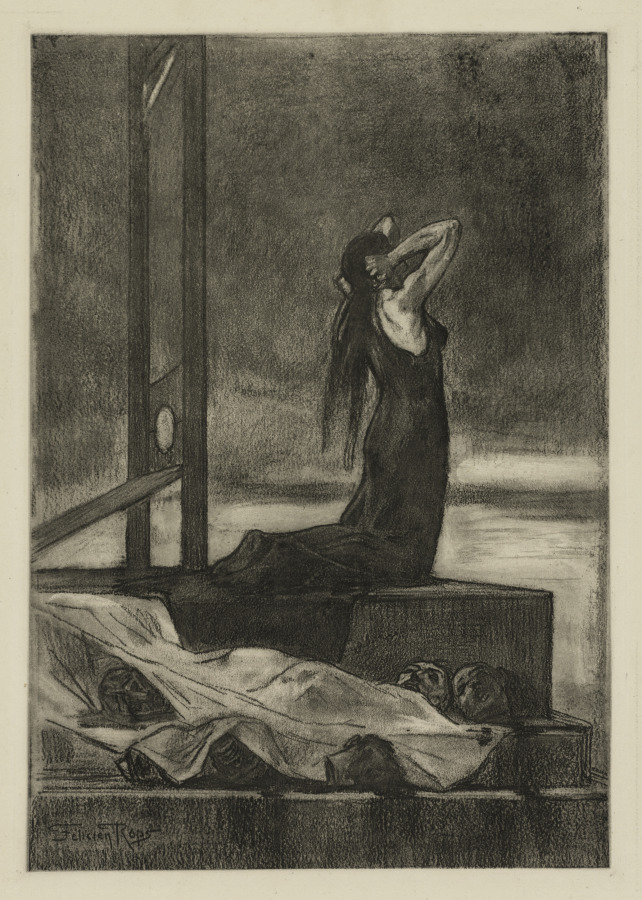
Capital Punishment: The Pain of Death (Todesstrafe: La peine de mort), 1880
He studied at the Université Libre de Bruxelles, where he developed not only his draftsmanship but his appetite for intellectual provocation. The Belgium of his youth was a nation newly formed, culturally ambitious, and socially stratified in ways that invited satirical dissection. Rops was constitutionally incapable of ignoring the absurdities he saw around him. He co founded the satirical journal Uylenspiegel in 1856, a publication that served as both a creative laboratory and a declaration of intent.
The journal announced that art could be politically sharp, visually daring, and morally fearless all at once. His early lithographs, including the pointed social commentary of his 1856 work Crinolinographies, show a young artist already in full command of caricature as a weapon. The piece, which proposes a costume for the magistrature, is equal parts wit and indictment, skewering legal authority with the elegance of someone who has studied Daumier carefully and decided to push further. That same year he produced Ostend, a lithograph that captures a solitary figure against an immense seascape, demonstrating that Rops was never merely a satirist.
Félicien Rops
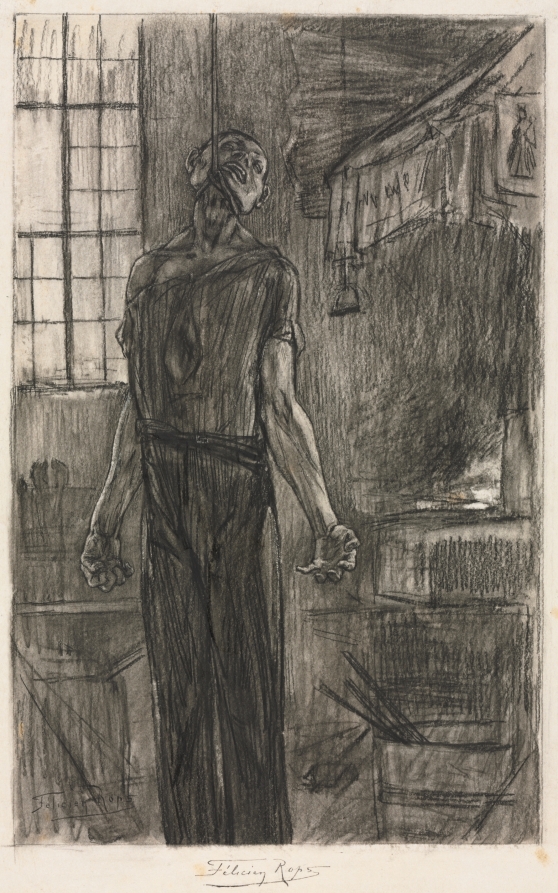
The Hanged Man in the Forge, 1875
He was also a lyricist capable of genuine atmospheric weight. These twin impulses, the biting and the beautiful, would define everything that followed. By the 1860s Rops had entered the orbit of Charles Baudelaire, a friendship and creative alignment that proved decisive. Baudelaire recognized in Rops a visual imagination that matched his own literary one, and Rops produced illustrations for several Symbolist and Decadent writers who saw him as their natural visual counterpart.
His 1867 etching and aquatint on chine collé illustrating the Legend and Adventures of Ulenspiegel reveals an artist who had mastered the technical vocabulary of printmaking and was now deploying it with full expressive freedom. The chine collé technique, which bonds thin paper to a heavier support during printing, gives the work an almost luminous quality, as though the image exists slightly outside normal physical space. It is the kind of technical and conceptual fusion that marks a true master of the medium. The works from the 1870s and 1880s represent the peak of Rops at full power.
Félicien Rops
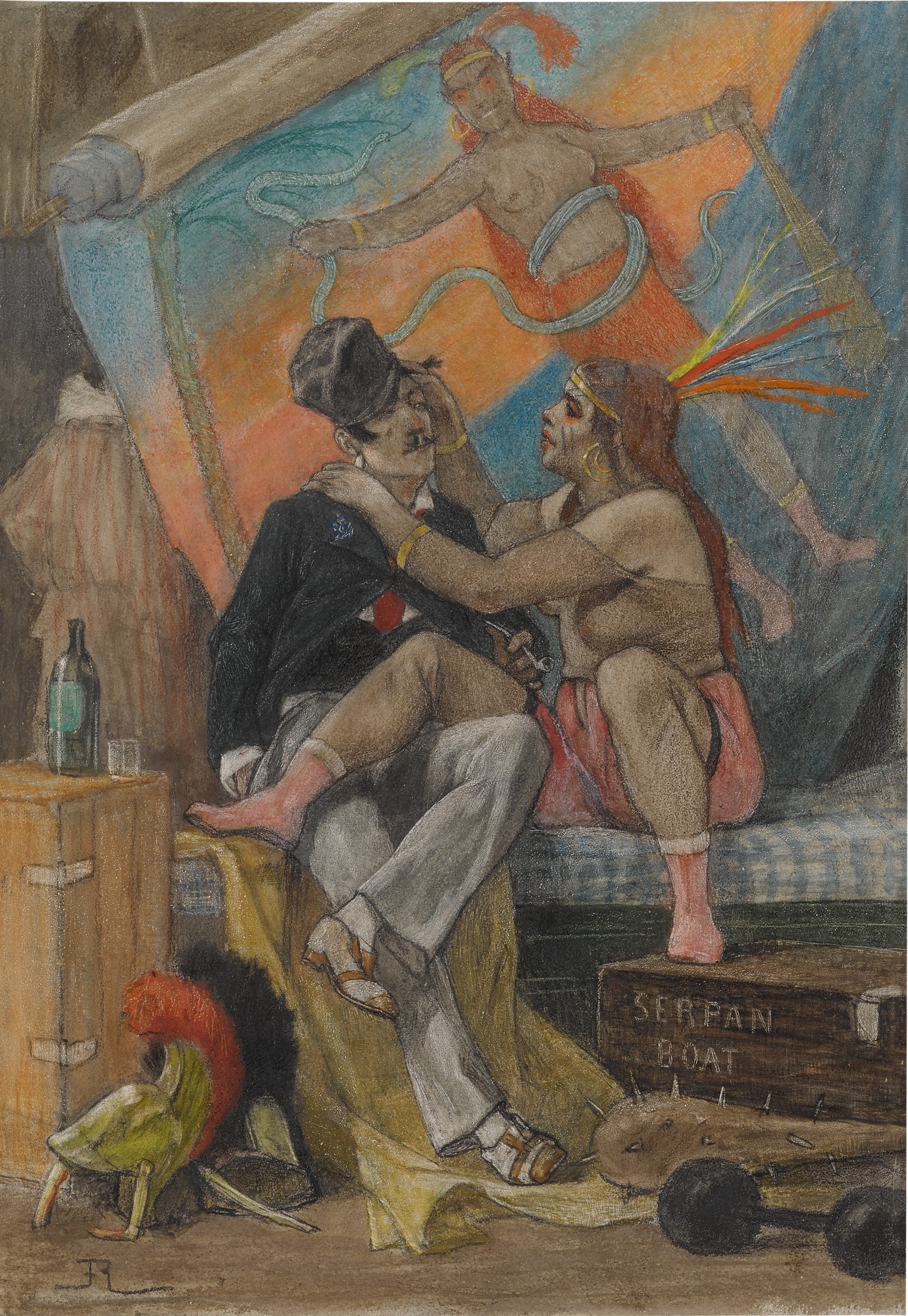
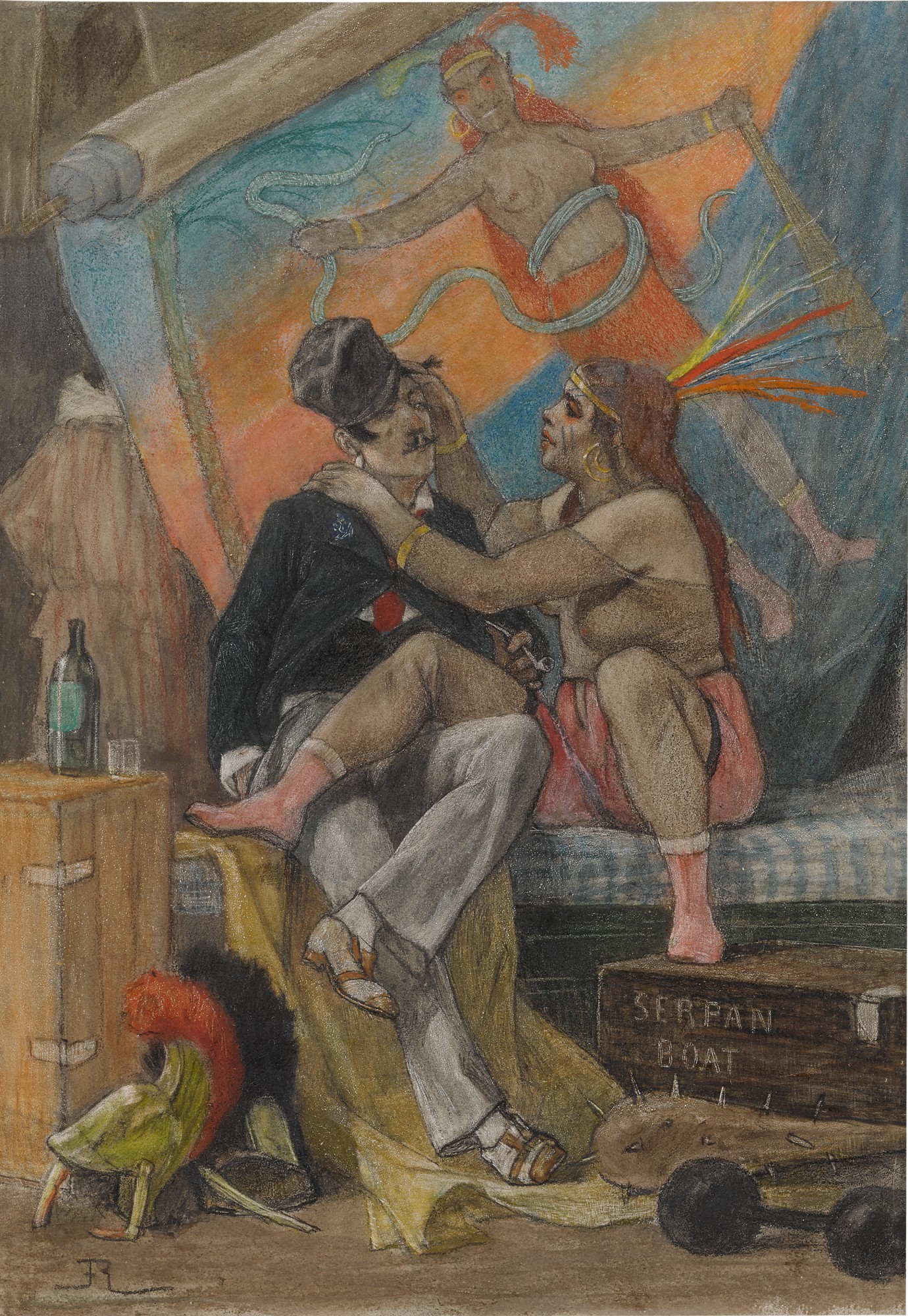
L’Homme à la femme sauvage, 1878
His 1878 pastel on paper L'Homme à la femme sauvage is a work of extraordinary psychological charge, the medium of pastel deployed not for its conventional softness but for an almost feverish intensity. His Capital Punishment print from 1880 and The Hanging of Levallois Perret from the same year demonstrate his ongoing fascination with mortality, justice, and the spectacle of state power. These are not comfortable works. They are designed to produce discomfort, to make the viewer conscious of their own position as witness to violence both physical and institutional.
The softground etching technique used in Capital Punishment allows for a line quality that mimics pencil or chalk, lending a deceptive intimacy to a deeply disturbing subject. For collectors, Rops presents a genuinely compelling proposition. His technical range is exceptional, encompassing lithography, etching, aquatint, softground etching, pastel, chalk, and graphite, and within each medium he achieved a level of mastery that rewards close looking. Works on paper by Rops appear at major auction houses with regularity, and the market reflects growing appreciation for Symbolist and Decadent era works broadly.
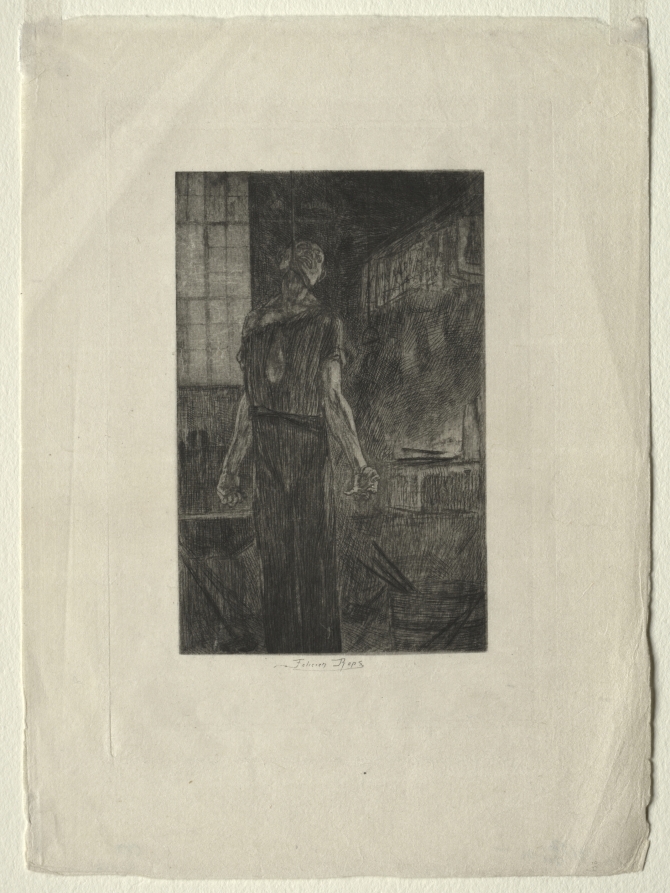
Félicien Rops
The Hanging of Levallois-Perret, 1880
His prints in particular offer an accessible entry point into a body of work that sits comfortably alongside Odilon Redon, James Ensor, and Max Klinger in the imagination of serious collectors. The Belgian connection to Ensor is especially instructive. Both artists were products of a small nation with an outsized artistic ambition, and both found in the grotesque a language precise enough for what they needed to say. Contextually, Rops belongs to a constellation of late nineteenth century artists who refused the decorum of academic tradition and pushed toward something rawer and more psychologically honest.
He is a natural companion to Gustave Moreau in his Symbolist leanings, to Francisco Goya in his willingness to confront violence and desire without flinching, and to Aubrey Beardsley in his understanding of the erotic as a site of genuine philosophical inquiry rather than mere titillation. The Viennese Secession artists who came a generation later owed him a debt they rarely acknowledged publicly. When you look at certain drawings by Egon Schiele or prints by Max Klinger, you can sense Rops somewhere in the background, having already cleared the path. The legacy of Félicien Rops is that of an artist who understood, perhaps before almost anyone else in his era, that art's power lies precisely in its ability to make us feel things we would prefer not to feel.
His Winter Evening from 1863, worked in black crayon, chalk, graphite, and gray wash with white chalk highlights, is a piece of almost consoling beauty, proof that the same hand capable of the most provocative imagery could also achieve genuine tenderness. That range is what distinguishes him from mere provocateurs. Rops was not interested in shock as an end in itself. He was interested in truth, in all its uncomfortable, luminous, and occasionally savage forms.
For collectors who prize works that sustain attention and reward repeated looking, Félicien Rops remains one of the great discoveries waiting to be made.
Featured Works
Capital Punishment: The Pain of Death (Todesstrafe: La peine de mort)
1880
The Hanged Man in the Forge
1875
L’Homme à la femme sauvage
1878
The Hanging of Levallois-Perret
1880
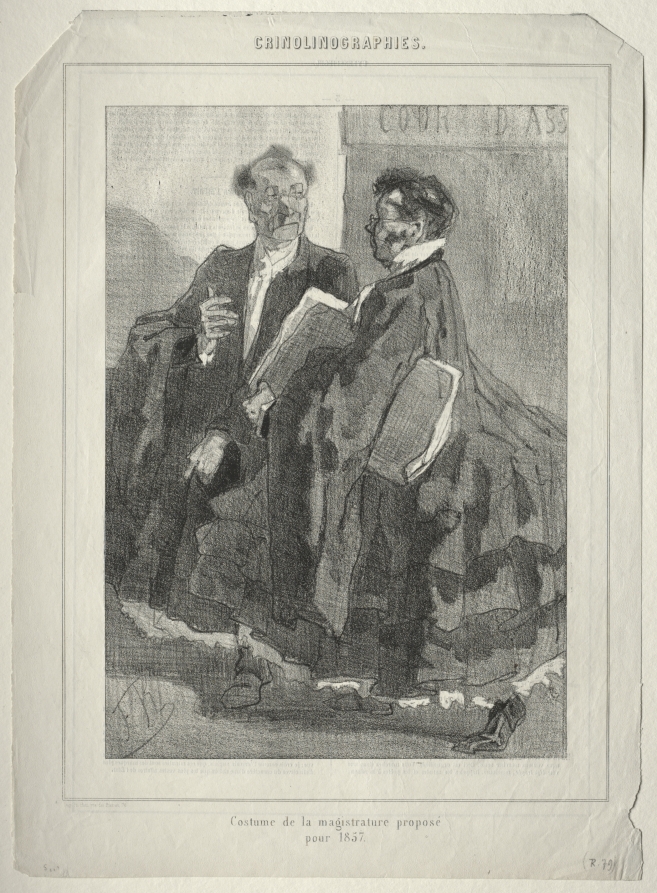
Crinolinographies (Costume de la magistrature proposé pour 1857)
1856
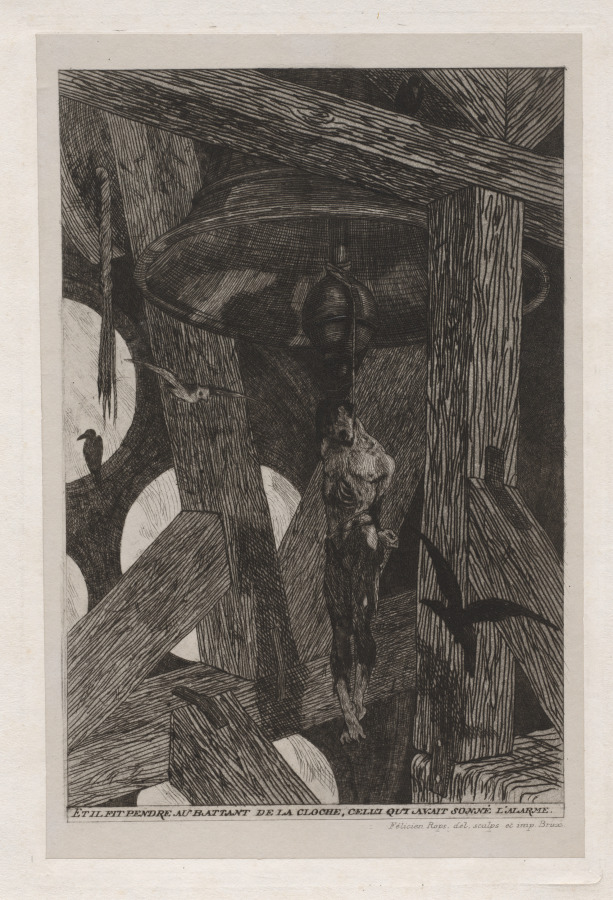
The Legend and Adventures of Ulenspiefel and Lamme Goedzak: The Hanged Man (La legende et les aventures d'Ulenspiegel et Lamme Goedzak: Le pendu)
1867
Explore books about Félicien Rops
Félicien Rops: Catalogue Raisonné of his Prints
Loys Delteil
Félicien Rops 1833-1898
Bénédict Nicolson
Rops: Les Estampes et les Albums
Émile Bergerat
Félicien Rops: The Satanist Sketches and Demonic Inspirations
Jean Pierrot
Félicien Rops: Catalogue of the Exhibition at the Musée de Namur
Musée de Namur Staff