Eliot Greenwald
Dreaming at Speed in Rural America
Artist Spotlight · The Collection Editorial
Something quietly extraordinary is happening in the hill towns of western Massachusetts. In Ashfield, a small farming community tucked into the folds of the Berkshire foothills, the self taught painter and sculptor Eliot Greenwald has been building one of the most visually arresting bodies of work in contemporary American art. His Night Car series, a sustained and deeply personal investigation into motion, suspension, and the spiritual charge of everyday objects, has begun attracting the attention of serious collectors who recognize in his saturated, amorphous canvases something genuinely rare: a visual language that feels entirely invented and yet somehow deeply familiar, like a dream you are certain you have had before. Greenwald arrived at his practice not through the corridors of art school but through the more circuitous and arguably more honest path of self discovery.
Eliot Greenwald
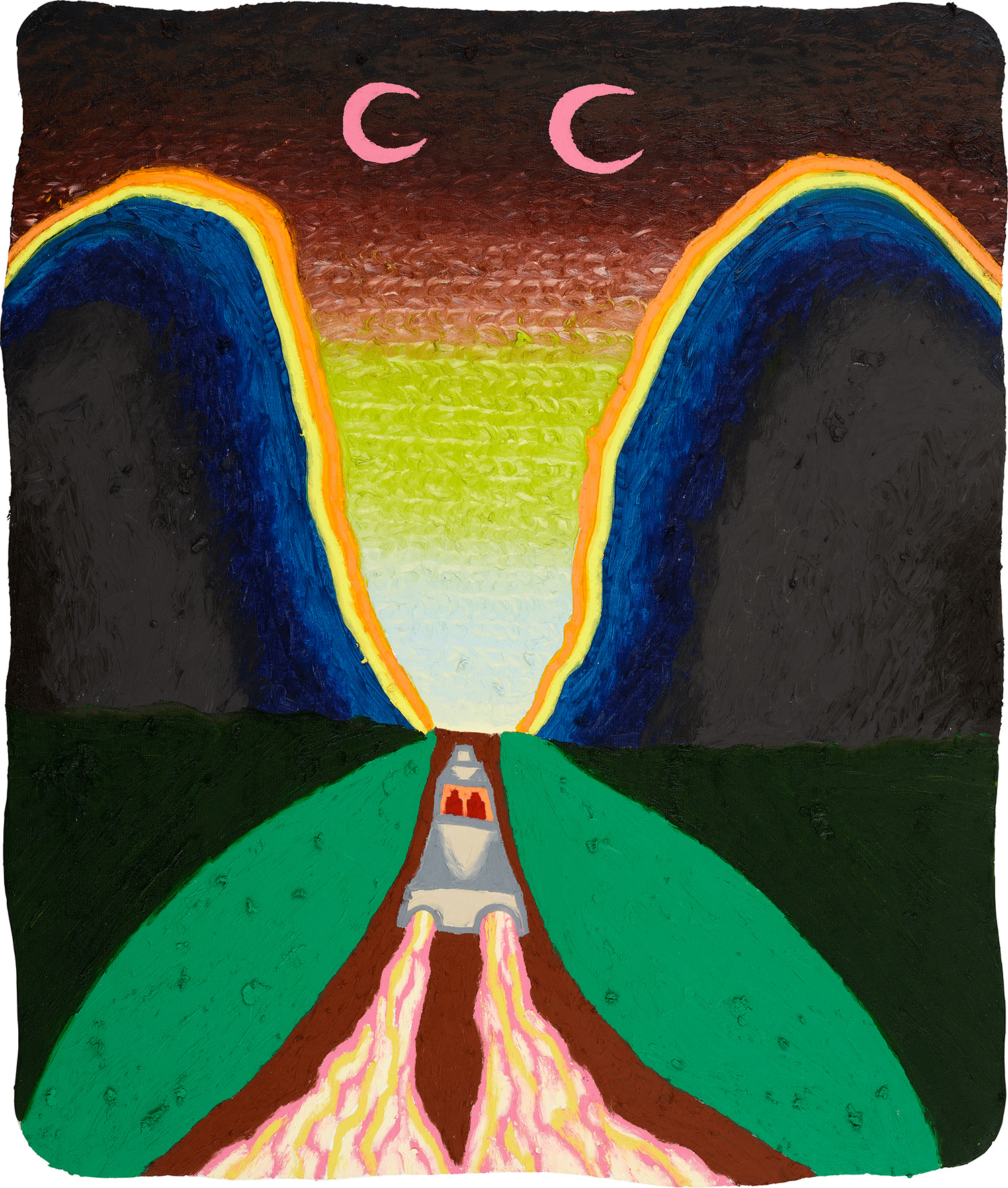
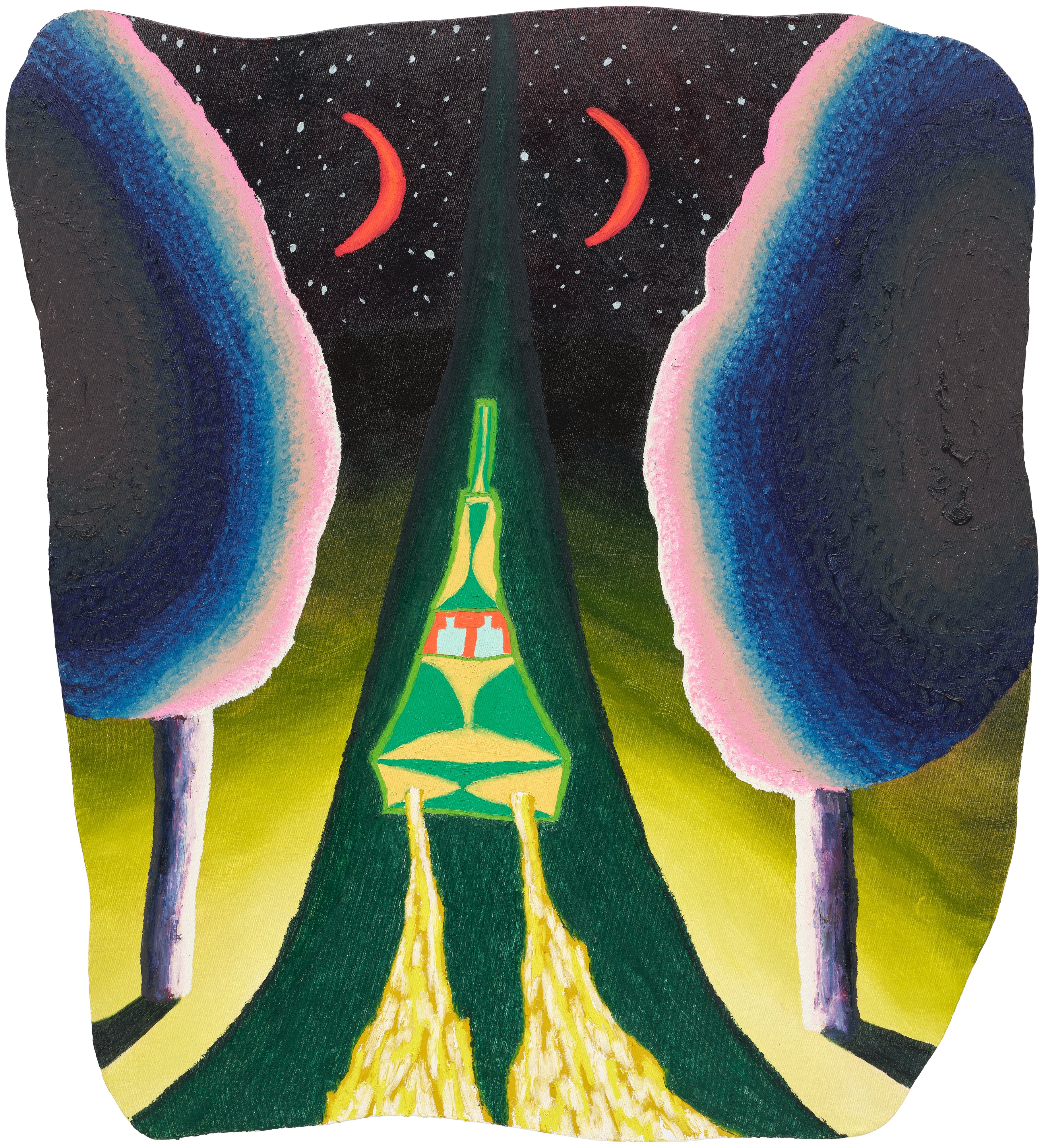
Night Car (ear here), 2020
Working without the scaffolding of institutional critique or the anxieties of an MFA cohort, he developed a sensibility that owes as much to American vernacular culture, the roadside, the drive in, the hallucinatory promise of the open highway, as it does to the formal traditions of painting. His base in rural Massachusetts is not incidental to his work. The particular quality of light in that landscape, the sense of isolation threaded with connection, the feeling that time moves differently outside of cities, all of it saturates the Night Car paintings with a mood that is simultaneously provincial and cosmic. The development of Greenwald's practice reflects a deepening commitment to the shaped canvas as a primary expressive tool.
His works are not simply paintings that happen to have unusual edges. The contours of each piece are integral to its meaning, allowing the image to exist somewhere between a painting and a sculptural object, between a picture plane and a physical presence in the room. This quality gives his work an almost totemic force. When you stand before one of his shaped canvases, mounted on board and radiating its extraordinary palette of electric greens, deep purples, acid yellows, and luminous reds, you feel that you are encountering something that has been conjured rather than simply made.
Eliot Greenwald
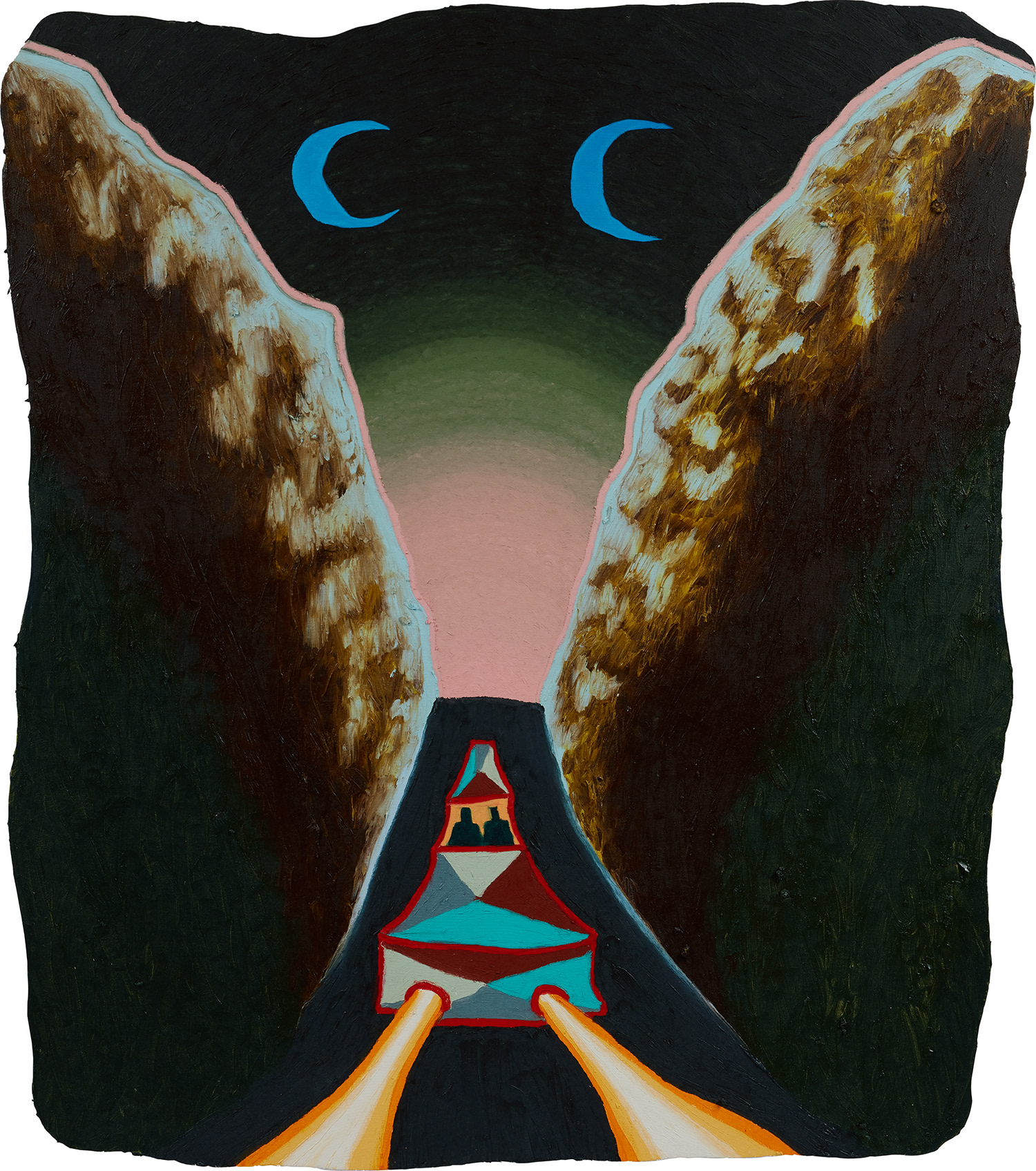
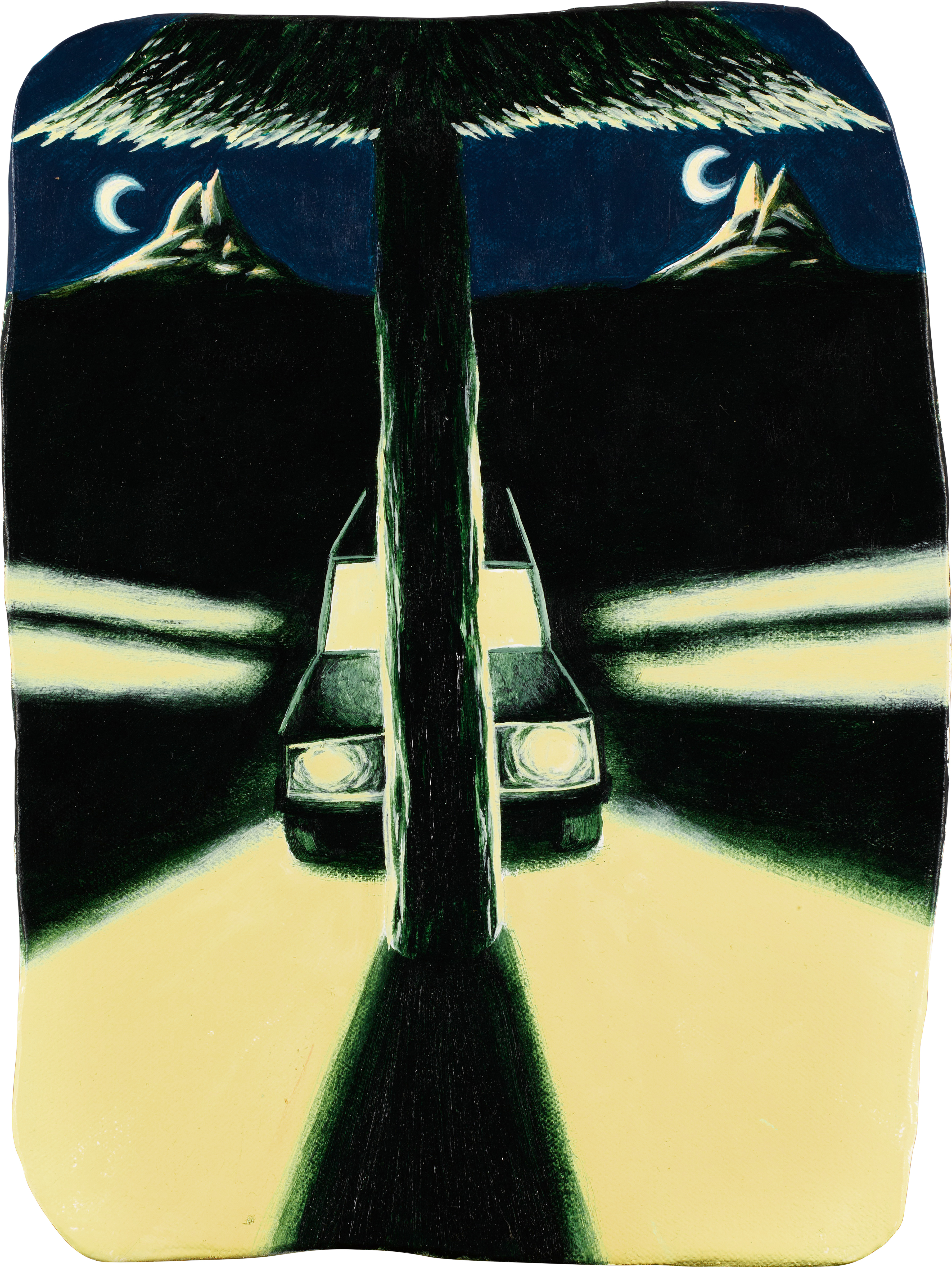
Night Car (vague distinction 3), 2021
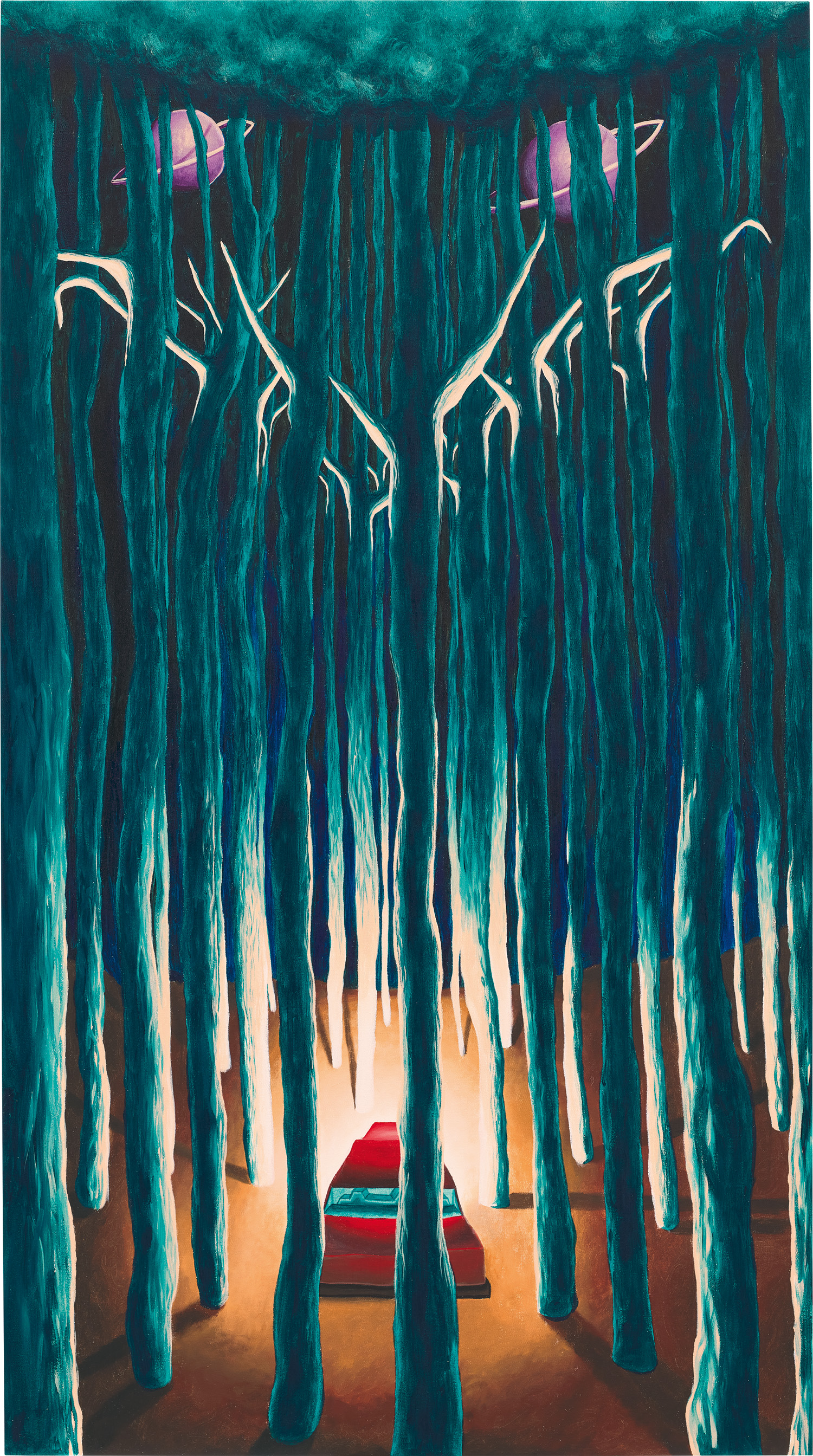
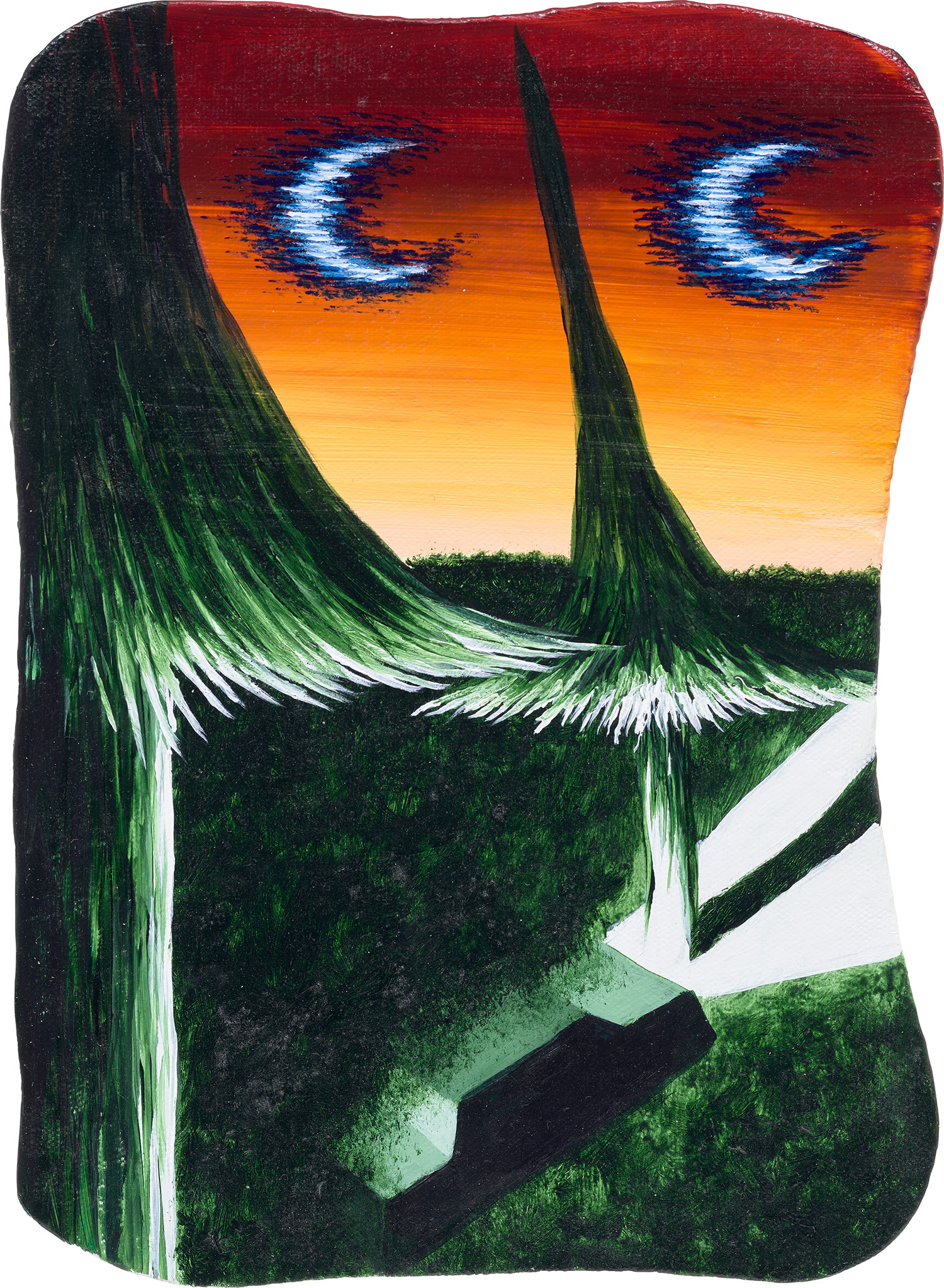
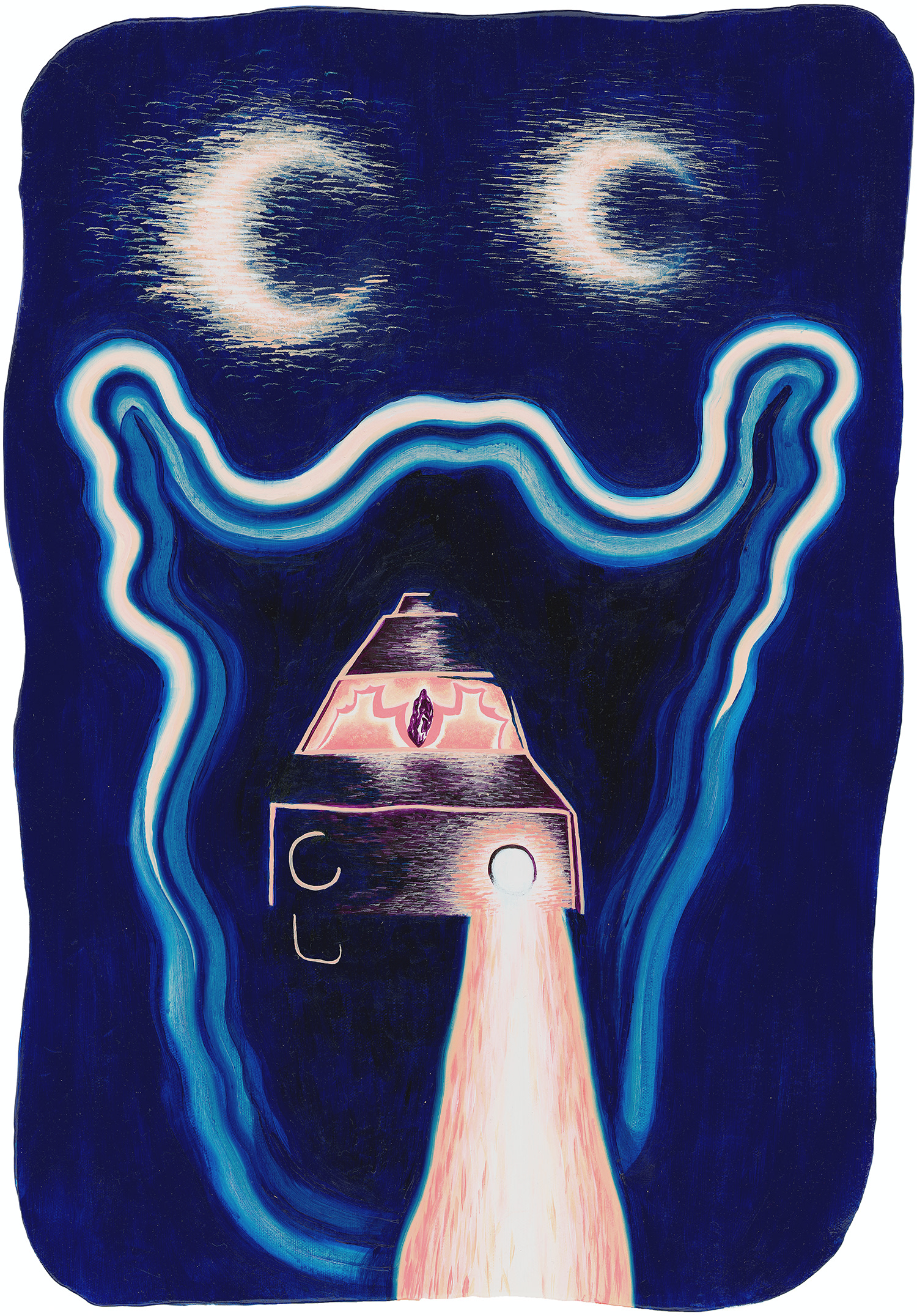
The hand of the artist is everywhere, in the molded edges, the impastoed surfaces, the sense that the canvas itself has been dreamed into its current form. The Night Car series, begun in earnest around 2020, represents the fullest expression of Greenwald's vision to date. Works such as Night Car (Calcification), Night Car (begins to vanish), and Night Car (Tall Tree), all produced in that remarkably fertile year, establish the essential grammar of the series. A vehicle, always recognizable as a car and yet always hovering at the edge of transformation, moves through a landscape that is part American Gothic, part science fiction, part pure psychic space.
In Night Car (Division), the shaped canvas pushes the image into three dimensions in a way that makes the car feel genuinely airborne, suspended in a moment between departure and arrival that may never resolve. Night Car (jungle egg), produced in 2021 using oil stick on shaped canvas, introduces a new level of biomorphic strangeness, as though the vehicle is in dialogue with organic forms that have no name in ordinary taxonomy. These are paintings about the uncertainty of time, about what Greenwald himself understands as the spiritual force latent in objects we take for granted. Greenwald's medium choices are as considered as his imagery.
Eliot Greenwald
Night Car (Division)
He works in acrylic, in oil stick, and in combinations of the two, each medium contributing a different quality of mark and light. The oil stick works, including Night Car (ear here) and Night Car (vague distinction 1), have a particular urgency and physicality, the lines feeling drawn from somewhere close to the nervous system rather than the analytical mind. His use of highly saturated color is not decorative but structural. Color in these paintings carries emotional and almost narrative weight, the deep night blues pressing against the phosphorescent pinks and oranges in a way that suggests not just nocturnal light but the entire temperature of a particular psychological state.
Collectors who have spent time with these works often describe the experience of living with them as unusually active, as though the painting continues to move and breathe after you have turned away. For collectors considering Greenwald's work, the moment feels genuinely significant. His practice sits at an interesting intersection of several currents that have gained considerable momentum in recent years. The renewed appetite for visionary and psychedelic American art, the growing appreciation for self taught and outsider adjacent practices that nonetheless operate with complete formal sophistication, and the collector enthusiasm for shaped and sculptural painting that has defined so much of the most interesting work of the last decade, all of these trajectories converge in Greenwald's canvases in a way that feels organic rather than calculated.
Eliot Greenwald
Night Car (begins to vanish), 2020
Artists whose work resonates alongside his include Peter Saul, whose exuberant cartoon grotesquerie shares a certain American dreamscape DNA, and the shaped canvas pioneers associated with the post minimalist generation, though Greenwald arrives at his forms from a place of pure intuition rather than theoretical program. There is also something in the Night Car paintings that echoes the visionary Americana of folk traditions and the roadside art that has always existed at the margins of the official art world, transformed here into something of genuine formal ambition. What Greenwald offers the art world, and what makes him a figure to watch with sustained attention, is the proof that a genuinely original sensibility can still emerge outside the usual networks and institutions. His Ashfield studio is as far from the Chelsea gallery circuit as it is possible to be while remaining within the same cultural conversation, and yet the work that comes out of it speaks with complete authority to some of the most urgent questions in contemporary painting: What does it mean to depict movement in a static medium?
How does an object accrue spiritual meaning? What is the relationship between the cartoon, the dream, and the sacred? These are not small questions, and Greenwald addresses them with a vision that is unmistakably his own. The cars roll through the night, glowing and vanishing and calcifying and dividing, and we follow them into a landscape that feels, somehow, like home.
Featured Works