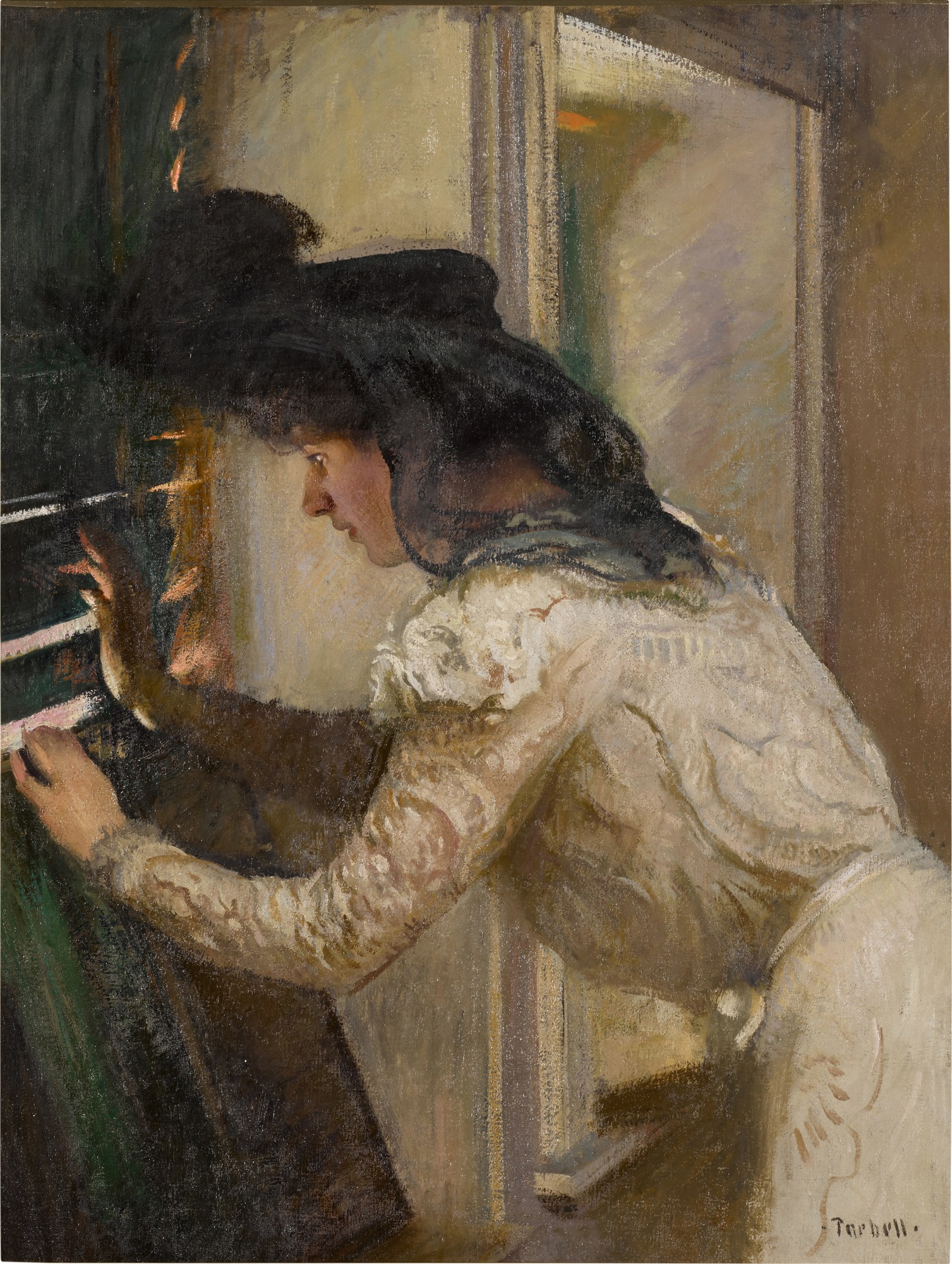
Edmund Charles Tarbell
1
Works
Edmund Charles Tarbell was a leading American Impressionist painter and influential teacher, best known for his luminous interior scenes and elegant portraits of women in domestic settings. Born in West Groton, Massachusetts, Tarbell studied at the School of the Museum of Fine Arts, Boston, and later at the Académie Julian in Paris, where he was exposed to French academic techniques and the emerging Impressionist movement. He became a central figure in the Boston School, a group of artists who adapted Impressionist principles to more refined, classical compositions, emphasizing subtlety of light, tonal harmony, and technical precision. Tarbell's most celebrated works include his interior paintings from the 1890s and early 1900s, such as "In the Orchard" (1891), "The Blue Veil" (1898), and "Girl Crocheting" (1904). These paintings typically feature fashionably dressed women in sun-dappled rooms or gardens, rendered with a sophisticated understanding of natural light and atmospheric effects. His work balanced Impressionist concerns with light and color against a more traditional, academic approach to form and composition. Tarbell was equally accomplished as a portraitist, receiving commissions from Boston's social elite and creating works that combined psychological insight with technical mastery. As an educator, Tarbell profoundly influenced American art through his four-decade teaching career at the Museum of Fine Arts School in Boston, where he served alongside his colleague Frank Benson. His emphasis on direct observation, craftsmanship, and the study of Old Masters shaped generations of American painters. Tarbell was elected to the National Academy of Design and received numerous honors during his lifetime, including the position of Principal of the Corcoran School of Art in Washington, D.C. His work represents a distinctly American synthesis of Impressionist innovation and academic tradition, and remains highly regarded for its technical refinement and understated elegance.
Artists in conversation