Edgar Brandt
Edgar Brandt, Master Who Shaped Modernism
Artist Spotlight · The Collection Editorial
There is a moment, standing before the monumental wrought iron doors of the French Embassy in Washington, when you understand what it means for a material to be fully alive. The iron moves. It breathes. Serpentine tendrils and stylized blossoms coil and expand across the surface with a confidence that belongs equally to nature and to the machine age.
Edgar Brandt
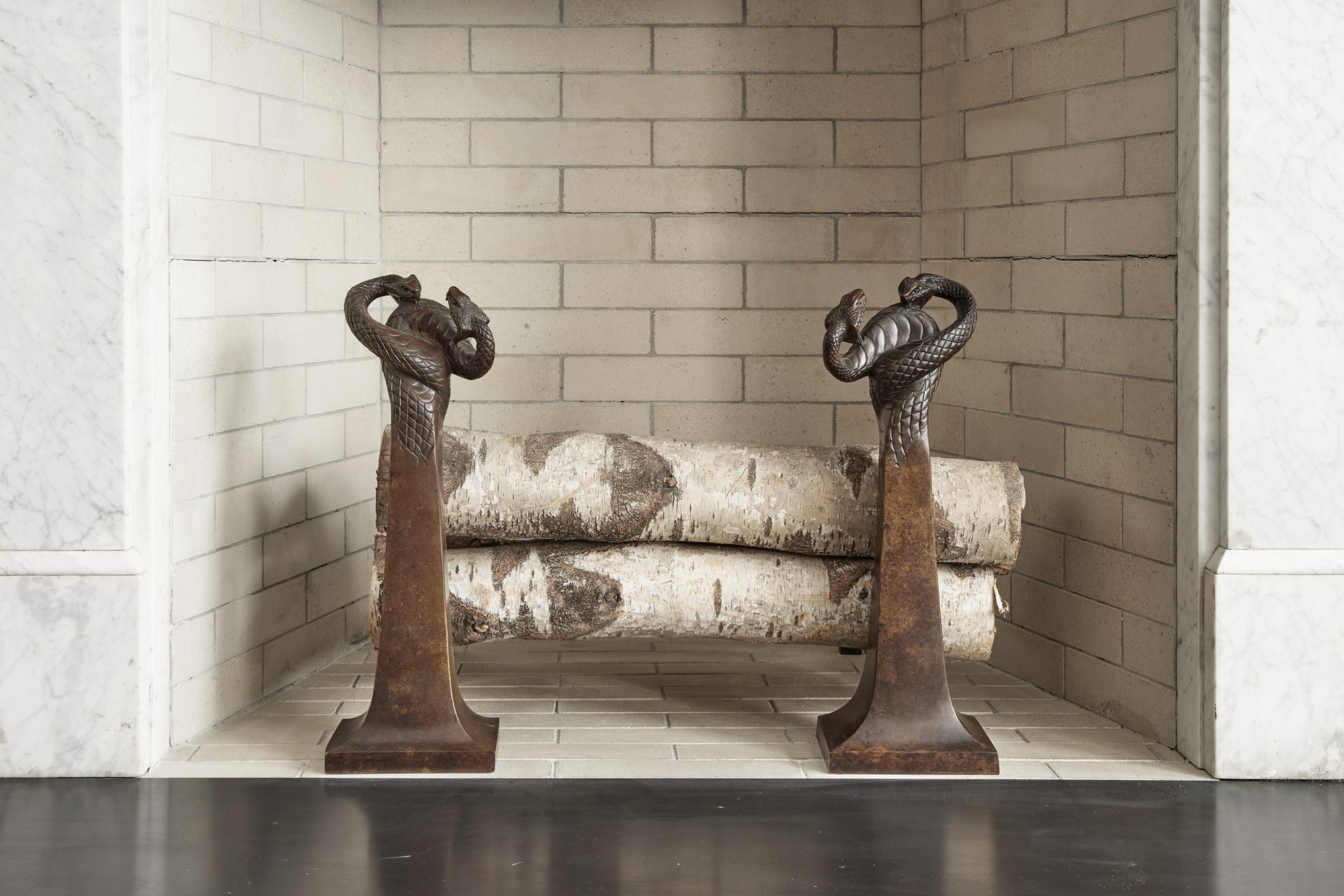
Pair of Andirons
These doors, among the most celebrated architectural metalwork commissions of the twentieth century, bear the unmistakable hand of Edgar Brandt, the French ironsmith who elevated a craft into a fine art and, in doing so, gave the Art Deco movement one of its most enduring and recognizable voices. Edgar William Brandt was born in Paris in 1880, arriving into a city that was remaking itself at every scale, from the grand boulevards Haussmann had sliced through its medieval core to the electric lights beginning to flicker along its arcades. He came of age in an era when the applied arts were being taken seriously as a vehicle for national prestige, and France, still processing the lessons of the 1900 Exposition Universelle, was producing craftsmen who moved fluidly between industry and ornament. Brandt trained as a metalworker from an early age, absorbing both the technical rigors of the forge and an instinctive feeling for decorative form.
By 1901, still in his early twenties, he had established his own workshop in Paris, a decision that announced both his ambition and his readiness. What set Brandt apart from contemporaries working in iron and bronze was his embrace of autogenous welding, a relatively new industrial technology that he recognized as a creative tool rather than merely a joining method. Welding allowed him to fuse elements with a fluidity that traditional wrought iron techniques could not easily achieve, and he exploited this freedom with exhilarating results. His forms loosened and expanded.
Edgar Brandt
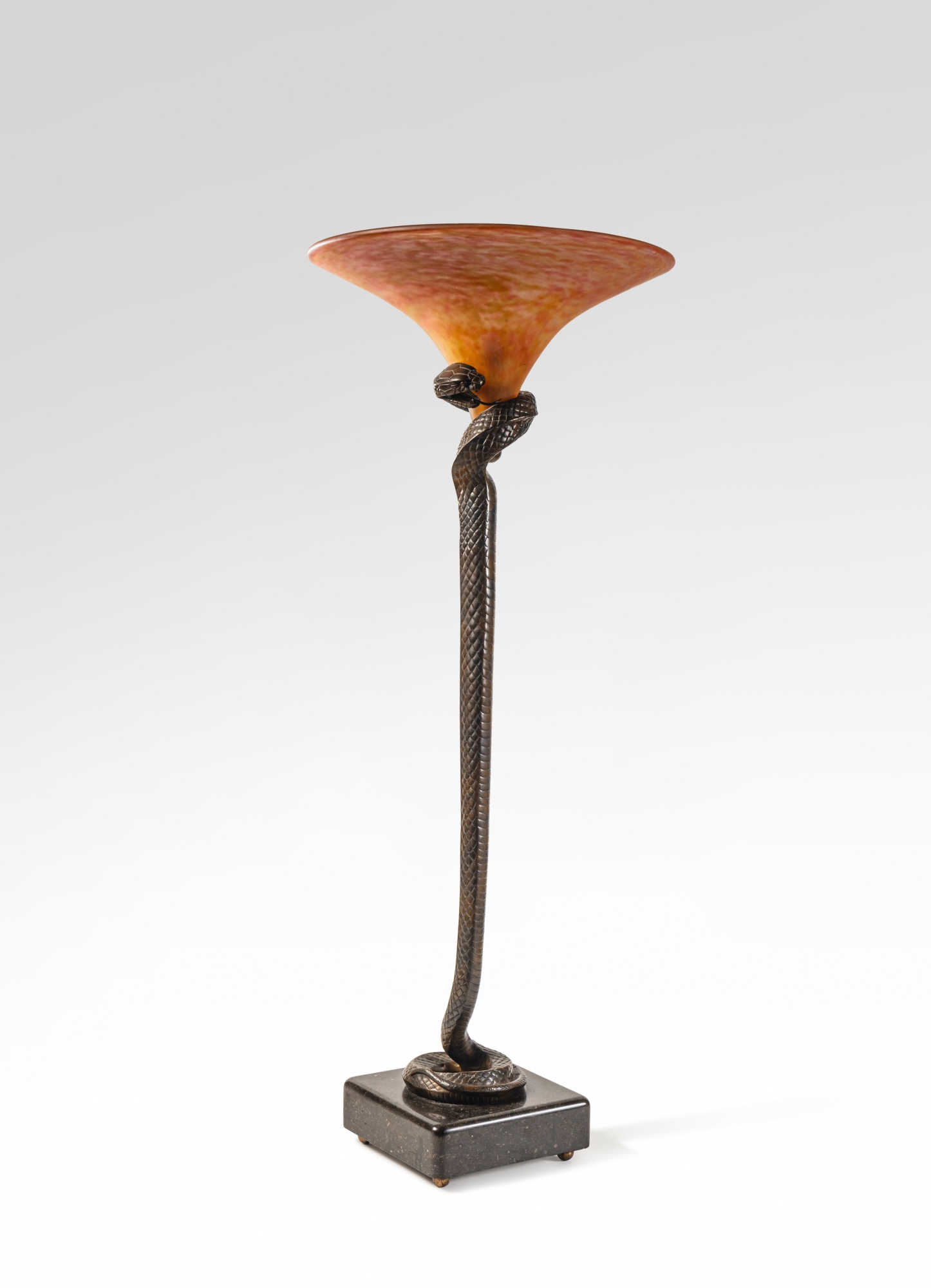
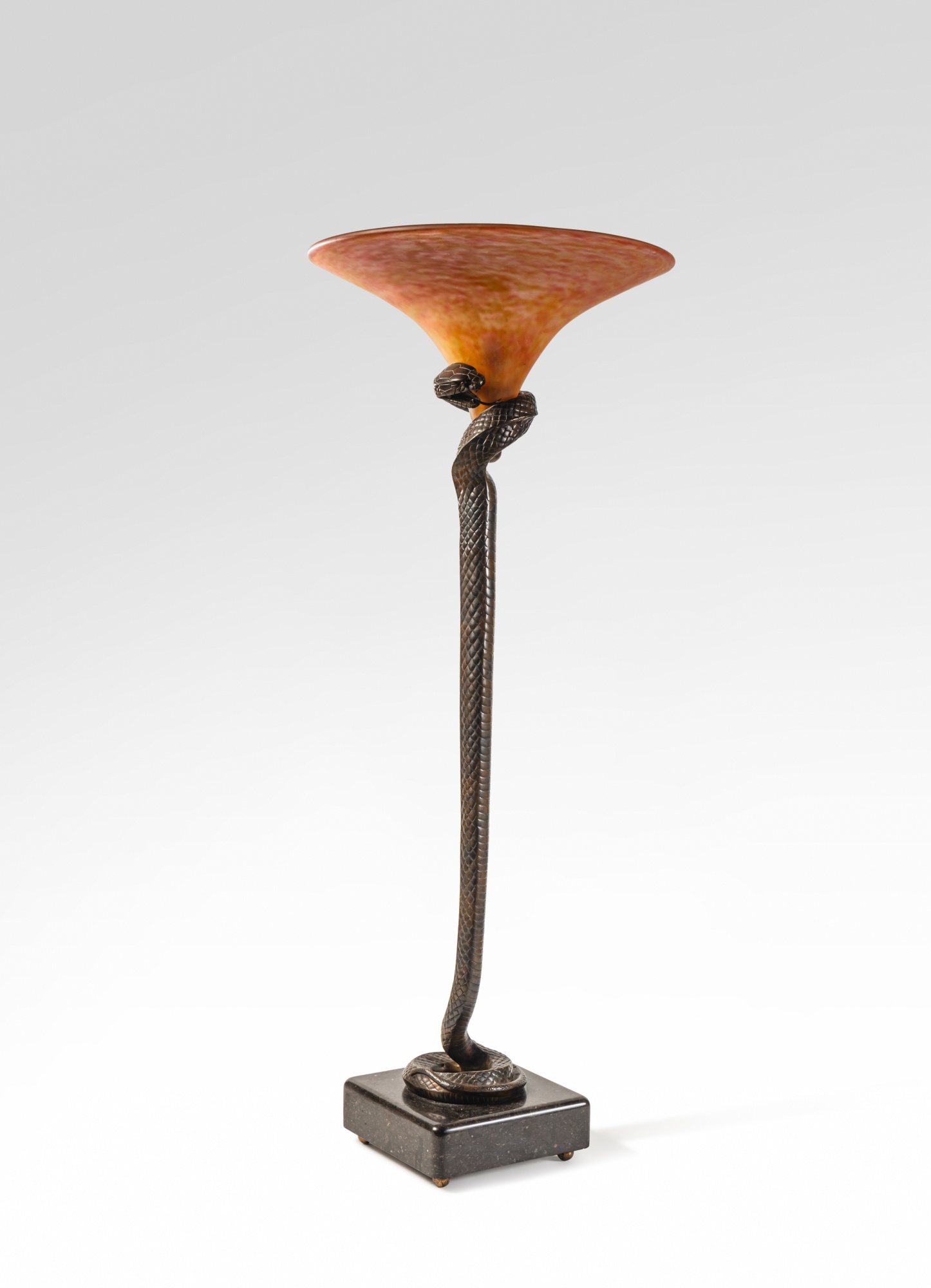
Lampe La Tentation
Fountains of iron seemed genuinely to splash. Cobras reared from lamp bases with a sinuous tension that felt sculptural rather than decorative. Brandt was not simply making beautiful objects; he was discovering what iron wanted to become when a skilled and imaginative hand met a modern process. The period between the First World War and the early 1930s represents the full flowering of Brandt's powers, and his participation in the landmark 1925 Exposition Internationale des Arts Décoratifs et Industriels Modernes in Paris marked his arrival at the center of the Art Deco world.
The exhibition, which gave the movement its very name, drew together the finest designers and craftsmen France could offer, and Brandt's contributions were among its most discussed. He collaborated with the architect Henri Favier on a series of monumental gates called Les Cigognes, and the work was widely reproduced and admired. His standalone pavilion at the exposition confirmed him as a figure of the first rank. Galleries and private clients across Europe and North America took notice, and commissions followed from institutions and individuals seeking to announce their modernity through his ironwork.
Edgar Brandt
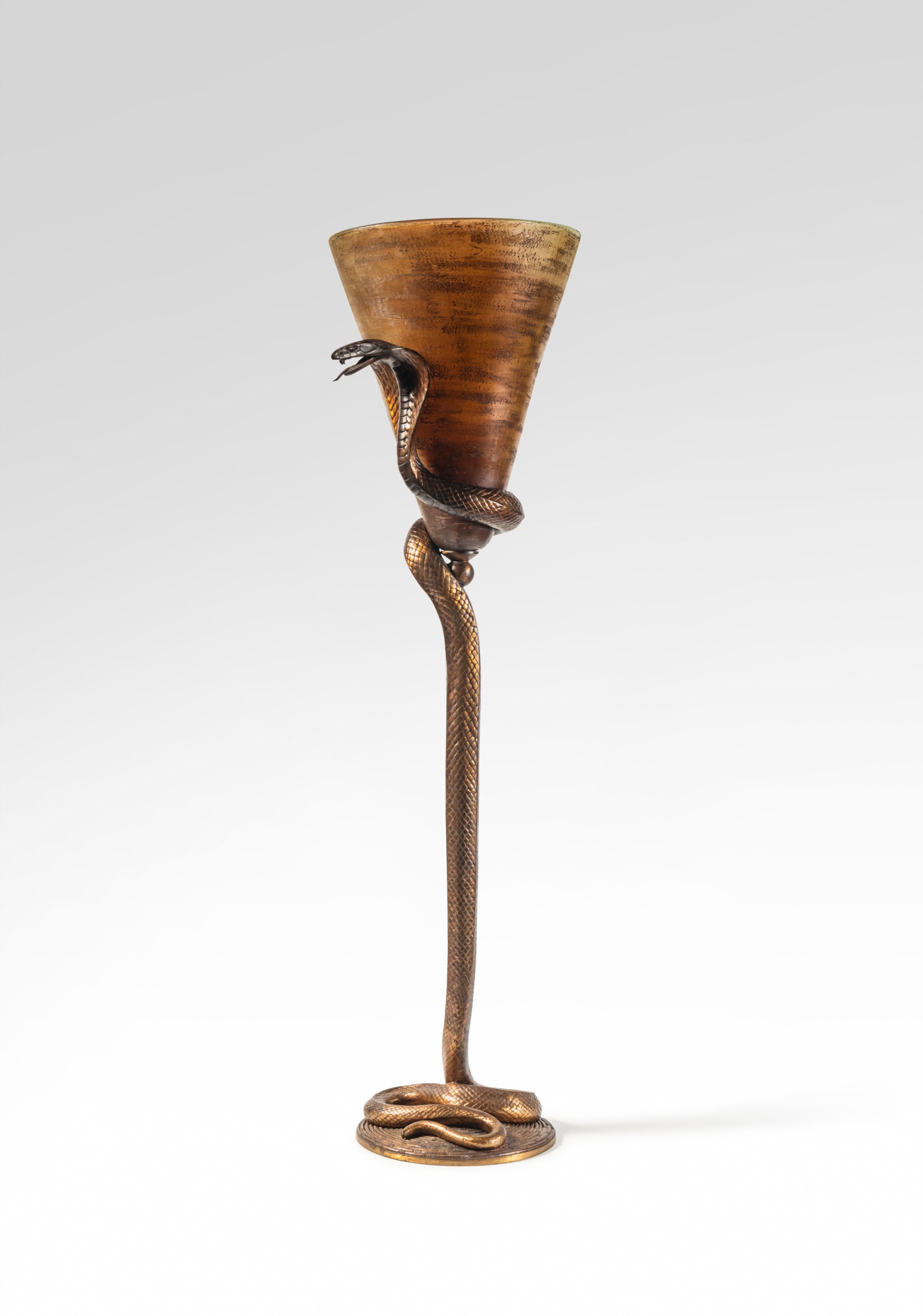
Lampe Cobra
Among the works that best reveal the range of Brandt's sensibility are those now available to collectors through The Collection. The Lampe Cobra, executed in gilded and patinated bronze with tinted glass, distills the Art Deco fascination with exotic fauna into an object of startling elegance. The cobra's pose is both threatening and graceful, and the glass shade it supports glows as if illuminated from within by the serpent's own energy. The Lampe La Tentation, combining patinated bronze with marmoreal glass and marble, operates in a register closer to classical allegory, its forms referencing the great tradition of European decorative arts while remaining unmistakably of its moment.
His Pair of Andirons and the Pair de chenets Paon, the peacock fireplace dogs, show how completely Brandt could transform functional objects into statements of aesthetic ambition. The peacock, one of the great talismanic motifs of the decorative arts since the Aesthetic Movement, becomes in Brandt's hands something wilder and more architectural. A Mirror from circa 1929 to 1932 rounds out the picture of a designer who understood that every surface in a well considered interior deserved his attention. For collectors, Brandt's work occupies a particularly attractive position in the market.
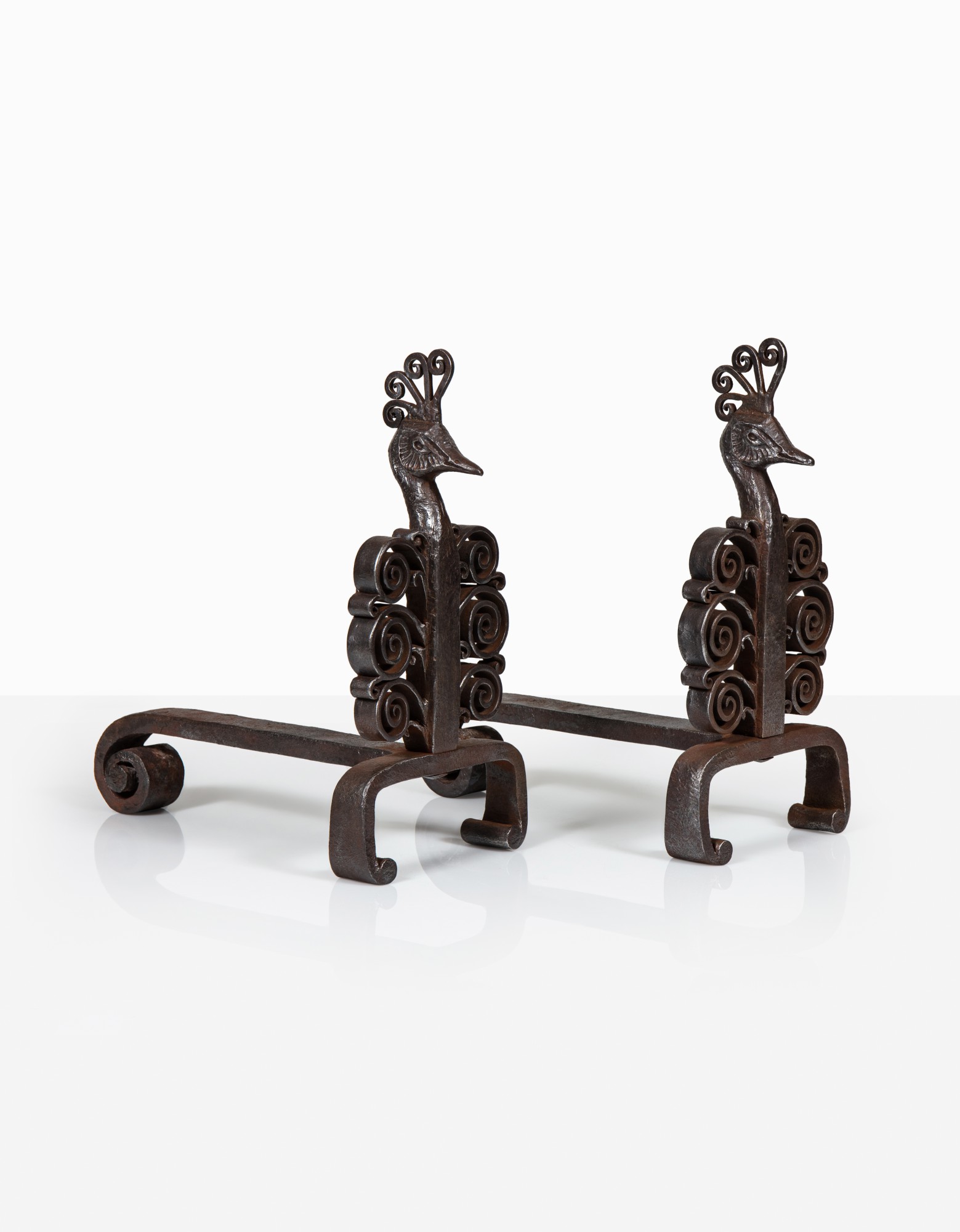
Edgar Brandt
Pair de chenets Paon
He is undeniably canonical, associated with the 1925 Exposition and with the broader French Art Deco achievement that now commands serious institutional and private attention worldwide. Major auction houses including Christie's and Sotheby's have consistently placed his pieces in their flagship decorative arts and design sales, and significant examples of his lamps and architectural metalwork have achieved prices that reflect both their rarity and their art historical importance. At the same time, Brandt worked prolifically and across a wide range of price points, meaning that engaged collectors at various levels of the market can find works that reward close looking. The key qualities to seek are the warmth and precision of his patination, the integration of glass and metal, and the sense that each piece has been resolved as a composition rather than assembled as a product.
Placing Brandt within art history means understanding him alongside a cohort of French designers who together defined the interwar decorative arts. Émile Ruhlmann brought the same rigorous seriousness to furniture that Brandt brought to ironwork, and the two were associated in the eyes of contemporaries as twin pillars of French craft excellence. The glasswork of René Lalique shares Brandt's appetite for natural motifs rendered with industrial precision. Among metalworkers, the American market was served by Brandt himself, who opened a New York showroom called Ferrobrandt in the 1920s, bringing his work directly to collectors across the Atlantic at a moment when American enthusiasm for French modernism was at its height.
Edgar Brandt died in 1960, having lived long enough to see the style he helped define move from the avant garde to the beloved and then into the kind of deep cultural respect that precedes full canonization. Today, with interest in the Art Deco period stronger than it has been in decades, driven partly by major museum retrospectives and partly by a renewed appreciation for craftsmanship in an age of mass production, Brandt's work feels not merely historical but genuinely instructive. He understood that beauty and utility are not opponents, that the well made object enriches everyday life in ways that pure fine art cannot always reach. For collectors who want their eye educated and their rooms transformed, there are few better guides than the sinuous, confident, joyful ironwork of Edgar Brandt.
Explore books about Edgar Brandt