David Alfaro Siqueiros
Siqueiros: Fire, Form, and Human Dignity
Artist Spotlight · The Collection Editorial
“We must use the technical knowledge of our time to serve the revolutionary social needs of our time.”
David Alfaro Siqueiros
Stand before the vast curving walls of the Polyforum Cultural Siqueiros in Mexico City and you will understand immediately why David Alfaro Siqueiros remains one of the most electrifying presences in twentieth century art. The building itself, completed in 1971, is a monument to an artist who refused to separate beauty from conscience, or aesthetic ambition from political conviction. Nearly half a century after his death in 1974, museum curators, scholars, and collectors across the Americas and Europe are returning to his work with fresh eyes, recognizing in his explosive compositions and pioneering techniques a radicalism that still feels urgent and alive. Siqueiros was born José de Jesús Alfaro Siqueiros in Chihuahua, Mexico, in 1896, into a country on the brink of revolutionary transformation.
David Alfaro Siqueiros
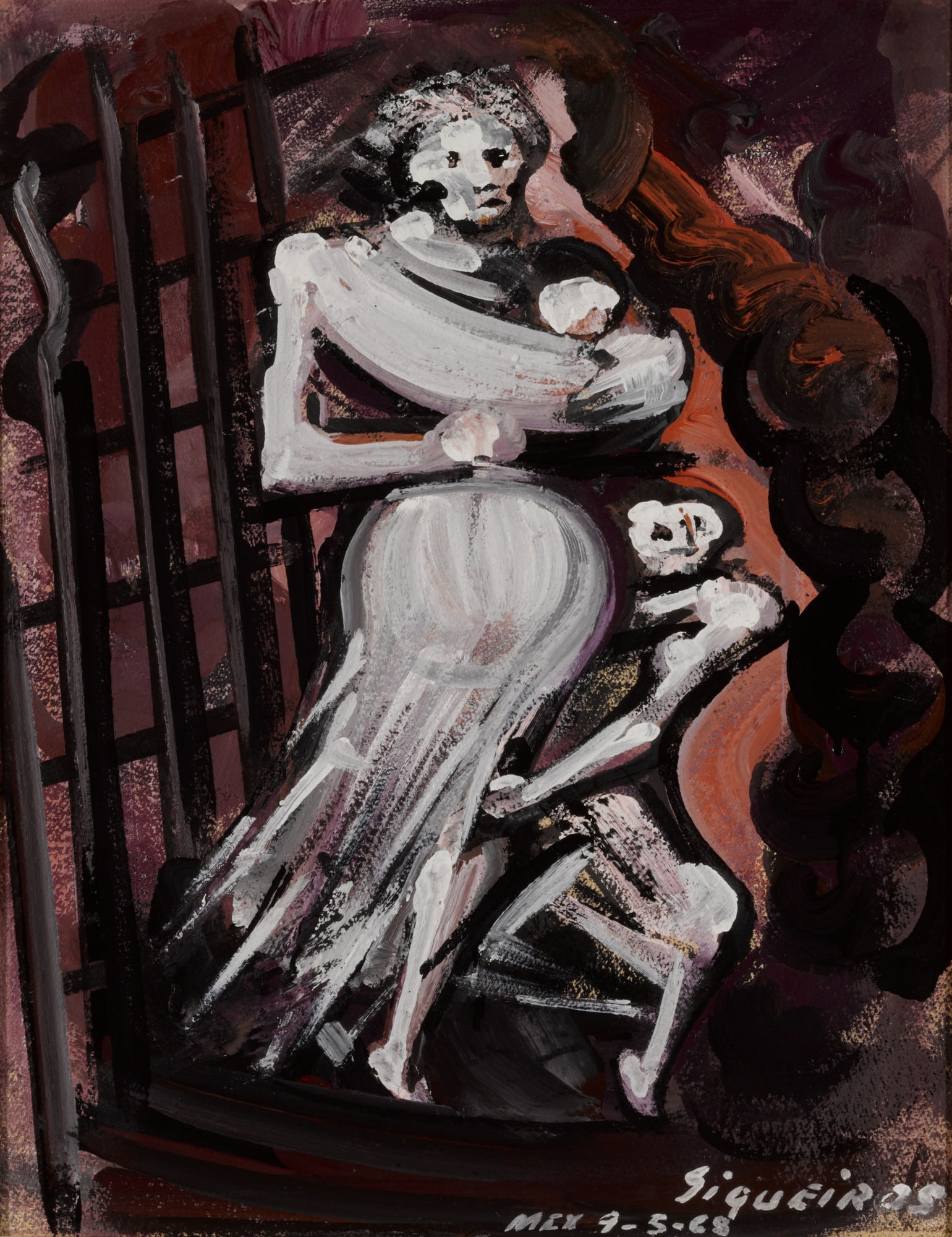
Estudio para el mural La Marcha de la Humanidad, 1968
He was barely a teenager when he enrolled at the Academy of San Carlos in Mexico City, the oldest art school in the Americas, where he absorbed the classical foundations that he would later gleefully subvert. By the time the Mexican Revolution erupted in 1910, the young Siqueiros was already politicized, and his participation in a student strike at the Academy signaled the pattern his life would follow: art and activism were, for him, not parallel pursuits but a single indivisible calling. His formative years took him to Europe, where he spent time in Paris and Barcelona in the early 1920s. There he encountered the fragmented planes of Cubism, the monumental figure traditions of the Italian Renaissance, and the experimental energy of a continent reinventing itself after the devastation of the First World War.
He was not a passive student of these influences but an interrogator of them, asking how the spatial ambitions of Cubism and the humanist scale of Renaissance fresco could be fused with the revolutionary demands of a newly awakened Mexico. He returned home in 1922 to join Diego Rivera and José Clemente Orozco in what would become one of the most celebrated collaborative projects in modern art history: the Mexican Muralist movement, a government supported effort to bring monumental public painting to the walls of schools, ministries, and public buildings across the nation. What distinguished Siqueiros from his great contemporaries was his restless hunger for technical innovation. He was among the first artists anywhere to use industrial spray painting equipment, adopting the airbrush and the spray gun not as novelties but as tools perfectly suited to his vision of art as a collective, democratic, and dynamic practice.
David Alfaro Siqueiros
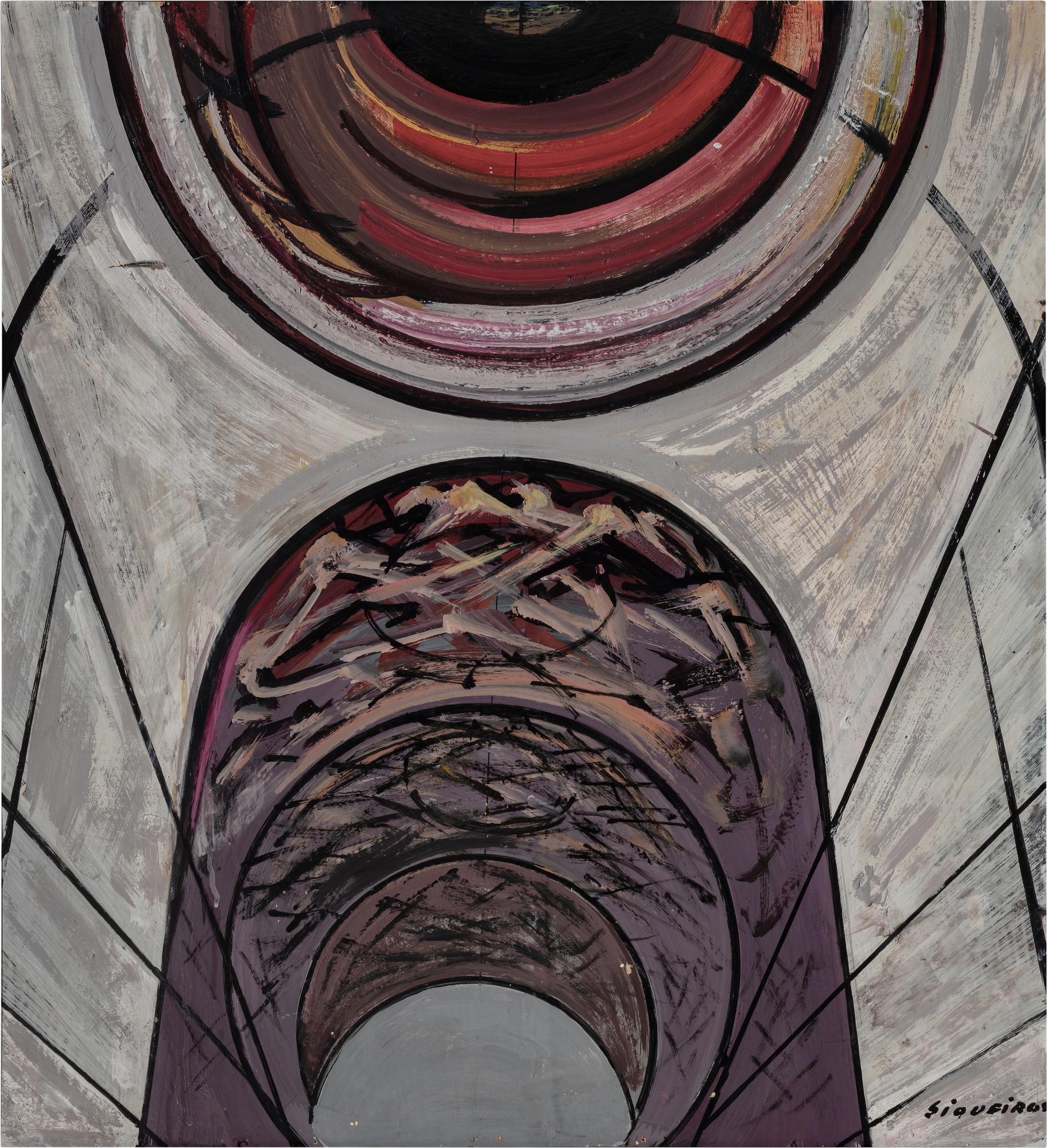
Primer estudio para el mural de la Secretaría de la Defensa Nacional (Naves)
He experimented extensively with pyroxylin, a lacquer derived from industrial processes, which allowed him to achieve surfaces of extraordinary luminosity and depth. He worked with acrylic paints at a time when most of his peers still relied on traditional media, and he was fascinated by the possibilities that curved and irregular surfaces offered for immersive, enveloping compositions. His Los Angeles mural America Tropical, painted in 1932 on the exterior wall of the Italian Hall in Olvera Street, caused an immediate scandal for its unflinching imagery, was painted over by authorities, and has since been painstakingly restored and is now celebrated as a landmark of twentieth century public art. The works available on The Collection offer collectors an intimate and revelatory encounter with different registers of Siqueiros's practice.
“There is no other way than to use all technical means available to paint the epic of our epoch.”
David Alfaro Siqueiros
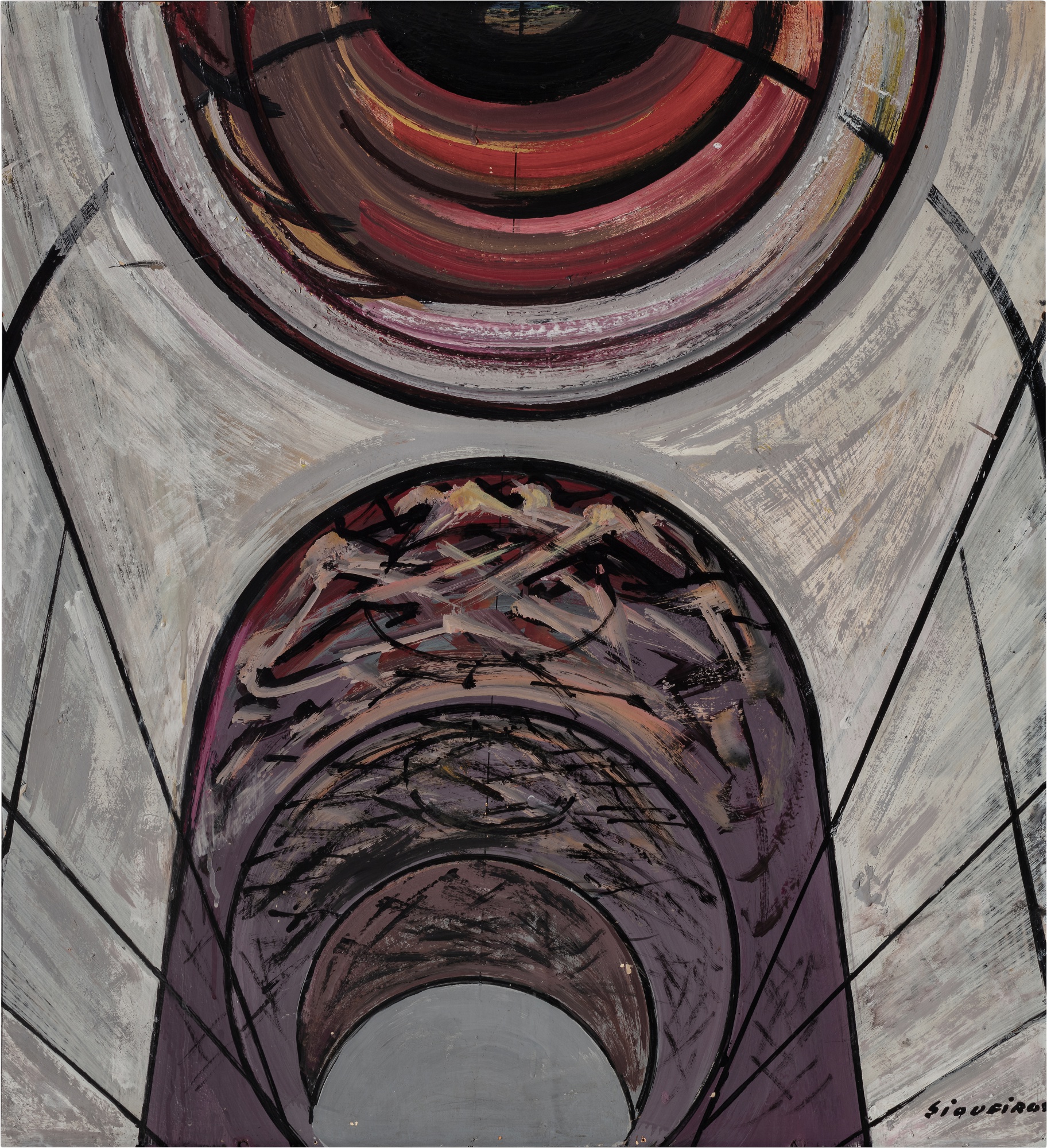
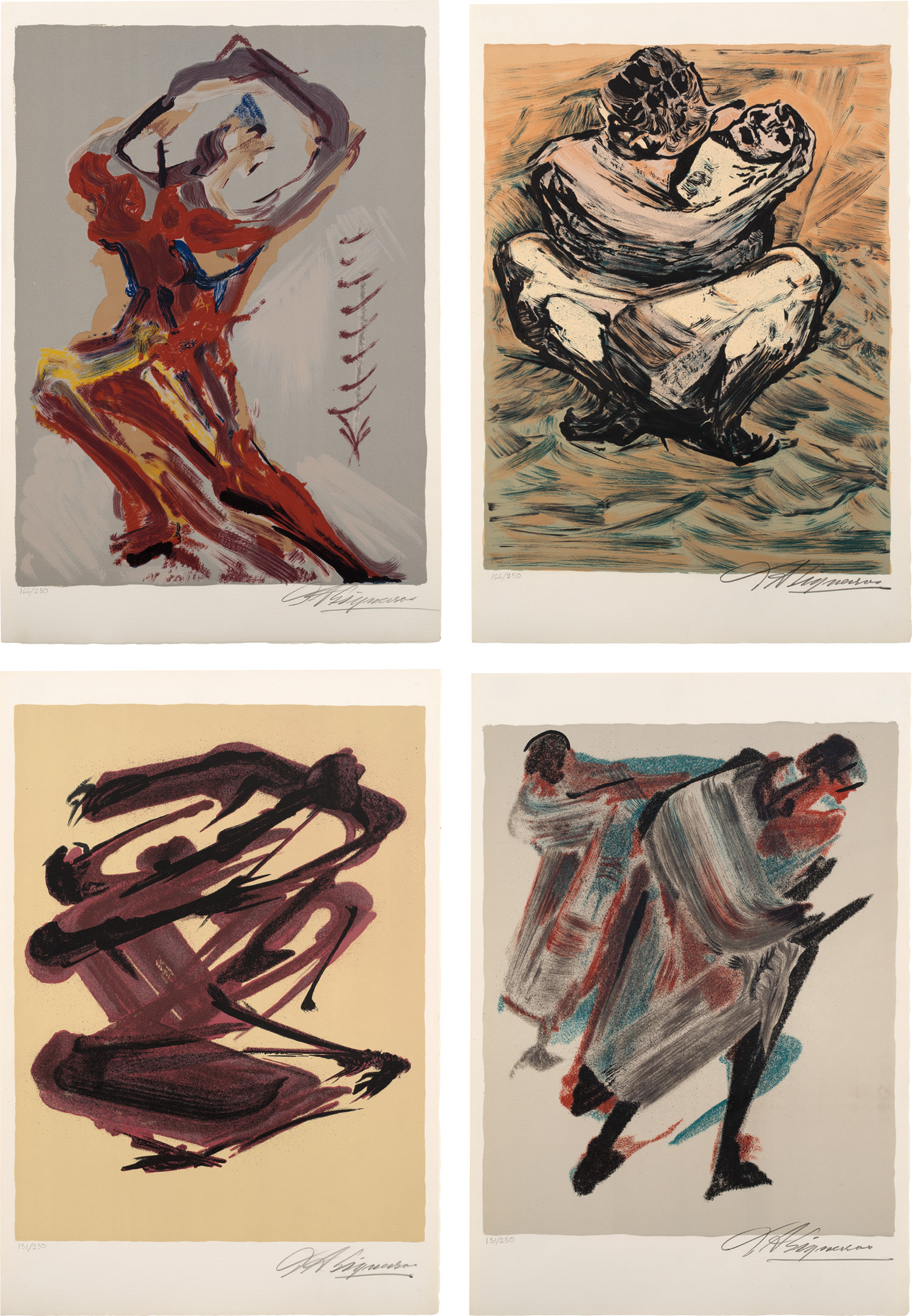
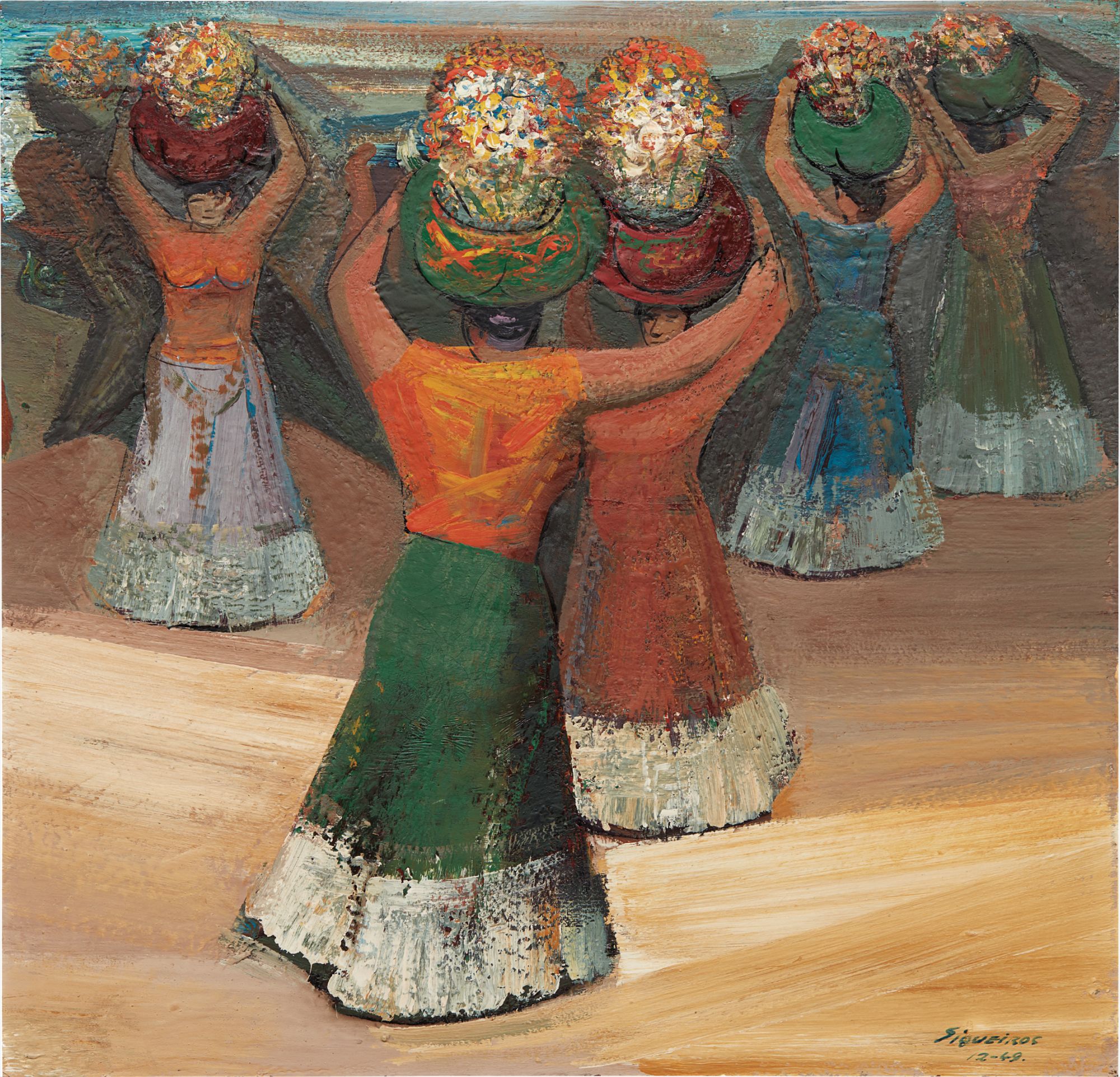
The Estudio para el mural La Marcha de la Humanidad, executed in pyroxylin on paper laid down on board in 1968, is a preparatory study for one of his most ambitious late projects and demonstrates the way Siqueiros worked: with the full force of his mature vision present even at the study stage, the composition alive with kinetic energy and formal invention. The Primer estudio para el mural de la Secretaría de la Defensa Nacional, rendered in acrylic on paper laid down on panel, gives collectors a similarly privileged view into his working process, the confidence of the mark making reflecting decades of technical mastery. Tehuanas, painted in 1949, shows a more intimate side of his vision, rooted in Mexican cultural identity and the dignity of its subjects, while Explosión en la ciudad pulses with the urban drama and formal dynamism that made his large scale work so commanding. The Prison Fantasies portfolios, published by Penn Atelier Graphics in New York, bring together twelve prints signed and numbered by the artist himself, a direct and personal edition that connects the collector to Siqueiros's hand and mind.
David Alfaro Siqueiros
Prison Fantasies: Portfolios I and II
Works on paper and preparatory studies by major muralists carry particular significance for collectors because they reveal the intelligence behind the spectacle, the thinking that underpinned the great walls. For collectors approaching Siqueiros, the market rewards both knowledge and patience. His works appear at major international auction houses with regularity, and prices have risen steadily as the Latin American modernist canon has received sustained scholarly and institutional attention over the past two decades. Museums including the Museum of Modern Art in New York and the Museum of Fine Arts in Houston hold significant works, providing the kind of institutional validation that underpins long term collecting confidence.
Siqueiros sits naturally alongside his fellow muralists Rivera and Orozco in any serious consideration of twentieth century Latin American art, but he also belongs in conversation with international contemporaries such as Fernand Léger, whose interest in the figure and industry parallels Siqueiros's own, and with later artists including Jackson Pollock, who encountered Siqueiros's experimental workshops in New York in the 1930s and absorbed lessons about automatism and unconventional paint application that would shape Abstract Expressionism itself. That lineage is not incidental: Siqueiros is, in a very real sense, one of the hidden architects of American modernism. His legacy today is inseparable from the questions that animate contemporary culture: the relationship between art and power, the politics of public space, the dignity of labor and collective struggle, and the possibilities of technical innovation in the service of humanist vision. Younger generations of artists working in street art, community muralism, and socially engaged practice routinely cite the Mexican muralists as essential predecessors, and Siqueiros in particular, with his embrace of industrial materials and his belief that art belonged to everyone, feels remarkably contemporary.
David Alfaro Siqueiros
Tehuanas
To collect Siqueiros is to hold in your hands a piece of one of the great conversations of the modern era, a conversation about what art can do when it refuses to be confined to the gallery wall and insists on speaking directly to the world.
Explore books about David Alfaro Siqueiros
David Alfaro Siqueiros: A Retrospective
Diego Rivera and others
Siqueiros: His Life and Works
Justino Fernández
David Alfaro Siqueiros
Laurence P. Hurlburt
The Murals of David Alfaro Siqueiros
Desmond Rochfort
Art and Revolution in Latin America
Stanton L. Catlin and Terence Grieder
Mexican Muralism: A Critical History
James Oles
Siqueiros: The Etchings
Elizabeth Carpenter