Cory Arcangel
Cory Arcangel Makes the Digital World Sing
Artist Spotlight · The Collection Editorial
“I am always trying to find the song in the system, the place where the technology starts to do something it was not supposed to do.”
Cory Arcangel
When the Whitney Museum of American Art devoted a major solo exhibition to Cory Arcangel in 2011, the art world had a rare opportunity to see the full sweep of a practice that had been quietly rewriting the rules of contemporary art for over a decade. The show, titled "Cory Arcangel: Pro Tools," filled the museum's galleries with hacked video games, YouTube compilations, and software drawings that felt simultaneously playful and profoundly serious. It was a landmark moment for an artist who had spent years working at the intersection of pop culture and digital technology, and it confirmed what many collectors and curators already understood: Arcangel is one of the most original and consequential artists of his generation. Born in Buffalo, New York in 1978, Arcangel grew up in a cultural moment defined by the rise of home computing and the Nintendo era, both of which would become central to his artistic vocabulary.
Cory Arcangel
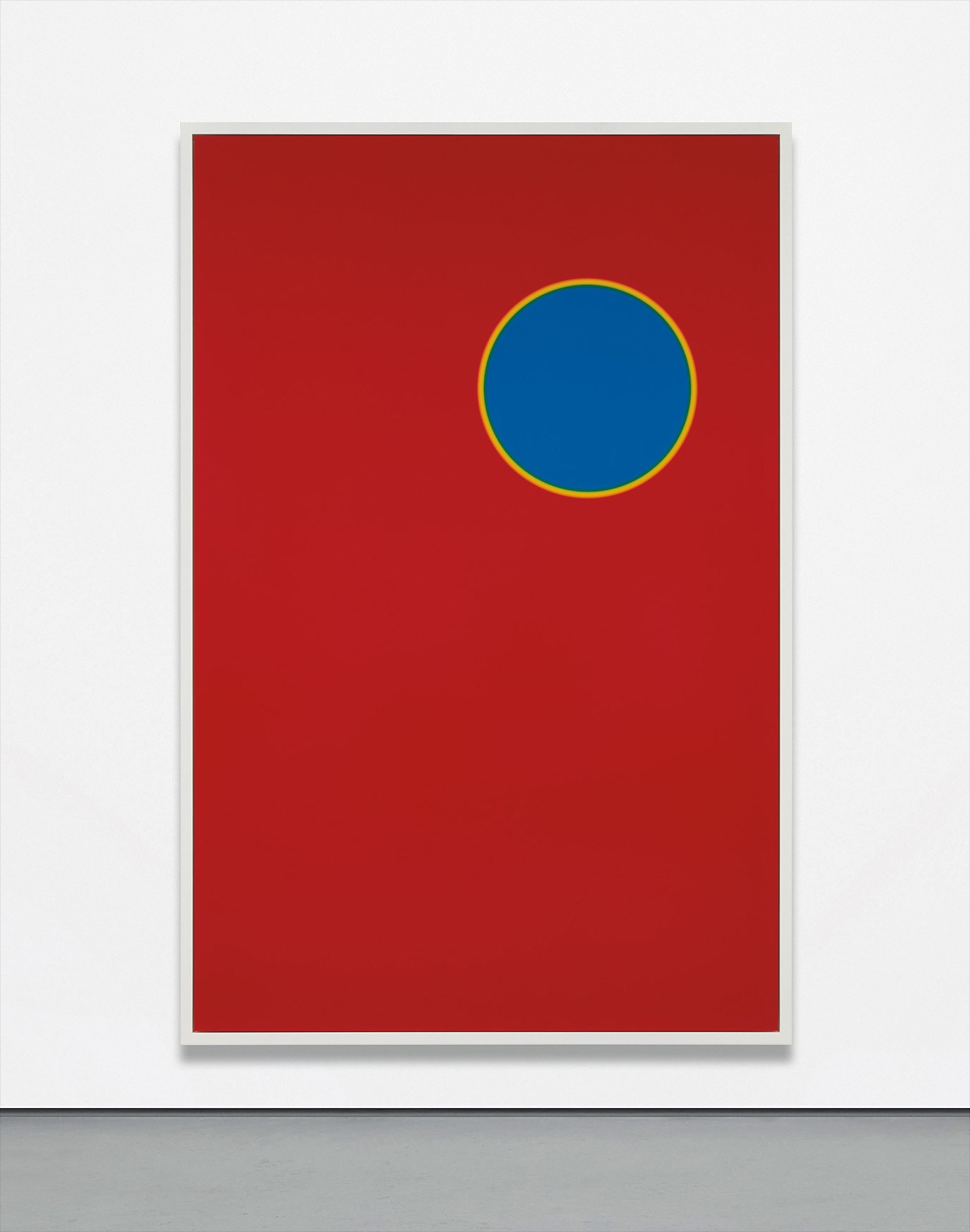
Photoshop CS: 110 by 72 inches, 300 DPI, RGB, square pixels, default gradient "Russell's Rainbow" (turn transparency off), mousedown y=9300 x=14550, mouseup y=9300 x=19000, 2010
He studied classical guitar at the Oberlin Conservatory of Music before shifting his focus toward the intersection of music, technology, and visual art. This musical background is not incidental to his practice. It gave him a disciplined ear for structure, timing, and the expressive potential of systems, qualities that animate everything from his software drawings to his video compilations. Buffalo itself, a Rust Belt city with a rich history of institutional art support through venues like the Albright Knox Art Gallery, provided an unlikely but fertile starting point.
Arcangel rose to early prominence in the early 2000s as a core member of the collaborative group BEIGE, which explored the creative possibilities of obsolete and low resolution technology. His 2002 work "Super Mario Clouds," in which he stripped a modified Nintendo cartridge down to nothing but scrolling blue sky and white clouds, became an instant touchstone for a generation grappling with how to make meaningful art from the detritus of consumer electronics. The work captured something essential: the elegiac beauty hiding inside commercial entertainment, the poetry that emerges when you subtract almost everything and leave only atmosphere. It was collected and exhibited widely, and it signaled the arrival of a genuinely new sensibility.
Cory Arcangel
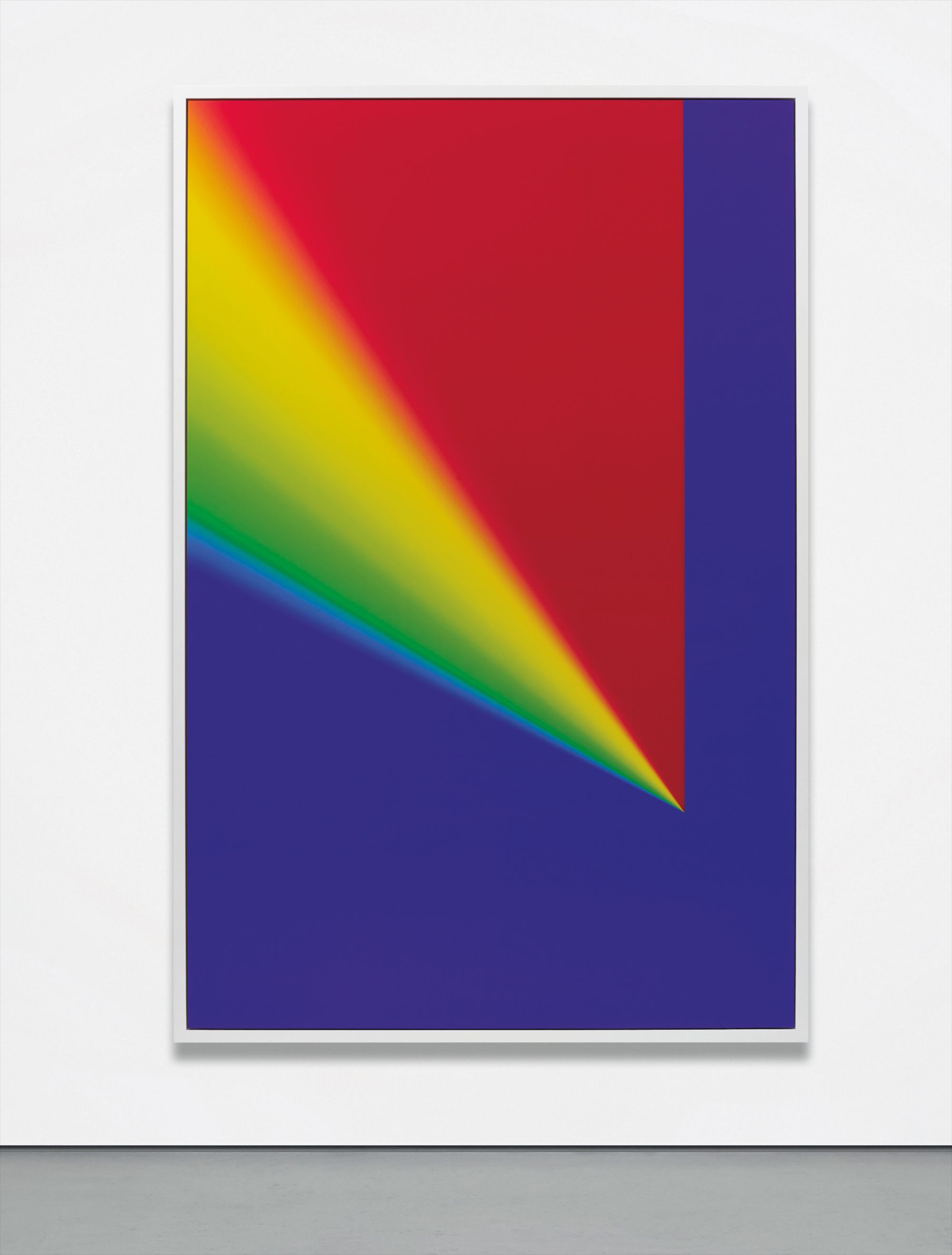
Photoshop CS: 110 by 72 inches, 300 DPI, RGB, square pixels, default gradient "Russell's Rainbow" (turn transparency off), mousedown y=25300 x=17600, mouse up y=4300 x=17600
Over the years, Arcangel's practice has expanded in scope while remaining anchored in a consistent set of concerns: what happens when technology is misused, repurposed, or allowed to run until it fails. His Photoshop gradient prints are among the most visually seductive and conceptually rigorous works of the past two decades. Each piece, with its exhaustively precise title documenting every mouse movement and software parameter, transforms an act of digital production into a kind of performance score. Works such as "Photoshop CS: 110 by 72 inches, 300 DPI, RGB, square pixels, default gradient 'Spectrum', mousedown y=23900 x=11650, mouseup y=32650 x=11650" from 2009 are presented as chromogenic prints face mounted to Diasec, objects of genuine physical beauty that also function as documents of a repeatable, demystified process.
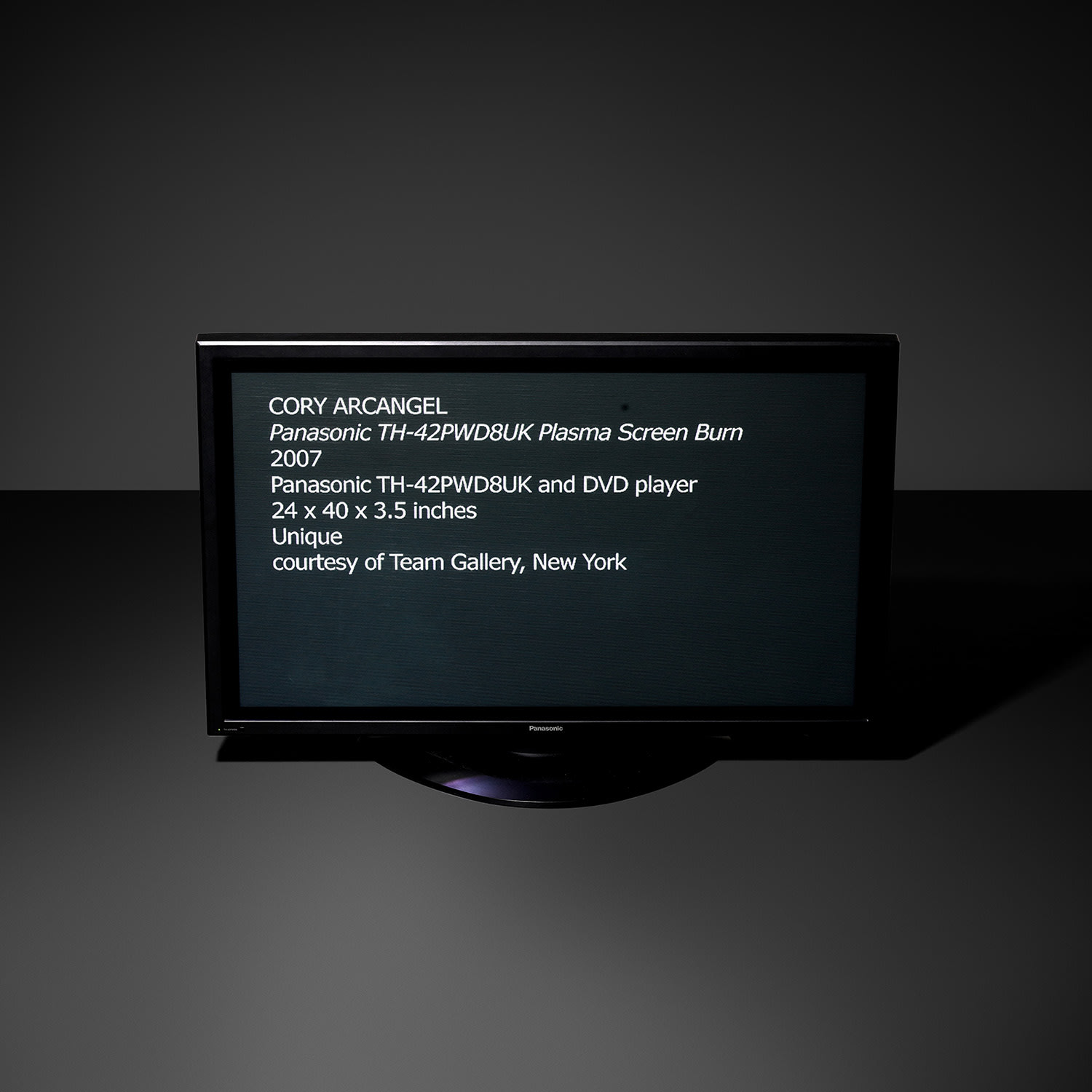
The titles are the instructions. The image is the proof. The elegance of this inversion rewards sustained attention in a way that few purely digital works can claim. The 2007 work "Panasonic TH42PWD8UK Plasma Screen Burn" extends this logic into the realm of hardware failure, capturing the ghostly afterimage left on a plasma screen after prolonged use.
Cory Arcangel
Panasonic TH-42PWD8UK Plasma Screen Burn, 2007
Rather than treating technological obsolescence as a problem, Arcangel frames it as a material condition with its own aesthetic dignity. "Clinton/Gore Lakes" from 2014 applies a similarly dry wit to political imagery, processing a photograph of the two former politicians into a shimmering chromatic field that is at once absurd and genuinely beautiful. Across all of these works, there is a consistent refusal to moralize about technology or to celebrate it uncritically. Arcangel simply observes, with great precision and great warmth.
For collectors, Arcangel's work presents a compelling combination of accessibility and depth. His prints, videos, and software pieces exist at multiple price points, and his presence in the collections of major institutions including the Museum of Modern Art, the Carnegie Museum of Art, and the Tate makes him a blue chip proposition with strong institutional validation. The Photoshop gradient works in particular have attracted significant collector interest for their formal beauty and their durability as objects. Mounted to Diasec in the artist's own frames, they are designed to be lived with, and they reward daily looking in a way that distinguishes them from purely conceptual work.
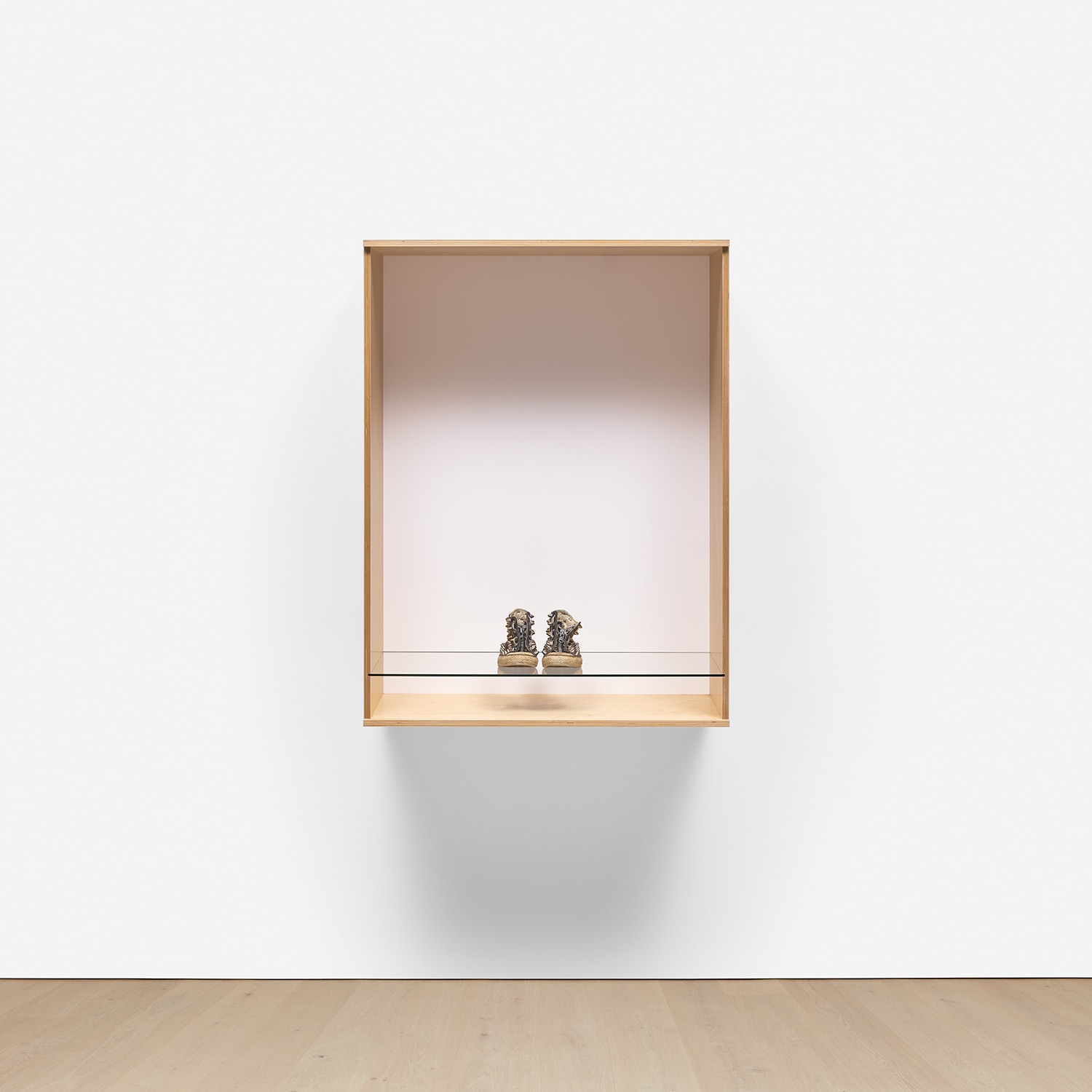
Cory Arcangel
On Compression / Lakes, 2014
Collectors who have built holdings around Post Internet and Net Art practices will find in Arcangel a pivotal figure, one whose work bridges the downtown New York experimental scene of the early 2000s and the fully globalized digital culture of today. Within art history, Arcangel occupies a position that is both specific and expansive. His closest affinities are with artists who treat systems, whether technological, social, or conceptual, as their primary medium. The spirit of John Cage animates his music works and his interest in chance and process.
There are echoes of Nam June Paik in his engagement with consumer electronics as raw material, and of Ed Ruscha in his cool deployment of text and instruction as aesthetic objects. Among his contemporaries, he shares sensibilities with artists such as Wade Guyton, Seth Price, and Kelley Walker, all of whom interrogated the conditions of image production in the digital age. Arcangel's solo exhibitions at the Barbican in London and the Carnegie Museum of Art, alongside his Whitney retrospective, place him at the center of this conversation at an international level. What makes Arcangel matter today, perhaps more than ever, is his insistence that looking carefully at digital culture is itself a form of critical practice.
At a moment when algorithms shape perception, when software mediates nearly every human interaction, and when the line between tool and artwork has never been more contested, his body of work functions as both a field guide and a celebration. He does not rage against the machine. He listens to it until it starts to sound like music. For collectors, curators, and anyone who has ever felt moved by the glow of a screen they cannot quite explain, Arcangel's practice offers something rare: genuine insight delivered with genuine pleasure.
Featured Works
Photoshop CS: 110 by 72 inches, 300 DPI, RGB, square pixels, default gradient "Russell's Rainbow" (turn transparency off), mousedown y=9300 x=14550, mouseup y=9300 x=19000
2010
Photoshop CS: 110 by 72 inches, 300 DPI, RGB, square pixels, default gradient "Russell's Rainbow" (turn transparency off), mousedown y=25300 x=17600, mouse up y=4300 x=17600
Panasonic TH-42PWD8UK Plasma Screen Burn
2007
On Compression / Lakes
2014
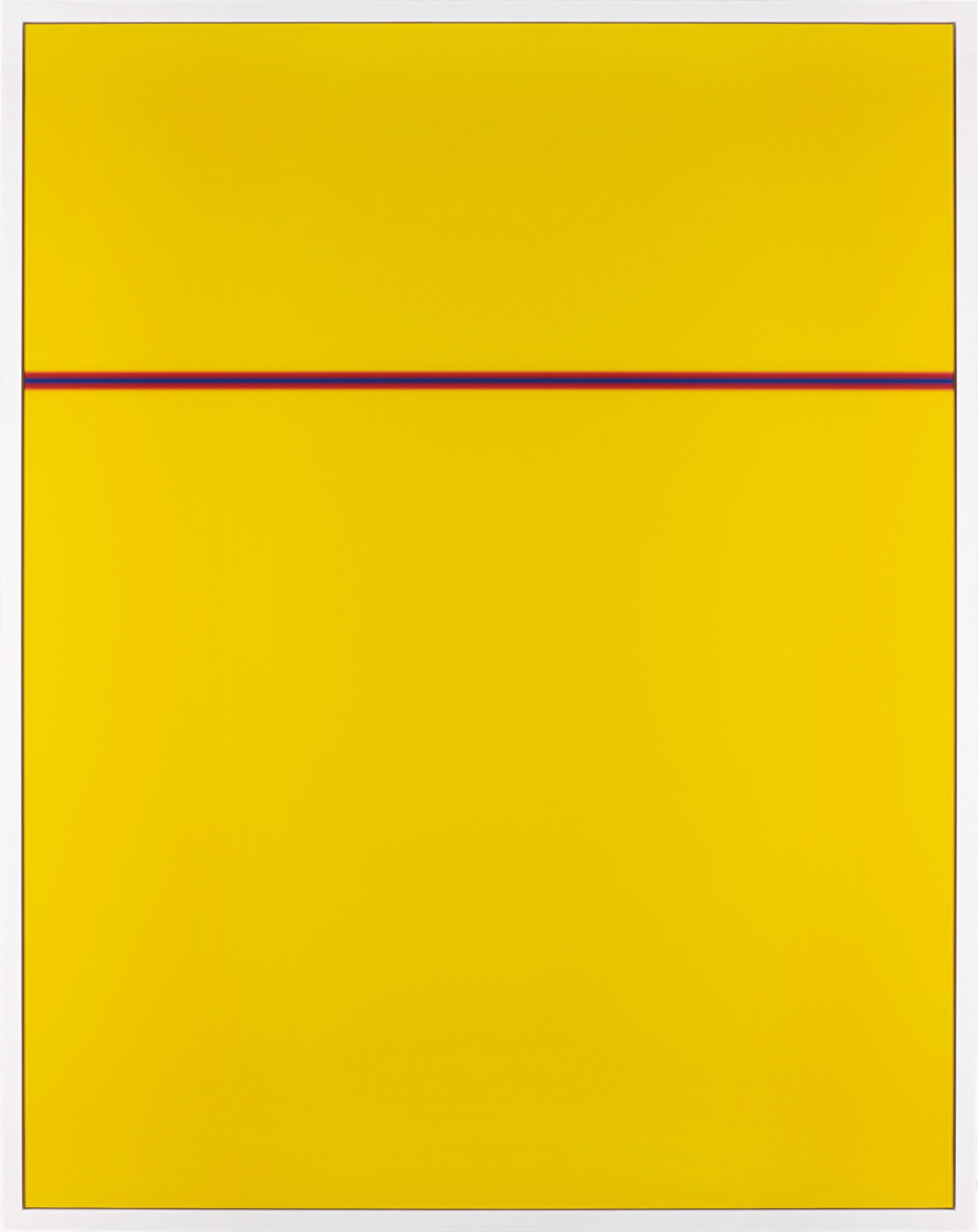
Photoshop CS: 84 by 66 inches. 300 DPI, RGB, square pixels, default gradient "Blue, Red, Yellow", mousedown y=7600 x=8600, mouseup y=7850 x=8600
Sweet 16